Arguably the undisputed enemy of lawns and turfs, the white grub can wreak considerable havoc. Knowing more about them will help you keep them off your greensward: identification, behaviour, usefulness, extermination, etc.
White grub behaviour
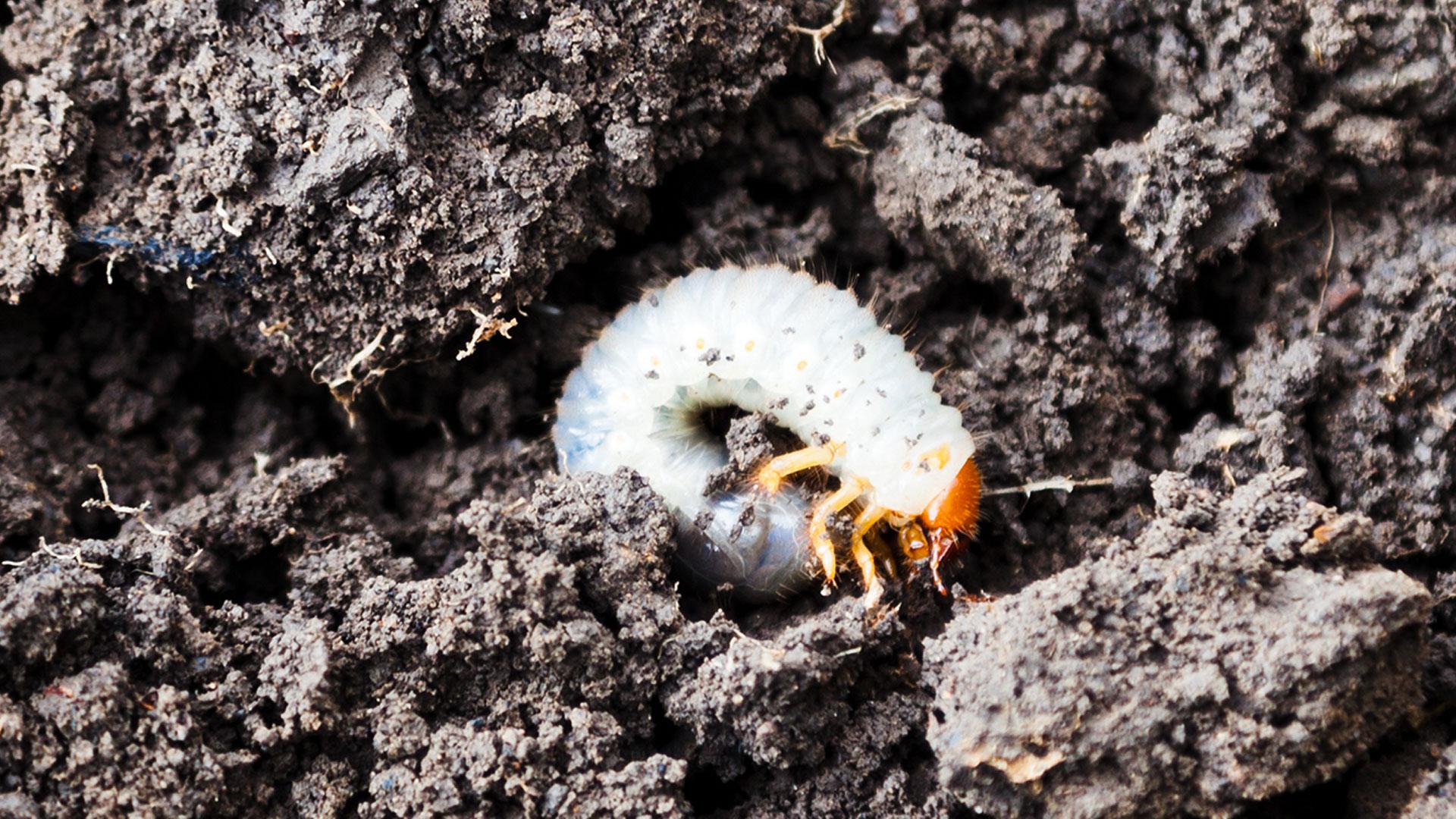
White grubs are white or yellowish, with wrinkled C-shaped bodies. When they hatch, they are small, but eventually reach up to 4 cm (0.2 in) in length, depending on the species. White grubs are in fact the larvae of three different insects:
The European chafer, common the Montreal, Laval, Lower Laurentian, Lanaudière, Montérégie and Outaouais regions.
The Japanese beetle, well established in southern Quebec.
The common June beetle, found mainly in the Greater Quebec City area and in central and eastern Quebec.
Are white grubs useful or bothersome?
Useful
- White grubs are a source of food for many animals and birds: skunks, groundhogs, moles, raccoons, blackbirds, starlings, etc.
Bothersome
- The larvae damage lawns by eating grass roots.
Turf eaten by grubs is often assaulted by birds and small mammals looking for the larvae.
If more than half of your lawn has been affected, you may need to replace all of the turf, which can be very expensive.
Tips for keeping white grubs away from your lawn
First, note that a healthy lawn is more resistant to larval attacks. Preventive maintenance is an effective way of fighting white grubs. Here are some tips for keeping white grubs away from your lawn:
Keep the grass mowed high, to about 8 cm, so that the soil underneath stays fresh and moist.
Fertilize the lawn using slow-release fertilizer, with a dosage suited to the soil and turf type. Confirm the required product dosage using the fertilizer calculator provides at pelousedurable.com (in French only).
Limit outdoor lighting, especially in summer. June and July are egg-laying season for chafers, which are attracted to light. For example, use motion-activated lights.
A neonicotinoid pesticide under re-evaluation
The pesticide option should be ruled out for the moment. To protect pollinating insects such as bees, Health Canada proposed new restrictions in the spring of 2018 on imidacloprid, a pesticide that green space maintenance companies use against white grubs.
How to know if you have white grubs?
You can tell whether there are white grubs on your lawn if the grass turns yellow and comes out of the ground in sheets, like a carpet. An invasion is diagnosed when grubs become abundant and the soil beneath 0.1m² (1ft²) of lawn contains:
7 or more European chafer larvae;
12 or more Japanese beetle larvae;
3 to 5 common June beetle larvae.
How to get rid of white grubs?
1. Extermination of white grubs over a small area
Take out all of the dead turf and turn the soil, removing all the white grubs by hand.
Add quality compost to the soil.
Reseed or lay sod.
2. Biological extermination of white grubs
One organic method consists of using an army of nematodes (e.g., Heterorhabditis bacteriophora, available at garden centres), which are microscopic worms that will kill the young chafer larvae. The best time to attack is mid-August. Control with nematodes is not dangerous to humans, animals or the environment.
For best results:
Water the lawn abundantly.
Mix the nematodes with water, following the instructions for use, and then apply them to the lawn.
Apply the treatment late in the day, or on a cloudy or rainy day.
Keep your lawn moist for up to a week after the treatment.
To learn more about white grubs
WHITE GRUBS, THE GREEN PAGES, SPACE FOR LIFE, MONTREAL
Do you need personalized advice on your home?
Our Residential Advisory Services counsellors are there to answer your questions and support you when you need it. Ask for their advice as often as you like. It’s one of the benefits of membership.