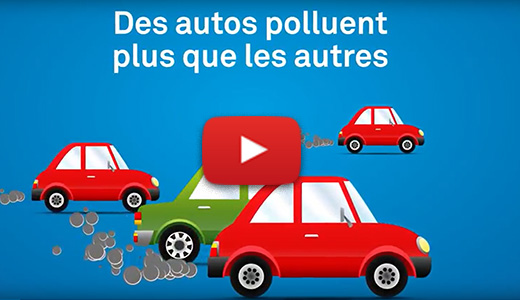
What to do with Vincent's car... and the other 600,000 just like his?
At 23, Vincent still didn't have a driver's licence. Until recently, he had studied, worked and got around by metro or bus. Then his situation changed and he needed to move beyond the public-transit zone. He promptly got his driver's licence and bought a used 2008 Corolla ̶ a good deal found through the classifieds. So, he switched to driving, like you, me and millions of others.
Vincent acknowledges that owning a car has several advantages. At the same time, however, he's well aware that it has a greater impact on the environment than taking the bus. When asked, he confirms that he takes good care of his car. But the tires are under-inflated and the annoying "check engine" light on the dash is lit up — two common problems that increase fuel consumption.
We know this to be true, thanks to the results of CAA-Quebec's most recent study of eight-year-old and older vehicles. Three out of 10 had failed emissions tests. In other words, roughly 600,000 cars currently operating on our roads emit more pollutants and generally burn more fuel than they should. That translates into thousands of tonnes of CO2 in the air and millions of wasted dollars. And when you consider the average age of vehicles is at least seven years and getting older, you'll appreciate the importance of what's at stake.
So what can be done about it? Taking 600,000 vehicles off the road is clearly unrealistic. Truth is, when it comes to transportation issues, ideals quickly collide with reality. Vincent knows that necessary repairs could cost hundreds of dollars that he hasn't budgeted for. What should he do? Should he just keep on polluting the environment?
We at CAA-Quebec have thought long and hard about the problem and the fact that, unlike California or Ontario, Quebec has no emissions-control program. We, therefore, propose using a part of the Fonds Vert (Green Funds) to help with the maintenance of vehicles eight years old and older. This would create a voluntary emissions-inspection program through which drivers can have access to affordable inspection costs as well as partly subsidized repairs — somewhat along the lines of the RénoVert energy-efficiency program.
And, yes, Vincent is a fictitious character, but the situation is all too real and so widespread that it justifies the creation of such a program.
Motorists make a substantial contribution to the Fonds Vert, so why not help them play a more concrete part? One thing is for sure: We will keep up our efforts to persuade public authorities that a plan to help motorists reduce emissions is a win-win situation.
An animation that says it all! (In french only)