The 75 deadliest days on the road: CAA-Quebec wants to beat the statistics
Many Quebecers will be celebrating our National Holiday on June 24 and although it’s a happy time, it also marks the start of the deadliest season on Quebec’s roads.
Regional data is available, please contact the media team if you need them.
The CAA-Quebec Foundation wants us all to do better in 2021 and bring the summer toll right down, marking a clean departure from the sad statistics of years past. The Foundation also has some practical advice to get road users to change certain behaviours.
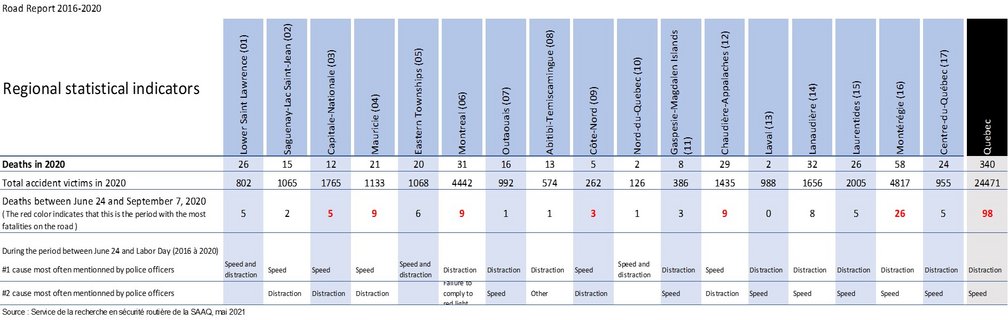
If the past few years are any indication, nearly 100 people will lose their lives on Quebec’s roads in the coming weeks, i.e., between Saint-Jean-Baptiste Day and Labour Day. In 2020, those 75 days saw 98 deaths, or 28.8% of the 340 deaths for the entire year. That’s slightly more than one death per day. Through greater awareness and vigilance on the road, we can beat the statistics.
Striking numbers for specific regions
The data compiled by Société de l’assurance automobile du Québec (SAAQ) for the period from June 24 to September 7, 2020, is particularly troubling for the Montérégie region, where 26 of the 98 deaths occurred.
Of the province’s 17 administrative regions, 6 of them (in red) have the highest proportion of road deaths during the 75 days of the summer season.
Although the roads in the 11 other regions aren’t at their most deadly during the summer, they still saw 37 deaths in 2020.
The main causes of accidents
The CAA-Quebec Foundation says it loud and clear: speed and distractions kill. Did you know?
- If you’re travelling at 90 km/h, looking away from the road for 5 seconds is like crossing a football field with your eyes closed.
- The faster you go, the greater the danger. Being hit at 50 km/h is like falling 4 storeys. At 100 km/h, it’s 14 storeys.
Distraction tops the list of causes most often cited by police officers attending the scene in the 75 deadliest days.

Along with distractions and speed, not wearing a seatbelt is a cause of death listed in SAAQ’s 2020 road report(1). Not only is wearing a seatbelt mandatory, it’s also an easy way to prevent up to 35 deaths per year.
How can we do better?
As the results of our recent survey on the holiday plans of Quebecers show, 83% of summer vacationers will stay in the province this summer. More than half of them will travel to other parts of the province. Which means the busy season on Quebec’s roads will be especially busy this year. Harrison stresses the need for everyone to be extra cautious. “We go on vacation to rest, recharge our batteries, and spend quality time with friends and family. There will be a lot of traffic on the roads. If we’re going to get to our destinations safely, everyone needs to adopt responsible behaviours.”
Some practical advice on how to beat the statistics:
- Keep more distance between you and the car in front of you so that you have more time to react.
- Road work: Slow down and plan your trip accordingly.
- In the summer, you see all kinds of vehicles on the road. Over a distance of 20 km, driving 110 km/h instead of 90 km/h saves you 2 minutes. Is it really worth it?
- Stay focused on the road at all times and take the weather into consideration when you travel. Those summer storms can get pretty hairy!
- Long drives are easier when you’re well rested. Light meals and short breaks every 2 hours reduce the likelihood of falling asleep at the wheel. If you do start to feel sleepy, pull over in a safe place and have a nap. Generally, it takes less than 20 minutes to feel rested.
Says Marco Harrison, “Hundreds of thousands of people in the province will take to the road this summer. If you’re one of them, enjoy it! Thinking of the journey as part of the vacation is a golden rule that helps people drive responsibly.”
About CAA-Québec
CAA-Quebec is a not-for-profit organization that assists each of its members by providing mobility, travel, insurance, and residential benefits, products, and services. CAA was named Canada’s most trusted brand in the annual Brand Trust Index for 2021 by the Peter B. Gustavson School of Business at the University of Victoria.
–30–
__________________
[1] The proportion of dead drivers and passengers who weren’t wearing their seatbelt rose sharply, from 20.9% in 2019 to 34.6% in 2020.