Slowing down in school zones should be a reflex, not an exception
Three out of four—that’s the proportion of vehicles travelling over the 30km/h speed limit in a school zone during a road user behaviour observation exercise conducted in early October. This figure gives us pause and raises a very simple question: why is slowing down when approaching a school still not a reflex for so many drivers?
To be precise, 75.2% of the 1059 vehicles observed by the CAA-Quebec Foundation for Road Safety team were exceeding the limit. Although most drivers weren’t going much over the limit, with an average speed of about 36km/h, some vehicles were clocked at more than 40km/h, and one reckless driver was even caught travelling at 69km/h.

“Respecting the speed limit in school zones should become second nature, just like stopping at a red light. I would add that 30km/h is a limit, not a target speed.”
A full day of observation
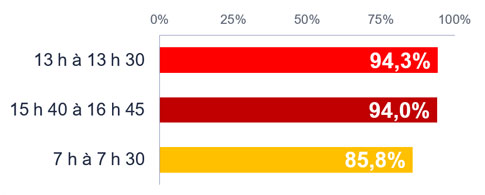
Not just a matter of speed
The exercise also identified 64 other risky behaviours, including drivers proceeding through yellow lights, making right turns on red where prohibited, and failing to yield the right of way on several occasions. Observers also saw people riding their bikes or scooters on the sidewalk, scooter riders without helmets, as well as several pedestrians crossing the intersection without waiting for the signal. In addition, serious violations were observed: on two occasions, vehicles ran the red light just as the crossing guard was stepping onto the roadway to lead schoolchildren across.
Good habits in school zones
Near a school, a few extra kilometres per hour can make a real difference: the faster you go, the longer it takes to react and bring your vehicle to a stop, and the more serious the consequences of an impact are likely to be. To protect children and all road users:
- Obey the posted speed limit, and slow down even more when traffic, visibility or the presence of children calls for it.
- When approaching a yellow light, stop unless you’re too close to do so safely; at a red light, come to a complete stop and obey the “No right turn on red” sign.
- Yield to pedestrians and always follow the crossing guard’s instructions; before turning, make sure the crosswalk and bike lane are clear.
- On foot, by bike or by scooter, obey the signs and signals, and use the crosswalks and lanes provided. Cyclists and scooter riders, ride in the right direction and stay off the sidewalk unless signage permits it.
Methodology
The field observations took place on October 7, 2026, near École de la Chanterelle on Boulevard Pie-XI Nord in Québec City, over three periods of the day: morning (6:35am to 8:20am), midday (11:15am to 1:30pm) and end of day (2:55pm to 4:45pm). The observation point was located near the traffic light, at the exit of the parent drop-off zone.
About CAA-Quebec
CAA-Quebec offers a wide range of assistance services in a wide variety of sectors, drawing on a human approach. As a socially committed organization, CAA-Quebec strives on a daily basis to protect the interests of its members. And in keeping with its values of reliability and benevolence, it fosters responsible consumption and promotes road safety.
– 30 –