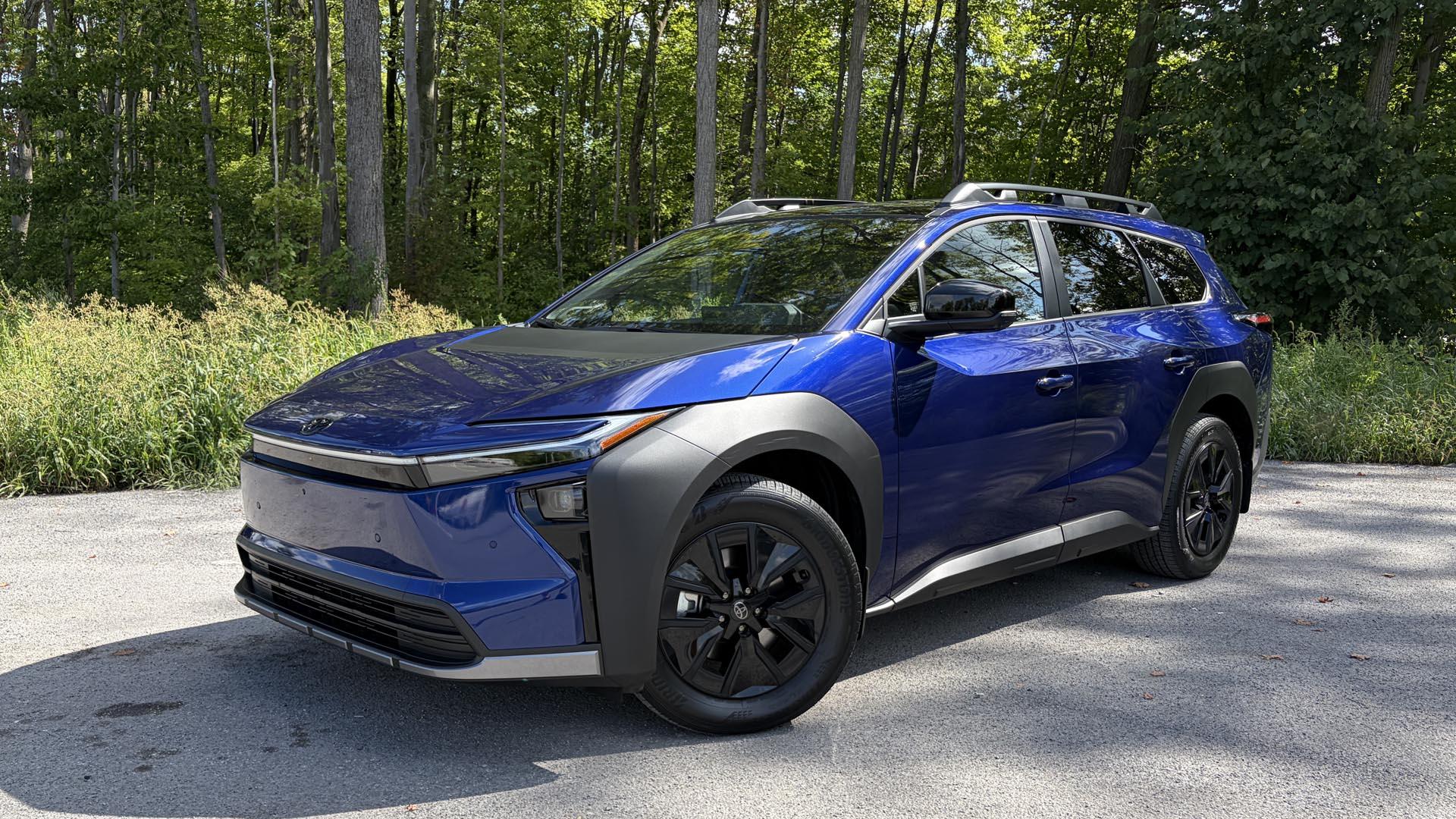
TOYOTA bZ Woodland 2026
Toyota’s electric family is growing
Pros and cons
Pros
- Blistering acceleration
- Smooth ride
- Good towing capacity
- Roomy cabin and cargo area
- Comfortable seats
- Competitive range
Cons
- Instrument display partly blocked by the steering wheel
- Centre console is too wide
- Too few physical buttons
- Limited charging power
- High retail price
Overview
Toyota may have mastered hybrid technology, but its entry into the fully electric market has been bumpier. The bZ4X, renamed bZ for the 2026 model year, was recalled several times and criticized for its limited real-world range and unremarkable charging performance.
The Japanese giant was already planning to shake off some of the conservatism surrounding its electric vehicles (EVs). Along with revitalizing the bZ for 2026, it unveiled two derivatives to expand the lineup: the subcompact C-HR, covered in a separate article, and the midsize bZ Woodland.
Woodland: The bZ for outdoorsy families
The bZ Woodland blends an SUV with a tall wagon. Its size, five-seat layout and mildly adventurous character recall the Subaru Outback. It is also roughly the same size as the Toyota Crown Signia, which uses a conventional hybrid powertrain.
Retail pricing for the 2026 bZ Woodland ranges from $62,729 to $68,079, including freight, PDI, and dealer fees. That puts it beyond the threshold for the federal government’s maximum $5000 incentive, although every trim qualifies for the $2000 provincial rebate (applied after sales taxes).
At the time of writing in August 2026, Toyota was offering a $7000 discount on top of the Quebec subsidy, bringing the effective price of a base model to $53,989 before sales taxes.
A cousin at Subaru
Like Toyota’s other 100% electric models, the bZ Woodland has a close relative in the Subaru lineup: the Trailseeker. In summer 2026, the Limited and Premier trims of the latter were priced slightly higher than the equivalent base and Premium Woodland models once Toyota’s $7000 discount was factored in.
Subaru has another card to play: a Touring trim priced at $49,995 before freight and PDI. That MSRP makes it eligible for the $5000 federal rebate, lowering its effective cost to $46,881. The Trailseeker therefore holds an advantage of nearly $7000, while giving up only a few niceties such as a power passenger seat, heated steering wheel and hands-free liftgate.
Toyota Canada invited us to the media launch of the bZ Woodland and C-HR in the Québec City area in summer 2026.
Scroll to the EVALUATION section for our first impressions of the bZ Woodland.
Verdict
When presenting new models to automotive journalists, Toyota often claims to be the only mainstream automaker covering every market segment. The bZ Woodland reinforces that message, as Toyota already offered a similarly sized crossover in the Crown Signia. Rather than turn that model into an EV, Toyota chose to offer it alongside the Woodland.
More appealing than the Crown Signia
If we had to pick a likely survivor in a sibling rivalry, we would bet on the bZ Woodland. The Crown Signia admittedly has the edge in finish, ergonomics (thanks to more physical buttons), and long-distance flexibility, courtesy of its hybrid powertrain.
The Woodland counters with more interior space, lower operating costs, and even a lower purchase price, which are all key criteria for many drivers. It is also considerably more powerful and quieter on the road than the Crown Signia.
Threatened by its Subaru cousins
The bZ Woodland’s real competition may instead come from Subaru, which offers both the Trailseeker, a less expensive version of the same vehicle, and the Outback, a gas-powered family crossover that is far cheaper than the Crown Signia.
We will also have to see how Toyota prices the upcoming all-electric Highlander, which will feature one more row of seats and more cargo room than the bZ Woodland. Indeed, Toyota will leave no base uncovered.
Evaluation
Just like the bZ … until you look behind the seats
At first glance, the bZ Woodland is essentially a longer, slightly raised version of the bZ AWD compact SUV. The grille is nearly the same, while the dashboard, seats and passenger space are identical. The apple did not fall far from the tree.
That is good news for front-seat comfort. The seats are supportive and long enough to provide proper thigh support for an average-sized person. The cabin can also accommodate four tall adults without compromise.
We would have preferred a little more distance from the family tree when it comes to the dashboard. Although Toyota slightly revised the instrument display from the bZ4X, the steering wheel still partly obstructs it unless positioned very low.
The wide centre console also seriously crowds the driver’s right knee, especially when using cruise control. Moving several climate controls to the centre screen, though their layout is fairly logical, also sacrifices the convenience of physical buttons.
Greater versatility
The bZ Woodland makes the most sense when you look at the cargo area. On paper, its body is 14cm longer than the bZ’s, adding 173 litres of cargo capacity, or 212 litres when comparing versions equipped with the optional subwoofer. Maximum capacity reaches 2120 litres, roughly halfway between a Subaru Outback and a Toyota Crown Signia.
The Woodland’s longer roof and sturdy rails also make it easier to carry sports and outdoor gear. It has 1cm more ground clearance than its smaller sibling.
A 1588kg (3500lb) towing capacity is another major Woodland advantage, as the regular bZ is not rated to tow.
Power and refinement go hand in hand
From behind the wheel, you have to push hard to notice the Woodland’s 37hp edge, for a total of 375hp, over the dual-motor bZ. Toyota says the latter already sprints from 0 to 100km/h in just 5.1 seconds. The Woodland cuts that to 4.4 seconds, enough to intimidate many true sports cars.
That thrilling burst of acceleration contrasts with the relaxed road manners. The comfortable suspension suits long trips and daily drives over battered city streets alike. Quick steering keeps the vehicle fairly agile, although its larger footprint compared with the bZ is slightly noticeable.
Competitive range
The Woodland benefits from the bZ lineup’s improved energy management. Its 452km range is about average for today’s EVs, though slightly lower than the bZ’s. Optional all-terrain tires reduce it to 418km. Although they are a no-cost option, we recommend skipping them unless you regularly drive on genuine forest roads.
Adequate charging, but…
Toyota partly addressed the bZ’s charging shortcomings for 2026, and the improvements carry over directly to the bZ Woodland. The two-fast-charges-per-day limit is gone, easing concerns on road trips. The battery can now be preconditioned before a charging stop, which should speed up the process.
The automaker has also fitted all its fully electric models with a NACS port compatible with Tesla Superchargers. It announced that 2027 models will include free adapters for J1772 connectors, common on home chargers, and CCS connectors, found on many fast-charging stations.
However, Toyota EVs’ charging power remain capped at 150kW. That is still sufficient in most situations, especially for drivers who rarely need to charge on the road. Even so, rivals often offer more power, while charging station manufacturers are increasingly keeping pace.
Safety features
- Anti-lock brakes with electronic brake-force distribution and brake assist
- Stability control with traction control
- Hill-start assist
- Downhill assist control
- Front airbags
- Driver and front-passenger knee airbags
- Front side airbags
- Side curtain airbags
- Five adjustable head restraints
- Rear-seat reminder
- Rearview camera
- Tire-pressure monitoring system
- Forward-collision warning
- Forward automatic emergency braking with pedestrian detection
- Lane-departure warning with steering assist
- Lane-centering assist
- Automatic high beams
- Adaptive cruise control
- Blind-spot monitoring
- Rear cross-traffic alert
- Rear automatic emergency braking
- Front and rear parking sensors
- Surround-view monitor
Crash test results
National Highway Traffic Safety Administration (NHTSA)
Overall score: not tested
Frontal impact: not tested
Side impact: not tested
Rollover resistance: 4 / 5
Insurance Institute For Highway Safety (IIHS)
Moderate overlap frontal impact: 3 / 4
Small overlap frontal impact:
- driver side: 4 / 4
- passenger side: 3 / 4
Side impact: 4 / 4
Features and specs
Price range (including shipping and preparation) | ||
| Minimum price | $62,729 | |
|---|---|---|
| Maximum price | $68,079 | |
| Price as tested | $67,729 | |
| Trim levels | bz Woodland
Premium | |
Chevrolet Blazer EV | ||
Subaru Trailseeker |
| Engine, horsepower and torque | Front and rear electric motor with 74.7-kWh lithium-ion battery; 375hp; 396 lb-ft
Range: 452km (all-season tires) or 463km (all-terrain tires)
Level 2 (240V) complete charge (Natural Resources Canada): 8hrs
Fast charging (manufacturer data): 10%-80% in 30min (150kW charger) |
|---|---|
| Transmission | 1-speed direct drive automatic |
| Front suspension | Independent with MacPherson struts |
| Rear suspension | Independent multilink |
| Front brakes | Ventilated disc |
| Rear brakes | Ventilated disc |
| Tires | 235/60R18 |
| Wheelbase | 285cm | ||
|---|---|---|---|
| Length | 483cm | ||
| Width | 186cm | ||
| Height | 167.5cm | ||
| Curb weight | 2015-2040kg | ||
| Towing capacity | 1588kg (3500lb) | ||
According to Natural Resources Canada | ||
| City | 16.5kWh/100km (equivalent to 1.9L/100km) | |
|---|---|---|
| Highway | 19.6kWh/100km (equivalent to 2.2L/100km) | |
As measured by CAA-Québec | ||
| City | 18.74kWh/100km (equivalent to 2.1L/100km) | |
| Highway | N/A | |
| CO2 emissions | 0kg/20,000km | |
| Fuel tank | N/A | |
| Recommended fuel | 100% electric vehicle | |