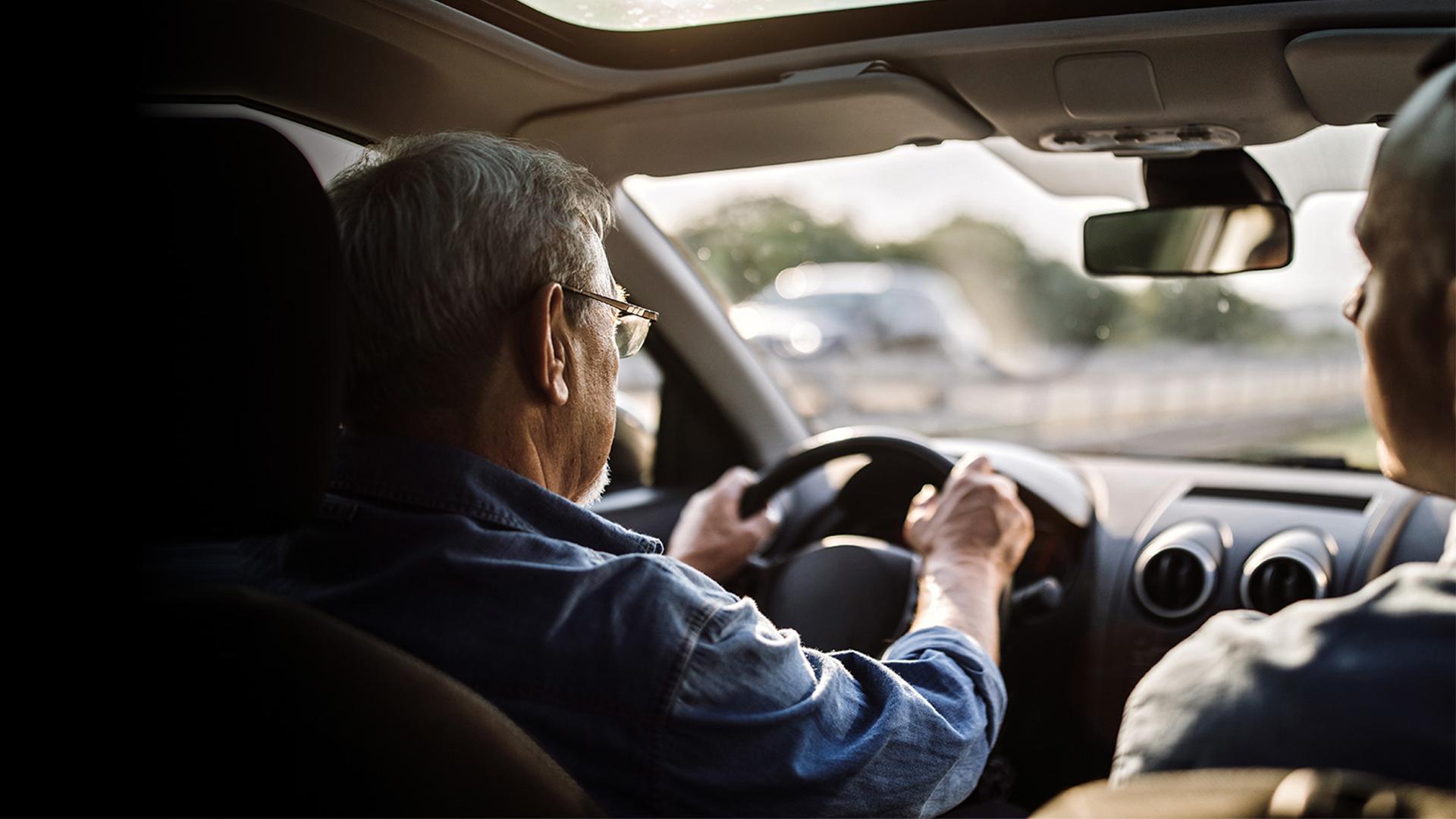
Assessing an older driver

Driving assessment
An assessment can help a senior—or their loved ones—determine if they are still fit to drive. Use the points below to identify skills that need improvement, bad habits that need correcting, and certain age-related limitations. Input from friends, neighbours, and even police officers can be valuable as well.
“You tell yourself: I know what I’m doing. But that might not be the case. You think you’re good, but maybe you’re not as good as you should be.”
— M. Amyot
Obeying the Highway Safety Code
Drivers and passengers are required to wear a seat belt under the Highway Safety Code. Buckling up offers the best possible protection, in any vehicle and regardless of the type of impact. Some drivers simply forget to put on their seat belt, while others may not like the way it fits or find it hard to buckle.
If a driver fails to stop at a stop sign or red light, it may be because they aren’t paying attention, or they might be struggling to make out road signs and signals.
Drivers must yield to any emergency vehicle whose lights or sirens are in operation by slowing down, keeping as far to the right as possible, and coming to a stop when necessary.
This tends to happen when a driver’s vision is too fixed or short-sighted. An eye exam and corrective lenses may solve the problem.
Driving the wrong way, failing to yield the right-of-way, and crossing over the white line or onto the shoulder are common moving violations for older drivers. And the more traffic violations, the higher the risk of an accident.
Signs of aging
Drivers have to keep their heel on the floor and swivel their foot between the accelerator and brake. In special cases, like if they drive an automatic, a driver can get by using both feet. Anything else—like lifting the leg or using the hands to operate the pedals—may be a sign of waning physical strength.
Common examples of this include swinging out before making a turn (especially left turns) or trying to turn from the wrong lane.
Vision problems can make it more difficult to judge how fast other vehicles are moving and the distance between them, making entering the highway and turning onto busy streets particularly problematic.
If a driver only checks the rear and side view mirrors when performing certain operations, it may just be a bad habit they’ve developed or it may be a sign of a stiff back or neck.
Several factors may explain why someone has difficulty making out other road users at night, including impaired night vision and sensitivity to glare as a result of aging.
Sharing the road
This might be a sign that a driver has trouble keeping up with the traffic around them.
Rear-end crashes, parking lot fender-benders, and side collisions while turning rank as the most common mishaps for drivers with declining skills, depth perception, or reaction time.
Signs of compromised driving abilities
The driver may have trouble judging distances or they may be intimidated by having to make tight parking lot manoeuvres so they give themselves more room by parking further from their destination.
Does something as simple as a road construction detour make them lose their bearings?
Maybe the driver has trouble remembering and retaining the information needed to navigate in traffic, which could be a first sign of cognitive impairment if it wasn’t an issue before.
Sharing the road
Most physical disability rehabilitation centres offer programs specially designed to assess the skills of older drivers and reveal any physical, cognitive, or perceptual impairments. These tests are usually done based on a doctor’s referral or by request from Société de l’assurance automobile du Québec.
If one or more of these behaviours have been observed, it’s time to take appropriate action. The solution may be quite simple—sometimes an eye exam, check-up, regular exercise program, refresher course, or vehicle adaptation is all that’s needed. If that’s not enough, it’s probably time they change their habits (e.g., stop driving after dark or during rush hour) or try new modes of transportation.
“I haven’t driven in five years, but I still have my license. I would probably take the test if I had to, but I don’t drive anymore. I have a history of panic attacks. Driving in traffic was terrifying.”
– D. Talbot
Test your road safety knowledge
The Highway Safety Code underwent a major overhaul in 2018. Drivers are responsible for knowing and obeying the rules in effect. Société de l’assurance automobile du Québec offers a number of different questionnaires to test your knowledge on particular topics like traffic rules, road signs and traffic signals, and driving and road safety for both automobiles and motorcycles.
Some driving schools, including those operated by CAA-Quebec, also offer refresher driving courses for seniors. They’re a good way for older drivers to brush up on the rules of the road or change their driving habits based on new restrictions.
Signs of an unsafe driver
No one wants to report a loved one to the authorities, but sometimes it’s a matter of public safety. There is a process for reporting an unsafe driver (in French only) to Société de l’assurance automobile du Québec (SAAQ), regardless of age. Police officers can also report a driver following an accident or other incident. The driver must pass one or more tests and their licence may be subject to additional conditions or even suspended based on the results.
Do you need personalized advice for your vehicle?
Our Mobility Advisory Services specialists can answer your questions about vehicles of all kinds. Feel free to ask for their input, maintenance advice or a list price. It’s just one of the benefits of membership, and there’s no limit to the number of calls you can make.