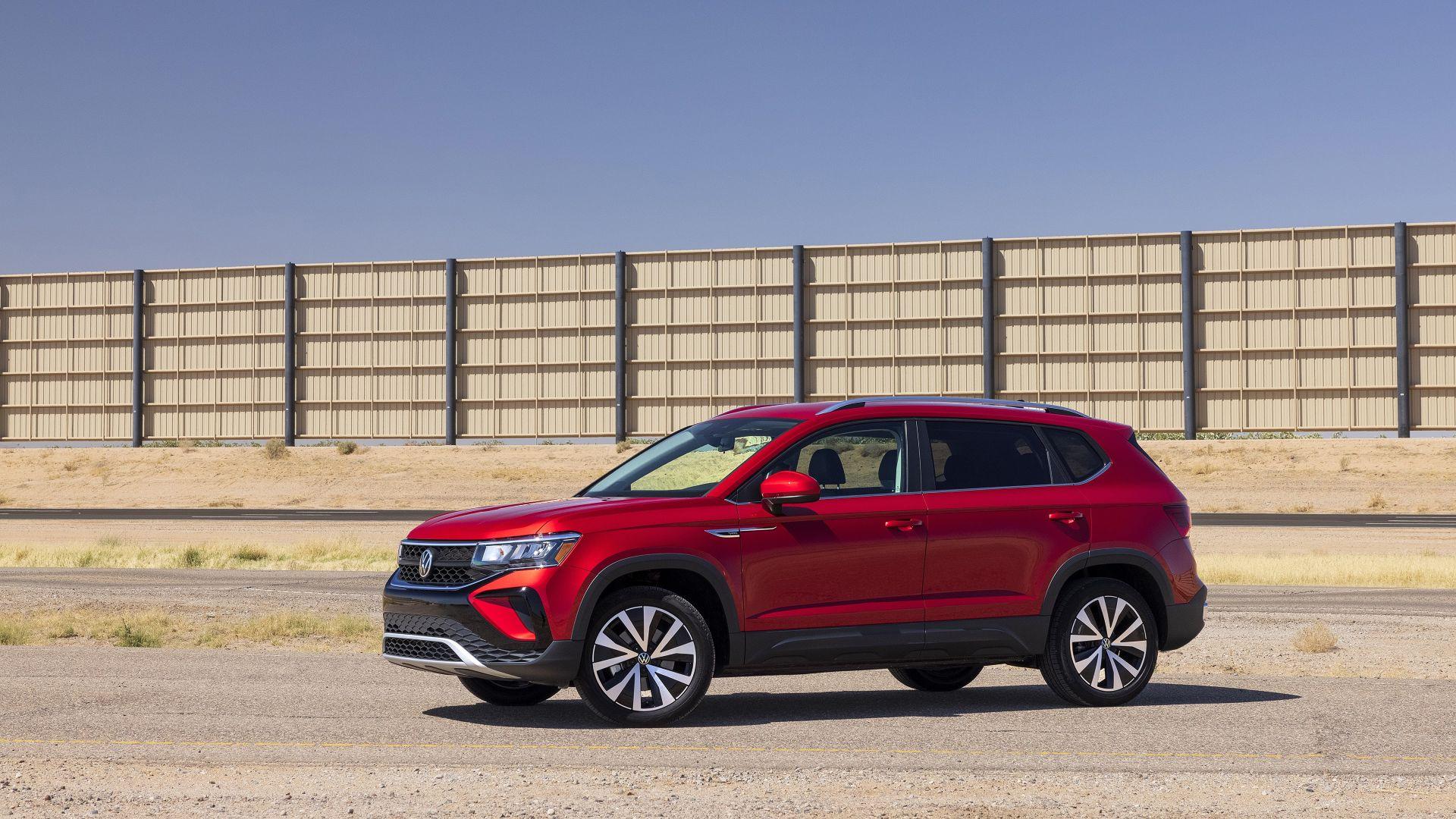
VOLKSWAGEN Taos 2022
A serious shadow on an otherwise satisfactory picture
Pros and cons
Pros
- Responsive engine
- Reasonable consumption
- Good balance of comfort and handling
- Roomy cabin and trunk
- Comfortable seats
- Simple controls
Cons
- Irritating dual-clutch transmission
- Cheap plastics
- Too-short centre armrest
- No traditional USB-A ports
- Automatic emergency braking unavailable on Trendline model
- High price
Overview
Volkswagen is one of the last players to join the sub-compact crossover segment. Named for the charming little town in New Mexico, the Volkswagen Taos places at the upper limits of the category, both in size and price. A small turbocharged four-cylinder—no electrified version on the menu—powers the front wheels, or all four, depending on the model and options selected. The arrival of the Taos spells the end of the non-sporty Golf models, from which the majority of its mechanical systems derive.
Volkswagen thus is following the industry trend to push compact car buyers towards small sport-utility vehicles, at least in North America. Too bad for the thousands of Quebecers who remained faithful to the Golf, despite the tidal wave of SUVs: with the base Taos selling for $28,645, their next VW hatchback will cost at least $2,300 more.
The difference will be even more significant for Comfortline and Highline versions, which come with standard all-wheel drive, a $2,500 value. Fanatics who cannot digest the stiff price can turn to Honda, Kia, Mazda or Toyota, all of which still sell small hatchbacks in Canada.
Volkswagen assembles the Taos at its huge plant in Puebla, Mexico, along with the Jetta and Tiguan.
Verdict
Let’s be clear: the Volkswagen Taos costs more than a Golf, and it doesn’t have the same agility or level of finish. For many potential buyers, the crossover’s roomier cabin and enhanced versatility will more than compensate. However, they will have to accept the dual-clutch transmission’s cruel lack of refinement in city driving, unless they opt for a front-wheel-drive Trendline, the only version available with a traditional automatic.
Evaluation
Body, cabin and cargo space
The Volkswagen Taos slots among the largest “sub-compact” crossovers on the market, along with the Subaru Crosstrek and Toyota Corolla Cross. It shows in the cabin, which proves nearly as roomy as certain compact SUVs, like the Ford Escape and Hyundai Tucson. It can easily accommodate a family, but for grown children, the panoramic roof of the Highline version—also optional on the Comfortline—will considerably reduce their headroom.
Cargo volume is also among the more impressive of the category, notably because the low floor lets you pile up plenty of gear. True to tradition, Volkswagen has equipped the 60/40-split/fold rear seatbacks with a centre pass-through, practical for transporting passengers and long objects at the same time. The seatbacks are around 10 cm higher than the bottom of the trunk when folded; certain competitors get around this with a dual-level cargo floor. On the other hand, the Taos is one of the few small SUVs with side carpeting to protect the cargo area against scratching.
Our Highline tester was equipped with front and rear leather seats that provided efficient and long-lasting support. However, their typically German firmness may not be to everyone’s liking. All versions including the base Trendline feature an attractive two-tone colour scheme for the seats and dashboard. However, an abundance of cheap plastic is a reminder that the Taos is an entry-level vehicle, despite a price tag that can reach nearly $40,000.
It is easy to achieve a good driving position, midway between that of a car and a minivan, thanks to the range of steering-wheel and seat adjustments. However, the fixed centre armrest is much too short: a far cry from the sliding and height-adjustable armrest that Volkswagen used to install on all its models.
Fortunately, the Taos is spared the nearly entirely tactile interface Volkswagen launched on the ID.4 last year. The 6.5- or 8-inch screen is less spectacular, but it comes with knobs and buttons that greatly facilitate access to the main functions. The separate controls for ventilation are easy to use without, or almost without having to take your eyes off the road.
Other highlights:
Instrumentation: digital gauges standard and customizable via buttons on the steering wheel. The system is complex; best to set it up before driving off and to use just the essential controls once underway.
Convenience: Android Auto and Apple CarPlay are standard; the wireless connection, on Comfortline trim and up, failed several times on our tester. Two or three USB-C ports, depending on the model; too bad for people who still have traditional USB-A cables. Wireless charging, voice control, power driver’s seat (including power lumbar), keyless entry and automatic climate control included starting on Comfortline trim. Ultrapowerful Beats audio system, heated steering wheel and ventilated front seats restricted to Highline model.
Safety features
- Antilock brakes with electronic brake force distribution and brake assist
- Stability and traction control
- Hill hold assist
- Hill descent control (included with all-wheel drive)
- Front airbags
- Front side airbags
- Side curtain airbags
- Five adjustable head restraints
- Rear passenger alert
- Tire pressure monitoring
- Rear-view camera
- Forward collision alert, automatic emergency braking with pedestrian detection, blind-spot monitoring and rear cross-traffic alert (standard, Comfortline and Highline; unavailable, Trendline)
- Automatic high-beams and rear parking sensors (standard, Highline; unavailable, other trims)
- Lane-departure warning with automatic lane assist, lane following system and adaptive cruise control (included with Advanced driving assistance package on Highline; unavailable, other trims)
Crash test results
National Highway Traffic Safety Administration (NHTSA)
Overall score: 4 / 5
Frontal impact: 4 / 5
Side impact: 5 / 5
Rollover resistance: 4 / 5
Insurance Institute For Highway Safety (IIHS)
Moderate overlap frontal impact: 4 / 4
Small overlap frontal impact:
- driver side: 4 / 4
- passenger side: 3 / 4
Side impact: 4 / 4
Rear impact: 3 / 4
Roof strength: 4 / 4
Visibility
The Volkswagen Taos’ classic shape and large glass surface provide very good visibility, for a crossover, in all directions. However, the small size and teardrop shape of the outside mirrors limit their efficiency. Warning: The Trendline model is deprived of all driving assistance features, including blind-spot monitoring and automatic emergency braking.
Headlights: the pivoting LED projectors on Highline models received top ratings from the Insurance Institute for Highway Safety in all situations. The LED reflector systems of the other trims were rated 2 out of 4, especially because of insufficient performance in turns.
Mechanical overview
You don’t have to look far for the mechanical origins of the Taos, since it uses the same platform as most of the German automaker’s other transverse-engine models. The wheelbase and several components are therefore similar to those of the Jetta sedan, including the rear torsion-beam suspension equipping the FWD Trendline. AWD models use a four-wheel independent multilink setup.
The Taos launched an updated version of the 1.4L engine used until 2021 on the Golf and Jetta. Now a 1.5L turbo-four, it develops 158 hp, 11 more than the engine it replaces. Maximum torque is unchanged at 184 lb-ft but peaks 250 rpm higher in the powerband. Despite the turbocharger, the little mill is designed to run on regular gasoline.
Front-wheel-drive models propose the same conventional eight-speed automatic transmission as the Jetta and compact Tiguan SUV. All-wheel-drive Taos’s come with a seven-speed dual-clutch gearbox. Both transmissions include a manual mode accessed by pushing the lever to the right.
All-wheel drive adds $2,500 to the price of the Trendline; it is standard on the Comfortline and Highline. It automatically sends up to 50 percent of torque to the rear wheels when conditions require, such as during heavy acceleration, in certain turns and in case of front-wheel slippage. The system includes a drive mode selector with Road, Off-road and Snow modes. The first two also allow the driver to adjust steering, transmission and engine response.
Our test drive of close to 1,000 km, three-quarters conducted on the highway as spring began, yielded a consumption of 8.3 L/100 km. Slightly lower than Natural Resources Canada’s combined city-highway rating, this result is about average for the category of the Taos. However, we obtained 7.1 L/100 km with a Jetta tested on the exact same week in 2019. The 17-percent higher fuel consumption of the Taos tends to prove that, in similar conditions, SUVs are thirstier than equivalent cars.
Driving impressions
Remember the first generation of the Tiguan? Many called it a raised Golf because its handling was so similar to that of VW’s legendary compact hatchback. But even though the dimensions of the Volkswagen Taos are a throwback to the first Tiguan, the same comparison no longer applies so directly.
The suspension delivers a nice balance of road holding and comfort, but it does not quite mask the Taos’ 200 kg or so of extra weight relative to a Golf or Jetta. With its higher centre of gravity, the small SUV leans more in curves than its low-stance cousins.
Additionally, the lightness of the steering erodes some of the road sensation that the Golf provided. Steering precision is intact, but a Mazda CX-30 better connects the driver to the road while handling turns more enthusiastically than its German rival. It is also quieter at highway speed, though the Taos performs relatively well in this respect.
Despite its duller dynamics, the Taos delivers the stability expected by the VW faithful. It has a tenacious grip in turns, with the all-wheel drive erasing most of the understeer that characterises VW’s small vehicles.
Smooth, lively and very linear, the small four-cylinder is a worthy successor to the 1.4L it replaces in the VW line-up. It won’t set any new acceleration records, but it always has a reserve of power for passing or quickly merging onto a highway.
It forms a dynamic duo with the dual-clutch transmission… once the vehicle is well underway, when it shifts in a blink of an eye and downshifts without hesitation. It is an entirely different story in the city, especially in dense traffic.
First gear often is long to engage, as though a driver was slipping the clutch, and the first three gears can be jerky. That is atypical of Volkswagen’s dual-clutch transmissions. Did our tester have a problem? What is certain is that the conventional eight-speed automatic, though not perfect, seemed much smoother in other VW products.
It is an unfortunate blot on what is an otherwise satisfactory report.
Other highlights
Braking: linear and easily modulated pedal, good power and reassuring reaction in emergency stops.
Driving assistance: adaptive cruise control is relatively quick to react when the way clears. The driving assistance menu includes a regular cruise control option. Lane keeping function is well tuned, avoiding ping-ponging between lane markings.
Features and specs
Price range (including shipping and preparation) | ||
| Minimum price | $28,645 | |
|---|---|---|
| Maximum price | N/A | |
| Price as tested | N/A | |
| Trim levels | N/A | |
| Wheelbase | N/A | ||
|---|---|---|---|
| Length | N/A | ||
| Width | N/A | ||
| Height | N/A | ||
| Curb weight | N/A | ||
| Towing | Not recommended | ||