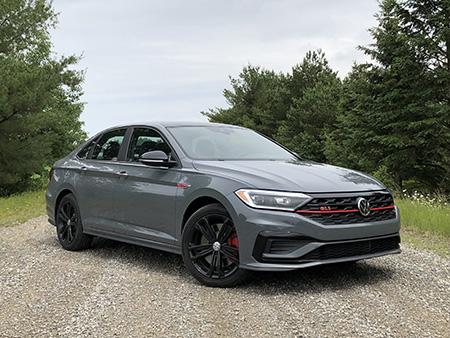
VOLKSWAGEN Jetta GLI 2021
Any excuse is good to get behind the steering wheel...
Pros and cons
Pros
- Flexible and spirited engine
- Enjoyable manual transmission
- Impeccable steering
- Excellent roadability
- Roomy interior and trunk
- Modest consumption
- Logical controls
Cons
- Noisy ride
- Numerous infotainment system glitches
- Disappointing seats
- Lackluster trim and materials
- Absence of traditional USB ports
- Uncertain reliability
Overview
The seventh generation of the Volkswagen Jetta appeared for model-year 2019, but Volkswagen waited another year before relaunching the sporty GLI version. In keeping with tradition, it uses the same potent engine as the Golf GTI. It is also the only Jetta delivered with an independent rear suspension, limited-slip differential and adaptive damping system. To the delight of purists, the GLI still offers a six-speed manual transmission that we had the pleasure of evaluating for you.
The Volkswagen Jetta GLI is sold in one fully equipped trim for $32,745, including destination fees. That’s nearly $2,000 less than a Mazda 3 GT Turbo, but the 3 comes standard with an automatic transmission (a $1,400 option on the GLI) and all-wheel drive (not offered by Volkswagen). Of the sporty compact sedans, the Subaru WRX is the GLI’s only rival that also offers a manual gearbox. The base WRX costs around $1,000 less than the Jetta, but apart from all-wheel drive, it is much less well equipped. The Hyundai Elantra N‑Line and Kia Forte GT sell respectively for $4,820 and $5,900 less than the GLI automatic, but both are less powerful and luxurious.
Volkswagen assembles all Jetta’s, including the GLI, in Mexico.
Verdict
While testing the Volkswagen Jetta GLI, we also test drove a small Japanese luxury sedan costing close to $60,000. Despite the latter’s prestige badge and rich materials, it was the Volkswagen we really wanted to drive. Comfortable, fast, balanced and roomy, it reinstates the affordable European character abandoned by several of the automaker’s popular models. Sadly, the electronic glitches noted on our tester raise the spectre of dubious reliability that has long plagued Volkswagen.
Evaluation
Body, cabin and cargo space
Volkswagen regulars will quickly recognize the Jetta GLI by its red trim bits (including brake calipers), absence of body chrome, black 18-in. wheels and dual exhaust tips. Other motorists won’t notice a thing, which will probably please the fans of discreet performance.The Volkswagen Jetta was one of the first compact sedans to reach a length of 470 cm. Some competitors have caught up, but it remains one of the most spacious of the category. The roomy rear seats easily accommodate adults, even when front occupants take advantage of the long seat sliders to stretch out. Only people over 6 ft. tall may find headroom a bit tight.
The GLI therefore works as a family hauler with no problem, and its regularly shaped trunk can swallow up surprisingly large items. However, even though the Jetta is 5 to 8 cm. longer, depending on the model, the most recent remake decreased trunk volume by 45 litres.
The 60/40-split rear bench folds down to expand cargo space, though not level with the trunk floor. The backrests are relatively well shaped and supportive, but the seat cushions are too firm and flat.
The front seats are equally disappointing for a car with sporty pretentions. The mild side bolstering makes you feel perched on rather than settled into the seat. The front portion is not height adjustable, which displeased certain testers. The passenger seat has lost its height and lumbar adjustment, which Volkswagen was one of just a few automakers to offer on an affordable car.
Another victim of cost reduction is the sliding and height-adjustable centre armrest, which has given way to a fixed model that is too short. Containers placed in the cup holders are directly in the way of one’s right arm when shifting gears, hampering an otherwise well-calculated driving position.
Despite those ergonomic problems, the cabin is very functional. The dashboard and console have a host of dials and physical buttons to access the main functions. There is sufficient cabin storage, and the fully digital instrument cluster is easy to consult. It is also highly customizable once you find the proper sequence of controls on the steering wheel. Unfortunately, everything can be modified while driving, which boosts the level of distraction by several degrees.
The annoyance factor also increases when the infotainment system starts acting up, which happened often during the week we test drove the vehicle. Inoperable wireless Apple CarPlay connection, absence of sound during hands-free calls, sudden radio muting, GPS imprecision… All we can hope is that those are isolated incidences.
Other highlights
Finish: materials, textures and layouts adequate for an ordinary compact sedan but unconvincing for a high-end model. Finish widely below the luxury of a Mazda 3 GT, or even a Golf, though made by the same company as the Jetta GLI.
Convenience: standard equipment is generous but with several glaring omissions, such as a heated steering wheel (standard on the Jetta Execline) and traditional USB ports. Volkswagen now provides only USB-C outlets, rapid and more and more common but not yet compatible with all devices.
Safety features
Antilock brakes with electronic brake force distribution and brake assist
- Stability and traction control
- Hill start assist
- Front airbags
- Front side airbags
- Side curtain airbags
- Emergency post-collision braking
- Five head restraints; adjustable on front and middle rear seats
- Tire pressure monitor
- Rearview camera
- Forward-collision alert with automatic emergency braking and pedestrian detection
- Automatic high-beams
- Blind-spot monitor
- Rear cross traffic alert
- Lane departure alert with automatic steering assist
- Adaptive cruise control
Crash test results
National Highway Traffic Safety Administration (NHTSA)Overall score: 5 / 5
Frontal impact: 4 / 5
Side impact: 5 / 5
Rollover resistance: 4 / 5
Insurance Institute For Highway Safety (IIHS)
Moderate overlap frontal impact: 4 / 4
Small overlap frontal impact:
- driver side: 4 / 4
- passenger side: 4 / 4
Side impact: 4 / 4
Rear impact: 4 / 4
Roof strength: 4 / 4
Visibility
Forward visibility is good but the wide B-pillar creates a large blind spot on the driver’s side for a person of average height. Small outside mirrors compensate only in part; the blind spot monitoring system handles the rest.Headlights: LED headlights received a score of 2/4 from the Insurance Institute for Highway Safety; they are barely adequate in low-beam position and the high beams lack brightness. According to our observations, the lighted path cuts off too abruptly.
Mechanical overview
The Volkswagen Jetta GLI stands apart from the other Jetta’s mainly because of its engine. Identical to that of the celebrated Golf GTI, this 2.0-litre turbocharged four-cylinder develops 228 horsepower and 258 pound-feet of torque on premium gasoline. Volkswagen does not quantify the reduction in power on regular gasoline, though it is recommended with no restrictions.Those numbers are 81 horsepower and 74 pound-feet higher than for the 1.4‑litre engine of the other Jetta’s. Many of today’s 2.0‑litre turbo engines present more impressive ratings than the GLI, but as you will read below, numbers aren’t everything.
In a similar vein, according to Natural Resources Canada, the combined city/highway fuel economy rating for the manual version is 8.5 L/100 km. However, we easily obtained 7.1 L/100 km without sparing the throttle or diversions from our usual highway test route.
Both the six-speed manual transmission and the seven-speed dual-clutch automatic transmit power to the front wheels via a limited-slip differential. Electronic torque vectoring also acts on the brakes to improve cornering precision.
The driver can choose among five drive modes that modify the steering, throttle, differential, adaptive cruise control and active dampers. Adaptive suspension damping is exclusive to the GLI in the Jetta series, as are the independent rear suspension and adjustable exhaust note. Custom mode lets you personalize your settings, for example to obtain less steering assistance without having to put up with the exaggerated engine growl in Sport mode.
Driving impressions
The Volkswagen Jetta GLI is one of those test cars you are loath to part with. In this case, it isn’t the styling that creates the dependence, but rather the particularly well balance and enjoyable drive.A few kilometres suffice to appreciate the steering; precise and well weighted, it is also more directly connected to the pavement than the other Jetta’s. No matter what degree of steering assist you choose, the GLI always tracks solidly on the highway. Body lean is relatively limited in tight curves, with the independent rear suspension ensuring sharper cornering than the torsion-beam setup of the other Jetta’s, especially on bumpy and cracked pavement.
The adaptive damping system plays a role in the excellent balance between comfort and grip. Except in Sport mode, which provides few advantages on public roads, it erases the harshness observed in a regular Jetta equipped with the R-Line package.
Traction is astonishing for a front-wheel-drive car, especially equipped with Hankook tires that are just adequate for a sport model. The secret lies in the limited-slip differential, which totally eliminates torque steer during acceleration.
It is even more noteworthy with an engine like the GLI’s. Few four-cylinders are as spirited, flexible and linear as this version of Volkswagen’s turbocharged 2.0‑litre—not to be confused with the much less convincing Tiguan SUV engine. Contrary to several other turbo engines, this one proves spirited right up to the rpm red line.
It is very satisfying to push it with the excellent manual gearbox. Throws are not quite as short or the lever as “mechanical” as a Mazda 3’s, for example. But the good gearing, paired with the abundant engine torque, provides easy pickup without always having to downshift. The smooth clutch makes the manual a choice ally to fully immerse in the driving experience.
If there’s one false note, it is the constant road noise at highway speed. Is it the tires that are to blame, or the lack of soundproofing underneath the body? Whatever the reason, the Mazda 3 (again!) is much quieter.
Other highlights
Braking: pedal has just the right firmness and bite. Pedal response quick and easy to modulate. Stable and linear emergency stops.
Driving assistance: all systems engage almost imperceptibly; for once we felt no need to turn off the lane departure alert during our test, except on very winding roads. Volkswagen has finally added a regular cruise function to the adaptive cruise control, for drivers who prefer to judge their own following distances. Adaptive mode is still one of the most efficient and progressive available today.
Features and specs
| Price range (including shipping and preparation) | ||
| Minimum price |
$32,745
| |
|---|---|---|
| Maximum price |
$0
| |
| Price as tested | $32,745 | |
| Trim levels | GLI | |
Hyundai Elantra N-Line
Kia Forte GT
Mazda 3 Turbo
Subaru WRX
| Wheelbase |
268.6 cm
| ||
|---|---|---|---|
| 470.2 cm |
470.2 cm
| ||
| Width |
179.9 cm
| ||
| Height |
144.3 cm
| ||
| Curb weight |
1,464 kg (manual)
1,494 kg (automatic)
| ||
| Towing |
false
| ||
| According to Natural Resources Canada | ||
| City |
9.7 L/100 km (manual)
| |
|---|---|---|
| Highway |
7.0 L/100 km (manual)
| |
| Result | ||
| Temperature |
3,960 kg/20,000 km
| |
| Temperature |
From 10°C to 23°C
| |
| CO2 emissions |
3,960 kg/20,000 km
| |
| Fuel tank |
50 litres
| |
| Recommended fuel |
Regular-grade gasoline
| |
| Acceleration as measured by CAA-Quebec | ||
| 60-100 km/h |
4.8 seconds (3rd gear)
| |