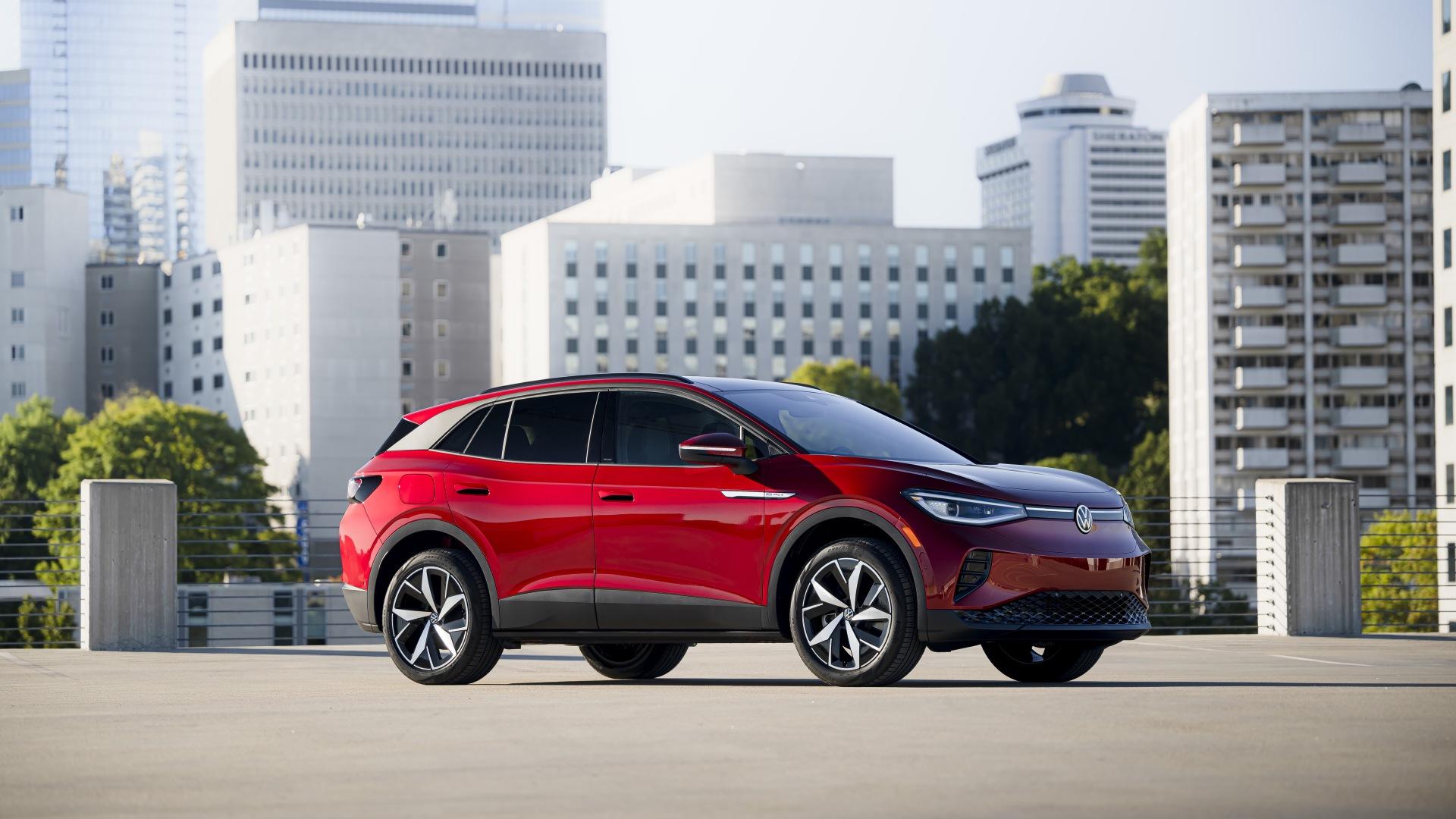
VOLKSWAGEN ID.4 2023
Comfort or sporty driving? That is the question...
Pros and cons
Pros
- Spacious cabin
- Comfortable seats
- Smooth ride
- Secure road holding
- Lively acceleration
Cons
- Complex infotainment system
- Limited and frustrating physical controls
- Unengaging drive
- Heat pump no longer standard
- Very limited availability
Overview
Model-year 2023 already represents the third iteration of the Volkswagen ID.4 in Canada. Volkswagen’s first vehicle built exclusively around an electric drivetrain, this compact crossover competes against such rivals as the Toyota bZ4X, Ford Mustang Mach-E, Hyundai IONIQ 5 and Kia EV6. For 2023 a rear-wheel-drive version with a smaller battery has been added to the trim line, to keep the starting price at an attractive level. However, the long-range versions (including the only AWD ID.4) now cost $3,000 more.
And that doesn’t include the $1,500 charge for a heat pump, which helps to stabilize battery temperature—thereby stretching driving range—and to heat the cabin. An invaluable accessory in our climate, the heat pump was standard on 2021 and 2022 models.
Concretely, a 2023 base Volkswagen ID.4 equipped with a heat pump and a 62‑kWh battery costs $500 more than a 2022 Pro version that had 20 kWh more battery capacity. It means that a model with the AWD that most Quebecers want now retails for close to $56,500, including a heat pump and before the deduction of government rebates.
It is easy for Volkswagen to raise prices: all 2022 ID.4 models are sold out with many orders already placed yet to be delivered. Moreover, pre-ordering for 2023 models had not yet begun at this writing (August 2022), even though models and prices have been released.
Availability could improve in upcoming months: Volkswagen will soon begin building the ID.4 at its assembly plant in Tennessee for the North American market. Up to now, all units sold in Canada were made in Germany.
Verdict
Roomy, lively, versatile and relatively affordable, the Volkswagen ID.4 has a lot to attract electric vehicle enthusiasts, precursors and recent converts alike. It also proves better at delivering promised range than the Volkswagen e-Golf, at least in mid‑summer. However, it leans more toward comfort than sporty driving, which could be disconcerting to some of the brand faithful.
Meanwhile, the confusing controls will try the nerves of anyone finally getting hold of a vehicle that is still rare on our roads.
Evaluation
Body, cabin and storage space
Of all the recent 100-percent electric crossovers, the Volkswagen ID.4 is the one that hews most closely to the proportions and shape of a classic compact SUV. Its wheelbase is shorter than that of the Hyundai IONIQ 5, yet its cabin seems just as open and spacious, notably because the ID.4 is higher and squarer. The optional fixed panoramic glass roof adds light without reducing space.Wide door openings, low sills and the ideal seat height facilitate access to the cabin. The bucket seats are less firm than average for a German vehicle but still provide excellent support on long trips. The driving position is just high enough, and complemented by a large dead pedal and adjustable centre armrest. The flat rear bench is relatively low, but there is plenty of room in all directions, notably thanks to the flat floor.
As in the Ford Mustang Mach-E, the digital instrument cluster facing the driver displays only the basic driving information—speed, range, active assistance and navigation. Nearly everything else is accessed via the 12-inch centre touch screen, including charging information, the trip computer and ventilation control.
This display presents the most recent generation of VW’s multimedia system. More modern and attractive than before, it unfortunately is also more complex, especially with the elimination of nearly all physical buttons on the dash.
All that’s left is a handful of smooth, touch-sensitive controls that constantly require taking one’s eyes off the road and do not always respond right away. The volume and climate controls are not even illuminated; the defrost control (also touch-sensitive) is grouped with the headlight switches left of the steering wheel.
And what about just two switches on the driver’s door to control all four windows? A touch marked REAR lets you toggle between front and rear, but you often hit it by mistake and end up lowering the rear window instead of the front. The gear selector lever to the right of the instrument cluster also could have been part of this festival of poor ideas, but you get used to it fairly quickly.
On the plus side, wireless Android Auto and Apple CarPlay allow you to get around certain difficulties linked to navigation and audio content. Voice commands also can help, but make sure you fully understand their logic before driving off. Four USB ports (type-C only) and wireless device charging are standard.
Other highlights:
Trunk: the relatively share-shaped luggage compartment counts among the most spacious of the category, in part because of its very low floor. The carpeted sides will be more resistant to scratching than the usual hard plastic used by the competition. A ski pass-through and a height-adjustable cargo floor add to the versatility of the 60/40 split-folding seats, but are available only with the $5,000 Statement package.
Safety features
- Antilock brakes with electronic brake-force distribution and emergency brake assist
- Stability and traction control
- Front airbags
- Front side airbags
- Side curtain airbags
- Five adjustable head restraints
- Tire pressure monitor
- Reverse camera
- Forward collision warning
- Automatic emergency braking with pedestrian and cyclist detection
- Lane departure warning with automatic steering assist
- Lane-keeping assist
- Blind spot monitoring with automatic steering assist
- Rear cross traffic alert with automatic braking
- Automatic high beams
- Adaptive cruise control
- Front and rear parking sensors with automatic braking
- Surround-view cameras (with optional Statement package)
Crash test results
National Highway Traffic Safety Administration (NHTSA)
Overall score: 5 / 5
Frontal impact: 5 / 5
Side impact: 5 / 5
Rollover resistance: 4 / 5
Insurance Institute For Highway Safety (IIHS)
Moderate overlap frontal impact: 4 / 4
Small overlap frontal impact:
- driver side: 4 / 4
- passenger side: 4 / 4
Side impact: 4 / 4
Rear impact: 4 / 4
Roof strength: 4 / 4
IIHS Top Safety Pick
Visibility
The Volkswagen ID.4 provides adequate forward visibility, but the thick centre and rear roof pillars hamper the view when changing lanes. Also, the high and narrow rear window does not help when backing up. The blind spot monitoring and cameras save the day, especially with the optional surround view system.Headlights: The LED reflector headlights received a 3/4 rating from the Insurance Institute for Highway Safety; they provide adequate lighting in all circumstances, with no notable weaknesses. Directional projector high-beams were included in the Statement package in 2021 and 2022; they received IIHS’s highest score.
Mechanical overview
The ID.4 is Volkswagen’s first vehicle to be built on its MEB platform, totally dedicated to electric models. This simple base architecture is much like that of the Ford Mustang Mach-E, Hyundai IONIQ 5, Kia EV6 and Tesla Model 3.Placed under the cabin floor, the battery supplies a 201-horsepower electric motor mounted on the rear axle; torque is 229 pound-feet. In all-wheel-drive models, a second motor powers the front wheels as required by driving conditions; combined total output is 295 horsepower and 339 pound-feet of torque. There is no drive shaft linking the two axles.
Since the arrival of the model, the only battery listed had a capacity of 82 kWh (77 kWh net). Still included on Pro models, it provides a range of 443 km with rear-wheel drive, according to Natural Resources Canada. With all-wheel drive, range drops to 410 km, because of the extra weight and power of the AWD system, which comes with a hefty $5,000 price tag.
In both cases, it takes an estimated 7-1/2 hours to attain a full charge with a 240-volt outlet, at least in theory. Our experience with an Electric Circuit level-2 public charging terminal in mid-summer indicates it would take twice that long: we recuperated an average of only 5 kWh per hour of charging.
At a 50-kW DC quick charging station, the level of charge went from 26 percent to 80 percent in 51 minutes. Volkswagen estimates it takes 30 minutes to go from 10 percent to 80 percent at a charging station capable of delivering the 135‑kW power the ID.4 can accept.
For 2023, VW Canada added a strictly rear-wheel-drive base model equipped with a 62‑kWh (58 kWh net) battery. As estimated by the automaker based on the North American method of calculation, range should attain 333 km.
Driving impresions
The first surprise at the wheel of the Volkswagen ID.4, apart from the nearly inaudible motor, is its comfortable ride. Bumps, cracks, expansion joints, dips: the suspension rigorously isolates the occupants from road imperfections. And that’s despite the 20‑inch wheels and the enormous tires (larger in rear than in front) that will cost a fortune to replace.The calm ride will appeal to many motorists, but nostalgic fans of the sporty VWs won’t be as happy with the ID.4. Road holding is not to blame, because the heavy battery promotes good grip at highway speeds and in turns. The fault lies more with the overly light steering and its disappointing lack of road feedback, even in Sport mode. Also, the body leans a bit too much in curves for performance to qualify as dynamic.
The ID.4 is simply following the example of Volkswagen’s other utility vehicles, starting with the Tiguan. Despite claims to the contrary, the ride is tuned above all for long trips on the highway. In this respect, the only blot on an otherwise very serein experience is the rather high tire noise.
Summer conditions prevented us from evaluating the efficiency of the all-wheel-drive system of our ID.4 Pro tester. We’ll also have to wait for colder weather to make a realistic assessment of the driving range. Meanwhile, at temperatures between 20oC and 30oC, we noticed a 5- to 10-percent difference between driving range and mileage at highway speed. In other words, for 50 km driven, range could drop about 55 km. That is already much better than with the e‑Golf.
Other highlights
Braking: maximum regenerative braking accessible at B position on the gear selector, allowing near one-pedal driving. However, a touch of the brakes is still necessary to come to a complete stop. Emergency braking is vigorous, thanks to the very natural pedal response.
Driving assistance: lane keeping system is almost exempt of ping-pong effect between lane markings. Adaptive cruise control is well-calibrated but cannot revert to classic cruise on the ID.4.
Features and specs
Price range (including shipping and preparation) | ||
| Minimum price | $48,545 | |
|---|---|---|
| Maximum price | N/A | |
| Price as tested | N/A | |
| Trim levels | Standard range (RWD)
Pro (RWD)
Pro (AWD) | |
| Wheelbase | N/A | ||
|---|---|---|---|
| Length | N/A | ||
| Width | N/A | ||
| Height | N/A | ||
| Curb weight | N/A | ||
| Towing | Not recommended | ||