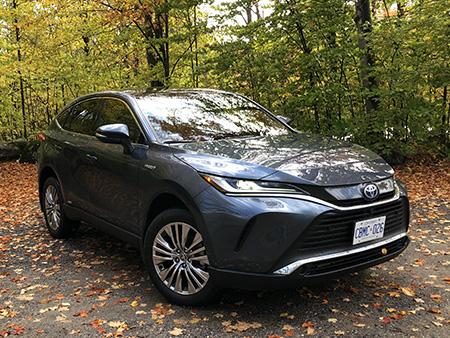
TOYOTA Venza 2021
Back in business
Pros and cons
Pros
- Smooth and seamless hybrid drivetrain
- Low gasoline consumption
- Secure handling
- Composed ride
- Comfortable front seats
- Refined finish and materials
Cons
- Tight rear seating for the segment
- Cargo area restricted by liftgate
- Frustrating capacitive touch controls
- Engine noise in acceleration
- Braking sometimes inconsistent
- Few conveniences in the back
Overview
The Toyota Venza resurfaces for 2021 after a four-year absence. Forget about the high-stance Camry station wagon of before: this time around, it is presented as a highly stylized crossover in hybrid form only. Its drivetrain and the all-wheel drive system with no drive shaft that comes with it are lifted directly from the RAV4. As a five-passenger midsize crossover, the Venza challenges such segment rivals as the Ford Edge, Hyundai Santa Fe and Nissan Murano.
The former Venza had a successful run in Canada, but not in the United States, probably because it did not look enough like an SUV for targeted buyers. Toyota USA therefore dropped it at the end of 2015, followed by the Canadian distributor a year later, as sales on our side of the border did not justify continuing production.
The reborn Venza is actually a quasi-clone of the Toyota Harrier, itself a dressed-up version of the RAV4 for the market in Japan. From now on, that is where Toyota is manufacturing the Venza, which it originally assembled at the same facility as the Highlander, in Kentucky.
At $40,330 (including destination fees), the starting price of the Toyota Venza is about average for a five-passenger midsize crossover. However, that is $5,000 to $6,000 more than for an equivalent RAV4 hybrid. Even the RAV4 Prime with an all-electric range of nearly 70 km costs less than the Venza when the government subsidies for which the former qualifies are taken into account.
Will the added style, luxury and exclusivity of the Toyota Venza, along with its past good reputation, be enough to renew its momentum?
Verdict
The Toyota Venza stands apart in a segment where many rival vehicles count on practicality and an aggressive look to attract buyers. Instead, the refined and stylish Venza is notable for its overall balance and fuel efficiency, for a crossover. More comfortable than a RAV4, more nimble than a Highlander but less spacious than either, the Venza may find a niche among Lexus admirers unwilling to pay the extra cost of a prestigious badge.
Evaluation
Body and cabin
The Toyota Venza is 14 cm longer than the RAV4 but no more spacious. Indeed, the Venza’s plunging roofline reduces rear headroom, especially in Limited models with the panoramic glass roof. The side windows are narrower than those of the RAV4, amplifying the tight feel in the back.Cargo space also suffers, because of the liftgate angle and higher floor. Overall, Ford Edge, Honda Passport and Hyundai Santa Fe, as well as the compact SUV RAV4, Honda CR‑V and Nissan Rogue, are more spacious than the new Venza. The latter does, however, offer a nearly flat cargo floor when the rear seats are folded. There is also a lot of free space between the floor and the compact spare tire.
Up front, the seats are well shaped, though the short bottom cushions may not suit certain individuals. The driving position is just high enough to please crossover fans. Worth mentioning is that all Venza’s have a power tilt-and-telescoping steering wheel, with sufficient range to accommodate tall people—not the case in several Toyota models up until recently.
Elaborate finish sets off the attractive soft-touch materials; the synthetic leather trim is even more convincing than the real leather of certain rival vehicles. The cheap plastic touches noticed in the RAV4 are notably absent in the Venza. Instruments, buttons on the steering wheel and adjacent controls are easy to reach, but in other respects, form wins over function. Storage space and USB ports, for instance, are lodged in front of the gear shift lever and too far away from the driver.
The same applies to the right half of the 12.3‑in. touch screen in XLE and Limited trims. Additionally, though clear and well-organized, the display is completely devoid of dials or physical switches for the main functions. Instead, Toyota chose to install a large capacitive touch panel that even controls ventilation—relegating some climate control functions to a secondary zone on the centre screen. Difficult to use without glancing away from the road; styling that causes so much distraction is out of place.
The Toyota Venza LE comes with good, traditional buttons and dials that make things much easier, along with a perfectly adequate 8‑in. screen. However, LE models cannot get a heated steering wheel or auto dimming rear view mirror—seriously, in a $40,000 vehicle?
Still on the subject of gadgets, Limited trim introduces a fixed panoramic glass roof that transitions from clear to frosted at the touch of a button. Something to impress rear passengers, but maybe they would have liked heated seats or integrated window shades instead.
Safety
Like nearly all Toyotas, the Venza offers the latest driving assistance features as standard equipment. Some are superfluous and overly intrusive, like the lane centering system; others can save lives, like automatic emergency braking with pedestrian and bicycle detection. But in all circumstances, an attentive driver always trumps the functioning of such systems, especially when the weather turns nasty.Large outside mirrors and blind-spot detection help to overcome the challenges to visibility of the body styling. Limited trim adds a camera rear view mirror and a rear camera washer.
Crash test results
National Highway Traffic Safety Administration (NHTSA)
Overall score: 5 / 5
Frontal impact: 4 / 5
Side impact: 5 / 5
Rollover resistance: 4 / 5
Insurance Institute For Highway Safety (IIHS)
Moderate overlap frontal impact: 4 / 4
Small overlap frontal impact:
- driver side: 4 / 4
- passenger side: 4 / 4
Side impact: 4 / 4
Rear impact: 4 / 4
Roof strength: 4 / 4
IIHS Top Safety Pick
Mechanical overview
If you have already seen the underside or even raised the hood of a Toyota RAV4, you have already seen the workings of the Toyota Venza. The two vehicles share nearly all of their mechanical systems, including wheelbase and the components of their independent suspension. The engineers simply retuned the suspension and the electric steering to polish the newcomer’s ride. They also enhanced the insulation to highlight its more luxurious character.However, Toyota left the RAV4 hybrid drivetrain alone when transplanting it into its larger sibling. So what we have is the same, dual-injection (direct and multipoint) 2.5-litre four-cylinder, paired with three electric motor, including one on the rear axle, and a continuously variable transmission. The system sends up to 219 horsepower to all four wheels in strong acceleration. Toyota does not reveal the maximum torque of its hybrid vehicles.
A small, 0.9‑kWh lithium-ion battery is lodged under the rear bench. It allows the vehicle to be driven in all-electric mode for a short distance only, with a very light foot.
Toyota equips all its hybrid SUV’s, including the Venza, with on-demand all-wheel drive with no mechanical link between the two axles. When the front wheels lose grip, when driving off and in strong acceleration, the rear axle electric motor switches on. The system can transmit up to 80 percent of torque to the rear by decreasing the torque of the much more powerful front motors.
The Toyota Venza is not available as a plug‑in, and Toyota offered the usual “We don’t talk about future products” response when a journalist asked if one was on the horizon. Considering the paucity of RAV4 plug‑in models for the Canadian market, don’t hold your breath in the case of the Venza.
The announced combined city/highway fuel efficiency rating (Natural Resources Canada) of 6.1 L/100 km is just slightly higher than that of the RAV4 hybrid, which is a bit lighter.
Driving impressions
Did you know that there are some wonderfully twisty roads southwest of Ottawa, heading towards the pretty town of Perth? That is where Toyota presented the Venza to Canadian journalists, respecting the sanitary measures in force early in October 2020. Those are not necessarily the best roads for a posh crossover, yet the Venza performed admirably well.The fine tuning the suspension received as it moved to the Toyota Venza did a lot of good, providing a smoother and more serene ride. The ensuing comfort is what differentiates the two vehicles on the road.
But it does not come at the expense of handling. You really have to push the vehicle in turns for grip to dissipate and for progressive understeer to appear. Steering is precise and linear, though feedback is limited.
The stability of our tester was never an issue as we drove on the throughway during a heavy downpour. However, there also was no trace of the surface grooving that is so often a problem in Quebec. A steady wind generated some whistle around the roof pillars but had little impact on the body.
Noise from the gas engine infiltrated the cabin a bit too easily during acceleration; more than in a Ford Edge, but less than in the RAV4.
That said, this gasoline-electric drivetrain is well-adapted to the Toyota Venza. Though not as quick as the V6 Chevrolet Blazer or Honda Passport, it still holds its own with a 0‑100 km/h sprint in just over 8 seconds. Good transmission linearity and instant response make for a smooth and serene daily drive. And let’s not forget the 6.5 L/100 km consumption we achieved without sparing the throttle on the twisty sections of our route.
The main letdown: the lack of braking progressiveness in both city and back-country driving, which made it difficult to modulate the pedal. In all other aspects, Toyota is still the uncontested leader when it comes to traditional hybrids.
Features and specs
Price range (including shipping and preparation) | ||
| Minimum price | $40,350 | |
|---|---|---|
| Maximum price | N/A | |
| Price as tested | N/A | |
| Trim levels | LE
XLE
Limited | |
Chevrolet Blazer | ||
Ford Edge | ||
Honda Passport | ||
Hyundai Santa Fe | ||
Jeep Grand Cherokee | ||
Nissan Murano | ||
Subaru Outback | ||
Volkswagen Atlas Cross Sport |
| Wheelbase | N/A | ||
|---|---|---|---|
| Length | N/A | ||
| Width | N/A | ||
| Height | N/A | ||
| Curb weight | N/A | ||
| Towing | Not recommended | ||