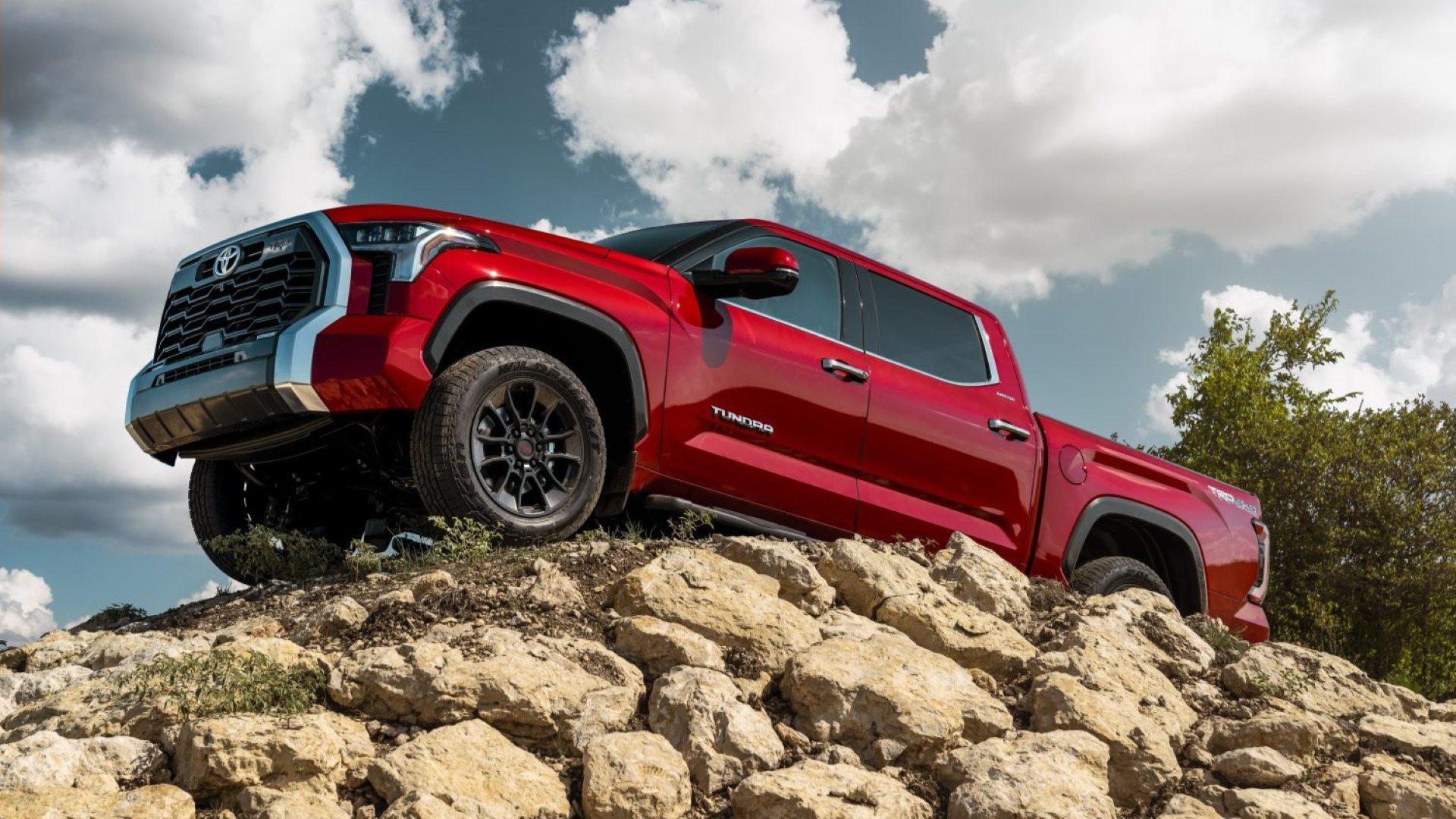
TOYOTA Tundra 2023
A reputation for reliability is good. But what about innovation?
Pros and cons
Pros
- Lively and refined engines
- Exemplary transmission
- Smoother and more composed ride than before
- Heightened finish (Limited trim and up)
- Vast crew cab
- Robust construction
Cons
- No automatic 4WD
- Hybrid engine restricted to high-end models
- Fuel consumption still too high
- Insufficient amenities
- Tight rear seating (double cab)
- Extensive use of hard-touch plastics (SR and SR5 models)
Overview
After 15 years of near-status quo, the Tundra pickup finally went under the knife in 2022. Everything, or nearly everything, is changed—platform, cab, suspensions and engine. The engine is now a turbocharged six cylinder instead of an eight, with an optional hybrid variant. Though less extensive than that of its rivals, the lineup still presents a vast choice of combinations. We evaluated two non-hybrid models: a relatively sober extended cab SR, and a luxurious crew cab Platinum.
The vehicles the automakers generally supply to journalists are fully equipped models that do not represent what the majority of customers actually buy. That was the case with our Tundra CrewMax Platinum with the 1794 option package, priced at nearly $80,000. Topping the lineup, the exclusively hybrid Capstone comes in at nearly $90,000. Though considerable, it is still less than similarly equipped pickups from Ford, GM and RAM. For a long time, the American manufacturers have used generous incentives to sweeten the deal, but that’s no longer the case in today’s tight supply environment.
The Tundra Double Cab SR of our second test went for $57,420, including a $3,300 charge for four-wheel drive—yes, it’s still optional on the base versions—and $3,700 for the SR5 package, which is well worth the price for its many features.
Despite their Japanese patronym, Tundras are built for and by North Americans at a plant in San Antonio, Texas.
Verdict
The Tundra was much in need of an update to catch up with its rivals. Mission accomplished? Yes, for the smoother drive, modernised cab, and rejuvenated engine—though the latter doesn’t impress much at the pump. But we’re still looking for advances to facilitate cabin storage, bed access, towing and 4WD use, to match the competition. A reputation for reliability is a good thing, but innovation is easier to find elsewhere than at Toyota.
Evaluation
Body, cabin and cargo space
With the discontinuation of the single cab, the extended-cab Tundra (or Double Cab in Toyota jargon) becomes the entry-level model. It can be ordered with either a 6 ft. 6 in. bed, or an 8 ft. 1 in. bed that makes it one of the longest half-ton pickups on the market. Typically, though, most units will leave the factory with the CrewMax crew cab, with a 6 ft. 6 in. bed or, more often than not, a 5 ft. 6 in.
You understand why when you travel in an extended cab with the family: even young children can toe the back of a front seat adjusted for a 1.78 metre (5 foot 10 inch) tall person. The crew cab completely takes care of that, though headroom seems less generous than in competing models.
The bed is distinctive for the excellent width between the wheel wells. However, Toyota missed out by not incorporating grab handles, retractable running boards or built-in bumper steps, like the competition, to facilitate loading. And unless you opt for Limited trim or up, you won’t find any power outlets.
The same goes for storage in the back of the cab: no hidden compartments under the floor or in the rear seatbacks, just an open bin under the bench. Considering that Toyota had 15 years to design the layout of its new pickup, the result is disappointing.
But that in no way diminishes the functionality of the cockpit. The main controls are well located, the instrument panel is clear and the driving position is easy to set up. The wide centre console offers roomy storage spaces and the usual charging outlets. The wide seats can accommodate a good variety of body shapes, but the leather bucket seats seemed better padded than the cloth versions.
Hard-touch plastic in the same monotonous grey as the cloth seats is found almost everywhere on the dash and doors of base models. Fit is impeccable, but finish only perks up starting on Limited versions. Though not on the level of a RAM 1500, the overall result is still considerably superior to that of the former-gen Tundra.
All Tundras are equipped with Toyota’s latest infotainment system. More modern and attractive than the preceding version, it measures no less than 14 inches in Limited, Platinum and Capstone trims, rather than 8 inches as on the others. However, it has become more complex to use. The quick access buttons for the main functions and the tuning knob have been eliminated, following the annoying industry trend.
Moreover, the navigation system now requires a Drive Connect subscription; free for three years on Limited trim and up, it is still payable on SR and SR5. It is true that wireless Android Auto and Apple CarPlay connectivity, standard on all trims, reduces the need for integrated GPS, if you don’t mind using your cell phone’s data plan.
Safety features
Antilock brakes with electronic brake-force distribution and emergency braking assistance
Stability and traction control
Hill start assist (standard, SR5 L, Limited, Platinum and Capstone; optional, 4WD SR; unavailable, 2WD SR)
Hill descent control (included in TRD Off Road and TRD Pro packages)
Front airbags
Driver and front passenger knee airbags
Front side airbags
Side curtain airbags
Five head restraints (adjustable on outboard seats, folding in the middle)
Rearview camera
Tire pressure monitoring system
Forward collision alert
Automatic emergency braking with pedestrian and cyclist detection and left-turning vehicle detection
Lane departure warning with automatic steering assist
Lane keeping assist
Rear cross traffic alert
Automatic high beams
Collision avoidance assist at intersections
Adaptive cruise control
Blind spot monitoring and parking sensors with automatic braking (standard, Limited, Platinum and Capstone; included in TRD Off Road and TRD Sport packages; unavailable, 2WD SR and Double Cab SR5 L)
Crash test results
National Highway Traffic Safety Administration (NHTSA)Overall score: 5 / 5
Frontal impact: 5 / 5
Side impact: 5 / 5
Rollover resistance: 4 / 5
Insurance Institute For Highway Safety (IIHS)
Moderate overlap frontal impact: 4 / 4
Small overlap frontal impact:
- driver side: 4 / 4
- passenger side: 4 / 4
Side impact: 4 / 4
Rear impact: 4 / 4
Roof strength: 4 / 4
IIHS Top Safety Pick+
Visibility
The high driving position provides a good peripheral view, but it is important to remember that the height of the body can hide low obstacles and even short people. The enormous towing mirrors on Platinum and Capstone models block side visibility dangerously at intersections and in tight turns. Considering the price and size of the Tundra, the absence of blind-spot monitoring on the base models seems inadmissible.
Headlights: the triple-beam LED projectors on Platinum and Capstone models received top marks from the Insurance Institute for Highway Safety. The LED reflector versions on the other models are a bit less powerful, and obtained an Acceptable rating.
Mechanical overview
Revised and more rigid since last year, the Tundra’s ladder frame now comes with a multilink coil spring rear suspension. Toyota thus followed the path traced by the RAM 1500 over ten years ago. And similar to the RAM, it also offers a variable air suspension for the first time, as an option on Platinum models. Both these types of suspensions are reputed to be less robust than traditional leaf spring types for intensive use, but we did not evaluate the pickup in this respect.
It certainly doesn’t stop the Tundra from listing competitive towing capacity ratings (between 8,289 and 11,171 pounds, depending on the configuration). Most versions come with a tow hitch, a seven-way connector and a trailer-brake controller. However, no trailer backup assist is offered, and trailer tire pressure and blind spot monitoring is unavailable.
Payload capacity is commendable, except on the hybrid, because of the weight of the battery.
The dual-motor hybrid models look good from an environmental viewpoint, but they aren’t there to set new records for fuel economy. They mostly exist to boost the power of the new 3.5‑litre biturbo V6 up to 437 horsepower while moderating its thirst for fuel.
As proof, the combined city-highway fuel-consumption rating for the hybrid is only 0.5 L/100 km lower than for the strictly gas-powered versions, which output 348 or 389 horsepower, depending on the model. But considering the 15.2 L/100 km we obtained at the wheel of our 4WD gas-model Double Cab, any improvement in fuel efficiency is welcome. Admittedly, our test was conducted in January, but with no hauling or towing and only the kids and a few Christmas gifts on board.
The high fuel consumption is what disappointed us most about this redesigned Tundra. Based on Natural Resources Canada's official fuel ratings, the new V6 looked to be considerably more sober than the former V8, especially since it is teamed up with a new and cutting-edge 10‑speed automatic. In reality, the difference is more in the range of 1.5 L/100 km. The competition continues to do better, independent of engine size.
The competition also still offers an automatic mode for their four-wheel drive, ensuring greater peace of mind than the Tundra’s part-time system.
Driving impressions
After a major remake you might have expected changes in the way the Tundra drives. However, when you step on the accelerator for the first time, you are reminded of the former model.
The reason is the rush of torque the new twin-turbo V6 delivers. Whether you have 348 or 389 horses on tap, depending on the Tundra you choose, this engine functions with a smoothness, linearity and vigor that have nothing to envy the old V8. The engine note is surprisingly rich, even without the sound amplification feature of the high-end models. The transmission shifts promptly and smoothly, and matches its 10 speeds well to the mechanicals. This powertrain would be almost beyond reproach if it wasn’t for its high consumption.
It will be interesting to see if the hybrid drivetrain improves the situation, but because of slow production of this model, we haven’t had a chance to sample it.
It’s once you are on the road that the differences with the former generation become apparent. The new rear suspension calms the ride considerably, relative to the traditional leaf springs. The rear end still bounces on very bumpy pavement but rarely to the point of moving sideways. Though not the equivalent of a RAM 1500, Ford F‑150 Lightning, or a GM pickup equipped with magnetic shocks, comfort is now acceptable.
The electric-assist steering—a first for a Tundra—is not particularly direct; its lightness disconnects the driver from the road, but it facilitates maneuvers in the city. The body leans perceptibly in tight turns, especially with the high-profile tires of the least costly models. It lowers the confidence level somewhat, even though roadholding remains secure.
Other highlights
Soundproofing: road noise well filtered except from the coil spring dampers at times. Wind whistles audible around the windshield pillars. Acceleration voluntarily loud and annoying over time.
Braking: pedal a bit spongy; adequate power once the initial dead zone is passed. Straight line panic stops, without overreaction by antilock system.
Driving assistance: as usual with Toyota, lane-departure alert and the adaptive cruise control are overly cautious, quickly prompting the driver to switch them off. Fortunately, Toyota still lets you revert to traditional cruise control by pressing and holding the stop-start button.
Features and specs
Price range (including shipping and preparation) | ||
| Minimum price | $50,420 | |
|---|---|---|
| Maximum price | N/A | |
| Price as tested | N/A | |
| Trim levels | N/A | |
| Wheelbase | N/A | ||
|---|---|---|---|
| Length | N/A | ||
| Width | N/A | ||
| Height | N/A | ||
| Curb weight | N/A | ||
| Towing | Not recommended | ||