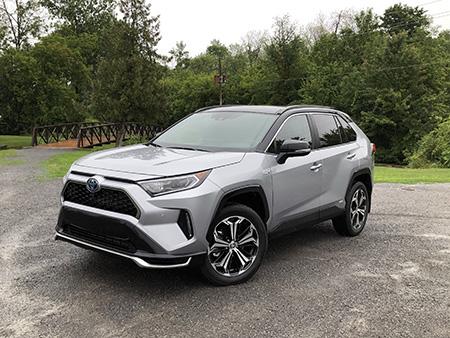
TOYOTA RAV4 Prime 2021
The RAV4 at its best, all versions combined
Pros and cons
Pros
- Long driving range
- Flexible and powerful drivetrain
- Appreciable fuel efficiency for an SUV
- Quiet drive, even in hybrid mode
- Roomy interior
- Logical and well-placed controls
Cons
- Supply much lower than demand
- Base model almost impossible to find
- Numb steering
- Short front seats
- Certain cheap materials
Overview
Two years after the last redesign of the Toyota RAV4, the long-awaited plug-in version has finally arrived in Canada. Named Toyota RAV4 Prime, like the plug-in Prius, it promises an all-electric driving range of 68 km as well as a 6-second sprint from 0 to 100 km/h—the second-fastest for a Toyota production vehicle after the GR Supra. Its 18.1 kWh battery and a starting price under $45,000 qualify the RAV4 Prime for the same $13,000 in government subsidies as 100‑percent electric vehicles.
But while you’re imaging yourself behind the wheel of a $32,000 plug-in Toyota RAV4, remember you have to add a $1,840 destination fee to the price tag. What’s more, government subventions apply after taxes, effectively reducing them to $11,307. As a result, the actual cost of the least expensive plug‑in SUV from Toyota is $35,523, before sales taxes and other fees.
And at that price you’ll be lucky to find one, since only 3 percent of the models Toyota Canada is importing will be the base SE. A mid-level XSE costs $7,000 more, whereas an XSE with the Premium Technology package maxes out at $47,923, including government subsidies.
Additionally, Canada’s initial allotment of the made-in-Japan Toyota RAV4 Prime is set at 1,000, much less than the number of reservations already registered at dealerships. You’ll have to be very patient—the rumoured delay is 18 to 24 months—if you haven’t yet placed an order.
Is final product worth the wait? Our first contact with the coveted vehicle, which took place in the Kingston, Ontario, area, will help you decide.
Verdict
The results are clear: the Toyota RAV4 Prime fulfils all its promises, starting with driving range. Except for 80 litres of cargo volume, the plug-in hardware in no way detracts from the acclaimed versatility of the RAV4 series. Instead, the added smoothness, composure and quiet make the Prime the best of the lineup. Now, if you could just get one… Meanwhile, a handful of competitors are keen to welcome buyers looking to experience the virtues of a plug-in hybrid SUV.
Evaluation
Body and cabin
Unlike the Toyota Prius Prime, which is clearly distinguishable from the regular Prius, the plug-in Toyota RAV4 Prime replicates the “sporty” look of the other RAV4 SE and XSE’s. Apart from the badging and passenger-side charge port, the main exterior distinguishers are the front lower bumper and specific wheels. Only a perceptive eye will note the 2-to-3-cm reduction in ground clearance, because of the underfloor battery.However, the plug-in ushers in several new features for the RAV4 lineup. Some, such as the panoramic sunroof, active headlights and head-up display, are restricted to the Premium Technology package on the XSE. On the other hand, all XSE’s get a 9-in. touch screen, 1-cm larger than on the other high-end RAV4’s.
The rest of the cabin displays the usual characteristics of this country’s best-selling compact SUV, starting with generous space for four adults. Tall people will no doubt deplore the short front cushions, but the seats are comfortable enough for most. The high-voltage battery located underneath the vehicle—a first for Toyota—does not infringe on interior room in any way.
Cargo volume behind the second row is 80 litres less than in the other RAV4’s, but it at least equals that of several other compact SUV’s. The sides of the trunk, the door panels and parts of the dash still use the same dubious-quality hard plastic found in the other versions.
A faultless driving position, clear instruments and easy-to-access controls make the daily drive enjoyable. Even the infotainment system is relatively simple to navigate, especially as it now finally includes Android Auto and Apple CarPlay, long overdue from Toyota. Two knobs and physical buttons provide instant access to the main functions. The 11‑speaker JBL audio system is powerful, but the overpowering bass notes hamper sound clarity.
Attention Technophiles: you have to opt for an XSE model to get remote air conditioning, charge management or door unlocking control, for example, via a smartphone application. But keep an eye on your bank account after the one-year trial, because Toyota will charge you $10 for each of four services offered.
Safety
Faithful to its policy, Toyota offers a full suite of driver aids on all RAV4 Prime models. The potential benefits of automatic emergency braking are widely recognized, and the RAV4’s proved particularly efficient in tests by the Insurance Institute for Highway Safety. The other assistance systems are a bit too quick to intervene but can all be adjusted individually. However, no advanced safety device can replace the constant attention of the driver, nor can they react in as fluid a manner as an alert motorist.Crash test results
National Highway Traffic Safety Administration (NHTSA)
Overall score: 5 / 5
Frontal impact: 4 / 5
Side impact: 5 / 5
Rollover resistance: 4 / 5
Insurance Institute For Highway Safety (IIHS)
Moderate overlap frontal impact: 4 / 4
Small overlap frontal impact:
- driver side: 4 / 4
- passenger side: 4 / 4
Side impact: 4 / 4
Rear impact: 4 / 4
Roof strength: 4 / 4
IIHS Top Safety Pick
Mechanical overview
To make the RAV4 a plug‑in model, Toyota added an 18.1 KWh lithium-ion battery to the lineup’s available hybrid system. That capacity, among the highest of plug-in vehicles, provides an all-electric driving range of 68 km. That is 8 km more than the Ford Escape plug‑in hybrid and nearly twice that of the Mitsubishi Outlander PHEV. To their credit, those two vehicles cost less than the RAV4 Prime… but they are eligible for only half of the $13,000 in government subsidies granted on the purchase of a Toyota RAV4 Prime.Toyota claims a recharge time of 2‑1/2 hours at a level 2 (240V) charging station at 32 amps. That is, respectively, 50 minutes and 60 minutes less than its Ford and Mitsubishi rivals, with their smaller batteries. The Outlander is still the only of the three vehicles to offer direct-current fast-charger capacity, but the high cost of this charging option makes it less pertinent for a hybrid vehicle.
Like the traditional Toyota RAV4 hybrid, the RAV4 Prime plug‑in has two electric motors up front and on for the rear axle. However, its 134 kW front motors are one-and-a-half times more powerful than those of the regular hybrid. The rear motor intervenes only during acceleration or in the case of front-wheel slippage. This full-time all-wheel-drive system sans driveshaft functions at all speeds, unlike that of the Prius AWD-e, limited by a smaller rear motor.
The large battery, juiced-up front motor and a 2.5L four-cylinder combine to boost power to 302 hp, or 83 more than the regular hybrid model. No other RAV4 has ever offered that many horses, not even the 2006‑2012 V6 variant.
Even with all that power and some 200 kg of extra weight, the RAV4 Prime has the same 6 L /100 km fuel-economy rating as the non-plug-in hybrid, according to specs. In electric mode, energy consumption is the equivalent of 2.5 L of gasoline per 100 km. That gives the Escape plug‑in a 0.2 L/100 km advantage in both respects, but with 81 hp less than the RAV4 Prime, and two-wheel-drive only.
Whether or not you can plug in your RAV4 hybrid, the structure, suspension, steering and continuously variable transmission are identical. The towing capacity does, however, jump to 1,134 kg (2,500 lb), second only to the gas-powered Trail version’s 1,587 kg (3,500 lb).
Driving impressions
Kingston is located beside Lake Ontario, where straight roads are legion and hills are rare. That terrain was ideal for the Toyota RAV4 Prime to shine, especially since the late-August weather was overcast and just cool enough to avoid overly using the air conditioning during our test.And guess what? We beat the claimed all-electric driving range by 2 km, with no special effort. In other words, we accelerated as we would with any gas-powered vehicle and kept pace with traffic on the section of highway 401 that made up about half of our route. As anyone who has driven to Toronto can tell you, the actual speed on this boring highway often exceeds the posted limit.
Once the battery was depleted, the hybrid powertrain required an average of 6.3 L/100 km, according to the trip computer. Again, that could increase in an evaluation under our own, stricter test conditions. It also remains to be seen how many kilometres of electric range are lost to cold weather.
Be that as it may, this first sample was impressive. It also revealed the RAV4 at its best, all trims included. In electric mode, the silent drivetrain showcases soundproofing improvements obtained in the 2019 remake. Acceleration is adequate in normal driving, and the gasoline engine does not (or very rarely) kick in below 135 km/h, according to Toyota officials.
Hybrid mode—automatic when the battery is too weak or activated by pushing a button—highlights the performance of the drivetrain. In fact, the power can even spin the front wheels briefly before the computer sorts out the torque balance.
In any case, the real advantage of all of that electric torque manifests itself at lower speeds. Since the gas engine seldom intervenes, the drive is more flexible and discreet, compared to a gasoline-engine RAV4. In terms of smoothness and transparency, Toyota’s hybrid system is unmatched.
The plug-in’s lower centre of gravity also reduces the tendency of the regular model to bounce on degraded pavement. However, the uncommunicative steering will not have you smiling in curves. In that respect, neither the sport mode nor the Prime’s muscular drivetrain make it as athletic as a Mazda CX‑5 or even a Ford Escape.
Features and specs
Price range (including shipping and preparation) | ||
| Minimum price | $46,850 | |
|---|---|---|
| Maximum price | N/A | |
| Price as tested | N/A | |
| Trim levels | XE
XSE | |
| Wheelbase | N/A | ||
|---|---|---|---|
| Length | N/A | ||
| Width | N/A | ||
| Height | N/A | ||
| Curb weight | N/A | ||
| Towing | Not recommended | ||