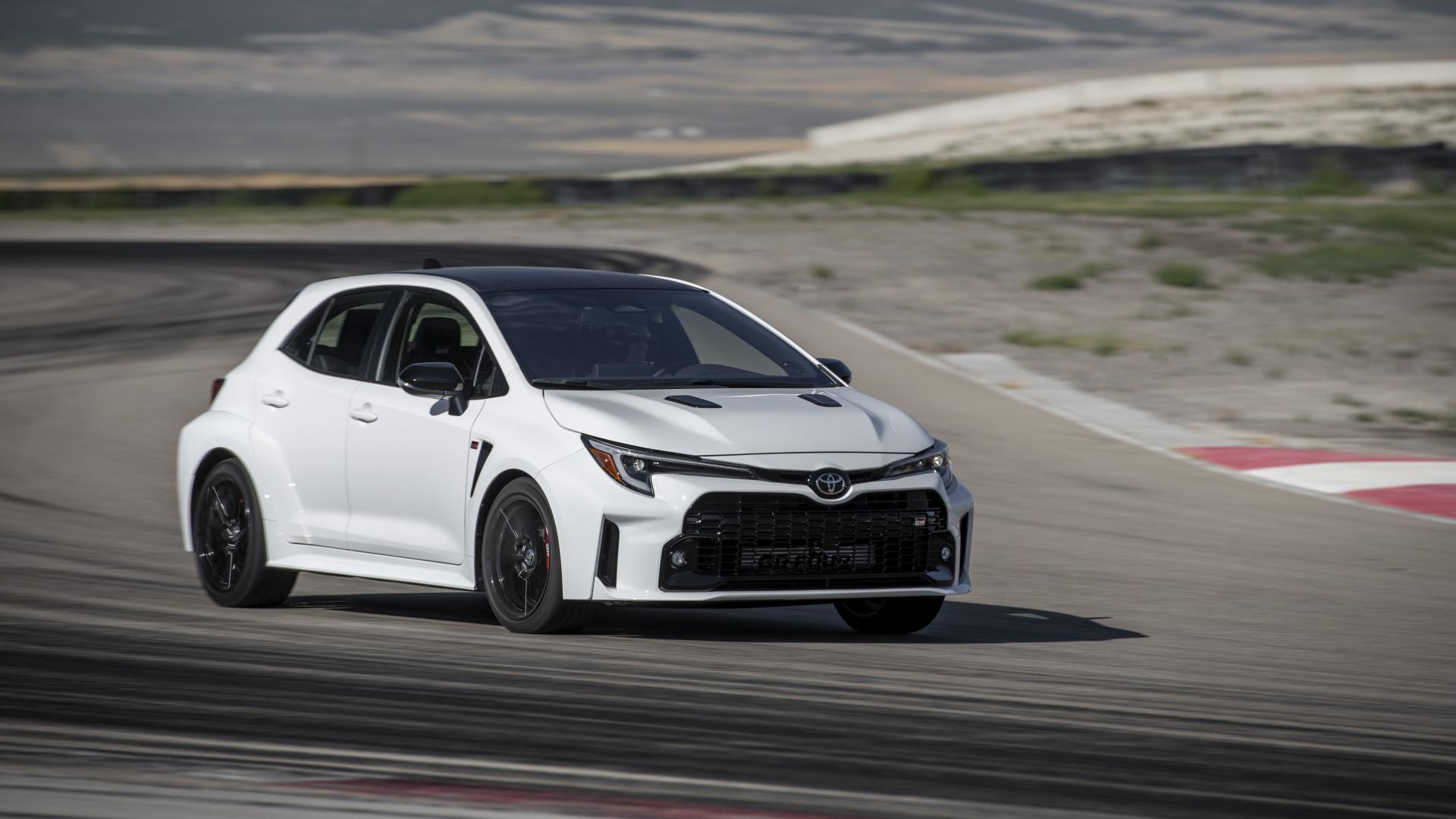
TOYOTA GR Corolla 2023
Fun on the road, surgical on the track
Pros and cons
Pros
- Astonishing performance
- Impressive handling
- Outstanding grip
- Ultraprecise steering
- Incisive and fade-resistant brakes
- Guaranteed exclusivity
Cons
- Long turbo lag
- Stiff suspension
- Noisy cabin
- Ordinary interior finish
- Restricted trunk
- Morizo version already sold out
Overview
There have been sporty Corollas before—remember the GT S of the 80’s?—and others with all-wheel drive, but Toyota had never blended the two with a five-door body and a 300-horsepower (!) engine. But all that changed with the 2023 GR Corolla, soon to arrive on our shores. We had a chance to sample it on a few Vancouver Island roads and especially on the tortuous Motorsport Circuit on said island to test Toyota’s ambitious endeavor.
The automaker also included the 86 and Supra, two other series with the same prefix. The GR badge is inspired by the Gazoo Racing team of the group’s president, Akio Toyoda, an avid motorsports fan whose self-avowed goal is ‘no more boring cars’. It may not be true of all the lineup, but the three GR models we tested solidly pave the way.
The only Corolla now to propose a manual transmission, the GR variant competes against gold standards of the likes of Honda Civic Type R and Volkswagen Golf R. Its $47,210 starting price positions it slightly below those two rivals, which each claim 15 horsepower more (but no AWD for the Honda). However, the Corolla becomes the costliest of the three if you opt for the $55,710 Circuit variant, or one of the ten (yes, just ten) Morizo editions, at $61,710, destined for Canada in 2023. Whereas the Circuit is above all visually distinctive from the base Core, the Morizo aims for performance with several very real chassis and mechanical modifications.
Toyota builds the GR Corolla exclusively at the Japanese plant that assembled the exotic Lexus LFA coupe from 2010 to 2012.
Verdict
As testified by the GR86 and GR Supra, Toyota knows how to surround itself with good partners to produce sporty and appealing cars. But the GR Corolla proves that the Japanese giant can succeed all on its own. Fun on the road and surgical on a track, this hot hatch propels the Corolla name light years from its habitual pragmatism. Less refined than a Golf R and less practical than a Civic Type R, the eye-popping Toyota nonetheless fully merits its place beside those two divas of hatchback performance.
Evaluation
Body and cabin
Despite its affiliation with a standard Corolla hatchback, the GR is distinctive for its massive front grille, wider fenders (especially the rear) and chromed triple exhausts, one right in the middle of the rear diffuser. The Circuit adds an oversized spoiler and red brake calipers; the Morizo sports matte paint and wheels.
Less ostentatious than the Honda Civic Type R, the GR Corolla exhibits a strong Japanese presence that contrasts with the Volkswagen Golf R’s typically German restraint. Toyota claims that its modifications impact the aerodynamics and not just the car’s sporty persona.
The GR treatment is much more subtle in the cabin, especially the Core model with its generic cloth upholstery. The GR-badged steering wheel, fully digital instrument cluster and a handbrake lever make up the main indicators of the transformation. Otherwise, dark grey and hard plastic predominate where the Civic Type R is trimmed in red and the Golf GTI is accented in blue.
The GR Corolla proposes the latest version of Toyota’s multimedia system with an eight-inch screen, like the proletarian models of the lineup. Though much more modern than before, it is not necessarily more logical, with the elimination of the quick-access buttons for the main functions, for example. At least, Android Auto and wireless Apple CarPlay are standard.
Though understated, the standard seats provide good support in sporty driving. They are even better in Circuit and Morizo versions, with more sculpted seatbacks. The ten Canadian Morizo owners can accommodate just one passenger, since Toyota has eliminated the rear bench. Along with the removal of the rear speakers, rear window motors and rear wiper, this strategy shaved 29 kg off the total weight, relative to a base Core model.
Obviously, the elimination of the rear bench increases cargo space, even though it was not the initial intention. In the case of the other GR Corollas, the trunk proves much less roomy than that of a Civic, Kia Forte5 or even a Golf when the rear seats are occupied.
Safety
The usual driving assistance technologies are standard on each GR Corolla, including adaptive cruise control, lane keeping assist, automatic high-beams and automatic emergency braking with pedestrian and motorcycle detection.
The Corolla hatchback received top marks in crash testing by the U.S. government and the Insurance Institute for Highway Safety. IIHS names it a Top Safety Pick, notably for headlight performance, often a weakness of mass-produced vehicles. With its structural reinforcements, it follows that the GR should at least equal the protection of the standard models.
Mechanical overview
The centrepiece of the GR Corolla, obviously, is its engine. This 1.6-litre turbocharged three-cylinder produces no less than 300 horses at 6500 rpm, power that wowed even ten years ago, when it was produced by an engine with double the cylinders and twice the displacement! The 273 pound-feet of torque is just as impressive, although delivered between 3000 and 5550 rpm, which is relatively high for a turbo engine. It is the price to pay for the very high boost pression used by Toyota to extract so much vigor from such a small engine.
As with the Civic Type R, the only available transmission is a six-speed manual. The GR Corolla is one of the last Toyotas to offer three pedals in North America, with the GR86 and the GR Supra. Designed in-house, this transmission features a rev-matching function; purists will appreciate that it can easily be deactivated when they want to practice their footwork.
Torque is distributed via a full-time all-wheel-drive system. The driver can choose between three fixed front-to-rear torque distributions: 60-40 road, 50-50 for track and 30-70 for rear-wheel-drive fun. Canadian models all come with limited-slip differentials at both ends, an option on Core models in the United States.
Toyota fortunately took steps to ensure the car can accept such an avalanche of power. The structure, for example, has 349 more spot welds than a standard Corolla, the brakes are oversized, a sport suspension is part of the mix and performance summer tires are mounted on reasonably sized, 18-inch wheels.
The Morizo edition nudges up several parameters, including torque, to 295 pound-feet, and structural bracing, six instead of the four of the other GR Corollas. It also uses grippier tires than its GR siblings, and a short-throw, close-spaced gearbox.
Driving impressions
It’s one thing to beef up the mechanicals of a mass-produced car, but if the add-ons do not mesh, the experience risks a lack of conviction and fluidity.
Nothing like that with the GR Corolla. Despite its deep resources, it inspires immediate confidence thanks to its high neutrality. Whether in 60-40 or 50-50 mode, the tires grip the road with equal tenacity, even when accelerating hard out of a turn. There is not a trace of understeer—the front-end wanting to plough straight ahead—and the rear-end feels like it is on rails.
The ultra-precise steering allows you to thread through curves, then quickly correct any errors in trajectory. However, we found it just a touch disconnected from the road, compared to the GR86, which telegraphs the slightest change in grip to the driver.
On the other hand, the brakes on the GR Corolla are significantly more powerful and fade resistant than those of the small coupe. Lap after lap, we were surprised to be able to brake later—and harder—repeatedly, without affecting stability.
And thanks to the prodigious resources of the small three-cylinder, we had to tone down our enthusiasm on the turns and elevations of the motorsport circuit. The same was true on the surrounding roads, where the 100-km/h limit popped up in the blink of an eye... as long as we stayed within the optimal power band. That is, the engine wakes up starting around 2500 rpm and pushes in linear fashion right up to the redline. It is the opposite of most contemporary turbo engines, which often give their all between 1500 and 4000 rpm.
In any case, it is a blast to play with the shifter and profit from the adequate pedal placement for heel-toe downshifting. It should, however, be mentioned that throws are a bit longer and engagement is less direct than with the Honda.
It isn’t a dealbreaker in terms of sporty driving, no more than the considerable intrusion of engine and road noise. We have always had a soft spot for the raucous sound of a three-cylinder, especially when accompanied by turbo whistle. We would probably miss the quiet smoothness of a Golf R after a few hours on the highway, but for full-out sporty driving, the GR Corolla is hard to beat.
Features and specs
Price range (including shipping and preparation) | ||
| Minimum price | $47,250 | |
|---|---|---|
| Maximum price | N/A | |
| Price as tested | N/A | |
| Trim levels | Core
Circuit Edition
Morizo Edition | |
Honda Civic Type R | ||
Volkswagen Golf R |
| Wheelbase | N/A | ||
|---|---|---|---|
| Length | N/A | ||
| Width | N/A | ||
| Height | N/A | ||
| Curb weight | N/A | ||
| Towing | Not recommended | ||