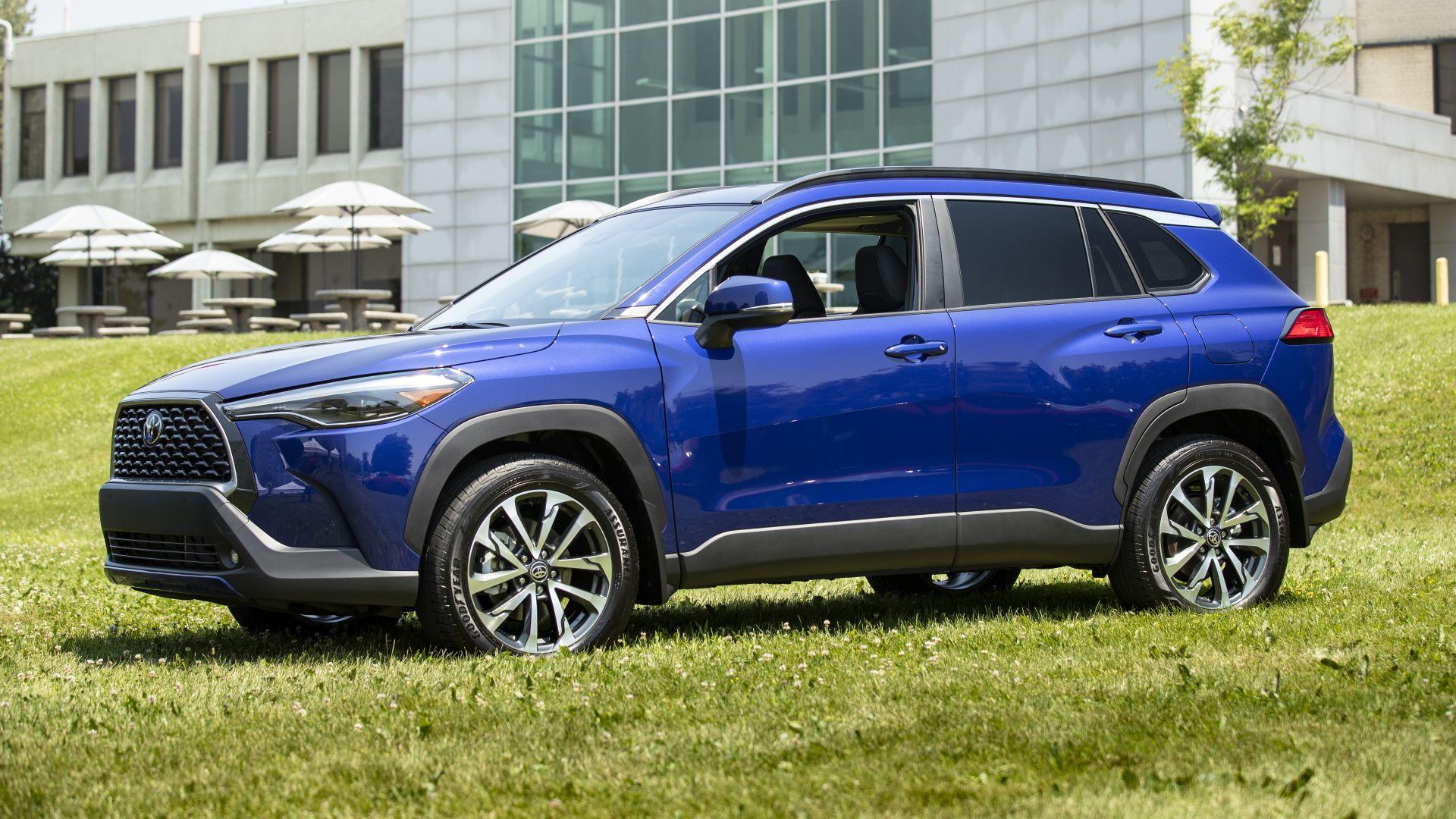
TOYOTA Corolla Cross 2022
Toyota Matrix Nostalgics, rejoice!
Pros and cons
Pros
- Roomy cabin and trunk
- Good visibility
- Simple controls
- Reasonable fuel consumption
- Proven mechanicals
- Good price-to-equipment ratio
Cons
- Very noisy engine
- Transmission sometimes slow
- Light steering
- Fabric seats too soft
- High monthly payments
Overview
The Corolla Cross represents Toyota’s first serious incursion into the hotly disputed subcompact sport-utility segment. With its optional all-wheel drive and functional design, the newcomer should easily outsell the C‑HR even though the latter is still holding its own.
The link between the best-selling car in history and the Toyota Corolla Cross is clearly evident. The platform, powertrain and dash (among others) come almost directly from the Corolla. That strategy certainly helped to offset the higher cost inherent to a small SUV compared to a similarly sized sedan.
The Toyota Corolla Cross therefore starts at $26,750 (including destination fees), the most affordable retail price of the segment after the South Korean competitors. All-wheel drive costs just $1,400 more on L and LE trims; it is standard on the XLE, which at $36,105 is reasonably priced for a high-end model. However, a four-year lease changes all that, at least as this article went online in November 2021. The Corolla Cross has one of the highest monthly lease payments in its category, primarily because of an interest rate of nearly 6 percent.
The first units arrived at dealerships in November from the new Toyota-Mazda factory in Alabama. A traditional hybrid model will follow sometime in 2022, with technical details yet to be announced by the automaker.
Verdict
Those nostalgic for the Toyota Matrix can rejoice in the fact that the Toyota lineup once again includes a small yet accommodating family hauler that is functional, safe and well equipped. Along with Toyota’s tradition of reliability, that makes the Corolla Cross a must-see when shopping for a subcompact SUV. However, buyers will have to settle for less-than-inspiring performance and deal with an annoying level of engine noise at even the slightest acceleration.
Evaluation
Body and cabin
Toyota’s new crossover looks much more like a RAV4 than the sedan or hatchback from which it takes its name. Its utilitarian shape makes it much easier to enter and exit than the sleekly styled C‑HR and enables a trunk design offering 60 percent more volume. Only the Volkswagen Taos has more trunk space than the Toyota Corolla Cross with the rear seatbacks in place.It should be noted that the Cross stretches 447 cm, making it one of the longest subcompact SUVs on the market. It explains why its cabin can accommodate a typical family of four with relative ease; several competitors cannot do as much, especially if the kids still need a jumbo-sized child seat.
The front seats come from the Corolla, but they are installed 13 cm higher in the Cross than in the sedan. The result is a pleasant driving position and good visibility helped by the generous glass surface. However, the fabric-trimmed bucket seats provide insufficient support, especially for the lower back. The slightly firmer faux-leather seats on the XLE model offset some of the problem; on the driver’s side, the power adjustments including power lumbar take care of the rest.
The affiliation with the other Corollas is also apparent in the dashboard. All of the upper part is identical on the car and crossover, except for the stitching on the passenger side. Instrumentation and controls are fairly traditional—including a conventional gear-shift lever—and quickly mastered. The touch screen is also relatively logical but the design of the graphics and resolution is not up to date.
The base-model L comes with a 7‑inch display, heated front seats, Android Auto and Apple CarPlay connectivity and a USB-A port. For $2,200 more, the LE adds several of today’s popular features, such as keyless ignition, a heated steering wheel, rear USB outlets, alloy wheels and blind-spot monitoring. Except for the absence of the power driver’s seat, the LE is the most interesting model from a price/equipment viewpoint.
Safety
Toyota was one of the first automakers to integrate driver assistance equipment on nearly all its models, five years ago. The Corolla Cross follows the same path, with standard automatic emergency braking, lane departure alert with lane keep assist, automatic high-beams and adaptive cruise control. XLE trim adds rear parking sensors with automatic reverse braking.
Crash test results
National Highway Traffic Safety Administration (NHTSA)
Overall score: n/d
Frontal impact: 4 / 5
Side impact: 5 / 5
Rollover resistance: Not tested
Insurance Institute For Highway Safety (IIHS)
Moderate overlap frontal impact: 4 / 4
Small overlap frontal impact:
- driver side: 4 / 4
- passenger side: 4 / 4
Side impact: 4 / 4
Rear impact: 4 / 4
Roof strength: 4 / 4
IIHS Top Safety Pick+
Mechanical overview
All Toyotas sold in Canada that are equipped with a transversely mounted engine now use the automaker’s TNGA global platform. The Corolla Cross uses the C (for “compact”) variant, which also serves to underpin the Corolla family of cars, the C-HR, the Prius and the Lexus UX.The suspension of the other Corollas was modified slightly to adapt to the higher weight and centre of gravity of the Cross. Two-wheel drive models are equipped with a rear torsion beam; all-wheel drive is paired with an independent multilink suspension. All versions have four-wheel disc brakes and an electric power steering system.
For the time being, all Toyota Corolla Cross models come with the same gasoline engine. This 2.0-litre four-cylinder combines direct fuel injection and port fuel injection, for optimum low-rpm performance and to profit from the cleaning power of gasoline in the cylinder head. Already used in the other Corollas, this engine outputs 169 horsepower and 151 pound-feet of torque at a relatively high 4,400 to 4,800 rpm.
The engine is equipped with automatic stop-start technology and a continuously variable transmission. In addition to the usual chain and pulleys, the transmission includes a launch gear for more direct start-offs from a stop. Simulated gearshifts appear during heavy or moderate acceleration; the shifter includes a manual position with ten preprogrammed gears.
Like the majority of current all-wheel-drive systems, the Corolla Cross’s sends all power to the front in most circumstances. It directs up to 50 percent of torque to the rear in case of front-wheel slippage, in heavy acceleration and in sharp curves.
This temporary engagement of the system puts gasoline consumption within a half-litre of the front-wheel-drive models, estimated by Natural Resources Canada at 7.3 L/100 km combined city/highway. That makes the Corolla Cross the most fuel efficient of its category even before the hybrid version hits our roads. In other markets, the Cross hybrid uses the same engine as the Corolla hybrid, rated at 4.5 L/100 km.
Very few subcompact SUVs announce a manufacturer-approved towing capacity. The Corolla Cross is one of them; its 680 kg/1,500 lb capacity equals that of several compact SUVs, including the RAV4 (except for the Trail version, which can tow 1,588 kg/3,500 lb).
Driving impressions
Toyota expects the Corolla Cross will prove popular with Quebec motorists. That’s why it held the Canadian press launch in our province, in the Outaouais region. We tested a front-wheel-drive LE model first and then finished up the day in an XLE, which comes with standard all-wheel drive.Both versions demonstrated good stability on the secondary highways and expressways we drove. They proved equally nimble in dense traffic, and relatively composed at highway speed. Wind and road noise are fairly well filtered for a subcompact vehicle.
Unfortunately, we cannot say as much for engine noise. Even very moderate acceleration—outside of city areas—produces an annoying racket that lets up only when the accelerator is released. Despite Toyota’s programming efforts, the CVT’s simulated gearshifts are not sufficient to calm things down.
As if that weren’t enough, performance is not as sparkling as in an “ordinary” Corolla with the same 2.0-litre engine. The higher weight of the crossover makes itself felt, and all the more with all-wheel drive. The 2WD seemed livelier than its 4WD counterpoint, but the latter delivered a smoother ride and better steering control on bumpy pavement, thanks to its independent rear suspension.
None of our test models displayed the refinement of a Mazda CX‑30, the pizazz of a Hyundai Kona or the agility of a Honda HR‑V. Additionally, Corolla Cross’s overly assisted steering dulled its potential driving enjoyment. However, its highly practical nature should ensure its success, and rightly so.
Features and specs
Price range (including shipping and preparation) | ||
| Minimum price | $26,780 | |
|---|---|---|
| Maximum price | N/A | |
| Price as tested | N/A | |
| Trim levels | L (RWD)
L (AWD)
LE (RWD)
LE (AWD)
XLE (AWD) | |
Buick Encore GX | ||
Chevrolet Trailblazer | ||
Honda HR-V | ||
Hyundai Kona | ||
Jeep Renegade | ||
Kia Niro | ||
Kia Seltos | ||
Mazda CX-3(0) | ||
Mitsubishi RVR | ||
Nissan Qashqai | ||
Subaru Crosstrek | ||
Volkswagen Taos |
| Wheelbase | N/A | ||
|---|---|---|---|
| Length | N/A | ||
| Width | N/A | ||
| Height | N/A | ||
| Curb weight | N/A | ||
| Towing | Not recommended | ||