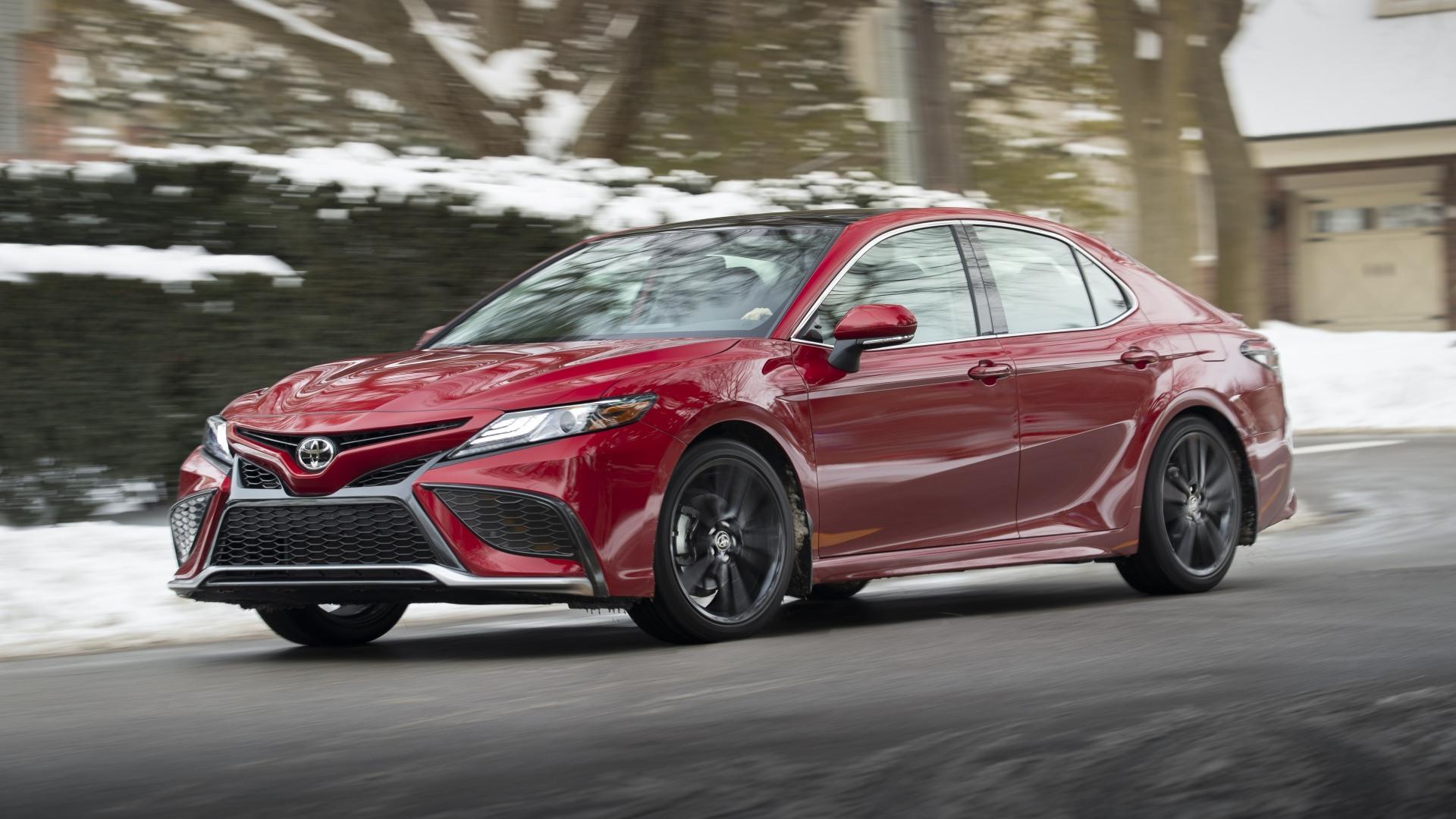
TOYOTA Camry 2022
The TRD V6 impresses with its dynamism... but it's the hybrid you'll want.
Pros and cons
Pros
- Faultless hybrid drivetrain
- Powerful and refined V6
- Reasonable (V6) or low (hybrid) consumption
- Sharpened road holding (TRD V6)
- Well-balanced ride (hybrid)
- Spacious cabin
- Simple controls
Cons
- Lack of equipment (TRD V6)
- Very low ground clearance (TRD V6)
- Non-folding rear seatbacks (TRD V6)
- Loud exhaust (TRD V6)
- Annoying adaptive cruise control
- Ordinary materials and finish
- No all-wheel drive hybrid version
Overview
The popularity of SUVs is crippling sales of mid-sized cars. Certain automakers have abandoned ship, but not Toyota, whose Camry remains the most sought-after model of the segment. The catalogue lists four-cylinder versions, some with all-wheel drive, others with hybrid drivetrains, and even the last six-cylinder midsize sedan on the market. We tested an SE hybrid and a TRD V6 to see what the Toyota Camry still holds for the faithful, more than four years after the arrival of the current generation.
With such a large offering, prices vary widely, from $29,570 for a base Camry LE to $44,005 for an XSE V6 with optional pearl white paint and black roof. All-wheel drive adds $1,800 to the price of a four-cylinder SE or XSE, but it is not available with the V6 or the hybrid drivetrain. The latter costs $2,000 on LE and XSE models and $2,060 on the SE with the Upgrade package.
Only the TRD V6 provides access to the six-cylinder engine for less money than the XSE V6; however, the $3,810 “saving” rolls back equipment more or less to the level of an SE without the Upgrade package. On the other hand, TRD (for Toyota Racing Development) treatment adds a lowered suspension, black 19-inch wheels, sport exhaust, side skirts, a black roof and a big spoiler, also black.
All North American Toyota Camrys are assembled in Kentucky.
Verdict
Before, purchasing a Toyota Camry meant sacrificing any notion of driving pleasure in exchange for rock-solid reliability. That no longer is true with the current generation, especially in the case of the impressively dynamic TRD V6 variant. Still, our choice is still the hybrid version, for its superior blend of comfort, equipment and overall enjoyment at a lower cost—both at purchase and at the pump. It warrants serious consideration if you only need the versatility of an SUV two or three times a year.
Evaluation
Body, cabin and cargo space
What do all the remaining midsized cars have in common? Among other things, a long wheelbase that ensures ample legroom for four adults. The Toyota Camry is no exception, even though the specs place it after the Honda Accord and Subaru Legacy in this respect. Also, people over 1.82 m (6 ft.) tall would find their head touching the ceiling with the sunroof, something that also applies to several SUVs said to be roomier than a car.
The trunk, separate from the cabin, obviously cannot replicate the usefulness of an SUV’s high cargo area. But thanks to its very clean lines, it can accommodate lots of luggage. The trunk lid opens fully, thanks to its trunk springs, but requires considerable effort to close; depriving the less expensive trims of an inner handle seems that much more stingy.
The folding seatbacks free up space for long items, but the opening is not very wide. The use of a structural reinforcement behind the rear bench of the TRD V6 requires fixed seatbacks that reduces the car’s practicality.
The Camry SE hybrid as well as the TRD V6 offer well bolstered and padded front seats, but they are too short for good thigh support. As the Camry does not have the same mission as a crossover in terms of practicality, its rear bench does not need to fold perfectly flat with the floor of the trunk. It thus avoids the overly low seat that handicaps so many SUVs. However, passengers will have to pass on heated rear seats, USB ports and air vents; the TRD V6 has neither a centre armrest nor cupholders!
The TRD V6 also gives up the sunroof, self-dimming rearview mirror, wireless charging pad, heated steering wheel and dual-zone climate control. None of these features are vital, of course, but their absence is surprising for a vehicle costing almost $40,000. In the same vein, the Camry TRD V6—like the LE and SE without options packages—feature a 7‑inch touchscreen with totally outdated resolution and graphics.
The 9‑inch screen on the other models is notably clearer, though far less modern than Toyota’s most recent infotainment system. However, the Camry’s interface is considerably more logical, and it comes with more physical buttons and knobs. If all vehicles had such simple controls as Toyota’s sedan, driver distraction would not be the scourge it is becoming today.
Other highlights:
Instrumentation: analog gauges of the hybrid version are very easy to read. The red gauge lettering on the TRD V6 becomes nearly illegible on sunny days, especially when wearing sunglasses. Trip computer is comprehensive and relatively simple to use.
Finish: rigorous fit, inside and out. Finish is adequate but not luxurious, even in high-end models, because of the wide use of hard, cheap-looking plastics. Only a few portions of the dashboard and doors are finished with soft-touch materials. Leather and red vinyl pair nicely with certain paint selections on XSE models.
Safety features
- Antilock brakes with electronic brake force distribution and emergency brake assist
- Traction and stability control
- Front airbags
- Front knee airbags
- Side airbags, front and rear
- Side curtain airbags
- Five adjustable headrests
- Tire pressure monitor
- Rearview camera
- Forward collision alert
- Automatic emergency braking with pedestrian and bicycle detection
- Lane departure alert with automatic steering assist
- Automatic high beams
- Adaptive cruise control
- Blind-spot monitoring and rear cross traffic alert (standard, SE Hybrid, XSE, XSE V6, XSE Hybrid, TRD V6 and XLE Hybrid; optional, LE and SE; unavailable, LE Hybrid)
- Lane-keeping assist (standard, hybrids, XSE and XSE V6; unavailable, other versions)
- Rear parking sensors, reverse automatic emergency braking and surround-view cameras (standard, XSE V6 and XLE Hybrid; unavailable, other versions)
Crash test results
National Highway Traffic Safety Administration (NHTSA)Overall score: 5 / 5
Frontal impact: 5 / 5
Side impact: 5 / 5
Rollover resistance: 5 / 5
Insurance Institute For Highway Safety (IIHS)
Moderate overlap frontal impact: 4 / 4
Small overlap frontal impact: 4 / 4
Side impact: 4 / 4
Rear impact: 4 / 4
Roof strength: 4 / 4
IIHS Top Safety Pick+
Visibility
Good forward and side visibility, thanks to relatively thin roof pillars and large glass surface. The outside mirrors could be larger; Toyota should provide blind-spot monitoring on all trims, to compensate. As with all sedans, the height of the trunk deck is a hindrance when backing up, especially true of TRD V6 trims with their oversized spoiler.
Headlights: Toyota offers two types of LED headlights for the Camry; each obtained a 3/4 rating from the Insurance Institute for Highway Safety. Lighting is generally superior straight ahead and better in right turns than in left turns.
Mechanical overview
Launched for model-year 2018, the current generation of the Camry was one of the first Toyota models to adopt the automaker’s global platform for its transverse-engine vehicles. This highly modular architecture easily accommodates the hybrid’s extra hardware, with no reduction in cabin or trunk volume.
It also was good to go for all-wheel drive, as it already is used for the majority of the make’s crossovers. It thus was easy for Toyota to list it as an option for 2020, one year after Nissan Canada included AWD as standard equipment on the Altima. Even though Toyota sells several hybrid and V6 models with four-wheel drive, it chose to restrict this AWD system to the four-cylinder Camrys.
Even the sporty TRD V6 model is front-wheel drive. On the other hand, it comes with a firmer lowered suspension, tighter steering and a throaty exhaust system. It rides on the same 19-inch wheels and tires as the non-hybrid XSE, but with distinctive wheel style and colour.
Contrary to several competitors, Toyota’s large sedan is equipped only with naturally aspirated engines, generally less expensive to maintain than turbo engines. What’s more, they are all old acquaintances that have evolved over time, with proven reliability.
The most affordable is a direct-injected 2.5-litre four-cylinder that develops 203 horsepower (206 in XSE variants), which is notable for an entry-level model. Toyota matches it to an eight-speed automatic transmission with manual mode.
A similar pairing is used with the 3.5-litre V6 on XSE V6 and TRD V6 models. With 301 horsepower (that’s right, a Camry with more than 300 horses!), it is the most powerful of the midsize segment, though certain competing turbo fours provide higher torque than the 267 pound-feet of this six-cylinder.
The third drivetrain combines a pair of electric motors with a small lithium-ion battery and a more frugal version of the above-mentioned four-cylinder. On paper, this non-plug-in hybrid drivetrain uses 31 to 34 percent less fuel than the gasoline-only 2.5-litre, while providing slightly superior power. It is mated with an electronic continuously variable transmission that links the two electric motors and the gas engine.
We drove nearly 1,200 km in a Camry SE hybrid in the spring of 2022. Our test, conducted mostly on the highway, yielded 5.7 L/100 km. That is close to Natural Resources Canada’s official rating, as is the 8.4 L/100 km we obtained the following week behind the wheel of a TRD V6. Those are impressive results for tests conducted without worrying about fuel economy.
Driving impressions
There was a time when driving a Toyota Camry was as engaging as washing windows. The current generation genuinely raised the bar for driving enjoyment, especially as concerns the SE, XSE and TRD series. We wouldn’t go as far as to compare their road comportment to that of a BMW 3-Series, or even a Lexus IS. However, it easily surpasses the Nissan Altima and even holds its own against a Honda Accord, the reference in the midsize segment.
The Honda remains more incisive in a series of fast turns, but the stiff ride it imposes with the 19‑inch wheels is not exactly consistent with the mission of a midsize sedan. The Camry offers a better balance of comfort and handling, the SE hybrid in particular, with its 18-inch wheels. Adequately soundproofed, it is as enjoyable on long trips on the expressway as when pushed a bit on the back roads.
The TRD V6 is naturally firmer, which sharpens its reactions a notch on winding roads. Despite its reduced suspension travel, it remains stable on bumpy pavement. However, its very low ground clearance could play nasty tricks on speed bumps or in deep snow. Be careful when parallel parking after a snowstorm!
The V6 engine is both fast and delightfully linear, especially in comparison to the sometimes-irregular turbo fours of certain Camry rivals. The eight-speed transmission shifts decisively, but always smoothly. However, the persistent drone of the TRD sport exhaust system becomes irritating at highway speeds.
If you absolutely want to get the V6 before it disappears, the XSE V6 represents a more cohesive package than the TRD, despite its higher price. But if the number of cylinders is of no real importance, you should seriously consider one of the hybrid variants: the gains in comfort and fuel economy amply compensate for the small sacrifice in pure performance.
Other highlights
Braking: the transition between regenerative and mechanical braking makes the pedal on hybrid models hard to modulate. Dual-piston front brakes on the TRD V6 are very powerful, but the system lacks initial grip, despite the firmness of the pedal.
Driving assistance: as usual with Toyota, both the lane departure alert and adaptive cruise control are overly cautious, which can become an incentive to switch them off. Fortunately, the automaker still allows the driver to opt for conventional cruise control mode by holding down the on-off button.
Features and specs
Price range (including shipping and preparation) | ||
| Minimum price | $29,570 | |
|---|---|---|
| Maximum price | N/A | |
| Price as tested | N/A | |
| Trim levels | LE
LE hybrid
SE
SE hybrid
TRD
XLE hybrid
XSE
XSE hybrid
XSE V6 | |
Chevrolet Malibu | ||
Chrysler 300 | ||
Dodge Charger | ||
Honda Accord | ||
Hyundai Sonata | ||
Kia K5 | ||
Nissan Altima | ||
Subaru Legacy |
| Wheelbase | N/A | ||
|---|---|---|---|
| Length | N/A | ||
| Width | N/A | ||
| Height | N/A | ||
| Curb weight | N/A | ||
| Towing | Not recommended | ||