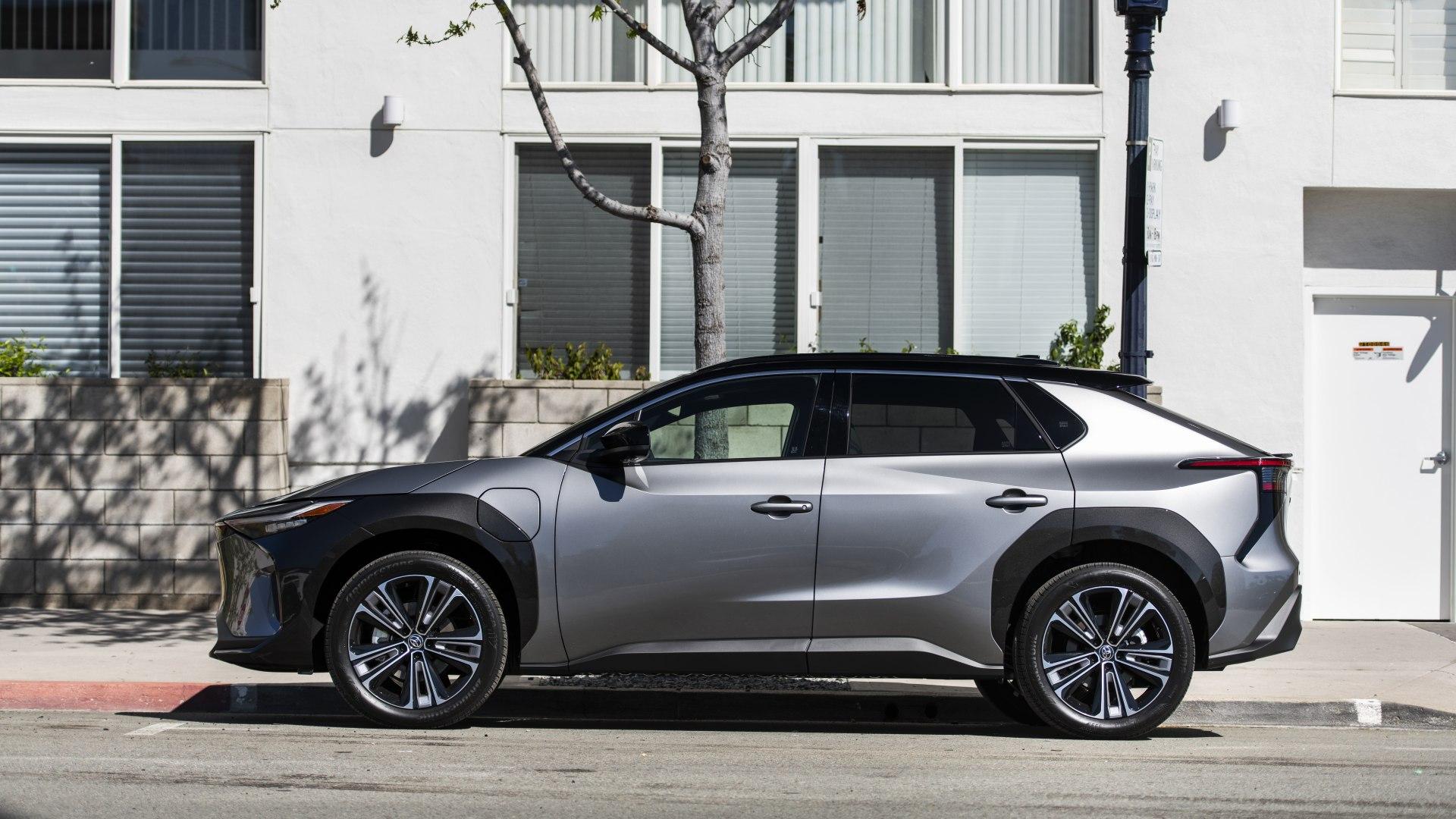
TOYOTA bZ4X 2023
Comfortable and versatile, but with modest range and power; Toyota's conservatism is evident.
Pros and cons
Pros
- Comfortable ride
- Secure handling
- Roomy cabin and trunk
- High ground clearance
- Pleasant driving position
- Battery heater is standard
Cons
- No rear wiper
- Steering wheel hides gauges
- Average driving range
- Disappointing one-pedal driving
- Certain controls are complex
- Noisy ride
Overview
We’ve been waiting a long time for Toyota’s first 100% electric vehicle (EV). Called bZ4X, it is presented as a RAV4-sized compact crossover. It launches a dedicated electric-vehicle version of the automaker’s global platform, with an optional all-wheel-drive system designed in collaboration with Subaru—which will have its own version, the Solterra. The two models arrive just in time to challenge the Ford Mustang Mach-E, Hyundai IONIQ 5, Kia EV6 and Nissan Ariya in a fast-growing segment.
Like most of its competitors, Toyota set the starting price of its electric SUV just under $45,000, before destination charges. Until April 24, that was the maximum starting price to qualify for the $5,000 federal subvention for all-electric models. Since then, Transports Canada has raised the ceiling to $55,000 for cars and $60,000 for SUVs, pickups and minivans. Let’s hope it won’t prompt automakers to inflate their prices too drastically…
The base L version comes standard with a heat pump, which is practically indispensable to ensure decent cabin and battery heating in the dead of winter. It costs $5,000 more to get heated seats and steering wheel, a power liftgate and blind-spot monitoring, all included on the LE version. For another $5,000 the XLE adds all-wheel drive, a fixed panoramic roof and sundry accessories. Topping the lineup the XLE with Technology Package notably brings faux leather seats (ventilated in front), a JBL sound system, 20-inch wheels and a smartphone-programmable digital key. That boosts the price of the bZ4X to close to $65,000, including destination fees.
Toyota assembles its new EV in Japan.
Verdict
Spacious, versatile and comfortable, the Toyota bZ4X does everything expected of a compact crossover. If Toyota has applied the same rigorous standards as to its numerous hybrid models, it should also deliver standout reliability. However, the automaker’s habitual conservatism is evidenced by the bZ4X’s decidedly ordinary driving range and power. Taking that long to join the EV fray, Toyota could have raised the bar a bit.
Evaluation
Body and cabin
With its chiseled lines and numerous gloss-black trim bits, Toyota’s designers made sure the bZ4X does not go unnoticed. The rather busy body design hides the proportions of a compact crossover: the Toyota bZ4X is 6 cm lower than the RAV4, but 9 cm longer and with 16 cm more wheelbase. Also noteworthy, its 20.6 cm ground clearance is almost identical to the RAV4’s. In this respect the bZ4X should handle banked snow and poor gravel roads better than the Hyundai IONIQ 5, which is 5 cm closer to the ground.
However, the IONIQ 5 takes the lead in terms of legroom thanks to its 300‑cm wheelbase—15 cm longer than the bZ4X’s. The IONIQ 5 cabin also has a more open feel thanks to its superior glass surface. But both models share the same lack of a rear wiper. Toyota says that the shape of the liftgate will keep it clean, but based on our winter experience with the IONIQ 5, we have our doubts.
Despite the specifications, the bZ4X has the upper hand for height, versatility and usable space in the luggage compartment. It also seats the driver higher than the IONIQ 5, which may be more to the liking of compact SUV fans. Though not particularly body-hugging, the front seats offer a nice combination of comfort and support. Overall, the Japanese model provides ample room for a family on a daily basis and on vacation trips.
A vaguely hexagonal-shaped pod situated far in front of the driver contains a digital gauge cluster. Information is well laid out but half hidden by the rim of the steering wheel, no matter how it and the seat are positioned. Like several other auto journalists at the launch of the bZ4X, we cannot fathom how Toyota could make such a blunder.
The new 12.3‑inch centre touch screen is much more modern and responsive than Toyota’s former interface, but its menus and structure complicate ordinary interactions such as selecting the audio source. The lack of volume and tuning knobs and the use of touch buttons for several comfort features require taking one’s eyes off the road even more. Certain automakers also do a better job of integrating Android Auto/Apple CarPlay with the basic functions of their own systems.
Safety
True to form, Toyota delivers all versions of the bZ4X with the usual driver assistance features. Unfortunately, blind-spot monitoring and cross-traffic alert are excluded on the base L model. Only XLE models come with parking sensors and automatic reverse emergency braking, and surround-view cameras are restricted to the XLE with Technology Package. Even with all of these driving assistance technologies, driver vigilance is essential.
Crash test results
National Highway Traffic Safety Administration (NHTSA)
Overall score: 5 / 5
Frontal impact: 5/ 5
Side impact: 5 / 5
Rollover resistance: 4 / 5
Insurance Institute For Highway Safety (IIHS)
Moderate overlap frontal impact: 4 / 4
Small overlap frontal impact:
- driver side: 4 / 4
- passenger side: 4 / 4
Side impact: 4 / 4
Rear impact: Not tested
Roof strength: Not tested
Mechanical overview
Toyota’s TNGA platform has underpinned the vast majority of its transverse-engine models for more than five years. The Toyota bZ4X is the first to use a version specifically designed for 100‑percent electric vehicles. Called e-TNGA, this platform is notably distinctive for the structural integration of the high-voltage battery under the cabin.
The four-wheel independent suspension takes into account the bZ4X’s high battery weight and significantly lower centre of gravity relative to a RAV4. The brakes use ventilated rotors, front and rear, but probably won’t be called on much in normal driving.
As in all electric vehicles, the regenerative braking will handle a good part of that job. When the throttle is released, the rotation of the electric motors reverses which slows the vehicle and charges the battery. Regenerative braking can be augmented via a switch on the console, but with timid results; unlike the Ford Mustang Mach‑E or Nissan LEAF, the bZ4X is far from able to stop without depressing the brake pedal.
It is further evidence of Toyota’s cautious approach, which also is apparent in the driving range of its first electric model. A motor powers the front wheels of two-wheel-drive models, which promise a driving range of 406 km in ideal conditions. All-wheel-drive versions, which add a rear motor, have an estimated driving range of 367 km.
To be fair, that will meet the daily needs of a majority of motorists. Still, a long-range Hyundai IONIQ 5 is rated at 488 km with 2WD and 414 km with AWD. The Kia EV6 does even better, with ratings of 499 km and 441 km. Both use a 77.4 kWh battery, whereas the bZ4X’s is limited to 71.4 kWh (2WD) or 72.8 kWh (AWD). The Mustang Mach‑E and Volkswagen ID.4 are both more generous in this respect.
The bZ4X also fares less well in terms of power, with 201 horses and 196 pound-feet of torque (2WD) or 214 horses and 248 pound-feet (4WD). Moreover, Toyota lists no official towing capacity, whereas the four-wheel-drive IONIQ 5, EV6 and ID.4 can tow 907 kg (2,000 lb), 1,043 kg (2,300 lb) and 1,225 kg (2,700 lb), respectively.
On the other hand, all versions of the bZ4X come standard with a heat pump, which is glaringly absent on the base model IONIQ 5 and EV6. Toyota Canada totally understands the importance of this device to heat the battery and cabin and, by extension, to maximize driving range in a climate as rigorous as ours.
The four-wheel-drive bZ4X also stands apart for its Subaru-designed all-wheel-drive system. This system splits torque continuously between the four wheels, whereas competing systems generally power only one axle outside of specific conditions, such as slippery pavement or heavy acceleration.
According to information from Toyota, the continuous use of both axles should not unduly increase energy consumption. The bZ4X requires 20.5 kWh/100 km, which translates to 2.3 L/100 km. To be confirmed in real-life conditions, along with the charging time, which Toyota estimates at 11 hours for a full charge on a 240‑volt charger.
The automaker did not reveal the estimated time at a quick-charge station. However, we do know that the bZ4X can channel up to 150 kWh, rather than 350 kWh like a growing number of EVs. Toyota says it is to promote the durability of its Panasonic-designed battery. This battery comes with an 8‑year or 160,000‑km warranty, rather than 10 years or 240,000 km like the batteries of Toyota’s hybrid vehicles.
Driving impressions
We were among the very first automotive journalists to drive the bZ4X in North American this spring. Our test was conducted mostly on southern California boulevards and secondary highways, in bright, 15°C to 20°C weather.
It would be hard to find better conditions to showcase an EV. The two Toyota bZ4Xs we drove whittled down their range with parsimony, allowing us to cover even more distance than the consumed kilometers on the dash. It will take a test on our roads, in the depth of winter, to determine if the cold will reduce the range of the bZ4X to the same extent as its rivals.
Like all other EVs, the Toyota delivers its power instantaneously and in a linear fashion. Acceleration is silent and straightforward, though not as punchy as that of a Mustang Mach‑E or an all-wheel-drive IONIQ 5.
Both those models also provide a more engaging drive than the bZ4X, in large part because of their more communicative steering. The bZ4X’s steering is precise and relatively direct, but it transmits little road sensation. That, however, in no way affects the stability of the Toyota newcomer both at highway speed and in curves, thanks to its low centre of gravity and very rigid structure.
The few sections of degraded pavement we encountered presage a comfortable and well-controlled ride. Once again, it will take a test on our worn-down roads to confirm this first impression. Road noise, already noteworthy on California’s smooth expressways, likely will be worse on our road network.
Again, once back home, we will be able to verify the efficiency of the all-wheel drive, a new-style system for Subaru tuned in partnership with Toyota for both the bZ4X and Solterra.
Features and specs
Price range (including shipping and preparation) | ||
| Minimum price | $46,920 | |
|---|---|---|
| Maximum price | $69,680 | |
| Price as tested | N/A | |
| Trim levels | N/A | |
| Wheelbase | N/A | ||
|---|---|---|---|
| Length | N/A | ||
| Width | N/A | ||
| Height | N/A | ||
| Curb weight | N/A | ||
| Towing | Not recommended | ||