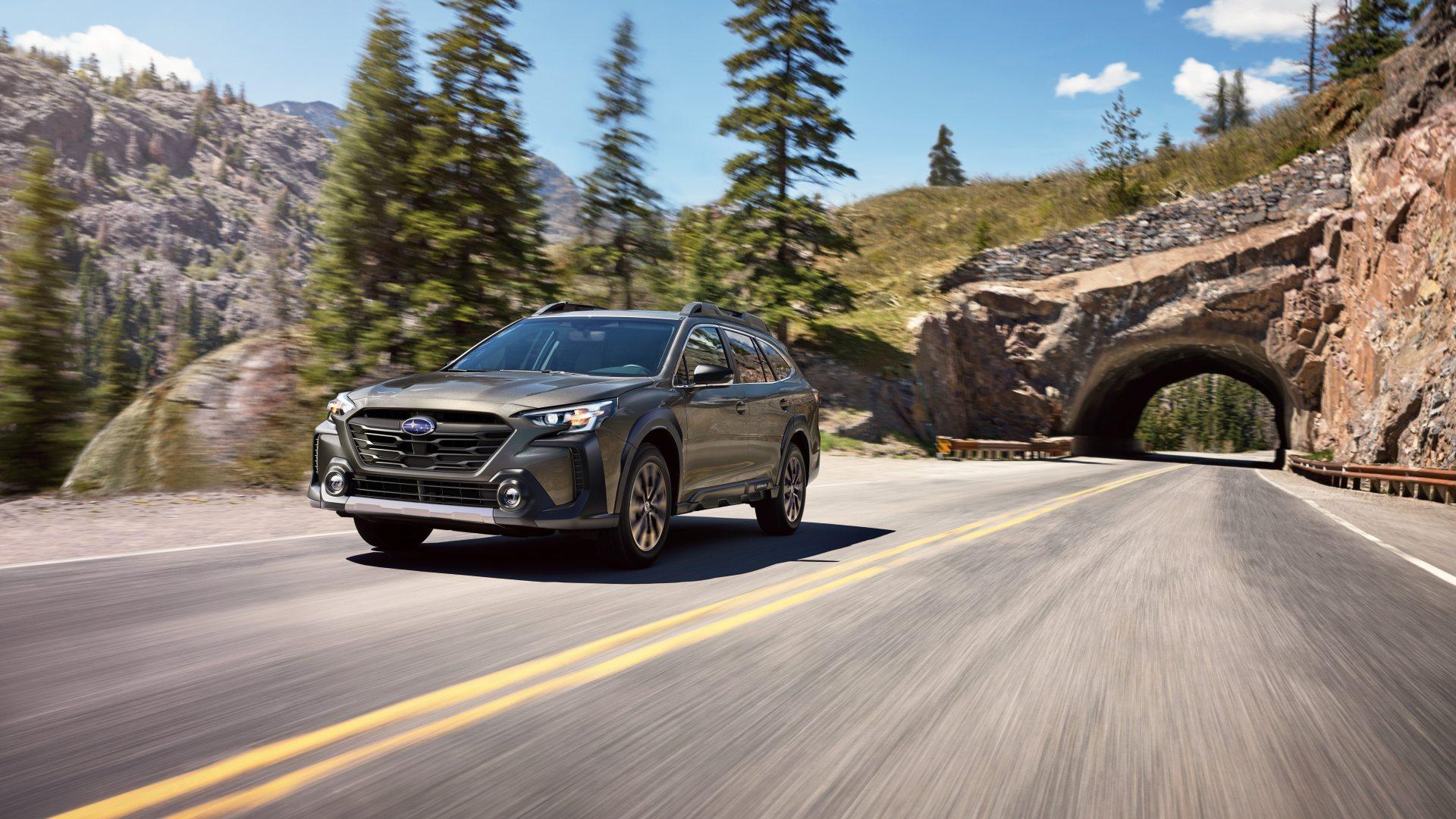
SUBARU Outback 2023
One of the last affordable station wagons on the market
Pros and cons
Pros
- Improved controls and centre screen
- Smooth ride
- Comfortable seats
- Assured safety
- Pleasant turbo engine
- Vast interior
Cons
- Base engine sometimes overworked and noisy
- Hard-to-modulate throttle
- Light steering
- Expensive turbo engine
- Scant storage
- Increasing prices
Overview
Three years after the launch of the sixth generation, the Subaru Outback introduces some noteworthy changes for 2023. Styling touch-ups are subtle, but driving assistance, the dashboard and all the technology in between have been thoroughly updated. A new Onyx variant slots between the Touring and Limited versions, as in the Ascent line-up. The powertrain still combines a horizontally opposed gasoline engine with a continuously variable transmission and full-time all-wheel drive.
The Subaru Outback is one of the last affordable station wagons on the market, if not THE last, with the demise of the Volkswagen Golf Sportwagen. If it has survived the SUV tsunami, it is partly because its high ground clearance, rugged wheel arch cladding and big roof rails help it pose as one. The recent Mazda CX-50 is its closest rival in terms of size and vocation, but Subaru Canada says that the Honda CR-V, Toyota RAV4 and Volkswagen Tiguan are also on the shopping list of potential Outback buyers.
Subaru took advantage of the partial remake to raise prices by $1,200 to $2,200, depending on the trim. Added to that is a $125 increase in destination charges, which reach close to $2,000. An entry-level Outback Convenience retails for $34,690, but most buyers will jump to the $38,990 Touring to get a power liftgate, alloy wheels and power sunroof. A Wilderness model now costs $45,190, the first of the series to offer the turbo engine. The Premier XT tops the line-up, at $48,390. Investigation shows that these prices remain quite competitive, especially for the base-engine models.
Subaru still assembles the Outback in Indiana for the North-American market.
Verdict
The 2023 Subaru Outback is another product of Subaru’s prudent evolutionary approach. It won’t astonish its admirers, but they will likely appreciate the improved convenience of the cabin, especially as concerns the centre screen controls. As comfortable, versatile and safe as ever, the big Subaru wagon scores power gains when equipped with the turbo engine, but it doesn’t come cheap. When can we expect a hybrid or even better, a plug-in, to fill the gap?
Evaluation
Body and cabin
You have to look closely to detect the styling changes, especially since Subaru concentrated them in the front. But compared to a 2022, the revised model does, indeed, have a more contemporary look.
As the name suggests, the new Onyx variant has distinctive black wheels, window trim and badging. It also displays a few unique cabin details, including seats upholstered in soft-touch vinyl with contrasting stitching. The Wilderness version has not changed one bit, since Subaru launched it barely a year ago.
At first glance the cabin seems identical to a 2020-to-2022 model. However, closer examination shows that the steering-wheel-mounted controls are more legible than before. The steering wheel is now heated on all the Outbacks, all the way around and not just on the sides.
The most notable changes are to the 11.6-inch centre touch screen that dominates the dash starting on the Touring model. The interface now displays permanent ‘buttons’ for the seat heaters, in addition to grouping the climate control functions more clearly together. Response times are quicker than before. Android Auto, Apple CarPlay and mobile device charging are now wireless, and USB-C and USB-A ports are both provided.
The resulting environment is more convenient and user-friendly compared to 2020 to 2022 models, though no storage is provided on the console, except for a phone and beverage holders. Additionally, concentrating infotainment, navigation, safety and climate control functions on a single screen too often requires taking one’s eyes off the road. Fortunately, there are some rotary knobs and physical buttons to facilitate basic operations.
In all other respects, the cabin is as pleasant as ever. First, for its relatively generous space for four tall adults, and next for finish, which has significantly improved over the years. The Outback also fulfills its utilitarian role well, thanks to a cargo area as wide as it is long. A twin mattress and box spring can fit in with the liftgate closed—as long as the front seats are not pushed back too far.
Safety
Subaru was one of the first automakers to equip most of its models with advanced safety technologies across the board. The 2023 Outback introduces the fourth generation of the EyeSight system, which still bases most of its driver assistance functions on a pair of cameras. This new version increases camera angle from 37 to 64 degrees, and adds a third, 100-degree-angle camera on the Premier XT model. This enlarges the zone of detection of vehicles, pedestrians and cyclists, especially at intersections.
Visibility is still a strong point of most Subarus, including the Outback. The designers always try to keep the roof pillars as slim as possible and to provide expansive side windows. The Premier XT model gets another exclusive feature, a rear-view mirror that displays images from a camera on the roof-mounted antenna. The resolution of the standard backup camera leaves much to be desired.
The Outback received top scores in collision tests conducted by the U.S. government and the Insurance Institute for Highway Safety. IIHS designates all versions a Top Safety Pick+.
Crash test results
National Highway Traffic Safety Administration (NHTSA)
Overall score: 5 / 5
Frontal impact: 5 / 5
Side impact: 5 / 5
Rollover resistance: 4 / 5
Insurance Institute For Highway Safety (IIHS)
Moderate overlap frontal impact: 4 / 4
Small overlap frontal impact:
- driver side: 4 / 4
- passenger side: 4 / 4
Side impact: 4 / 4
Rear impact: 4 / 4
Roof strength: 4 / 4
Top Safety Pick+
Mechanical overview
Subaru made absolutely no change to the mechanicals of its midsized station wagon for 2023. The Subaru Outback still uses the automaker’s global platform first introduced in 2017 in the compact Impreza.
Still featured are an independent double-wishbone rear suspension and full-time all-wheel drive. In other words, 60 percent of torque goes to the front wheels and 40 percent to the rear wheels in normal driving; this proportion can vary up to 50-50 when one or more tires lose grip.
All models offer an X-Mode system to improve traction in difficult low-speed conditions. The system includes a second specific setting for muddy or rutted roads on Onyx and Wilderness models, designed for a bit more adventure than the other Outbacks. Wilderness trims also come with higher ground clearance, all-terrain tires, a close-ratio rear differential and ‘off-road’ suspension tuning.
The Wilderness is also the starting trim with access to the optional engine, a 2.4-litre turbocharged four-cylinder in Subaru’s traditional horizontally opposed layout. Found also under the hood of the Limited XT and Premier XT, this engine delivers 260 horsepower and 277 pound-feet of torque, the latter fully available at 2000 rpm.
These ratings crush the 182 horses and 176 pound-feet of the naturally aspirated version. This 2.5 litre engine equips the lineup’s most popular models, headed by the Touring and Limited. Equipped with the same engine, the new Onyx could become 2023’s most popular Outback, at least if the big station wagon follows the example of the Ascent midsize SUV.
Both engines are paired with a continuously variable transmission with a manual mode comprised of eight simulated speeds. There is still no trace of electrification to be found in the Outback catalogue. Even though the arrival of the 100-percent electric Subaru Solterra is imminent, it is high time that the automaker extended hybridization to models other than the Crosstrek.
For the time being, Natural Resources Canada’s combined average fuel efficiency rating of 8.3 L/100 km at least seems competitive. The 9.5 L/100 km of the boosted engine are not bad either, but the 10.1 L/100 km rating of the ‘rugged’ Wilderness is moving dangerously close to six-cylinder territory.
Driving impressions
Subaru presented the 2023 Outback to Canadian journalists in the lake-and-cottage Muskoka region, two and a half hours north of Toronto. As might be expected, just a quick turn off a main road can lead to a narrow, twisty, hilly and sometimes unpaved byway. And it can be scattered with bumps, cracks, undulations and dips—yes, even in Ontario.
If the automaker was looking to demonstrate the comfort of the station wagon, it succeeded. The Outback’s supple ride remains one of its strong points, especially paired with the well-padded front seats. Good soundproofing underneath the vehicle reinforces the quietness of the cabin, even on gravel roads.
The steering is smooth but light enough to disconcert someone who has not driven an Outback in the past ten years. Turning and straight-line accuracy is good, but feedback is conspicuously absent. It is unfortunate: the improved handling and controlled body movements brought by the 2020 makeover would allow things to be spiced up a bit.
It is fascinating to see an automaker deliver vehicles as different as the docile Outback and edgy WRX using the same, or almost the same, mechanical components.
That includes the turbo engine in the Premier XT we drove during our day of testing. Sonorous and engaging in the WRX, it displays a tranquil forcefulness in the Outback. Except for the uneven throttle response at low speed—a familiar fault with Subaru—this engine powers the big station wagon effortlessly in all circumstances. It becomes vocal in hilly terrain and when passing, but its typically Boxer engine note does not become overwhelming.
The base engine is another story. It has to work hard to maintain the rhythm in steep climbs, which can be felt under the right foot and heard everywhere in the vehicle. It is neither dramatic nor unprecedented among the compact SUV competition, quite the contrary. But for anyone who often ventures out of town or off the highway, especially with a full load of passengers and luggage, the optional engine makes good sense. Unfortunately, Subaru restricts it to the most expensive or fanciest trims, which limits its reach.
Features and specs
Price range (including shipping and preparation) | ||
| Minimum price | $34,690 | |
|---|---|---|
| Maximum price | N/A | |
| Price as tested | N/A | |
| Trim levels | Convenience
Touring
Onyx
Limited
Wilderness
Limited XT
Premier XT | |
| Wheelbase | N/A | ||
|---|---|---|---|
| Length | N/A | ||
| Width | N/A | ||
| Height | N/A | ||
| Curb weight | N/A | ||
| Towing | Not recommended | ||