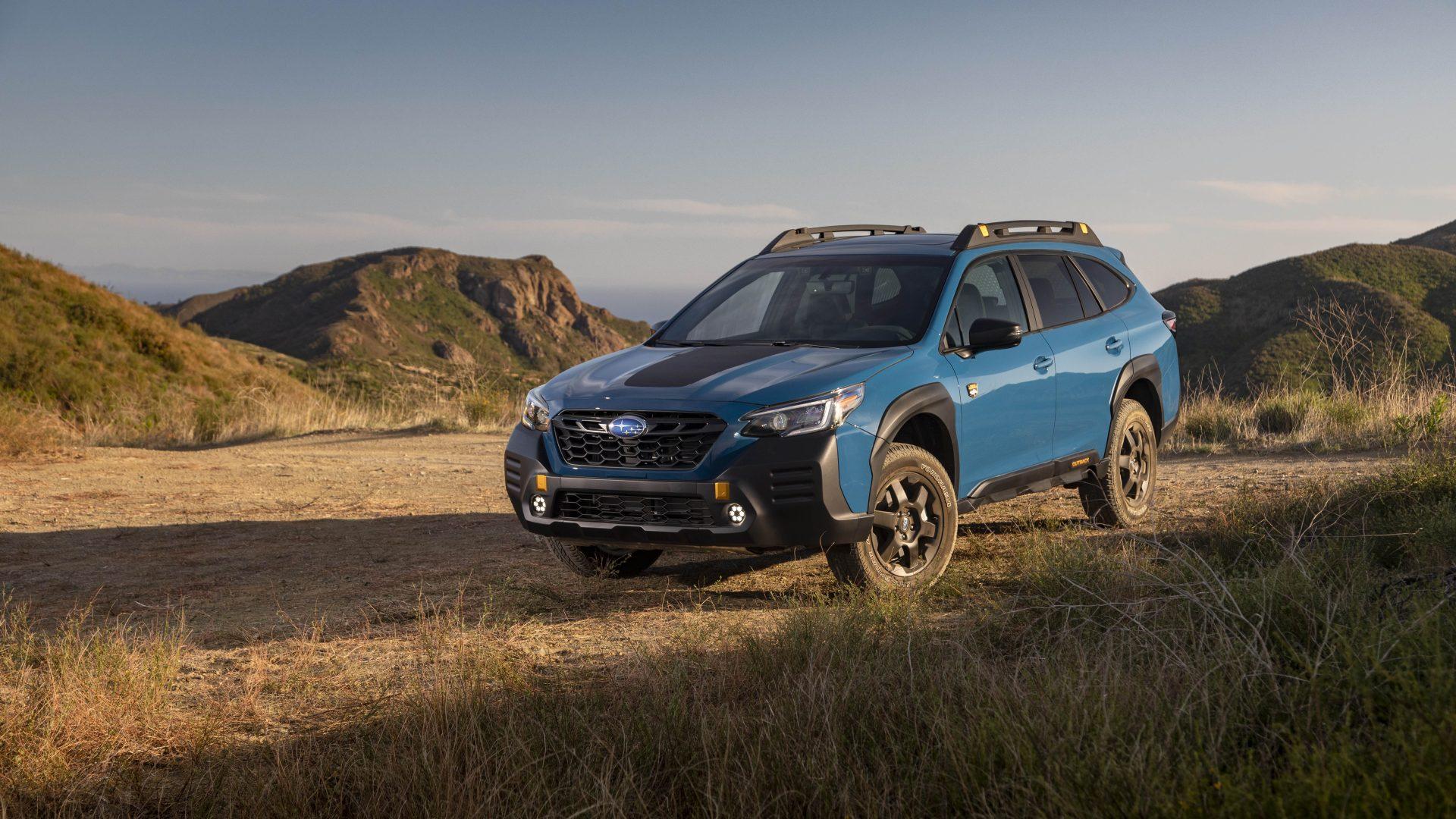
SUBARU Outback 2022
The Outback is stepping into the spotlight as a compelling alternative to the SUVs that are currently in high demand.
Pros and cons
Pros
- Very comfortable ride and seats
- Improved handling
- Powerful turbo engine
- Roomy cabin and trunk
- Benchmark all-wheel drive
- Good equipment-to-price ratio
Cons
- Low-beam glare
- Non-linear acceleration
- Engines still noisy
- Slow and complex touch screen
- High fuel-consumption (turbo engine)
- Reliability still to be confirmed
Overview
Two years on from its last redesign, the Outback becomes the first Subaru to offer a Wilderness version. The new variant is set apart mainly by heightened ground clearance, a perfected off-road drive mode, off-road suspension and tires, and a “rugged” visual treatment. Replacing the Subaru Outback Outdoor XT, the Wilderness uses the turbo engine that powers the higher-end models of this raised station wagon lineup. As always, all Outbacks come equipped with Subaru’s signature full-time all-wheel drive and boxer engine, still gasoline only.
All crossovers on the market today use a unibody platform rather than a truck body-on-frame. In the case of the Outback, the filiation with the mid-sized Legacy is still as obvious as when the model was launched in 1995. Though likened because of its dimensions and five-passenger capacity to vehicles like the Chevrolet Blazer, Ford Edge, Honda Passport and Hyundai Santa Fe, the Outback has always remained faithful to its tall wagon formula. As such, it is an alternative to models like the Audi A4 Allroad, Mercedes-Benz E 450 and Volvo V60 Cross Country.
The Subaru does not have the prestige of those noble Europeans but neither does it have the same stiff price tag. Even at $33,070 (including destination charges), the Outback Convenience is priced lower than all of the competitors mentioned above. Expect to pay $10,800 more for the Wilderness model, the first of the line-up that offers the turbocharged engine. The latter is a $2,800 option on Limited and Premier models.
Subaru assembles the Outback in Lafayette, Indiana, at the same factory as the Ascent, Impreza and Legacy.
Verdict
Subaru Outbacks in general and the Wilderness in particular offer genuine off-road capability. However, the overwhelming majority of buyers won’t be driving it off the pavement. They will reconnect with the comfort, practicality and secure handling that anchor the reputation of the series, enhanced since 2020 with a zest of enjoyment on twisty roads. However, they will have to accept an annoying infotainment interface, while hoping that engine reliability will continue to improve.
Evaluation
Body, cabin and cargo space
The size of the Subaru Outback brings it closer to a mid-size than a compact SUV in all but height. Excluding the big roof rails, height is actually less than for a compact SUV. The same goes for the Wilderness version, which finishes 2 cm higher than the other Outbacks.
That doesn’t stop the cabin from providing ample space for four tall adults. Rear legroom is particularly impressive, thanks to the long body and the absence of a third row of seats. That also contributes to the generous size of the trunk, notable for its long floor, with seatbacks up or down. Subaru specifications indicate maximum volume is superior to that of the Ascent, which is 13 cm longer than the Outback.
All Outbacks except the Convenience model are delivered with a very practical rubber cargo tray to keep items in place and protect the carpeting. Even the base model gets a cargo cover and a 12-volt outlet, like the other models.
True to another Subaru tradition, the front seats combine generous padding and unfailing support on long trips. The power-adjustable driver’s seat includes lumbar adjustment. The slightly elevated driving position got a thumb’s up from our team of testers of various builds. The rear bench is relatively firm, yet supportive, with reclining seatbacks. The outboard positions are heated, except on Convenience and Touring trims. However, the latter have the same heated front seats and steering wheel as the other Outbacks.
Certain controls such as the traditional gearshift lever are brilliantly simple, but that does not include audio, navigation or even the ventilation systems. They all occupy the same 11.6‑inch vertical touch screen, whose striking appearance does not excuse its complexity. Several functions require multiple touches on different parts of the screen, for example to switch on the seat heaters. Its slow response time does nothing to help. The dual-screen infotainment system on the Convenience is a bit less modern but easier to use.
Other highlights
Equipment: the Convenience version costs $4,200 less than the Touring, but it forfeits several common features such as push-button start, dual-zone climate control, sunroof, power hatch and alloy wheels. The other trims are well equipped for the price.
Instrumentation: the main dials are traditional and legible. The trip computer displays certain information on the upper part of the touch screen instead of opposite the driver, which causes confusion.
Safety features
- Antilock brakes with electronic brake force distribution and brake assist
- Stability and traction control
- Hill start assist
- Hill descent control
- Front airbags
- Driver knee airbags
- Front side airbags
- Side curtain airbags
- Passenger seat cushion mounted airbag (to prevent slipping from under seatbelt in a frontal collision)
- Pretensioners on front and rear outboard seatbelts
- Five adjustable head restraints (with whiplash prevention in front)
- Rear passenger reminder
- Rearview camera with lens washer
- Front camera (standard, Wilderness, Premier and Premier XT; unavailable, other versions)
- Forward collision warning
- Automatic forward emergency braking
- Automatic post-collision braking
- Lane departure warning with automatic steering assist
- Lane centering assist
- Automatic high-beams
- Adaptive cruise control
- Blind-spot monitoring, rear cross traffic warning and reverse automatic emergency braking (standard, Touring, Limited, Premier, Wilderness, Limited XT and Premier XT; unavailable, Convenience)
Crash test results
National Highway Traffic Safety Administration (NHTSA)
Overall score: 5 / 5
Frontal impact: 5 / 5
Side impact: 5 / 5
Rollover resistance: 4 / 5
Insurance Institute For Highway Safety (IIHS)
Moderate overlap frontal impact: 4 / 4
Small overlap frontal impact:
- driver side: 4 / 4
- passenger side: 4 / 4
Side impact: 4 / 4
Rear impact: 4 / 4
Roof strength: 4 / 4
IIHS Top Safety Pick+
Visibility
Very good for a raised car thanks to relatively thin roof pillars and tall side windows. Well-sized outside mirrors. Absence of blind-spot monitoring on Convenience trim is disappointing for a vehicle of this category.
Headlights: the standard pivoting LED projectors earned top score from the Insurance Institute for Highway Safety. Though IIHS did not note low-beam glare, headlight flashes from other drivers when we drove at night attested to the contrary. One CAA-Quebec tester who owns a 2020 Outback reported similar experiences.
Mechanical overview
Like all Subarus except the BRZ, the Outback uses the automaker’s global platform. The fully independent suspension is notable for its rear double-wishbone setup, which is rarely seen. Power steering assistance is speed variable.
The entire Subaru Outback series is equipped with the X‑Mode traction management system. It acts on the throttle and the traction control system to facilitate off-road driving, and automatically activates hill descent control. Wilderness models include an upgraded version of the system as well as a protective skid plate under the engine, a more robust suspension, all-terrain tires and an extra centimetre of ground clearance (for an impressive total of 23 cm).
Convenience, Touring, Limited and Premier models are powered by Subaru’s perpetual 2.5-litre flat-four engine. The latest iteration includes direct injection and, according to the automaker, internal updates to improve reliability. Oil consumption and reliability are still a concern, given the engine’s unequal track record.
Wilderness, Limited XT and Premier XT versions get a 2.4-litre turbo engine. Turbocharging adds 78 hp and 101 lb-ft of torque relative to the base engine for a net result of 260 hp and 277 lb-ft.
Both engines are mated to a continuously variable automatic transmission designed by Subaru, and not by an independent supplier. It simulates eight gears in manual mode or during heavier acceleration.
Towing capacity is rated at 1,225 kg/2,700 lb with the 2.5‑litre engine, which is higher than average for a four-cylinder of that power. It climbs to 1,588 kg/3,500 lb for the turbocharged engine, whereas V6-equipped competitors can generally tow 2,268 kg/5,000 lb.
The other major difference between the two engines is their gasoline consumption. According to Natural Resources Canada, the turbo engine requires 9.1 L/100 km on average, or 1 L/100 km more than the base four-cylinder. Because of shorter ratios for the rear differential and transmission, the Wilderness is officially rated at 10 L/100 km. We measured 11.4 L/100 km, three-quarters on the highway, at the beginning of the cold season. Numerous larger and more powerful crossovers have done better in our tests over the years.
Driving impressions
It is something of a mantra, at each renewal of the Outback, for Subaru to promise having reduced cornering lean by 20, 30 or even 40 percent. Then we test the car and note that it still largely tuned towards comfort—or in other words, it still leans a lot in turns.
Admittedly, with respect to the present generation, those claims are not just empty words. The Subaru Outback finally proves more able to attack a series of sharp curves, more stable in a sweeping highway entrance, and more precise when changing directions. In other words, it drives more like a car instead of a heavy SUV.
That came as a surprise, especially since we drove a Wilderness version, which is higher, less aerodynamic and more softly tuned than the others. We also found the steering to be more precise on centre than before, which improves straight-line tracking and reduces small steering corrections on the highway.
Subaru therefore has successfully improved the dynamics of its large station wagon without stiffening the ride. The Outback still isolates the occupants from pavement defects as well as before, with good control of body movements on a series of small bumps.
The turbo engine is well matched to the car thanks to its robust low-end torque. It is also capable of solid performance when the time comes to merge onto a busy highway, for example. However, it can seem lethargic in urban driving, because the transmission reduces engine speed too quickly after the initial push on the accelerator. Several of our testers found this uneven throttle response annoying. Some were also bothered by the noise of the flat-four engine, while others appreciated its distinctive sound.
All, however, applauded the efficiency of the all-wheel-drive system. As it is always engaged, usually in a 60 percent front/40 percent rear proportion, there is none of the brusque transfer of power sometimes felt with the part-time systems used by the competition.
Well-soundproofed for road noise, the Outback makes more sense than ever as an alternative to the SUVs that rule our world today.
Other highlights
Braking: firmer pedal than before. Good power. Antilock braking system controls any hint of skidding.
Driver assistance: adaptive cruise control one of today’s most progressive. Lane-departure system quite sensitive but with smooth corrective steering. Lane-keeping system is adequate, with little ping-pong effect between lane markings.
Features and specs
Price range (including shipping and preparation) | ||
| Minimum price | $33,070 | |
|---|---|---|
| Maximum price | N/A | |
| Price as tested | $43,870 | |
| Trim levels | Convenience
Touring
Limited
Premier
Wilderness
Limited XT
Premier XT | |
Chevrolet Blazer | ||
Ford Edge | ||
Honda Passport | ||
Hyundai Santa Fe | ||
Jeep Grand Cherokee | ||
Nissan Murano | ||
Toyota Venza | ||
Volkswagen Atlas Cross Sport |
| Engine, horsepower and torque | 2.4L turbo, direct injection horizontally opposed 4-cyl.; 260 hp at 5,600 rpm; 277 lb-ft from 2,000 to 4,800 rpm
2.5L direct injection horizontally opposed 4-cyl.; 182 hp at 5,800 rpm; 176 lb-ft at 4,400 rpm |
|---|---|
| Transmission | Continuously variable automatic with manual mode |
| Front suspension | Independent with MacPherson struts |
| Rear suspension | Independent double wishbone |
| Front brakes | Ventilated disc |
| Rear brakes | Ventilated disc |
| Tires | 225/65R17
225/60R18 |
| Wheelbase | 274.5 cm | ||
|---|---|---|---|
| Length | 486 cm | ||
| Width | 185.5 cm
189.5 cm (Wilderness) | ||
| Height | 168 cm
170 cm (Wilderness) | ||
| Curb weight | From 1,656 to 1,789 kg
1,789 kg | ||
| Towing capacity | 2.5L engine: 1,225 kg (2,700 lbs); 2.4L turbo engine: 1,588 kg (3,500 lbs) | ||
According to Natural Resources Canada | ||
| City | 10.9 L/100 km (Wilderness) | |
|---|---|---|
| Highway | 8.9 L/100 km (Wilderness) | |
As measured by CAA-Québec | ||
| City | 11.4 L/100 km (Wilderness) | |
| Highway | N/A | |
| CO2 emissions | 4,700 kg/20,000 km (Wilderness) | |
| Fuel tank | 70 litres | |
| Recommended fuel | Regular-grade gasoline | |
| 0-100 km/h | Not tested |
|---|---|
| 60-100 km/h | Not tested |