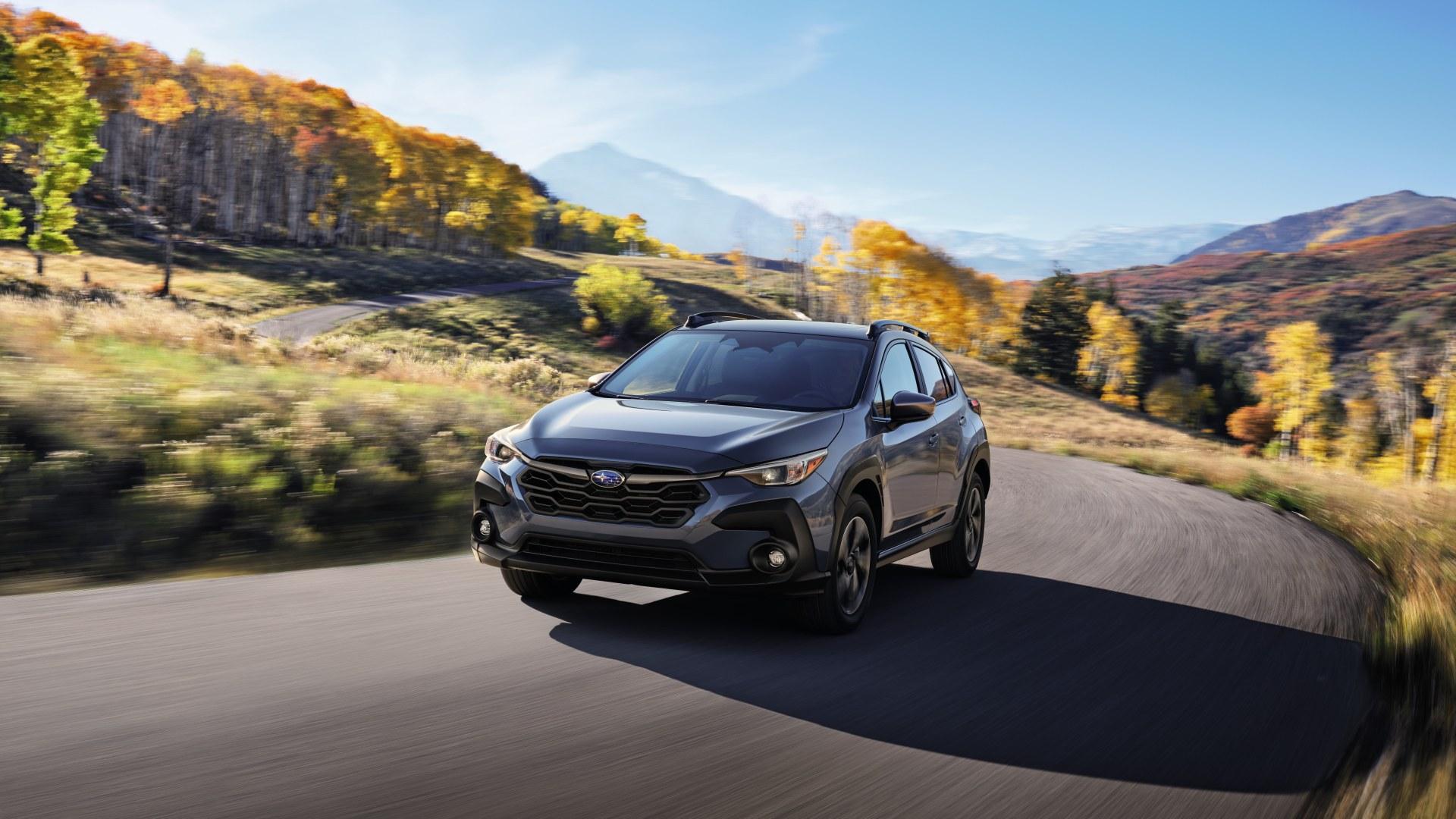
SUBARU Crosstrek 2024
Why change a winning formula?
Pros and cons
Pros
- Efficient all-wheel drive
- Supple ride
- Well-adapted 2.5-litre engine
- Reasonable fuel consumption
- Comfortable seats
- Spacious interior
Cons
- Imprecise on-centre steering
- Complexity of certain controls
- Lean in turns
- Prices on the rise
- Reliability to be ascertained
Overview
The Subaru Crosstrek launches into model-year 2024 with a restyled exterior. Subaru is talking third generation even though the mechanicals and platform of its best-selling Canadian model have undergone only minor changes. Still closely related to the compact Impreza, also renewed, the brand’s smallest crossover advances mostly in terms of technology and safety. An Onyx version replaces the Outdoor and it now shares its 2.5-litre engine with the Limited. Both the manual transmission and the plug-in hybrid variant have been retired.
The discontinuation of the manual raises the starting price by $2,200. To that is added another $2,020 for the automatic model, which bumps up the sticker price of a base Crosstrek to $31,190. Result: a monthly payment of $506, including taxes, for a four-year lease with no down payment. Three years ago, that’s what you paid for an Outback… all typical of soaring prices throughout the industry.
All Subaru Crosstreks offered in Canada arrive from Japan, whereas 2.5-litre models sold in the United States are made in Indiana.
Verdict
Why change a winning formula? That’s probably what Subaru repeats each time a vehicle comes up for renewal. The 2024 Crosstrek maintains the practical size, sturdiness and secure drive that have built its renown, along with a newfound level of serenity. However, as on other recent Subaru models the all-inclusive centre screen represents a setback in terms of ergonomics, and imprecise straight-line tracking becomes annoying on long trips. Despite all, the Crosstrek remains one of the most appealing small SUVs, provided reliability does not become an issue.
Evaluation
Body, cabin and cargo space
Some manufacturers start with a clean sheet when they redesign a vehicle, at the risk of upsetting the faithful. Not Subaru: nearly all their products resemble one another, not only from one series to another but from one generation to the next. The 2024 Subaru Crosstrek reproduces nearly all the dimensions of its predecessor.
That includes both the body and the cabin, apart from a few centimetres less width for the rear occupants. You find the same relatively vast environment for a so-called subcompact, with enough room for four average-sized adults. However, the combination of the sunroof and the arched roof limits headroom in the back.
The roof curves down to a slanted liftgate that complicates loading tall items when the rear seatbacks are up. The relatively high trunk floor, common to several Subarus, produces a similar difficulty. Cargo volume is reduced slightly in the 2024 model, but it remains in the top third for the segment. People who want more will have to turn to a Toyota Corolla Cross or Volkswagen Taos.
The front seats combine lasting support and generous padding and received a thumbs up for comfort from our group of four testers of very different sizes. They also appreciated the slightly raised driving position along with the simplicity of the main controls, starting with the conventional gearshift lever. However, the too-short centre armrest and the cupholder layout eventually become annoying on long trips.
But that’s nothing compared to the new 11.6-inch centre screen. Installed portrait-style, it contains not only radio and navigation functions but also several others related to driving and air conditioning. Even though Subaru touched up its menus in 2023, this interface remains more complex than the buttons, knobs and dedicated ventilation displays formerly provided. Android Auto and Apple CarPlay provide some relief, but it still takes a cable to connect a device in the Convenience model, which has only one USB port.
Safety features
Antilock brakes with electronic brakeforce distribution and brake assist
Brake override
Stability and traction control
Hill-start assist
Hill-descent assist
Front airbags
Driver knee airbag
Front side airbags
Side curtain airbags
Front seatbelt pretensioners
Five adjustable head restraints
Rear passenger reminder
Rearview camera
Tire pressure monitor
Forward collision alert
Forward automatic emergency braking
Lane departure alert with steering assist
Lane centering assist
Automatic high-beams
Adaptive cruise control
Blind-spot monitoring, rear cross-traffic alert and collision mitigation assist (standard, Touring, Onyx and Limited; unavailable, Convenience)
Reverse automatic emergency braking (standard, Onyx and Limited; unavailable, Convenience and Touring)
Driver distraction detection system (standard, Limited; unavailable, Convenience, Touring and Onyx)
Crash test results
National Highway Traffic Safety Administration (NHTSA)Overall score: 4 / 5
Frontal impact: 4 / 5
Side impact: 5 / 5
Rollover resistance: 4 / 5
Insurance Institute For Highway Safety (IIHS)
Moderate overlap frontal impact: 4 / 4
Small overlap frontal impact: 4 / 4
Side impact: 4 / 4
Rear impact: 4 / 4
Roof strength: Not tested
Visibility
Subaru always pays special attention to visibility. This redesigned Crosstrek is more proof, thanks to thin windshield and side pillars and big front windows. However, it does not escape the trend to wider rear pillars, a narrower liftgate window and tapered rear windows. The rearview camera and blind-spot monitoring compensate somewhat, but the latter feature is still absent on the base model.
Mechanical overview
The redesigned Subaru Crosstrek still uses Subaru’s global platform introduced on the 2017 Impreza, in a version claimed, as usual, to be lighter and stiffer than before. Overall, the 2024 model is only some 30kg heavier than its predecessor despite its enriched content. Suspensions are virtually unchanged, with the rear suspension maintaining its double wishbone design that is more advanced and relatively rare for the segment.
And not much new in terms of engines. The two most affordable models still arrive with a 2.0-litre flat-four engine that makes 152hp and 145lb-ft of torque, which corresponds to the standards of the category. Onyx and Limited are equipped with the same 2.5-litre engine as the Forester and Outback, good for 30hp and 33lb-ft more than the base engine.
Both engines send power to all four wheels via a continuously variable automatic transmission. It mimics gearshifts in moderate or heavy acceleration to keep the engine from revving at high rpm’s for too long. All versions except the Convenience provide a manual mode with eight preprogrammed speeds selected via steering wheel paddles.
As for most automatic Subarus, the full-time all-wheel drive sends a constant 60 percent of power to the front wheels and 40 percent to the rear. In case of loss of grip, distribution varies to favour the axle with the best traction.
While a handful of enthusiasts will be sad to see the manual transmission go, no one will really be surprised in view of diminishing sales. But in an era of unbridled electrification, the disappearance of the plug-in Crosstrek hybrid is raising more eyebrows. However, this variant was no match for the competition, with just 27km of electric range and an $8,000-plus supplement relative to a gas-engine Limited model.
Nor did it really improve fuel consumption, at least on the highway. The gasoline Crosstrek does fairly well in this respect, at least for its segment. We recorded an average of 7.6L/100km in mostly highway driving, compared to Natural Resources Canada's official highway rating of 7.2L/100km. The fuel efficiency of the two engines is essentially the same, at least on paper.
Driving impressions
If you could drive with your eyes closed, it would no doubt be very hard to distinguish a 2024 Crosstrek from its predecessor. The redesigned version feels very familiar to anyone who has driven a recent Subaru, beginning with initial acceleration that is almost too sharp. The pedal is still a bit hyperactive despite the fact that Subaru has smoothed it out a bit.
It did the same with the automatic stop-start system, but the engine continues to start back up with a jerk that is annoying enough to want to shut off the system.
Once underway, our test vehicle’s 2.5-litre four-cylinder did its job with brio. Overburdened by the weight of an Outback and barely adequate under the hood of a Forester, this engine fits the Crosstrek to a tee.
The continuously variable transmission manages power well and responds promptly to throttle input. The simulated gearshifts can be jerky in heavy acceleration but are smooth in city driving and at highway speeds.
The improved sound insulation contributes to the serenity of the cabin, along with the more supple suspension tuning. The Crosstrek is now much closer in terms of comfort to the brand’s other crossovers, whereas before, it felt much more entry-level.
The flipside is that despite its smaller size, the Crosstrek is little more agile than its larger siblings. Body lean is considerable in turns, and the steering is too light to transmit good road feel. The steering is also vague on-centre and requires constant corrections at highway speeds.
Ultimately, none of that detracts from the secure handling backed by excellent all-wheel drive, in both enthusiastic driving or on slippery surfaces. The solid feel for which Subaru is known also remains intact. That’s all many motorists will ask from a pseudo-SUV.
Other highlights
Braking: firmer pedal than before, with just enough bite and easy to modulate. Straight panic stops, but not particularly short, for a vehicle of this size.
Driving assistance: the adaptive cruise control does not slow too quickly on approaching another vehicle, but it delays reacceleration somewhat when the way is clear. You can switch to conventional cruise control by pressing and holding one or other of the distance setting buttons. Lane departure alert is well tuned. Lane centering system is linear enough to be tolerable.
Features and specs
Price range (including shipping and preparation) | ||
| Minimum price | $31,190 | |
|---|---|---|
| Maximum price | N/A | |
| Price as tested | $36,190 | |
| Trim levels | Convenience
Touring
Onyx
Limited | |
| Engine, horsepower and torque | 4 cyl. à plat de 2L; 152ch à 6000tr/min; 145lb-pi à 4000tr/min
4 cyl. à plat de 2,5L; 182ch à 5800tr/min; 178 lb-pi à 3700tr/min |
|---|---|
| Transmission | Automatique à variation continue
Automatique à variation continue, mode manuel |
| Front suspension | Indépendante, jambes de force |
| Rear suspension | Indépendante, double levier triangulé |
| Front brakes | Disque ventilé |
| Rear brakes | Disque ventilé |
| Tires | 225/60R17
225/55R18 |
| Wheelbase | 267cm | ||
|---|---|---|---|
| Length | 448cm | ||
| Width | 180cm | ||
| Height | 160cm | ||
| Curb weight | De 1486 à 1518kg
1511kg | ||
| Towing capacity | 680kg (1500lb) | ||
According to Natural Resources Canada | ||
| City | 8,9L/100km (moteur de 2,5L) | |
|---|---|---|
| Highway | 7,2L/100km (moteur de 2,5L) | |
As measured by CAA-Québec | ||
| City | 7,6L/100km | |
| Highway | N/A | |
| CO2 emissions | Non communiqué | |
| Fuel tank | 63 litres | |
| Recommended fuel | Ordinaire | |