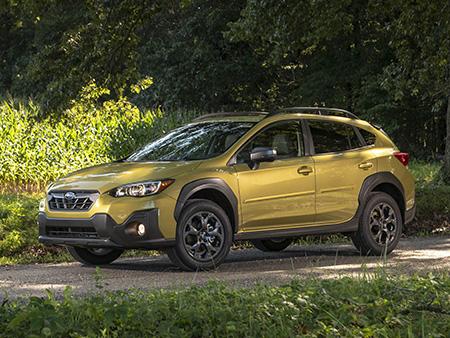
SUBARU Crosstrek 2021
Thirty more horsepower doesn't change the world, but…
Pros and cons
Pros
- Well-adapted 2.5-litre engine
- Comfortable ride
- Benchmark all-wheel drive
- Spacious interior
- Excellent visibility
Cons
- Vague steering at centre
- Uninspiring drive
- Engine noise (2.0-litre)
- Unproven reliability
Overview
The Crosstrek is one of Subaru’s most popular models, but the 2.0-litre engine is often faulted for just-adequate power. To silence the critics, this year the automaker is installing a 2.5-litre four-cylinder under the hood of the Limited version. It is offered only with an automatic transmission, and it also powers the new midlevel Outdoor trim model. All Subaru Crosstreks also receive minor styling and equipment updates.
The Subaru Crosstrek Outdoor sells for $31,795, which is $4,200 more than an automatic base model, or $1,800 more than the Touring automatic, to which Outdoor trim mostly adds the 2.5-litre engine, an 8 inch touch screen (instead of the 6.5), blind-spot monitoring and a front camera. The Outdoor also is distinctive for its yellow and dark grey trim accents and wide wheel-well moldings.
The lineup still features a plug-in hybrid version. It pairs Toyota’s hybrid technology with Subaru’s mechanical all-wheel drive. The 8.8 kWh battery had to be placed under the floor of the trunk because of the driveshaft, which significantly reduces trunk volume. Natural Resources Canada estimates an all-electric range of 27 km; when the battery is depleted, fuel economy is expected to be 16 percent inferior to that of a non-plug-in Limited model.
Subaru manufactures the Crosstrek in Japan, whereas the closely related Impreza is built in Indiana for North American markets.
Verdict
The 2021 Subaru Crosstrek's 2.5-litre four-cylinder is significantly quieter and more responsive than the base engine, without really consuming more fuel. It is well suited to a solid and safe vehicle that is impressively versatile, for its size. Access to this engine alone is worth the $25 per month difference between the Outdoor and Touring models. Durability is a remaining question mark, but Subaru finally seems to have found a solution to the problem; the future will tell.
Evaluation
Body, cabin and cargo space
A Subaru Crosstrek is a raised Subaru Impreza hatchback, trimmed to look more rugged. And an Impreza is a compact car, whereas most of the Crosstrek’s rivals are subcompact-based.It shows in the interior: the Crosstrek, with the Honda HR-V and Nissan Qashqai, is one of the rare vehicles of its category that can accommodate a small family without too much compromise. Even with a front seat pushed back, there is enough room behind for an average-sized person. The cabin is too narrow to seat three abreast in the back, but the rear seat is a far cry from the park-bench-type seats found in some other entry-level crossovers.
The trunk is longer and especially wider than usual for the category. It helps compensate for the relatively low load height below the windows, which is characteristic of most Subaru’s. All models come with a compact spare, which is becoming increasingly rare in the industry.
Another good Subaru feature, the front seats are snug and nicely padded without sacrificing support. However, their short bottom cushions provide poor thigh support for tall persons. The excellent driving position with just the right elevation is handicapped only by a rather short centre armrest.
Most driving functions are accessed via simple, traditional controls, including three large knobs for climate control and even a good old emergency brake lever. Hard buttons mounted on the steering wheel and ceiling allow access to driver-assistance functions without having to resort to the trip computer.
There are all of three screens, two in the centre and one between the gauges, for driving information and infotainment functions. However, the information is not always where you’d expect to find it and you sometimes have to search for the right sequence. Also, the touch screen on our test vehicle had a tendency to freeze up and occasionally made its own choices of music, bypassing ours. We experienced similar problems with other recently tested Subaru’s, an indication that the programming needs work.
Other highlights
Finish: superior-quality materials for the category. Pleasing design and contrasting and matching colours. Impeccable interior fit. Paint is uniform, but sometimes fragile. Bumper cover mounts vulnerable to minor impacts.
Convenience: audio system is an improvement over Subaru’s traditionally poor radios but sound is still somewhat lackluster. Android Auto, Apple CarPlay, USB port and alloy wheels are standard. You have to move up to Touring trim, which costs $2,400 more than the base model, to obtain everyday features such as welcome lighting, a luggage cover and, especially, heated seats.
Safety features
- Antilock brakes with electronic brake force distribution and brake assist
- Stability and traction control
- Hill start assist
- Hill descent control (automatic transmission only)
- Front airbags
- Driver knee airbags
- Front side airbags
- Side curtain airbags
- Front seatbelt pretensioners
- Five adjustable or folding head restraints
- Whiplash-reducing front seats (standard, Limited Plug-In Hybrid; unavailable, other models)
- Rearview camera
- Front camera (standard, Outdoor; unavailable, other models)
- Blind-spot monitoring and rear cross traffic alert (standard, Outdoor, Sport, Limited and Limited Plug-In Hybrid; unavailable, Convenience and Touring)
- Forward collision alert with automatic emergency braking and pedestrian detection, lane departure alert with automatic steering assist, lane centering system, adaptive cruise control, and rear-bench passenger alert (standard with automatic transmission; unavailable with manual)
- Automatic high-beams and automatic reverse emergency braking (standard, Sport with automatic transmission, Limited and Limited Plug-In Hybrid models; unavailable, other models)
Crash test results
National Highway Traffic Safety Administration (NHTSA)Overall score: 5 / 5
Frontal impact: 4 / 5
Side impact: 5 / 5
Rollover resistance: 4 / 5
Insurance Institute For Highway Safety (IIHS)
Moderate overlap frontal impact: 4 / 4
Small overlap frontal impact:
- driver side: 4 / 4
- passenger side: 4 / 4
Side impact: 4 / 4
Rear impact: 4 / 4
Roof strength: 4 / 4
IIHS Top Safety Pick
Visibility
Visibility is excellent, as with nearly all Subaru’s, because it is of utmost importance to the automaker. Expansive glass surface, relatively narrow roof pillars and big exterior mirrors are worthy of note. In this context, it is easier to forgive the absence of blind-spot monitoring on the two lowest trims.Headlights: the curve-adaptive LED projector headlights on Sport, Limited and Limited Plug-In Hybrid versions received a top rating from the Insurance Institute for Highway Safety, with limitations noted on left curves. Halogen headlights on the other models rated 1/4 because of just-adequate performance and excessive glare.
Mechanical overview
With the exception of the BRZ coupe, all Subaru’s use one version or another of the automaker’s global platform. The second-generation Subaru Crosstrek was one of the first to do so, a year after the Impreza. The two vehicles are closely linked mechanically, with the Crosstrek receiving a few added features to underscore its sport-ute affiliation.The X-Mode feature, for example, modifies the settings of the all-wheel drive, throttle and continuously variable transmission to enhance off-road driving performance. The Crosstrek also gets a very efficient hill descent control system, and its 22‑cm ground clearance is significantly higher than the overall average of the competition.
The double-wishbone rear suspension also is also relatively advanced, in a segment mostly dominated by simple torsion beams.
The full-time all-wheel drive system is another exclusivity among the subcompact SUV’s. On the manual-transmission models, torque is split equally between the two axles using a mechanical viscous-coupling centre differential. Automatic models are equipped with an electronic multi-plate transfer clutch system that transmits 60 percent of power to the front in normal driving. The front-to-rear torque split can vary up to 50-50 in case of loss of grip.
However, the big news on the mechanical front is the arrival of a 2.5-litre engine on the Limited and the new Outdoor model. It is the same four-cylinder Boxer engine used for years on the Forester, Legacy and Outback. Launched in 2019, the latest evolution includes direct injection and modifications to internal components designed to put a stop to excessive oil consumption.
The 2.5‑litre outputs 182 horsepower and 176 pound-feet of torque, respectively 30 and 31 more than the 2.0‑litre base engine. The 2.0-litre is the only engine listed for Convenience, Touring and Sport versions.
Those models still come standard with a six-speed manual gearbox. That makes the Crosstrek one of the last three-pedal four-wheel-drive crossovers sold in Canada. If you’re a fan, get one now while the option is still listed.
You will, however, have to pass on the EyeSight package. It includes most of Subaru’s driving assistance systems and is available only with the continuously variable transmission. It is a questionable decision by Subaru, since several automakers include such equipment on their manual models. But it won’t make much difference to the majority of buyers, who will be opting for the CVT automatic. Standard with the 2.5-litre engine, it offers a manual mode with eight simulated speeds on all but the Convenience model.
CVT models also deliver the best fuel economy, according to Natural Resources Canada, with a combined city/highway average of 7.8 L/100 km. The manual gearbox increases that to 9.4 L/100 km. It is interesting to note that the larger engine consumes only 0.2 L/100 km more gas than the 2.0‑litre automatic. Our springtime test delivered a real-life result of 9.3 L/100 km, which is marginally better than a 2018 Outback tested in the same conditions.
Driving impressions
To paraphrase an old Loto-Quebec slogan, 30 horses won’t change the world, but… it changes a Crosstrek! The added power of the 2.5-litre engine is especially felt when you merge onto the highway or pass on a two-lane road. The new engine makes such manoeuvres easy, whereas the 2.0‑litre requires more serious pre-planning.The interior sound level is reduced, simply because the larger engine does not have to work as hard. It is really worth considering for people who regularly drive on a variety of roads. Still, the base engine is fine for city and suburban because of sufficient low-end torque and lively throttle action.
The continuously variable transmission serves both engines well in normal driving, responding promptly to throttle inputs. It mimics the functioning of a traditional automatic in heavy or moderate acceleration, avoiding overly long and noisy high revs. However, the simulated shifts can be jerky at times.
Road comportment is resolutely comfort oriented thanks to the relatively compliant suspension tuning. The very rigid structure provides an uncommonly solid and stable feel, for the category. It also ensures secure cornering, helped by the excellent full-time all-wheel drive system.
But contrary to Subaru’s claims with each renewed edition, body lean is still too pronounced in sharp curves. The steering isolates the driver from the road and displays vagueness at centre that requires frequent corrections at highway speed.
Without generating much passion, Subaru’s overall approach delivers a more tranquil, mature and conciliatory driving experience than the majority of other subcompact SUV’s.
Other highlights
Braking: pedal is now relatively firm with good bite, rather than spongy, compared to the former generation. Larger brake rotors than most of the Impreza’s to offset the extra weight of the Crosstrek. Short, straight stops.
Soundproofing: ride noise is audible but much better filtered than in the 2013-2017 models. 2.0-liter engine is noisy during acceleration. Wind whistle is well controlled.
Driving assistance: the adaptive cruise control does not decelerate too quickly when approaching another vehicle but is a bit slow to reaccelerate when the road is clear. Lane-departure alert is well calibrated. Lane centering system is sufficiently linear to be tolerable.
Features and specs
Price range (including shipping and preparation) | ||
| Minimum price | $25,595 | |
|---|---|---|
| Maximum price | N/A | |
| Price as tested | $31,795 | |
| Trim levels | Convenience
Touring
Outdoor
Sport
Limited
Limited Plug-In Hybrid | |
Buick Encore and Encore GX | ||
Chevrolet Trailblazer and Trax | ||
Fiat 500X | ||
Ford EcoSport | ||
Honda HR-V | ||
Hyundai Kona | ||
Jeep Renegade | ||
Kia Seltos | ||
Mazda CX-3 and CX-30 | ||
Mitsubishi Eclipse Cross and RVR | ||
Nissan Qashqai | ||
Toyota C-HR |
| Engine, horsepower and torque | 2.0L direct injection horizontally opposed 4 cyl.; 152 hp at 6,000 rpm; 145 lb-ft at 4,000 rpm
2.0L direct injection horizontally opposed 4 cyl. with electric motor; 137 hp at 5,600 rpm (gasoline only); combined power and torque output undisclosed
2.5L direct injection horizontally opposed 4 cyl.; 182 hp at 5,800 rpm; 176 lb-ft at 4,400 rpm |
|---|---|
| Transmission | 6-speed manual
Continuously variable automatic with manual mode |
| Front suspension | Independent with MacPherson struts |
| Rear suspension | Independent double wishbone |
| Front brakes | Ventilated disc |
| Rear brakes | Disc |
| Tires | 225/60R17
225/55R18 |
| Wheelbase | 266.5 cm | ||
|---|---|---|---|
| Length | 446.5 cm
448.5 cm (Limited and Limited Plug-In Hybrid) | ||
| Width | 180 cm
182 cm (Outdoor) | ||
| Height | 159.5 cm (Limited Plug-In Hybrid)
161.5 cm | ||
| Curb weight | From 1,415 to 1,704 kg
1,485 kg | ||
| Towing capacity | Limited Plug-In Hybrid: 454 kg (1,000 lbs); other versions: 680 kg (1,500 lbs) | ||
According to Natural Resources Canada | ||
| City | 8.8 L/100 km (2.5L engine) | |
|---|---|---|
| Highway | 7.0 L/100 km (2.5L engine) | |
As measured by CAA-Québec | ||
| City | 9.3 L/100 km (2.5L engine) | |
| Highway | N/A | |
| CO2 emissions | 3,760 kg/20,000 km | |
| Fuel tank | 50 litres (Limited Plug-In Hybrid)
63 litres | |
| Recommended fuel | Regular-grade gasoline | |