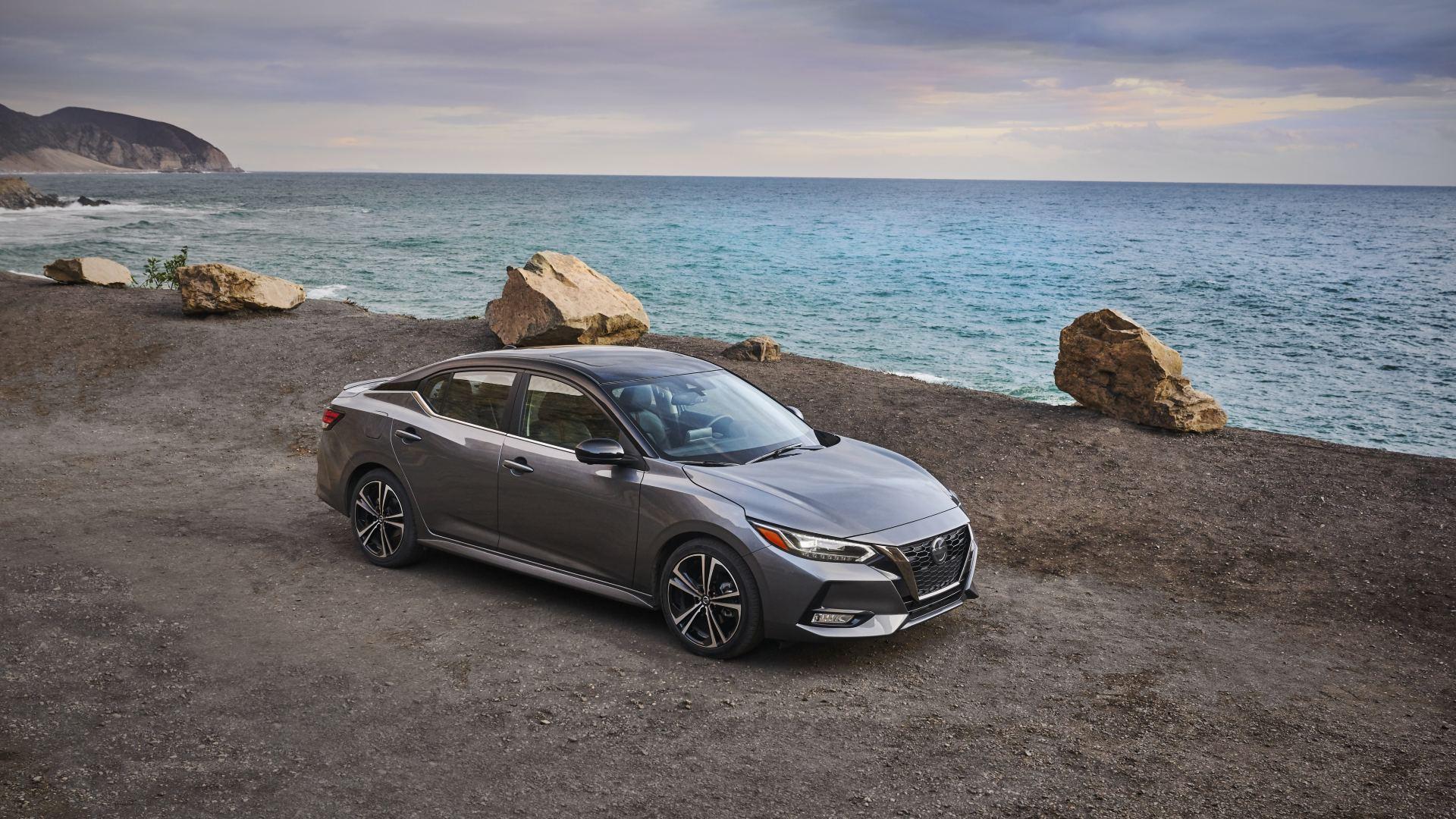
NISSAN Sentra 2021
From a sleepy sedan to a serious contender in the compact segment
Pros and cons
Pros
- Good balance of comfort and handling
- Reasonable fuel efficiency
- Pleasant transmissions
- Comfortable front seats
- Simple controls
- Standard advanced safety features
Cons
- Annoying road noise
- Poor rear visibility
- Low rear bench seat
- Too-short centre armrest
- Unproven reliability
Overview
The redesigned Nissan Sentra appeared in Canada just over a year ago. Several mechanical components including the engine, platform and rear suspension were improved in the remake, which also introduced a refreshed cabin and enhanced driving assistance equipment. Unlike in the United States, Canadian buyers can still obtain a manual gearbox; in 2021, it is even offered on the top-line SR model. We tested two Sentra SR’s, one a manual and the other with the optional continuously variable transmission.
At nearly $21,000 for a manual S version, or $22,700 for an automatic, the Nissan Sentra is the lowest priced of the Japanese compacts. Only the Hyundai Elantra sells for less with an automatic transmission and advanced safety features comparable to those of the Sentra. At this writing, in April 2021, the Sentra, which is assembled in Mexico, holds the advantage in terms of monthly leasing payments.
Verdict
In the space of one year the Nissan Sentra has quietly evolved from a drab car to a serious contender in the compact segment. It is not the most refined or powerful of the category, but it offers a surprisingly enjoyable drive and an excellent equipment-safety-price ratio. This is a refreshingly simple sedan that should not be costly to maintain—if it proves reliable, which remains to be seen.
Evaluation
Body, cabin and cargo space
The redesigned Nissan Sentra now uses the same platform as the Rogue and Qashqai sport utilities, rather than that of the Micra, Kicks and Versa. It is 6 cm wider and 5 cm lower than the outgoing model, which gives it a more dynamic look and significantly more width inside. The cabin can now accommodate four adults even more easily than before.The trunk lost 23 litres of volume in the transformation. The remaining 405 litres is about average for the category. The carpeted finish is deplorably thin, and there is no inside handle. Cabin finish is otherwise good for the category, at least as concerns the SR, but it is still far from the level of a Mazda 3.
For the first time, Nissan has equipped the Sentra with its “zero gravity” front seats. Whatever the term’s marketing signification, the seats prove as comfortable in the Sentra as in the other models that use them. Only the SR Prime comes with driver-side power adjustment, including for lumbar support. The heating elements are rapid, as claimed, including the one for the steering wheel.
The contemporary look of the new dashboard is a striking improvement. Whether or not one likes its perched positioning, the touch screen is distinctive for its simple interface and quick response. Traditional knobs and buttons ease access to the main functions; for more convenience and safety, the climate controls and displays are separate from the main screen. After a false start in 2020, Nissan has added Android Auto and Apple CarPlay on the base model in 2021.
Do not, however, expect a head-up display, integrated navigation or an electric parking brake. Instead, Nissan put the focus (and money) on popular equipment such as keyless ignition, automatic climate control and driving assistance technologies. The automaker likely is betting that those small luxuries would not be an issue and that the targeted buyers of compact sedans would appreciate a reasonable price more. It’s the buyer’s choice.
Other highlights
Driving position: better with the manual transmission than with the automatic, thanks to a less cumbersome centre console and a parking brake lever instead of a pedal. Centre armrest a bit short for use with one’s hand on the steering wheel, unless the seat is pushed far back.
Instruments: traditional dials are impeccably clear and easy to consult. Clear, comprehensive trip computer; its numerous pages can, however, be a distraction.
Convenience: large cup holders with tabs to grip narrow containers. Audio system is adequate at low or average volume but distortion appears relatively quickly.
Safety features
- Antilock brakes with electronic brake force distribution and brake assist
- Stability and traction control
- Hill start assist
- Front airbags
- Driver and passenger knee airbags
- Front and rear side airbags
- Side curtain airbags
- Pretensioners for front seatbelts
- Five head restraints (adjustable in front, fixed in rear)
- Tire pressure monitor
- Rearview camera
- Rear parking sensors
- Blind-spot monitoring
- Rear cross traffic alert
- Forward collision warning with automatic emergency braking and pedestrian detection
- Lane departure warning
- Automatic high-beams
- Adaptive cruise control (standard, SV, SR and SR Prime; unavailable, S and S Plus)
- Surround view monitoring (standard, SR Prime, unavailable, other models)
Crash test results
National Highway Traffic Safety Administration (NHTSA)Overall score: 5 / 5
Frontal impact: 4 / 5
Side impact: 5 / 5
Rollover resistance: 5 / 5
Insurance Institute For Highway Safety (IIHS)
Moderate overlap frontal impact: 4 / 4
Small overlap frontal impact:
- driver side: 4 / 4
- passenger side: 4 / 4
Side impact: 4 / 4
Rear impact: 4 / 4
Roof strength: 4 / 4
IIHS Top Safety Pick
Visibility
Visibility is good towards the front and on the sides, notably thanks to the well-sized outside mirrors and relatively low window sills. Wide rear roof pillars and the sharply angled package shelf are a hindrance when backing up. Blind-spot monitoring is standard; the warning signals placed inside on the front window frames are more easily noticed in the daytime than exterior mirror lamps.Headlights: SR Prime version’s LED projectors received a three out of four rating from the Insurance Institute for Highway Safety; they light a long path in all directions but can dazzle other motorists. The LED reflector type equipping the other versions received the institute’s lowest rating for lack of power. Our observations confirm these evaluations.
Mechanical overview
The move to Nissan’s compact crossover platform brings a more rigid structure. As a general rule, more structural rigidity automatically improves handling without necessarily stiffening the suspension. The new suspension is a multilink rear setup that is much more advanced than the torsion beam it replaces. The car also gets an extra 6 cm between the wheels, which along with the lowered centre of gravity paves the way to improved stability.The engine also is new to the Sentra series. Similar to the Qashqai’s, it is a 2.0‑litre direct injection four-cylinder that provides 149 horsepower, 25 hp more than the former 1.8‑litre with the automatic transmission. Torque also increases, but the 146 pound-feet maximum is attained at slightly higher RPMs than the 125 lb‑ft of the smaller engine.
Most Nissan Sentra’s will be purchased with a continuously variable automatic transmission. Nissan was one of the first to use these transmissions on a wide scale, but several other automakers have been offering better ones over the past few years. The Sentra uses the latest generation made by Japanese supplier Jatco; it is said to respond more quickly to throttle inputs and to mimic the shifts of a traditional automatic more efficiently.
Last year, motorists who still prefer three-pedal driving had to opt for a Sentra S base model. For 2021, the manual gearbox also appears on the SR version, which tops the lineup with enhanced equipment and a sporty allure. This six-speed transmission is confirmation of the youthful impetus Nissan hopes to give to its compact sedan.
The increased engine power offsets a 5 percent average gain in weight. The aerodynamic profile and revised transmissions keep fuel consumption on a level with the automatic, at least according to Natural Resources Canada combined city-highway ratings.
The agency expects SR automatics will deliver an average of 7.3 L/100 km, or 0.8 L/100 less than the manual SR’s. Surprisingly, we recorded the same 6.9 L/100 km result with both transmissions, which we tested mainly on the highway. However, it was colder when we drove the manual Sentra, which may have been more of a handicap.
Driving impressions
The Nissan Sentra’s new platform transforms its road comportment. The former heaviness and exaggerated body movements have given way to much more solid and balanced handling.Now, the car moves as a unit rather than giving the impression that the rear end is being hauled by the front. The independent rear suspension definitely contributes to the more precise cornering and control of bounce on bumpy pavement. Multilink suspensions are more expensive to maintain that a simple torsion beam, but in the case of the Sentra, the benefits are worth the expense.
The significantly improved steering also plays a part in the new-found driving enjoyment. More precise and direct, it delivers a level of road sensation long missing in the Sentra lineup. The car displays good straight-line tracking at highway speeds, though stability can be affected somewhat by strong winds.
The 18-inch wheels and wide tires that equipped our two test models sharpened cornering response but did not seem to overly stiffen the ride.
The 2.0-litre four-cylinder proved smoother and quieter than the former 1.8 litre. The continuously variable transmission is well matched to the engine without displaying the delays and elastic-band effects associated with preceding generations of this type of transmission by Nissan.
The manual gearbox provides an extra dose of fun, with the first three close-spaced gears revealing unexpected engine vivacity. The top three gears are longer; you have to play with the shifter to pass or to merge onto a highway. The surprisingly progressive clutch and relatively precise shifter add to the enjoyment. It is a clear improvement over the former model, though the Mazda 3 gearbox is still the benchmark.
The only letdown in an otherwise positive evaluation is the poor soundproofing underneath the vehicle. Tire noise infiltrates the cabin starting at 70 km/h and is more annoying than in certain competing vehicles such as Toyota Corolla and Mazda 3.
Other highlights
Braking: firm pedal is easy to modulate without excessive bite. Short and stable panic stops.
Driving assistance: adaptive cruise control is relatively progressive but too quick to slow, even at the shortest distance setting. On the other hand, it reaccelerates without delay as soon as the way is clear. Lane departure warning is unobtrusive and easily deactivated.
Features and specs
Price range (including shipping and preparation) | ||
| Minimum price | $20,868 | |
|---|---|---|
| Maximum price | N/A | |
| Price as tested | N/A | |
| Trim levels | S
S Plus
SV
SR
SR Prime | |
Honda Civic | ||
Hyundai Elantra | ||
Kia Forte | ||
Mazda 3 | ||
Subaru Impreza | ||
Toyota Corolla | ||
Volkswagen Jetta |
| Engine, horsepower and torque | 2.0L direct injection 4 cyl.; 149 hp at 6,400 rpm; 146 lb-ft at 4,400 rpm |
|---|---|
| Transmission | 6-speed manual
Continuously variable transmission |
| Front suspension | Independent with MacPherson struts |
| Rear suspension | Independent multilink |
| Front brakes | Ventilated disc |
| Rear brakes | Drum (S and S Plus)
Disc (SV and SR) |
| Tires | 205/60R16
215/45R18 |
| Wheelbase | 271.2 cm | ||
|---|---|---|---|
| Length | 464 cm | ||
| Width | 181.6 cm | ||
| Height | 144.8 cm | ||
| Curb weight | From 1,349 to 1,411 kg
1,374 kg (SR manual)
1,411 kg (SR automatic) | ||
| Towing | Not recommended | ||
According to Natural Resources Canada | ||
| City | 8.2 L/100 km (SR automatic) 9.4 L/100 km (SR manual) | |
|---|---|---|
| Highway | 6.2 L/100 km (SR automatic) 6.5 L/100 km (SR manual) | |
As measured by CAA-Québec | ||
| City | 6.9 L/100 km (SR manual and SR automatic) | |
| Highway | N/A | |
| CO2 emissions | 3,420 kg/20,000 km (SR automatic)
3,800 kg/20,000 km (SR manual) | |
| Fuel tank | 47 litres | |
| Recommended fuel | Regular-grade gasoline | |