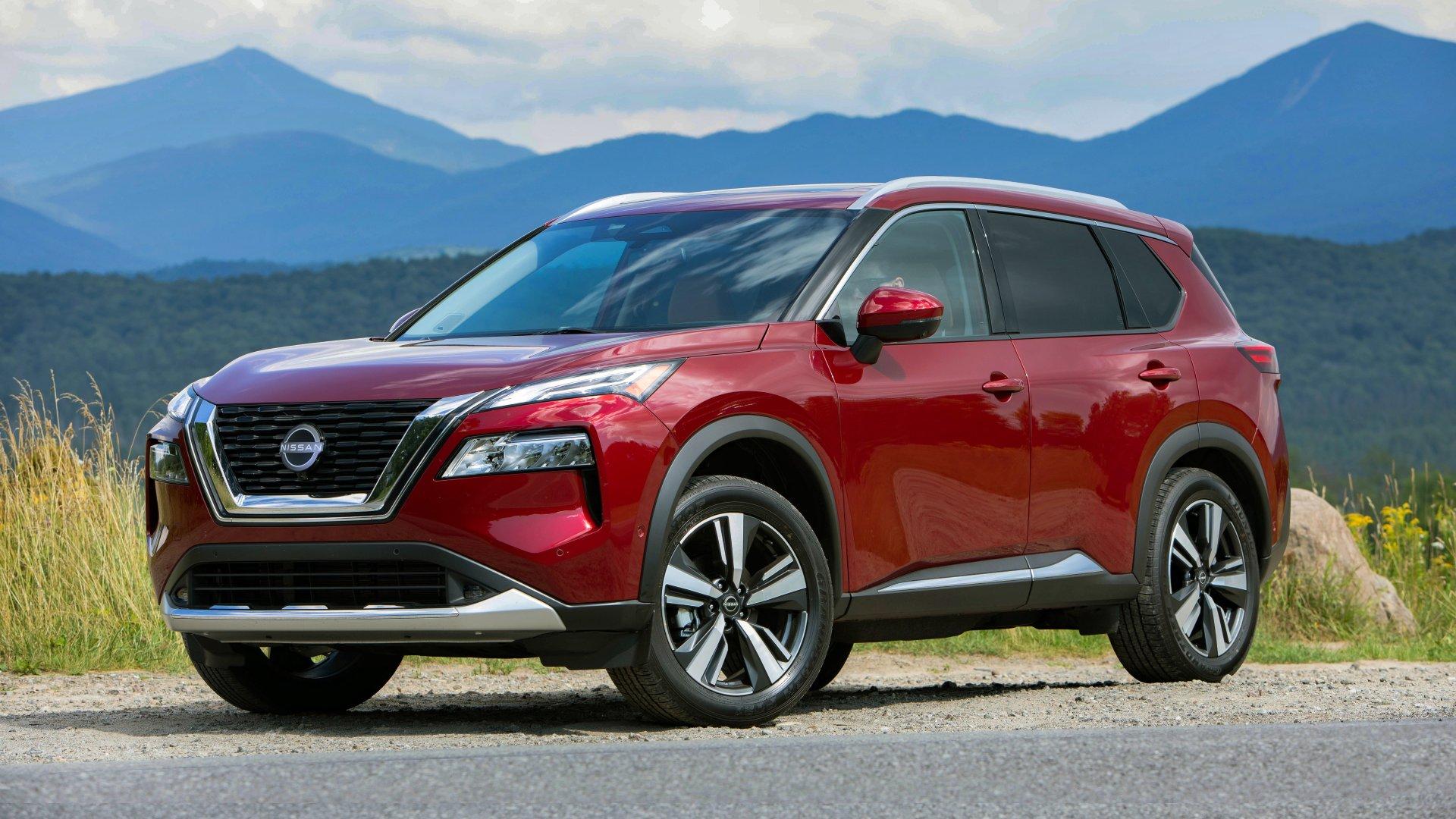
NISSAN Rogue 2023
Try before buying; the Rogue's new engine may leave you wanting more...
Pros and cons
Pros
- Vast cabin
- Excellent visibility
- Simple controls
- Comfortable ride
- Good equipment-to-price ratio
Cons
- 3-cyl. is noisy, quick to run out of steam and as thirsty as a 4 cyl.
- Reliability of the 3 cyl. is unproven
- Suspension still too compliant
- Increased prices
- No electrified version
Overview
It is not often a company replaces the engine on a vehicle barely a year after a remake. But that is what Nissan did in 2022 with the Rogue, when it installed a turbocharged three-cylinder under the hood of most versions. On paper, this engine is more powerful and more fuel efficient that the four-cylinder, which is still used on the Rogue S. Even though the SUV is otherwise unchanged, we tested a Platinum model to see if the engine swap makes sense.
The Platinum, like the other models in the lineup, has increased considerably in price for 2023. Prices now range from $32,468 to $45,963 (including destination fees), which more or less places the Rogue in line with a non-hybrid Toyota RAV4. The current context of inflation and tight supply also makes it easy for automakers to raise their financing rates. Which is to say that the ridiculously low monthly payments of the former generation of the Rogue are a thing of the past.
Nissan’s crossover must therefore be judged on its actual merits, in what is still a highly competitive segment of the Canadian market. The comparison with the Mitsubishi Outlander, notably, seems inevitable, given the number of components the two have in common. For now, however, Mitsubishi is passing on the Rogue’s new engine.
Our test vehicle was manufactured in Japan, but Nisan also assembles the Rogue in Tennessee.
(Video in French only)
Verdict
Despite its promising specs, the Nissan Rogue’s three-cylinder adds little relative to the four-cylinder used on the base model, apart from a constant growl in hilly terrain. It may even cost more to maintain, because of its increased complexity. If that does not curb your enthusiasm, you’ll be glad to know that the Rogue is more competitive than ever, thanks to its remarkable versatility, enhanced comfort and generous equipment.
Evaluation
Body, cabin and cargo space
The Nissan Rogue joined the ranks of the most practical SUV’s nearly ten years ago with the launch of its second generation. The current generation takes practicality to an even higher level, notably thanks to rear doors that open nearly 90 degrees. It is phenomenal for installing booster seats, and the children that come with them!
With ample room for four adults and a fifth person of smaller stature, the cabin also offers a cargo area comparable to that of a Honda CR‑V, Toyota RAV4 or Volkswagen Tiguan. SL and Platinum trims add a dual-level floor that lets you flip between maximum volume and a surface that lines up perfectly with the folded rear seatbacks. The top panel can also partition the trunk to help hold items in place or hide them from view.
User-friendliness is also key in the cockpit area, thanks notably to simple, intuitive and easily accessed controls. Numerous physical buttons and knobs adjoin the touch screen, and there are separate controls for the climate control system. The screen proves just as easy to consult as the instrument display in Platinum versions.
Android Auto and Apple CarPlay are included, but only the latter is wireless, and only on SL and Platinum models. Strangely, it sometimes refused to display, even though our cell phone was correctly set up in our test vehicle. Similarly, wireless charging, restricted to the top trim, was interrupted if the device shifted the slightest bit on the pad.
Storage spaces abound, on and under the console, thanks to an electronic gear selector that is basically easy to get used to. The driving position accommodates people of all builds, but the front seats were not universally praised: well-bolstered and comfortable for some of our testers, too firm and too short for others. No one was impressed by the flat and hard rear bench.
Other highlights
Finish: significantly superior to that of the outgoing generation, especially the Platinum with its quilted leather seats, soft-touch surfaces and contrasting stitching on the dashboard. Keep an eye on the materials: on preceding generations, they wore out quickly.
Convenience: front-seat heaters are standard and heat rapidly. Panoramic sunroof on SV trim and up. Ventilated seats are unavailable. Head-up display is practical and easy to read, even with polarised sunglasses; it is restricted to the Platinum model. Platinum trim’s Bose audio system is disappointing in terms of both power and sound clarity.
Safety features
Antilock brakes with electronic brake-force distribution and emergency brake assist
Stability and traction control
Hill start assist
Front airbags
Driver and front passenger knee airbags
Front and rear side airbags
Side curtain airbags
Front center airbag that deploys between the driver and front passenger
Five adjustable head restraints
Rear passenger alert
Tire pressure monitor with adequate pressure signal
Reverse camera
Forward collision warning
Automatic emergency braking with pedestrian detection
Automatic high-beams
Blind spot monitoring (with automatic lane keeping assist, SV, SV Midnight Edition, SL and Platinum)
Rear cross traffic alert
Lane departure warning with automatic lane keeping assist
Lane centering assist, adaptive cruise control and surround view monitoring (standard, SV, SV Midnight Edition, SL and Platinum; unavailable, S)
Crash test results
National Highway Traffic Safety Administration (NHTSA)
Overall score: 5 / 5
Frontal impact: 4 / 5
Side impact: 5 / 5
Rollover resistance: 4 / 5
Insurance Institute For Highway Safety (IIHS)
Moderate overlap frontal impact: 4 / 4
Small overlap frontal impact:
- driver side: 4 / 4
- passenger side: 4 / 4
Side impact: 4 / 4
Rear impact: 4 / 4
Roof strength: 4 / 4
IIHS Top Safety Pick
Visibility
Very good, thanks to large side windows with near-horizontal sills. Thin windshield pillars facilitate urban driving, and well-sized outside mirrors help when changing lanes. Blind zone monitoring is standard and surround view monitoring is accessible starting on second trim level, rare for the category.
Headlights: LED reflector-type headlights are standard on all models; they obtained a top rating for good overall performance in tests by the Insurance Institute for Highway Safety.
Mechanical overview
Reducing displacement and turbocharging an engine is a strategy commonly called on to reduce the environmental footprint of gas-powered vehicles. That said, Nissan is only the second manufacturer to power a vehicle the size of the Rogue with a three-cylinder, after Ford with the Escape and Bronco Sport.
The automaker did not start from scratch. It took the variable-compression turbocharged 2.0-liter four-cylinder used on the Infiniti QX50 and QX55 and amputated one of its cylinders to create a 1.5‑litre three-cylinder. While that may seem small, its displacement is identical to that of a Chevrolet Equinox or Honda CR-V four-cylinder.
Nissan indicates 201 horsepower and 225 pound-feet of torque for this engine. Those ratings exceed not only the 181 horses and 182 pound-feet of the 2.5‑litre four-cylinder still used on the Rogue S, but also those of several competitors. But read on for our driving impressions; once again, the numbers do not tell the whole story…
Nor do official fuel consumption ratings. According to Natural Resources Canada, the smaller engine should reduce fuel consumption nearly 8 percent in combined city-highway driving. Our three-cylinder Rogue tester registered 8.8 L/100 km, which exceeds the official 8.4 L/100 km city rating, even though two-thirds of our 1,000‑km test was conducted on the highway or in the country.
Each engine is mated to a continuously variable automatic transmission, which was updated in 2022 to improve response and fuel economy. Steering-wheel paddles provide access to a range of fixed gears imitating those of a traditional automatic. In heavy acceleration, the transmission resorts to these artificial speeds.
As of last year, all-wheel drive is standard on all Rogue models except the base S, where it is available for a reasonable $1,850 supplement. This on-demand system sends up to 50 percent of power to the rear when traction decreases, during acceleration and in certain turns. Intelligent Trace Control can brake each wheel individually to improve grip in a turn. Depending on the terrain or the mood of the moment, the driver can choose among five driving modes that adjust the throttle, steering, transmission and all-wheel drive.
Driving impressions
When we tested the Nissan Rogue after its 2021 remake, we found its 2.5‑litre engine to be rather lethargic, despite the addition of direct fuel injection. Unfortunately, the new three-cylinder also falls short of expectations.
The problem is that even the slightest incline or prolonged acceleration elevates engine noise and engine revs, without a corresponding increase in performance. Whether merging onto a highway or passing on a two-lane road, you do not feel any real power advantage relative to the Rogue’s, or even the competition’s four-cylinder engines.
The continuously variable transmission is party to this situation, despite the recent improvements. It often keeps engine revving high to extract more power in uphill climbs. The simulated transmission speeds do not mask the problem.
On the flip side, this drivetrain mostly avoids the lack of smoothness and vibration often associated with three-cylinder engines. It even does well in urban driving, where its generous torque provides a bit more punch.
The moral of the story is, take the time to test the Rogue on a route that replicates your usual drive. And as for any vehicle, do not rush into a contract, even though supply is tight.
If yours is mostly highway and suburban driving, you will appreciate the vehicle’s composure and straight-line stability, both much improved since 2021. Though not a model of communication, the steering has gained significantly in precision in the most recent remake.
However, the suspension is still relatively soft, generating rear-end wobble on certain bumps and noticeable body lean in a succession of turns. It seems to be the price to pay for better-than-average comfort on degraded pavement, according to Nissan’s recipe.
Other highlights
Braking: pedal has just-right firmness and is easy to modulate. Adequate in normal driving, power diminishes gradually on multiple downhill slopes. Emergency stops are relatively straight, without unnecessary intervention of the antilock brakes.
Driving assistance: adaptive cruise control is relatively smooth but too prompt to decelerate, even at the shortest distance setting. However, it reaccelerates without delay as soon as the way is clear. Speed limit assist/vehicle speed adjustment in curves is too abrupt; fortunately, it is facultative. Lane keeping assist is sometimes erratic. Adaptive cruise control reverts to conventional cruise by pushing and holding the distance setting button. Lane departure alert is discreet and easy to switch off.
Features and specs
| Price range (including shipping and preparation) | ||
| Minimum price |
$32,468
| |
|---|---|---|
| Maximum price |
$52,028
| |
| Price as tested | $45,963 | |
| Trim levels | S SV SV Midnight Edition SL Platinum | |
Chevrolet Equinox
Ford Escape
GMC Terrain
Honda CR-V
Hyundai Tucson
Jeep Cherokee
Kia Sportage
Mazda CX-5
Mitsubishi Outlander
Subaru Forester
Toyota RAV4
Volkswagen Tiguan
| Wheelbase |
270.6cm
| ||
|---|---|---|---|
| 464.8cm |
464.8cm
| ||
| Width |
184cm
| ||
| Height |
168.9cm
| ||
| Curb weight |
From 1,542 to 1,700 kg
1,,700 kg
| ||
| Towing |
true
| ||
| Towing capacity |
2.5L engine: 612 kg (1,350 lbs); 1.5L turbo engine: 680 kg (1,500 lbs)
| ||
| According to Natural Resources Canada | ||
| City |
8.4 L/100 km (1.5L turbo engine, SL and Platinum trims)
| |
|---|---|---|
| Highway |
6.8 L/100 km (1.5L turbo engine, SL and Platinum trims)
| |
| Result | ||
| Temperature |
3,620 kg/20,000 km
| |
| Temperature |
From 0 to 18°C
| |
| CO2 emissions |
3,620 kg/20,000 km
| |
| Fuel tank |
55 liters
| |
| Recommended fuel |
Regular
| |
| Acceleration as measured by CAA-Quebec | ||
| 0-100 km/h |
9.9 seconds
| |