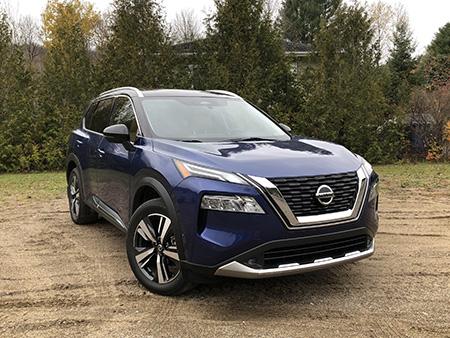
NISSAN Rogue 2021
Forget your driving gloves, put on your slippers instead…
Pros and cons
Pros
- Spacious cabin
- Versatile cargo area
- Compliant ride
- Much-improved soundproofing
- Generous equipment
- Comfortable seats
Cons
- Steering still vague
- Flabby handling
- Tepid performance
- No battery-powered version
- Quality of materials to be watched
Overview
By far Nissan Canada’s most popular vehicle, the Nissan Rogue enters into its third generation for 2021. The styling transformations inside and out are impossible to miss, but the remake also includes platform and chassis updates. Three-quarters of buyers opt for the available all-wheel drive. An electric version is not offered; Nissan is counting on convenience and driver-assist technologies to attract customers.
At $30,328 (including destination fees), the starting price is up $1,000 from last year but it gives access to a wide range of additional equipment. Most notable, a heated steering wheel, alloy wheels, dual-zone automatic climate control, LED headlights and rear automatic emergency braking. Several high-end features also trickle down to the mid-level SV, including a panoramic sunroof and surround-view monitor. In turn, Platinum models acquire exclusive goodies such as a head-up display, a 12.3‑in. digital gauge cluster and navigation-linked driver assist technologies.
Nissan still assembles all Rogue’s sold in North America at its plant in Smyrna, Tennessee. The same complex also produces the all-electric LEAF, but nothing indicates that a battery-powered Rogue is in the works. Nissan served up the usual “we don’t talk about future products” when queried at the Canadian press launch last October.
Verdict
Though the muscular styling of the 2021 Nissan Rogue may tempt you to dig out your driving gloves, a nice pair of slippers would put you more in sync with the vehicle, since comfort and practicality far outweigh performance dynamics. It is in no way a failing for a family hauler that features an excellent equipment-to-price ratio. Hopefully, the body and interior of this iteration will hold up better than in the past.
Evaluation
Body and cabin
The 2021 Nissan Rogue may look heftier than its predecessor but it is actually 4 cm shorter and 5 cm lower. And while the redesign eliminates the former high-hat look, backseat passengers actually get more headroom. In fact, all interior dimensions are similar or superior to those of the outgoing model.You can feel it when you get in: Practicality is key, in terms of both space and access. The rear doors open to 85 degrees, which is a big help when installing a child in a safety seat. Cargo space is among the roomiest for the segment along with the Honda CR‑V and Toyota RAV4. The Rogue’s trunk is notable for its side carpeting, which is much more scratch resistant than the cheap plastic its rivals use. Nissan’s Divide‑N‑Hide system provides multiple cargo configurations, but along with a motion activated liftgate, it is restricted to Platinum trim.
We tested a Platinum model, and it was obvious that in terms of finish Nissan has pulled out all the stops. Quilted leather, striped faux wood, contrast stitching and soft-touch surfaces are as pleasing to the eye as to the touch. Here’s hoping this time around the materials will stand up better; the former version often displayed obvious traces of wear by the end of a four-year lease.
We’ve never been able to confirm if the Zero Gravity front seats hyped by the automaker are as spaceship-like as they are labeled. Suffice it to say that generous padding and bolstering make them very comfortable for a range of body shapes. The driving position, simple controls and abundant cabin storage all facilitate life on board.
Both the 8-in. (S and SV) and 9-in. (Platinum) touch screens react promptly and include buttons and dials for easy access to the main functions. All models come with Android Auto and Apple CarPlay, but wireless charging and wireless Apple CarPlay are restricted to Platinum trim, which also holds exclusive rights to the attractive, well-designed digital gauge cluster and head-up display.
Complaints? The new electronic gear selector frees up space in the console but it is not as easy to shift in a hurry as a lever, for example in a busy parking lot. The console is also overly wide and encroaches on knee room. Equally surprising is the unavailability of ventilated front seats, especially since the seat trim is already perforated in the Platinum version. On the other hand, rear passengers get heated outboard seats and separate climate control, a first for a compact sport-utility.
Safety
For several years, all Rogue’s have been equipped with standard blind spot detection, rear cross traffic alert and automatic emergency braking (AEB). For 2021 Nissan adds pedestrian detection to AEB and includes lane-departure warning, automatic high-beams and reverse automatic emergency braking on all trims.
The adaptive cruise control and steering assist that compose the ProPilot Assist system are now standard starting on the SV. Platinum trim adds another level linking it to the navigation system to adjust speed to the posted limit and reduce speed for tight curves, automatically or on demand, as chosen by the driver.
None of these technologies replace driver vigilance, especially in bad weather, as many still come up short. However, they are helpful up to a point and can even avoid a collision in certain cases.
With 10 airbags (all models) plus an extra airbag that inflates between the front seats in a side impact (Platinum), passive safety should be good.
Crash test results
National Highway Traffic Safety Administration (NHTSA)
Overall score: 4 / 5
Frontal impact: 4 / 5
Side impact: 5 / 5
Rollover resistance: 4 / 5
Insurance Institute For Highway Safety (IIHS)
Moderate overlap frontal impact: 4 / 4
Small overlap frontal impact:
- driver side: 4 / 4
- passenger side: 4 / 4
Side impact: 4 / 4
Rear impact: 4 / 4
Roof strength: 4 / 4
IIHS Top Safety Pick+
Mechanical overview
Nissan indicates it has revised the platform of the Rogue for 2021, even though wheelbase is identical to that of the outgoing model. Increased use of ultra high strength steel and aluminum provides 27 percent more rigidity and a 40‑kg reduction in weight. The steering and rear suspension were updated to improve handling.More aerodynamic than before, the body incorporates several additions designed to improve the soundproofing.
Despite its expertise in the field, Nissan has chosen not to offer a battery-powered version of its compact SUV. While it certainly would have pushed up the price, it also would have given the Nissan Rogue an edge in a very competitive segment. Meanwhile, Ford, Mitsubishi and Toyota will be delighted to welcome customers eager to switch to electric powertrains.
The Nissan Rogue therefore maintains the 2.5-litre four-cylinder engine that has powered it from the beginning. In reality, it is a revised version that first appeared in the 2019 Altima sedan. The introduction of direct injection and a series of other changes increased power from 170 to 181 hp, and torque from 175 to 181 lb-ft, with maximum torque available at 3,600 rpm, or 800 rpm lower than before.
Natural Resources Canada rates combined city/highway fuel consumption at 8.3 L/100 km, an improvement of nearly 5 percent, which places the Rogue in the low average for the segment.
The continuously variable transmission is essentially the same as before, apart from a few internal modifications. It now includes a manual mode with eight simulated speeds. Also new, all models get three drive modes (Standard, Eco and Sport), and Snow and Off-Road modes on all-wheel drive versions.
Seventy-five percent of buyers opt for all-wheel drive, which now features an electro-hydraulic clutch claimed to accelerate torque transfer to the rear when the front wheels lose traction.
Driving impressions
We sampled the new 2021 Nissan Rogue on a 250-km-plus round trip from Montreal to Saint-Sauveur at the end of October. While we took the Laurentians Highway for the drive back to Montreal, we opted for a secondary, if not to say third-level road when we headed north. Featuring tight curves, bumps, crevices and steep hills, the road between Wentworth-Nord and Morin Heights quickly reveals the dynamic strengths and weaknesses of any vehicle.In the case of the Rogue, it especially highlighted the ability of the suspension to soak up road defects. The smooth ride pairs well with the comfortable seats and genuinely improved soundproofing of the 2021 edition. If what you want from an SUV is a serene ride, the new Rogue will serve you just as well as its predecessor.
Which also means it won’t generate much excitement in the twisty sections. While road holding is secure, the body still leans too much to satisfy a driving enthusiast. And while the steering is precise, it is still overly light. Suffice to say that the driving feel is still quite diluted, despite the sharper tunings Nissan talks about.
The powertrain produces the same tepid effect despite the latest overhaul. The engine runs out of steam relatively quickly in hilly terrain and there is still a certain transmission delay when you hit the throttle to merge onto the highway or to accelerate out of a tight turn. Unlike several of its competitors, Nissan does not offer a beefier option under the hood of its compact SUV.
Make no mistake: the Nissan Rogue’s placid performance is perfectly suited to city driving on an urban boulevard or on the highway. Nissan says it has toned down the driver-assist systems, but they are still quite intrusive; fortunately, the settings are easy to change.
All in all, the appeal of the 2021 Nissan Rogue lies in ease of use rather than performance dynamics of the likes of a Ford Escape or Mazda CX‑5.
Features and specs
Price range (including shipping and preparation) | ||
| Minimum price | $30,858 | |
|---|---|---|
| Maximum price | N/A | |
| Price as tested | N/A | |
| Trim levels | S (FWD)
S (AWD)
SV (FWD)
SV (AWD)
Platinum (AWD) | |
Chevrolet Equinox | ||
Ford Escape | ||
GMC Terrain | ||
Honda CR-V | ||
Hyundai Tucson | ||
Jeep Cherokee | ||
Kia Sportage | ||
Mazda CX-5 | ||
Mitsubishi Outlander | ||
Subaru Forester | ||
Toyota RAV4 | ||
Volkswagen Tiguan |
| Wheelbase | N/A | ||
|---|---|---|---|
| Length | N/A | ||
| Width | N/A | ||
| Height | N/A | ||
| Curb weight | N/A | ||
| Towing | Not recommended | ||