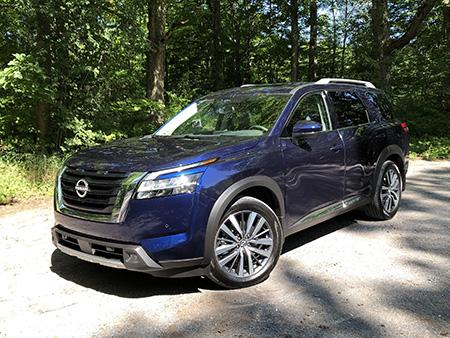
NISSAN Pathfinder 2022
Still no electric version. Too bad...
Pros and cons
Pros
- Advanced driver assistance
- Improved driving enjoyment
- Vast and practical cabin
- Comfortable seats
- Intuitive controls and screens
- Above-average towing capacity
Cons
- Lack of agility in turns
- Weighty feel
- No hybrid or electric version
- Transmission sometimes slow
- Sharp price increase
Overview
Nine years ago, the Nissan Pathfinder abandoned its truck-based origins in favour of a crossover unibody platform. The redesigned 2022 model adheres to the same formula and also keeps the former generation’s platform and V6 engine. However, Nissan revised the rest of the mechanicals and replaced the continuously variable transmission by a traditional, nine-speed automatic. No electric version is scheduled, but the body, cabin and tech software reflect what’s currently in vogue at Nissan.
Up until last year, Nissan offered the Pathfinder starting around $38,500, including all-wheel drive. For 2022, the base price jumps more than $7,000, to $45,658, including destination fees. That’s $1,000 to $3,000 more than several competing base models. Enriched standard equipment explains some of the difference, but it appears the automaker has also taken advantage of the remake to align its pricing strategy with that of the competition. On the other hand, a good number of popular features appear lower on the price scale of the Pathfinder than that of rivals like the Honda Pilot, Hyundai Palisade and Toyota Highlander.
Nissan has assembled its midsize SUV Pathfinder in Tennessee since 2004.
Verdict
The 2022 Nissan Pathfinder still does not drive with the poise of a Ford Explorer or Mazda CX‑9, but it shows significantly more character than the bland generation it replaces. It is due to a large extent to the new transmission and reworked steering. Nissan also took care with the flexibility and convenience of its star family SUV. However, the lack of a plug-in version is disappointing, especially on the part of a pioneer of mass-produced electric vehicles.
Evaluation
Body and cabin
Like the Nissan Rogue a year before, the redesigned Nissan Pathfinder traded its rounded lines for a squarer shape and more rugged look. In reality, the body is a bit shorter compared to the 2020 model, height and wheelbase are virtually unchanged, and width gains just 1.5 cm.The designers therefore enlarged the vehicle from the inside. Front occupants can now move their seats farther back, if the middle-row passengers agree to give up some their generous allotment of legroom. They all enjoy very accommodating seating with excellent thigh support for tall people. The comfort comes at the cost of side support, as quickly becomes evident in turns. Excellent armrests, a well-positioned dead pedal and good range of the telescoping steering column ensure an ideal, albeit high and dominating driving position.
Thanks to an extra 12 cm of hip room, the third-row bench now seats three. Access is easy thanks to middle row seats that flip forward at the touch of a button, even with a safety seat attached. The additional 3.5 cm of head space lets adults sit right in the back. They’ll have to make to with a very low seat cushion, but it would be the same in any other competing SUV.
The larger width makes it possible to install three child safety seats in the second row, as long as the middle one faces rearward. It also adds cargo space with the two rear rows folded down. Items up to 1.2 m/4 ft wide can now be loaded flat, something normally restricted to minivans. We noted that the sides are largely carpeted, which protects against scratching. A more vertical hatch than before makes it possible to pile up more luggage, especially when the third row in in place. An underfloor bin adds 54 litres of useful volume, more than twice as much as before.
Numerous storage spaces add versatility elsewhere in the cabin. For example, the move to an electronic gear shifter opens up a large open space under the centre console. Though not as natural as an ordinary lever, the new selector is relatively easy to master.
Drivers also should not have any difficulty navigating the user-friendly touch screen. Physical buttons and dials provide access to all the main functions and, thankfully, Nissan still provides separate climate controls. Wireless Apple CarPlay appears on SL trim and above; however, we have had trouble with this system in every vehicle we’ve tested, including the Pathfinder. It is also possible to connect with a USB cable, as for an Android phone.
In terms of convenience, a panoramic sunroof, hands-free liftgate and a full towing package appear on the SV and above, one grade earlier than before. The two most expensive models come with a head-up display, whereas Platinum is the only trim to offer second-row captain’s chairs and a digital dashboard.
Safety
The redesigned 2022 Nissan Pathfinder has four more airbags than the former model: two front knee airbags, and two side airbags in the second-row seats. Platinum trim adds another one between the two front bucket seats to prevent the occupants from hitting one another in a side crash.For the first time, all Nissan Pathfinders include a full suite of advanced safety and driver assistance features. To automatic forward emergency braking, standard since 2018, Nissan adds others such as reverse automatic braking, blind-spot monitoring, lane departure alert with lane keep assistance and adaptive cruise control. SL and Platinum grades let the driver connect the latter two to the navigation system to automatically adjust speed to the highway route. A surround view camera system appears on SV trim and above (rather than the SL). Driver vigilance is essential even when all these functions are switched on.
Crash test results
National Highway Traffic Safety Administration (NHTSA)Overall score: 5 / 5
Frontal impact: 4 / 5
Side impact: 5 / 5
Rollover resistance: 4 / 5
Insurance Institute For Highway Safety (IIHS)
Moderate overlap frontal impact: 4 / 4
Small overlap frontal impact:
- driver side: 4 / 4
- passenger side: 4 / 4
Side impact: 4 / 4
Rear impact: 4 / 4
Roof strength: 4 / 4
IIHS Top Safety Pick+
Mechanical overview
The 2022 Nissan Pathfinder is built on the latest version of the Renault-Nissan D platform. First appearing in the 2019 Altima, it uses 50 percent more high-strength steel than the preceding version. The slightly lighter structure and aluminum doors made it possible to add more equipment and sound deadening materials with little increase in overall weight.Bolted to this chassis is a new dual-pinion electric power steering system. It replaces the electrohydraulic system (electric pump providing power assist via hydraulic pressure) of the outgoing generation. Nissan also revised the strut-front, multilink-rear suspensions.
The main mechanical change concerns the transmission. Gone is the continuously variable transmission and taking its place is a traditional nine-speed automatic. Created by the German firm ZF, it marks a turning point for Nissan, all of whose other transverse-engine models use a CVT. Is it a sign of things to come in response to the reliability issues still plaguing the automaker’s CVT transmissions?
In any event, this will probably be a period of transition for the Pathfinder until the arrival of an electric powertrain. Right now, it is impossible to know if it will occur before the 2035 target date announced by the Canadian government. But it is rather disappointing on the part of a manufacturer so closely associated with electric vehicles, LEAF first and foremost.
In the meantime, Nissan is calling on the VQ-series 3.5-litre V6, which the Pathfinder was one of the first to use starting in 2001. The 2022 model uses the direct injected version launched five years ago, good for 284 hp at 6,400 rpm, and 259 lb‑ft of torque at 4,800 rpm.
This engine now comes with an automatic stop-start system to improve fuel efficiency. Together with the new transmission, it delivers a meager 0.2 L/100 km reduction in the combined city/highway fuel rating. At 10.5 L/100 km, that puts it in the lower-middle range for midsize SUVs.
All Nissan Pathfinders are delivered with part-time all-wheel drive that powers the front wheels in normal conditions and directs up to half of torque to the rear depending on traction. Nissan says the new electrohydraulic clutch and revised tuning eliminate the delay in engaging the rear wheels when the front wheels begin to slip. Seven electronic modes modify the throttle, steering, transfer case and stability control to adapt the drive to various situations.
Like the former model, the 2022 Nissan Pathfinder has a maximum towing capacity of 2,722 kg/6,000 lb—454 kg/1,000 lb more than most of its rivals. It is also the only Japanese SUV to offer a factory-installed towing package complete with hitch receiver and seven-pin tow harness.
Driving impressions
Like other companies during the pandemic, Nissan invited the automotive press to Kingston to launch its redesigned model. Midway between Montreal and Toronto, this historic locality is surrounded by small picturesque villages linked by a highly varied road system.Highway 401 and the main provincial roads highlighted the improved stability of the redesigned Nissan Pathfinder. The floating and jiggly body movements remarked in the former model have disappeared. The steering is more precise and more direct without being overly nervous on centre, resulting in good straight-line tracking at highway speed. The reduced assistance gives an impression of better control, despite a lack of road feedback.
We can attest to that because our spectacular test route included several portions of narrow, winding roads. Sections of gravel and degraded pavement represented a bit of a challenge for a big vehicle like the Nissan Pathfinder. It came through with nary a scratch, and little panache. It is tough for the suspensions to mask the weight of the body, and the occasional sharp bounce can make its way through. It holds its path but lacks agility on this type of terrain.
Our route also included sections of slippery mud and rocky and relatively steep descents. Dialling in Mud & Rut mode sharpens the response of the all-wheel drive, while hill descent control allows you to concentrate fully on steering. That said, Auto mode will probably be fine to get the Pathfinder to the cottage, provided you accept a bit more slippage from the front wheels. Because, yes, despite Nissan’s claims to the contrary, you still feel them slip a fraction of second before power reaches the rear wheels.
In normal driving, several of those traits disappear, making way for a comfortable and secure vehicle that is significantly more enjoyable to drive than its predecessor. The new transmission sometimes needs a nudge to get it to downshift, and it is a bit slow to shift through the first gears. However, it injects a vitality that was lacking with the former CVT transmission. Furthermore, there is no trace of the harshness and indecision that characterized the earlier generations of this ZF gearbox.
Note: Sport mode sharpens the response just enough to allow the transmission to take full advantage of the engine. Give it a try; it’s a gadget that’s actually useful for once!
Features and specs
Price range (including shipping and preparation) | ||
| Minimum price | $46,758 | |
|---|---|---|
| Maximum price | N/A | |
| Price as tested | N/A | |
| Trim levels | N/A | |
| Wheelbase | N/A | ||
|---|---|---|---|
| Length | N/A | ||
| Width | N/A | ||
| Height | N/A | ||
| Curb weight | N/A | ||
| Towing | Not recommended | ||