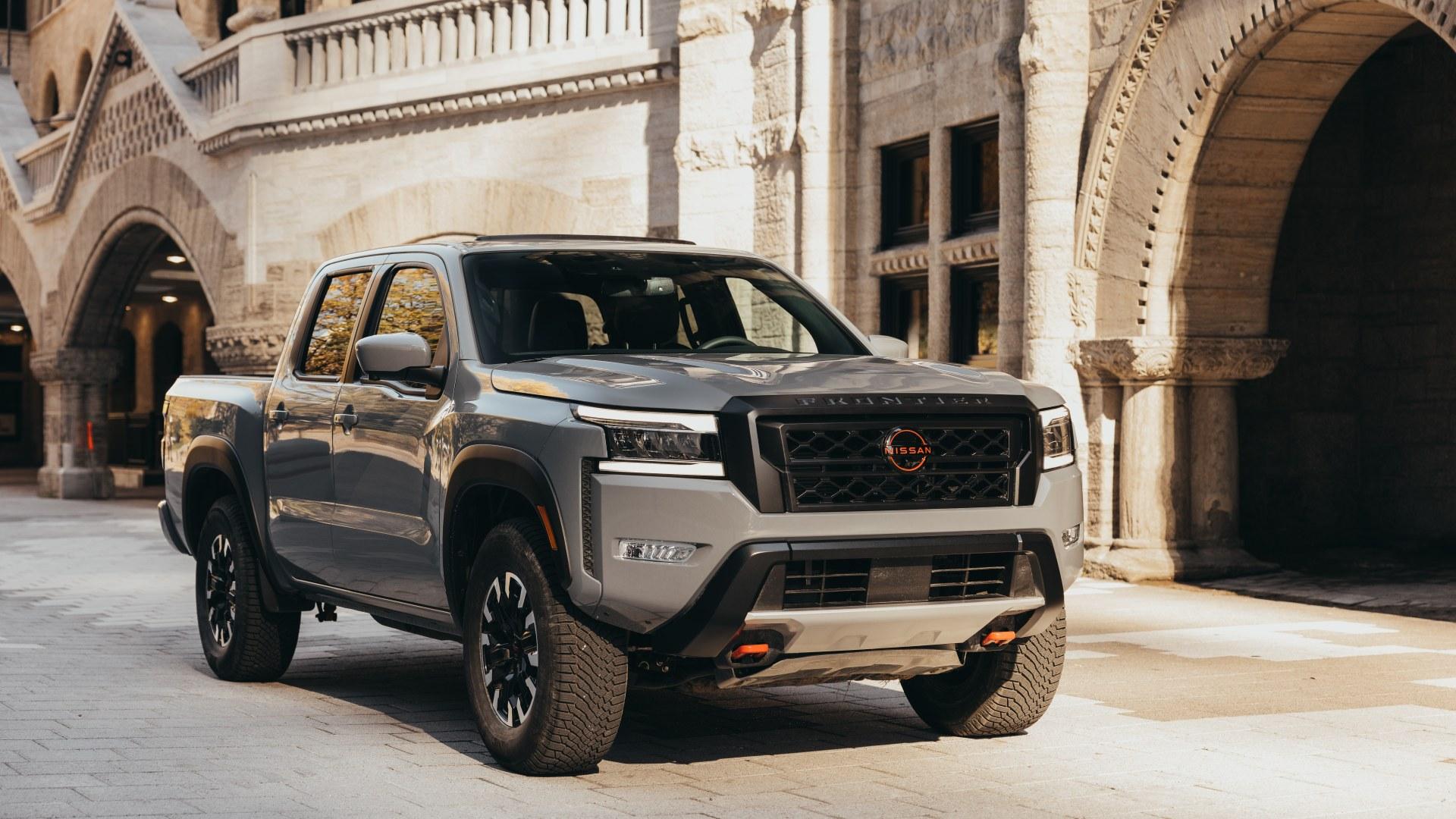
NISSAN Frontier 2022
The midsize pickup truck finally enters the modern era, but...
Pros and cons
Pros
- Powerful and refined engine
- Efficient transmission
- Supple and controlled ride
- Good straight-line tracking
- Well-tuned traction control system
- Simple controls
Cons
- High gasoline consumption
- Heavy steering
- Noisy and inconsistent heating
- Non-telescoping steering wheel
- Restricted interior space
- High price
Overview
The Nissan Frontier gets a major redesign for 2022, seventeen long years since its last remake. The body and cab as well as safety and interface technology finally enter the modern era, after so many years of near stagnation. However, the third-gen edition retains the chassis and several of the mechanical components of the old model. All Frontiers sold in Canada now come with four-wheel drive, a V6 engine and a nine-speed transmission.
As with the Pathfinder, Nissan took advantage of the redesign to raise the price of its midsize pickup. At $41,948, the lowest-priced Nissan Frontier costs $10,500 more than an equivalent model in 2019, the last year the preceding generation was produced. That’s more than the top-priced variant before the remake! A survey shows that only the Toyota Tacoma is priced higher for a base model.
Unique from the midsize pickups Nissan sells elsewhere else in the world, the North-American Frontier is made in Mississippi.
Verdict
Changes to the Nissan Frontier have ironed out some of its deepest wrinkles, especially noticeable in the cab. Road comportment is also more refined, notably thanks to the smoothness of the engine and ride, including even the Pro-4X with its off-road proclivities. However, the Frontier still displays certain aspects that become annoying on a daily basis. In that respect it is not alone; the midsize pickup segment is evolving at a snail’s pace, compared to crossovers or even full-sized pickups.
Evaluation
Body, cabin and cargo space
Though the vast majority of pickups are now sold as a crew cab fitted with four standard doors, Nissan and its competitors still offer extended-cab versions with rear-opening half-doors. The extended-cab Nissan Frontier comes with a bed just over 6 feet long (183 cm).In this configuration total length is identical to that of the crew cab Pro‑4X, which is fitted with a 58.9‑inch (149.6 cm) short bed—the only bed under five feet (152 cm) in the category. The SV crew-cab model is delivered with a 6‑foot bed only, which explains the gain of 35 centimetres in wheelbase and length.
The four-door Nissan Frontier’s cab can accommodate a young family but not like the limousine-like cabs of the full-size pickups. The rear bench provides almost no support because of its low seating and flat shape. The very upright seatback does nothing for comfort. It folds in two sections to create a nearly flat cargo surface. The seat cushion can be flipped up to stow a bulky object inside and out of the weather. The long compartment underneath is undivided and has no lid.
The front seats are much more inviting that the bench, though there is no lumbar or cushion-angle adjustment, even on high-end versions.
Drivers may feel they have to push their seat farther back than usual because the bottom of the dash is too close to their right knee. The lack of a telescoping steering wheel exacerbates this for people who do not like to drive with their arms extended. Nissan should have seized the opportunity to add that feature, now nearly universally available.
The pedal-type parking brake is another relic of the past; most vehicles now have a push-button electric park brake. In a similar vein, the rear window still doesn’t have an electric defroster. The Frontier’s rivals don’t, either, but once again, why not take the lead and innovate?
At least the redesigned dashboard comes with the latest version of the Nissan infotainment system. Both the 8-inch (S and SV trims) and 9‑inch (Pro‑4X) touch screens are clear, logical and responsive. True to tradition, Nissan also provides several buttons and two knobs to facilitate access to the main functions. A traditional gear shifter and a series of dedicated HVAC controls round out the presentation.
However, the latter system proved very poor at heating the windshield and floor simultaneously. Our feet were still cold even after several hours’ driving during our winter test, which almost never happens. Making matters worse, the blower is one of the noisiest we have come across in a recent vehicle.
Other highlights
Convenience: heated front seats and steering wheel, power driver seat, automatic climate control, alloy wheels and power side mirrors are unavailable on base extended-cab S model; it is really worthwhile paying the extra $1,500 for the SV. Skid plates, bed channels and sliding cleats, navigation, wireless charging and intelligent keyless entry restricted to Pro‑4X.
Safety features
- Antilock brakes with electronic brake force distribution and brake assist
- Stability and traction control
- Hill start assist
- Hill descent control
- Front airbags
- Front knee airbags
- Front side airbags
- Side curtain airbags
- Front seatbelt pretensioners
- Two adjustable and whiplash-reducing front head restraints, two detachable rear outboard head restraints, none at centre
- Rear passenger alert
- Rearview camera
- Tire pressure monitoring with pressure alert
- Forward collision warning with automatic emergency braking and pedestrian detection
- Blind spot monitoring
- Rear cross traffic alert
- Lane departure warning
- Automatic high beams
- Reverse parking sensors
- Adaptive cruise control
- Traffic sign recognition and surround view monitoring system (standard, Pro-4X; unavailable, other trims)
Crash test results
National Highway Traffic Safety Administration (NHTSA)
Overall score: 4 / 5
Frontal impact: 4 / 5
Side impact: 5 / 5
Rollover resistance: 3 / 5
Insurance Institute For Highway Safety (IIHS)
Moderate overlap frontal impact: 4 / 4
Small overlap frontal impact: Not tested
Side impact: 3 / 4
Rear impact: Not tested
Roof strength: Not tested
Visibility
The high driving position and large, horizontal-sill side windows provide good visibility in an unobstructed environment. Blind spot monitoring system partially compensates for the small size of the outside mirrors. Backup camera and surround view improve safety during parking manoeuvres, complicated by the height of the hood.Headlights: standard LED lights on Pro-4X trim; halogen lights on other trims. Headlights not yet tested by the Insurance Institute for Highway Safety.
Mechanical overview
Most pickups sold in North America are composed of a cab and bed bolted onto a separate frame. The same applies to the Nissan Frontier, which carries over its fully boxed frame from the old to the new generation.Nissan’s engineers have made notable revisions to the suspension to improve damping. New hydraulic cab mounts reduce vibration by 80 percent, according to Nissan.
Pro-4X models get Bilstein shock absorbers in front, a Dana rear axle and underbody skid plates. Like all the other 4X4 Frontiers, they come with a standard shift-on-the-fly 4-wheel drive system engaged via a control switch on the dash. A 4Lo drive mode and hill descent control facilitate off-roading.
Surprisingly, the steering is still hydraulic rather than electric assisted like the vast majority of contemporary vehicles. Nissan says it has been revised to quicken response and reduce effort; our driving impressions clearly reveal that one of those objectives has not been achieved.
The 2022 Nissan Frontier is now sold in Canada with a new engine offered in the U.S. since 2020. This 3.8L V6 with direct injection replaces both the 2.5L four-cylinder and the 4.0L V6 of the former model. It outputs 310 hp (49 hp more than the former V6) and identical torque of 281 lb-ft at 4,000 rpm.
Similar to the old Nissan Titan, the automatic transmission is nine speed rather than five as offered until 2019. This transmission—and the engine to which it is matched—contribute to a reduction of 11.5 percent in the combined consumption rating by Natural Resources Canada.
Still, at 12.3 L/100 km, the official rating exceeds that of all Frontier rivals with an automatic transmission, except the Jeep Gladiator. In a week of testing in frigid January weather, we recorded 16 L/100 km, two-thirds on the highway.
At 2,944 kg (6,490 lb), towing capacity is slightly higher than that of the Toyota Tacoma; all North American branded rivals can tow at least 3,175 kg (7,000 lb).
Driving impressions
Unassuming on paper, the modifications Nissan brought to the mechanical components of the Frontier have done marvels for its road comportment.
Compact pickups are often noisy, bouncy, and almost unstable on any road that is the least bit bumpy. The Nissan Frontier ably avoids those traps: most of the time, the ride proves both smooth and well controlled. You have to hit a big surface crack to feel the rear end skip when the bed is empty.
The steering provides good straight-line tracking at highway speed and relatively precise cornering. However, its unusual heaviness at low speed hampers manoeuvrability in the city. It is too bad, because the Frontier’s reasonable dimensions allow it to slip through spaces where full-sized pickups would be very unwieldy.
Needless to say, the body leans in fast curves but not to the point of shaking one’s confidence behind the wheel. The well-tuned intervention of the traction control system reinforces driver self-assurance, as it allows the vehicle to be driven in RWD even on ice and tamped-down snow at intersections. It still would be nice if the 4X4 system could engage on its own when traction diminishes, but for now, the only midsize pickups to offer that possibility are the Honda Ridgeline and Jeep Gladiator.
Lastly, the new engine surpasses all the V6s of its category for smoothness, even if it is still noisy at highway speed. It feels much more spirited than the Tacoma engine, which always seems to be working hard, or the V6 on GM pickups, which lacks low-end torque. It is due in large part to the ideal gearing of the transmission, which almost always shifts with impeccable smoothness.
Other highlights
Braking: pedal with just the right firmness and progressivity reacts at first touch. Adequate power and straight-line emergency stops. Antilock system is efficient but too sensitive.
Driver assistance: adaptive cruise control is prompt to slow down, even adjusted at minimum distance. Reverts to regular cruise by pushing and holding the main button.
Features and specs
Price range (including shipping and preparation) | ||
| Minimum price | $41,948 | |
|---|---|---|
| Maximum price | N/A | |
| Price as tested | $51,748 | |
| Trim levels | King Cab S
King Cab SV
King Cab SV Convenience
King Cab Pro-4X
Crew Cab SV
Crew Cab SV Sport
Crew Cab Pro-4X | |
Chevrolet Colorado | ||
Ford Ranger | ||
GMC Canyon | ||
Honda Ridgeline | ||
Jeep Gladiator | ||
Toyota Tacoma |
| Engine, horsepower and torque | 3.8L direct injection V6; 310 hp at 6,400 rpm; 281 lb-ft at 4,000 rpm |
|---|---|
| Transmission | 9-speed automatic with manual mode |
| Front suspension | Independent double wishbone |
| Rear suspension | Solid axle with leaf springs |
| Front brakes | Ventilated disc |
| Rear brakes | Ventilated disc |
| Tires | 265/70R16
265/65R17
265/70R17 |
| Wheelbase | 320 cm
355 cm (Crew Cab SV) | ||
|---|---|---|---|
| Length | 533.9 cm
569.2 cm (Crew Cab SV) | ||
| Width | 185.4 cm | ||
| Height | 182.6 cm (crew cab)
183.2 (extended cab) | ||
| Curb weight | From 2,064 to 2,180 kg
2,141 kg | ||
| Towing capacity | From 2,830 to 2,944 kg (6,240 to 6,490 lbs); Crew Cab Pro-4X: 2,839 kg (6,260 lbs) | ||
According to Natural Resources Canada | ||
| City | 13.7 L/100 km | |
|---|---|---|
| Highway | 10.6 L/100 km | |
As measured by CAA-Québec | ||
| City | 16.0 L/100 km | |
| Highway | N/A | |
| CO2 emissions | 5,760 kg/20,000 km | |
| Fuel tank | 80 litres | |
| Recommended fuel | Regular-grade gasoline | |