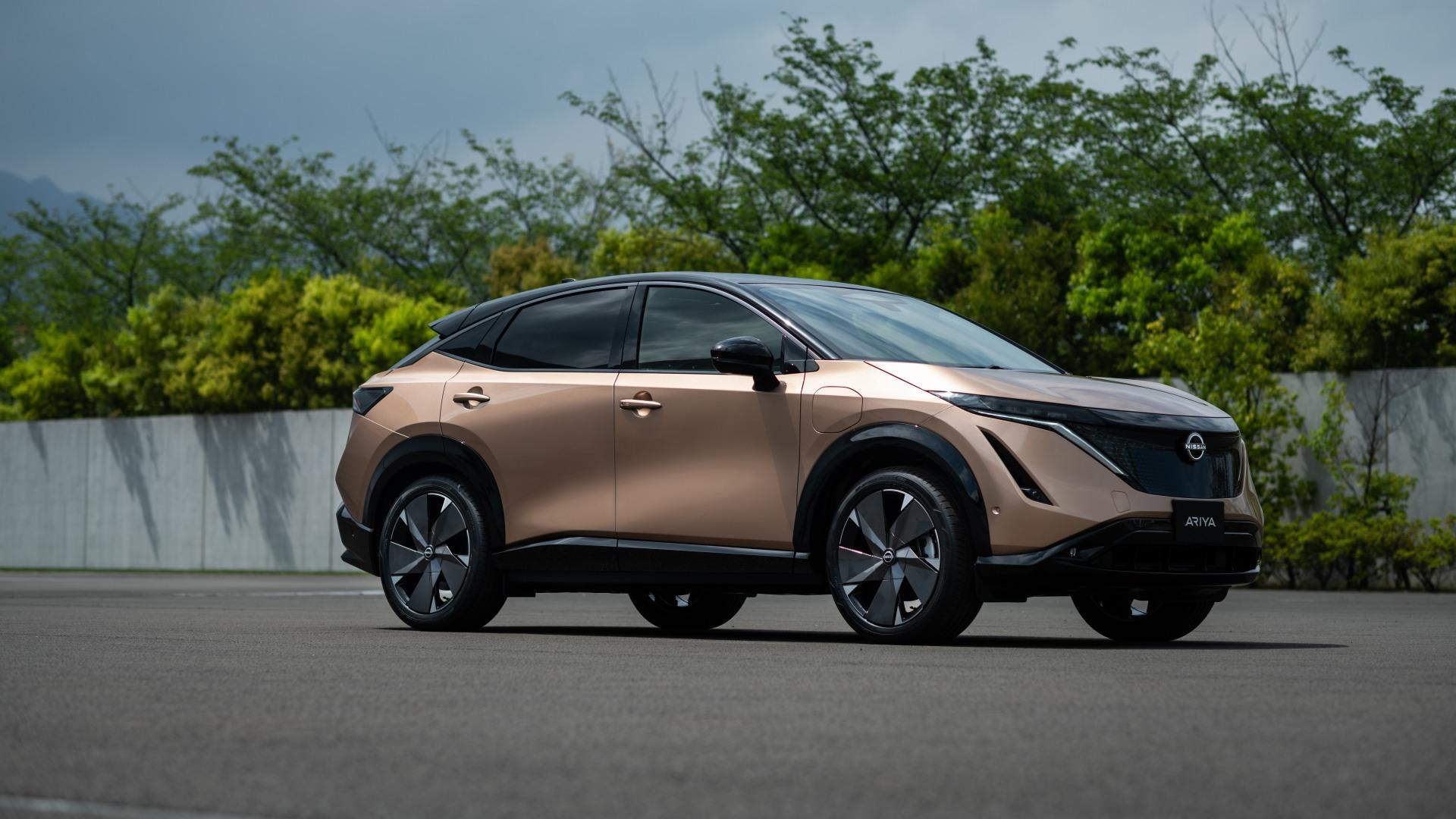
NISSAN Ariya 2023
Spacious and comfortable, the 100% electric SUV lacks excitement, however, and is far from being a bargain.
Pros and cons
Pros
Vast interior
Versatile trunk
Comfortable front seats
Very comfortable ride
Competitive and realistic range
Efficient charging
Cons
Lean in turns
Overly light steering
Restricted rear visibility
Irritating haptic controls
No real one-pedal driving
High price
Overview
Pioneer of electric vehicles with the LEAF, unveiled in 2010, Nissan has finally launched its second electric-drive model twelve years later. The 2023 Nissan Ariya enters the highly competitive all-electric compact sport-utility segment with no less than six combinations of batteries (standard or extended range), drive wheels (front- or all-wheel drive) and interior features. Depending on the version, driving range extends from 330 km to 490 km, right on average for the category.
What’s higher than average is the price Nissan is asking for its new arrival. The front-wheel-drive Engage starts things off at $55,193 (including destination fees), which is several thousand dollars more than a base-model Hyundai IONIQ 5, Kia EV6, Toyota bZ4X or Volkswagen ID.4. The lineup culminates with the Platinum+ and Premiere all-wheel-drive variants, both offered for around $72,000. That disqualifies them for the $7,000 Quebec government rebate; the four other versions of the Ariya are eligible. All trims qualify for the $5,000 federal rebate, as the program operates under different rules.
Considering the supply problems still plaguing the industry, the number of Nissan Ariya’s already on the road is surprising. To verify what justifies this initial popularity, we tested an Evolve+ model with front-wheel drive, an extended-range battery and loads of equipment. All that brings the bill to $67,093 before the $12,000 subventions that apply, as usual, after taxes.
Verdict
The arrival of the Ariya allows Nissan to make up for lost time in the electric vehicle ecosystem, notably in terms of charging, range and battery cooling. Spacious, comfortable and well-made, the brand’s first electric SUV can meet the needs of most families. However, it lacks what it takes to stand out in a fiercely competitive segment, especially in view of a strangely stiff price from an automaker that usually aims for affordability.
Evaluation
Body, cabin and cargo space
Though well hidden by its ovoid shape, the Nissan Ariya is about the same size as a Nissan Rogue. Its dimensions position it mid-pack in the all-electric SUV segment, though it gives up more than 20 cm in wheelbase to the Hyundai IONIQ 5.
Still, the cabin easily accommodates a family with room in the back for two, or even three child car seats if they are not too wide. There is plenty of leg and foot room, but rear headroom is tight for tall individuals because of the plunging roof line. It also limits the height of cargo, though the trunk makes up for it in floor length and with a dual-level floor that is easily configured to hide the charging cable or to prevent light items from sliding around.
The driving position is just high enough to suit typical crossover buyers. As usual with Nissan, the front seats provide an excellent combination of padding and support. The power sliding console adds to the comfort, though a simple sliding armrest could have done the same job. However, the door armrest is too low and too far away for support when holding the steering wheel in a 9-o’clock position during long drives.
The absence of a module under the middle of the dashboard enhances the feeling of spaciousness but limits storage compartments to cupholders. A lidded bin is tucked in left of the glove box, where American sedans used to have an ashtray, but it is barely large enough for a sunglasses case.
The minimalistic dashboard houses two 12.3-inch screens in a large rectangular pod. All necessary information is displayed in front of the driver, as is proper, but several of our testers noted that the steering wheel hides the upper part of the display.
The centre screen handles more functions than on the other Nissans; sadly, the automaker has eliminated most of the physical buttons that make its regular system so user friendly. There is still a row of specific haptic buttons for climate control, but they are almost impossible to identify without taking one’s eyes off the road. The sometimes slow response of the system does nothing to help.
Other highlights
Convenience: base Engage model is generously equipped. Oddly, though, the next trim up, the Venture+, is the only one that doesn’t offer a power driver’s seat, auto-dimming rearview mirror, sliding centre console and, especially, heated seats and steering wheel. That’s an unacceptable oversight for a $62,000 EV.
Safety features
Antilock braking with electronic brake force distribution and emergency brake assist
Stability and traction control
Hill-start assist
Front airbags
Driver and front passenger knee airbags
Front and side airbags
Front between-seat airbag (standard, Platinum+ and Premiere; unavailable, other versions)
Side curtain airbags
Five adjustable head restraints
Rear passenger alert
Rearview camera
Tire pressure monitor with pressure alert
Forward collision alert
Front automatic emergency braking with pedestrian detection
Rear automatic emergency braking
Lane departure alert with steering assist
Lane centering system
Blind spot monitoring with steering assist
Rear cross traffic alert with automatic braking
Automatic high beams
Adaptive cruise control
Front and rear parking sensors
Surround view monitor (standard, Evolve, Evolve+, Platinum+ and Premiere; unavailable, Engage and Venture+)
Crash test results
National Highway Traffic Safety Administration (NHTSA)
Overall score: 5 / 5
Frontal impact: 4 / 5
Side impact: 5 / 5
Rollover resistance: 4 / 5
Insurance Institute For Highway Safety (IIHS)
Moderate overlap frontal impact: 4 / 4
Small overlap frontal impact: 4 / 4
Side impact: 4 / 4
Rear impact: Not tested
Roof strength: Not tested
Visibility
Visibility is very good front and side thanks to the slightly elevated driving position, large windows and narrow windshield pillars. The narrow, high and sharply slanted rear window along with wide rear pillars create large blind spots when backing up. On the other hand, Nissan provides a rear window wiper, which is glaringly absent on rival vehicles like the IONIQ 5, Kia EV6 and Toyota bZ4X.
Mechanical overview
The Nissan Ariya inaugurates a new platform that will underpin fifteen Renault-Nissan-Mitsubishi electric models by 2030. This structure pushes the mechanical components to the extremities to create the longest floor possible, both to maximize the cabin and to house a large battery underneath.
The battery of four of the models has a capacity of 87 kWh, one of the highest in the Ariya’s category. That results in a driving range of 490 km and 465 km respectively for the Venture+ and Evolve+, both front-wheel drive. Those variants have a single motor good for 238 hp and 221 lb-ft of torque.
The Platinum+ and Premiere limit maximum range to 428 km because of their all-wheel drive. They compensate by extracting 389 hp and 442 lb-ft of torque from a pair of motors (one per axle). Obviously, range varies depending on factors such as driving style and outside temperature.
Neither Natural Resources Canada nor Nissan Canada provide a charging time on a 240V charger. The U.S. Environmental Protection Agency, which dictates test protocols for this data in North America, indicates 14 hours. That corresponds to what we observed on a Level 2 Electric Circuit charger.
Our two quick-charge sessions at 100 kW yielded a power of 73 kW. We hoped for better, since Nissan indicates that the Ariya can channel up to 130 kW. That said, we experienced the same situation with other vehicles, including the Ford F-150 Lightning.
Nissan also lists a 63 kWh standard-capacity battery to lower the price for people who rarely drive long distances. Range tops out at 348 km for the FWD Engage version, whose motor outputs 214 hp and 221 lb-ft of torque. The AWD Ariya Evolve delivers up to 335 hp and 413 lb-ft of torque and a range of 330 km.
In our test in June, a fully charged Evolve+ model indicated a maximum distance of 433 km instead of the claimed 465 km. The range indicator was quite realistic for combined city/highway trips of 100 to 150 km. However, a few hours of following the flow of traffic on the highway reduced range more than actual distance travelled—for example, 320 km ‘consumed’ vs 232 driven.
Driving impressions
No, you won’t exercise your driving talents at the wheel of the Nissan Ariya. Exaggerated body roll in twisting turns and on sharp highway ramps prompts you to ease off on the pedal. We detected a certain amount of understeer (plough straight ahead in curves) that was impossible to correct with the throttle in the front-wheel-drive Evolve+ we tested.
Feedback from the front wheels is vague because of the overly assisted steering, a situation that Nissan has improved notably on its more recent gas-powered models. Nevertheless, the Ariya remains stable, and it faithfully respects the chosen trajectory at highway speed. Credit is due in part to the famously low centre of gravity of EV vehicles, compliments of the heavy battery mounted under the floor.
The Ariya therefore should please despite its lack of agility on the backroads. This composure accompanies another quality likely to seduce target buyers: comfort. The suspension soaks up bumps so gracefully, it almost seems to smooth the road. It also avoids unnecessary bounce, without completely eliminating a slight hop of the rear end on traverse cracks in a curve. We noticed the same reaction, annoying but not dangerous, with the current Rogue.
Everything functions smoothly in Nissan’s electric SUV, including acceleration. The single motor of the FWD models, which weigh in at over 2,100 kg, is up to the task, but it loses steam when it comes time to pass or when fully loaded. Nor should you expect explosive starts: the engineers have designed the throttle to be very progressive, clearly to avoid torque steer.
We look forward to testing an all-wheel-drive version to see if this drivetrain, and the influx of power that comes with it, will make things a bit more exciting.
Other highlights
Soundproofing: road noise is well filtered thanks to excellent aerodynamics for an SUV. Tire noise is audible without being intrusive. The overall sound level at highway speed is well contained for an EV with no gas engine to mask other noises.
Braking: pedal a bit too firm for certain testers. The e-Step mode is disappointing, as it doesn’t let you come to a complete stop without touching the brakes. Short and straight emergency stops.
Driver assistance: adaptive cruise control is relatively progressive, but too prompt to slow, even at the shortest possible distance setting. On the other hand, it reaccelerates without delay as soon as the way is clear. Speed limit assist and curve speed assist are too pronounced, but fortunately, are optional and can beb turns off. Lane keeping is inconsistent. You can switch to conventional cruise control by pushing and holding the distance setting button. Lane departure alert is unobtrusive and easy to deactivate.
Features and specs
| Price range (including shipping and preparation) | ||
| Minimum price |
$55,093
| |
|---|---|---|
| Maximum price |
$72,093
| |
| Price as tested | $68,043 | |
| Trim levels | Engage (FWD) Venture+ (FWD) Evolve (AWD) Evolve+ (FWD) Platinum+ (AWD) Premiere (AWD) | |
Ford Mustang Mach-E
Hyundai IONIQ 5
Kia EV6
Subaru Solterra
Tesla Model Y
Toyota bZ4X
Volkswagen ID.4
| Wheelbase |
277.5cm
| ||
|---|---|---|---|
| 464.5cm |
464.5cm
| ||
| Width |
190cm
| ||
| Height |
166cm
| ||
| Curb weight |
From 1960 to 2273kg
2120kg
| ||
| Towing |
true
| ||
| Towing capacity |
FWD: none; AWD: 680kg (1500lbs)
| ||
| According to Natural Resources Canada | ||
| City |
Evolve+, FWD, front engine: 19.6kWh/100km (equivalent to 2.2L/100km)
| |
|---|---|---|
| Highway |
Evolve+, FWD, front engine: 23.1kWh/100km (equivalent to 2.6L/100km)
| |
| Result | ||
| Temperature |
0g/20,000km
| |
| Temperature |
From 7 to 34°C
| |
| CO2 emissions |
0g/20,000km
| |
| Fuel tank |
N/A
| |
| Recommended fuel |
100% electric vehicle
| |
| Acceleration as measured by CAA-Quebec | ||
| 0-100 km/h |
8.2 seconds
| |
| 60-100 km/h |
4.3 seconds
| |