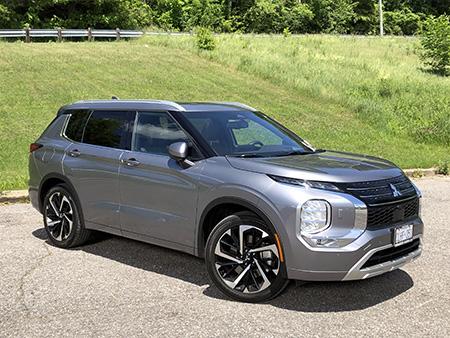
MITSUBISHI Outlander 2022
The redesign of the compact SUV brings it up to date, which it sorely needed.
Pros and cons
Pros
- Roomy interior
- Comfortable front seats
- Improved finish
- Updated technology, finally
- Good driver assistance
Cons
- Useless third row seat
- Numb steering
- Suspension stiffness in city
- Disappointing performance
- Mediocre standard tires
Overview
Seven years and counting after its last remake, the Mitsubishi Outlander is completely redesigned for model-year 2022. It is the first Mitsubishi product since it became part of the Renault-Nissan alliance. The filiation with the Nissan Rogue is obvious, under the hood, on the dash and in terms of proportions. Mitsubishi’s contribution includes styling, mechanical tunings and equipment levels. Unlike the Rogue, the Outlander is offered with all-wheel drive only and a third-row seat.
Standard four-wheel drive corresponds to what the majority of potential buyers want on their vehicle. However, it raises the starting price to nearly $34,000. That’s at least $3,000 more than a competing front-wheel-drive model. Even with AWD, several rivals cost $1,000 to $1,500 less than a base Outlander ES. On the other hand, Mitsubishi still offers a 10‑year/160,000‑km powertrain warranty, the longest in the industry. At this writing, in July 2021, low interest rates and a decent residual value also generated competitive monthly payments.
Mitsubishi manufactures the Outlander in Japan, unlike Nissan, which assembles the Rogue in Tennessee.
(Video in French only)
Verdict
Improvements to refinement, technology and the interior bring some much-needed upgrades to the Mitsubishi Outlander. However, its most distinctive feature is its long warranty, now that it has lost the optional V6 engine that allowed it to tow up to 3,500 pounds—rare for a compact SUV. For now and until the plug-in hybrid version moves onto the new platform, the Outlander simply represents another reasonable choice in a very competitive segment.
Evaluation
Body, cabin and cargo space
The Mitsubishi Outlander has the same wheelbase as the Rogue, but Mitsubishi designed it with a higher, longer and wider body. It is essentially an exercise in style, since the Outlander is no roomier than its corporate cousin. It didn’t have to be, since both vehicles can accommodate four people with no problem apart from tight rear headroom with the panoramic sunroof.
Mitsubishi still installs a third-row seat in the Outlander, but it is no more inviting than before. It is uncomfortable for an adult of any size and not even roomy enough for a large child safety seat. The third row also replaces the practical dual-level floor found in the Rogue Platinum.
Despite that unnecessary loss of space, trunk volume is about average for the segment. The second-row bench seat folds in three sections, to accommodate long items when the outboard seats are occupied. As with a majority of competing vehicles, the sides of the trunk lined with plastic will get scratched in no time.
Finish throughout the rest of the interior is more substantial; materials, textures and colors on the Outlander GT are the best ever seen on a Mitsubishi product. The front perforated leather seats are as comfortable as they look but are not ventilated, unlike the high-end models of several competitors.
Apart from that, equipment is generous on all five trims. Second level and up add wireless charging, push-button start, heated steering wheel and a hands-free power liftgate.
The controls for all those features are seamlessly integrated, whereas they often looked like add-ons and afterthoughts on the outgoing model. The centre touch screen and digital instruments now function together and their parameter settings are easy to decipher. Buttons and dials provide quick access to the main functions. Nissan’s influence is clearly evident in this interior, which is significantly more refined and attractive than the other Mitsubishis.
Safety features
- Antilock brakes with electronic brake force distribution and brake assist
- Brake override
- Stability and traction control
- Hill start assist
- Hill descent control
- Front airbags
- Driver and passenger knee airbags
- Front and rear side airbags
- Front centre airbag
- Side curtain airbags
- Front seatbelt pretensioners
- Seven head restraints; adjustable on front and rear outboard seats, folding on the others
- Rear passenger alert
- Tire pressure monitoring
- Rearview camera
- Rear parking sensors
- Forward collision warning
- Blind-spot warning (with automatic intervention on GT)
- Lane departure warning with automatic steering assist
- Driver fatigue detection
- Automatic high-beams (standard, SE, LE, SEL and GT; unavailable, ES)
- Adaptive cruise control and surround-view monitoring system (standard, LE, SEL and GT; unavailable, ES and SE)
- Lane keep assist (standard, GT; unavailable, other models)
Crash test results
National Highway Traffic Safety Administration (NHTSA)
Overall score: 4 / 5
Frontal impact: 4 / 5
Side impact: 5 / 5
Rollover resistance: 4 / 5
Insurance Institute For Highway Safety (IIHS)
Moderate overlap frontal impact: 4 / 4
Small overlap frontal impact:
- driver side: 4 / 4
- passenger side: 4 / 4
Side impact: 4 / 4
Rear impact: 4 / 4
Roof strength: 4 / 4
Visibility
Visibility is adequate to the front and on the sides, thanks among other things to the relatively horizontal window sills. The thick B-pillar hampers lane changes somewhat on the driver’s side, mitigated by the blind-spot monitoring system. Mitsubishi includes a surround-view camera system starting on mid-level SEL trim. Side-view mirrors are nicely sized.
Headlights: The Insurance Institute for Highway Safety has not tested the standard LED headlamps. The Nissan Rogue received a top score but it does not automatically extend to the Outlander because its grille is completely different. Headlamp washers are standard on all trims, which is rare.
Mechanical overview
The platform of the previous-generation Outlander was still solid, notably as concerns crash protection, but it displayed its limits in terms of handling. Mitsubishi saved big money by adopting the structure of the Nissan Rogue, 33 percent more rigid than that of the 2020 Outlander.
Unlike the Rogue, which lost weight in its remake, the Outlander gained just over 100 kg. It should be noted that it added a number of safety and convenience features already offered on the preceding generation of the Rogue.
Nearly all the mechanical components derive from the Rogue, including the Outlander’s gasoline engine, a 2.5‑litre direct injected four‑cylinder. It produces 181 horsepower and 181 pound-feet of torque, 15 hp and 19 lb-ft more than the former Mitsubishi 2.4‑litre. The continuously variable transmission also bears the Nissan stamp. More advanced that the CVT used on the former Outlander, it offers an automatic mode and eight simulated speeds accessible via paddle shifters.
As of 2019, all Outlanders are delivered with all-wheel drive. Called Super All-Wheel Control, this system transmits power to the front wheels in normal driving. Power is directed to the rear wheels on departure, during heavy acceleration, in certain corners and, of course, when the front wheels begin to slip. The system uses the same electrohydraulic clutch as the Rogue, but with different programming by Mitsubishi.
Mitsubishi’s engineers also tuned the suspension, steering and brakes. The brake discs are significantly larger than before, and ventilated front and rear, which is rare in a mass produced vehicle.
According to Natural Resources Canada, the combined city/highway fuel efficiency of the 2022 Outlander is 8.9 L/100 km, a few tenths of a litre less than the outgoing four-cylinder model. The Rogue promises slightly better, with rating of 8.3 L/100 km. Our test of the Outlander at the beginning of summer yielded an average of 8.6 L/100 km.
For more, you’d have to turn to the plug-in hybrid powertrain that Mitsubishi pioneered in the compact SUV segment. Buyers who choose it this year will have to make do with the outgoing generation of the Outlander PHEV, which we evaluated in 2018. The automaker has announced the arrival of the redesigned plug-in hybrid for the spring of 2022, but range and technical specifications have yet to be revealed.
At 907 kg/2,000 lb, towing capacity surpasses the 680 kg/1,500 lb segment average and the Rogue’s low 612 kg/1,350 lb rating. However, some Outlander customers will no doubt miss the 1,588 kg/3,500 lb capacity authorized with the optional V6 engine of the 2007‑2020 models.
Driving impressions
Nissan’s presence is felt as soon as you enter the Mitsubishi Outlander and continues on the road. And it is not a reproach; most users should appreciate the new refinement brought by the affiliation with redesigned Rogue.
The engine is significantly smoother and quieter than the former Outlander four-cylinder that was practically unchanged for nearly 15 years. The noise level increases in heavy acceleration but no more than for most four-cylinder rivals. Part of the credit goes to the continuously variable transmission, which reacts promptly and with smooth simulated shifts at high engine speed. Nissan has finally achieved success with this new generation of CVTs; all we can hope for now is better reliability.
This powertrain is well suited to suburban driving and long trips at highway speed. However, there is a cruel lack of power when passing on a two-lane road or merging onto a busy highway. The Rogue seemed a bit livelier in similar circumstances, perhaps thanks to its slight weight advantage.
The inevitable comparison between the two cousins also applies to handling, and again, the Rogue enjoys a slight edge. You can tell the emphasis is on comfort, as with the Rogue, but the Mitsubishi suspension bounces more on degraded pavement. Is it the fault of the 20‑inch wheels (instead of 19 inches, like the Rogue) or is the Rogue better tuned?
In any case, neither of the two can match the driving enjoyment of a Mazda CX5, Ford Escape or Honda CR‑V. The Outlander even less so, because of the frequent steering inputs required on the highway consequent to a lack of on-centre precision. Once again, it is something we did not note when testing the Rogue.
The inferior quality of the Outlander’s original Nexen tires no doubt explains some of the difference. They are also responsible for the excessive road noise that undermines the refinement of the redesigned model.
Other highlights
Braking: pedal is just right in terms of firmness and bite and very easy to modulate. Emergency stops are stable, powerful and rectilinear.
Driver assistance: adaptive cruise control system reacts too quickly upon approaching a vehicle, even at the shortest distance setting. Automatic speed modulation based on map data and traffic sign recognition quickly becomes tiresome as it prevents you from following the natural flow of traffic. Fortunately, you can switch it off or use it like a classic cruise control, if desired. The other features function relatively transparently.
Features and specs
| Price range (including shipping and preparation) | ||
| Minimum price |
$33,898
| |
|---|---|---|
| Maximum price |
$0
| |
| Price as tested | $44,228 | |
| Trim levels | ES SE LE SEL GT | |
Chevrolet Equinox
Ford Escape
GMC Terrain
Honda CR-V
Hyundai Tucson
Jeep Cherokee
Kia Sportage
Mazda CX-5
Nissan Rogue
Subaru Forester
Toyota RAV4
Volkswagen Tiguan
| Wheelbase |
270.6 cm
| ||
|---|---|---|---|
| 471 cm |
471 cm
| ||
| Width |
189.7 cm (folded mirrors included)
| ||
| Height |
174.5 cm (ES and SE)
174.8 cm (LE, SEL and GT)
| ||
| Curb weight |
From 1,690 to 1,750 kg
1,750 kg
| ||
| Towing |
true
| ||
| Towing capacity |
907 kg (2,000 lbs)
| ||
| According to Natural Resources Canada | ||
| City |
9.7 L/100 km
| |
|---|---|---|
| Highway |
7.9 L/100 km
| |
| Result | ||
| Temperature |
Not available
| |
| Temperature |
From 10°C to 30°C
| |
| CO2 emissions |
Not available
| |
| Fuel tank |
55 litres
| |
| Recommended fuel |
Regular-grade gasoline
| |
| Acceleration as measured by CAA-Quebec | ||
| 0-100 km/h |
11.9 seconds
| |
| 60-100 km/h |
6.8 seconds
| |