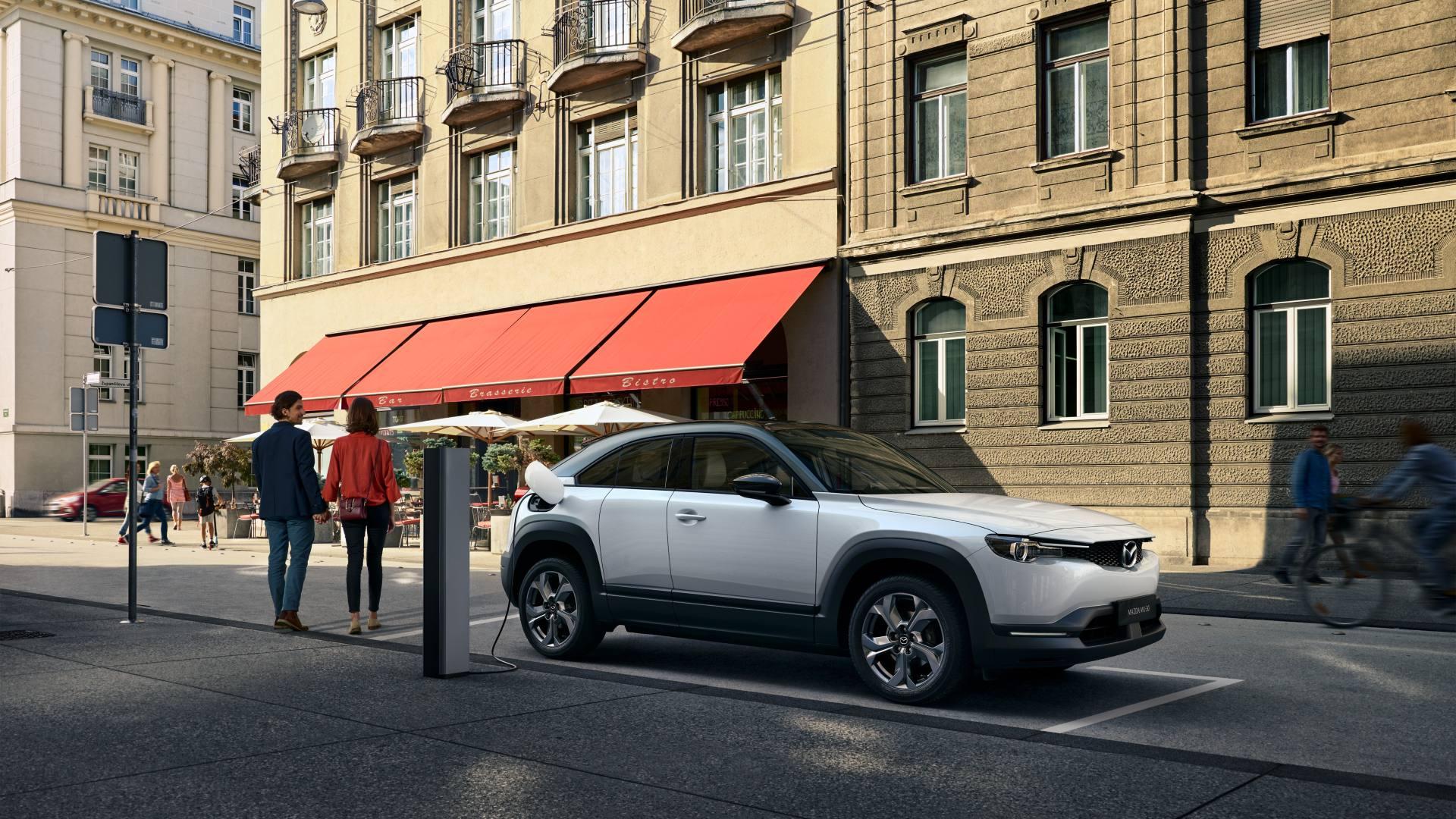
MAZDA MX-30 2022
Disappointing electric range for the first Mazda EV
Pros and cons
Pros
- Excellent balance of comfort and handling
- Ultra-smooth acceleration and braking
- Good driving position and front seats
- Meticulous finish
- Reasonable battery charging time
- Precise range indicator
Cons
- Disappointing range
- Tepid power for an EV
- Tight rear seats
- Mediocre visibility
- No all-wheel drive
Overview
Mazda is finally presenting its first electric vehicle, the Mazda MX-30. A subcompact crossover closely based on the CX-30, it swaps the latter’s gasoline engine for an all-electric powertrain with a 35.5 kWh lithium-ion battery. In price, size and front-wheel-drive configuration, the MX-30 is directly aimed at the Chevrolet Bolt EV, Hyundai Kona Electric and Kia Soul EV—all with significantly more range than the 161 km offered by the new Mazda.
Fully aware of the situation, Mazda says the small battery is meant to limit the weight of the CX-30, the goal being to offer the same engaging driving experience as its other products. It adds that the proposed range is sufficient for everyday use and that most Canadian owners of an electric vehicle (EV) also have a second vehicle capable of driving longer distances without refueling. It also admits that the Mazda CX-30’s platform limits the size of the battery it can install.
Mazda is not expecting record-breaking sales for its first EV. It will distribute 700 units the first year and only in Quebec and British Columbia, where the interest for electric vehicles is concentrated in Canada. A plug-in MX-30 hybrid will appear in showrooms across the country sometime in 2022; it will pair a rotary engine with its electric motor, but the technical specifications have yet to be revealed. By 2030 Mazda expects to sell three all-electric models, five plug-in hybrids, and as many classic hybrids.
Manufactured in Japan, the Mazda MX-30 is offered in GS and GT trims, priced from $44,100 to $50,200. In Quebec, it qualifies for the same $13,000 government rebates as the other EV’s of the segment.
Verdict
The Mazda MX-30 exemplifies the upscale image Mazda has been cultivating for the past five to ten years. Comfortable, well-made and quiet, it is distinguished by its highly refined electric powertrain and careful attention to detail. It delivers the celebrated Mazda drive, despite rather tepid off-the-line performance. However, all these qualities risk being overshadowed by the low range, which is out of place in a modern EV despite what the manufacturer says.
Evaluation
Body and cabin
The Mazda MX-30 does not display quite the same lines as the CX-30, but the two vehicles are within millimetres of each other in terms of exterior dimensions. However, the electric model provides 16 cm less legroom in the back. In addition, the Mazda MX-30 has rear-hinged rear doors that open only when the front doors are open, similar to certain extended-cab pickups or a BMW i3.It is therefore hard to envision using the MX-30 as a family vehicle, despite that rear passengers can press a button on the back of the driver’s seat to power it forward for more room to get out. This configuration also significantly reduces visibility, especially when changing lanes.
The MX-30 has 25 percent less cargo volume with the rear bench in place than the CX-30. Even the Hyundai Kona offers more, despite being 19 cm shorter. Maximum use of interior space doesn’t seem to have been a priority, which is nothing new at Mazda.
The situation improves in front. Body-hugging seats and an excellent driving position create a welcoming environment. Carefully executed and original, the finish calls on eco-friendly and innovative materials such as cork and fabrics made from recycled plastic bottles.
The dash is very similar to the Mazda CX-30’s, apart from a new touch screen for climate control. The display requires taking your eyes off the road for certain adjustments, but a few real buttons provide easy access to the main functions. The MX-30 uses Mazda’s first electronic gear selector, and like all such devices it requires a certain period of adaptation. On the other hand, eliminating the mechanical linkage made way for a vast open storage space under the centre console.
The infotainment system uses the same 8.8-inch non-touch display as the Mazda 3 and CX-30, controlled exclusively via two rotary controllers and a few buttons behind the shift lever. Some manipulations are more complex than with a well-designed touch screen; things become easier once you get the hang of the quick-access buttons on the console. In addition to Android Auto and Apple CarPlay connectivity, telematics include remote door lock/unlock and verification of vehicle status via a smart phone.
Convenience features are generous for the price; even the entry-level GS offers a head-up display and navigation. GT adds a power sunroof, power and memory driver’s seat, auto-dimming mirrors and a 12-speaker Bose audio system. Moreover, Mazda has partnered with ChargePoint to offer a $500 credit applicable at the latter’s public charging network or towards the purchase of a ChargePoint residential charging station.
Security
Crash test results
National Highway Traffic Safety Administration (NHTSA)Overall score: 5 / 5
Frontal impact: 5 / 5
Side impact: 5 / 5
Rollover resistance: 4 / 5
All MX-30s come will a full suite of advanced safety and driver assistance systems including blind-spot monitoring, automatic emergency braking with pedestrian detection, lane keep assist and adaptive cruise control. The GT adds surround view cameras, front cross traffic alert, reverse automatic emergency braking and traffic jam assistance, among others. Of course, these systems never replace driver vigilance.
The Insurance Institute for Highway Safety (IIHS) hasn't yet tested the Mazda MX-30 for crash protection. However, the small EV SUV received EuroNCAP’s top five-star rating, and the Mazda CX-30 on which it is based is rated a Top safety pick by the IIHS.
Mechanical overview
The structure of the Mazda MX-30 is 45 percent more rigid than the Mazda CX-30’s even though they share the same platform. The explanation lies underneath the cabin, or more precisely, with the solid safety structure surrounding the battery. Moreover, the electric motor as opposed to a gas engine sufficiently reduces vibration to allow the use of tires that are 15-percent stiffer, without compromising comfort. As a result, according to Mazda, steering response is much more direct.The MX-30 uses the same suspensions as its gas-engine cousin—independent strut front and semi-independent torsion beam rear—but tuned in function of the electric model’s 200 kg or so extra weight.
Unsurprisingly, most of that weight increase is due to the lithium-ion drive battery. Designed in collaboration with Panasonic, this liquid-cooled battery also has a heat pump, which should attenuate the range loss associated with cold weather.
That’s all for the better, given that a capacity of 35.5 kWh gives a theoretical range of 161 km, according to U.S. Environmental Protection Agency estimates. It should be remembered that temperatures between minus 5oC and minus 10oC reduce the range of a drive battery between 20 and 30 percent, and as much as 50 percent at minus 25oC and below.
According to Mazda, the charging time to bring the battery from 20 percent to 80 percent is 2 hours and 50 minutes at a 240-volt 30-amp charging station, either public or domestic. It takes 36 minutes to get to 80 percent with a 50-kw fast-charger, the maximum the vehicle can accept. For people not pressed for time, a 120-volt 15‑amp domestic outlet delivers the same result in 13 hours and 40 minutes.
Manufacturer’s specifications indicate an energy consumption equivalent to 2.4 L of gasoline per 100 km (Le/100 km) city, and 2.8 Le/100 km highway, for a combined average of 2.6 Le/100 km. That is higher than a Bolt EV or an electric Kona (2 Le/100 km average). Our test of the MX-30 on mixed roads yielded an average of 18 kWh per 100 km according to the trip computer, or exactly 2 Le/100 km. Such integrated indicators are often overly optimistic, but the result is still promising.
Like all EV’s, the MX-30 uses deceleration energy recovery and regenerative braking to save battery energy. The intensity of regeneration is controlled by steering wheel paddles. Traditional friction brakes do the rest, but they are not directly linked to the pedal. Like vehicle throttles for many years, the MX-30’s brake pedal sends a signal to a module that continuously adjusts the proportion of regenerative and friction braking.
The brakes work with the torque vectoring system, as needed, to improve cornering grip. Mazda claims that the electric motor allowed it to refine torque distribution and selective braking to quicken the response of the system. It also says that the throttle has been carefully tuned to minimize jerkiness and smooth the ride.
Driving impressions
Our first contact with the Mazda MX-30 unfolded in pelting rain at the vehicle launch organized by Mazda in the Montérégie region. Weather conditions prevented us from fully evaluating the road grip in the few sharp turns the route included. Worse yet, just as the deluge ceased, we experienced a slow tire leak, duly signalled by the tire pressure monitor system.All the same, the test route allowed us to appreciate the extreme refinement of the powertrain. With only 143 horsepower on tap, acceleration lacks the vigour of a Bolt EV or Kona. However, it stands out for exceptional linearity and smoothness, even for an EV. Acceleration is accompanied by a well-tuned, artificial gas-engine sound that never becomes annoying.
Mazda promised that the braking had nothing to envy a traditional system in terms of smoothness, and sure enough, the pedal conserves its bite while remaining easy to modulate. The regenerative braking is less aggressive than that of certain rival systems, but it still allows you to bring the vehicle to nearly a complete stop without touching the pedal.
The suspension seemed more compliant on degraded pavement than that of the Mazda CX-30 we were testing at the time. It avoids the occasional stiffness noted with an electric Kona. The steering displays the exemplary precision and weighting we’ve come to expect from Mazda.
There’s still the thorny question of range… At start-off, the range meter indicated 186 km, falling immediately to 171 km when the climate control switched on. After exactly 100 km on mixed terrain—highway, suburban and country roads—that had dropped by 102 km, to stand at 69 km. In view of the limited maximum distance allowed by the battery, such precision is of special importance.
One thing Mazda fans are sure to find in the MX-30 is the finely tuned balance of refinement and driving enjoyment that has been the focus of the automaker for the past several years. They will just have to learn to live with lower range than the current EV average, or else plan on more frequent stops at a quick-charge station.
Features and specs
| Price range (including shipping and preparation) | ||
| Minimum price |
$44,100
| |
|---|---|---|
| Maximum price |
$0
| |
| Price as tested | $0 | |
| Trim levels | ||
| Towing |
false
| ||
|---|---|---|---|