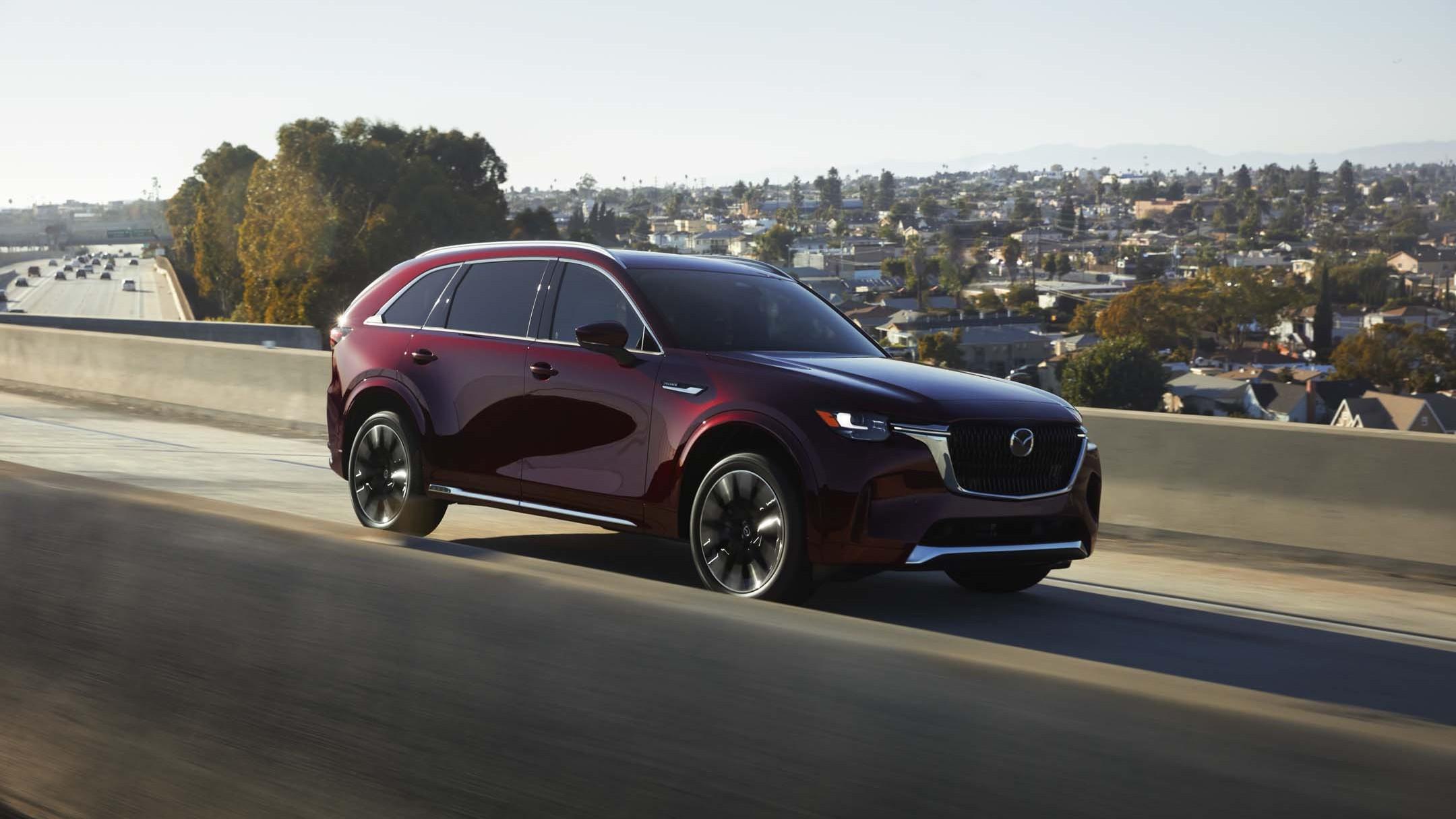
MAZDA CX-90 2024
This eight-passenger SUV expertly marries agility with refinement
Pros and cons
Pros
- Outstanding 6-cylinder engine
- Responsive road holding
- Flawless finish
- Quality soundproofing
- Improved driving position
- At long last, a plug-in hybrid Mazda
Cons
- Hesitant transmission at low speeds
- Disappointing electric range (PHEV)
- Firm ride (21-inch rims)
- Interior space still below average
- Certain controls can be annoying
- Rising price
Overview
The Mazda CX-90 brings quite a breath of fresh air to Mazda. Not only does it replace the aging CX-9, but it also introduces a longitudinal-engine platform and a mild-hybrid turbocharged six-cylinder, in addition to a separate plug-in hybrid powertrain and an eight-speed automatic transmission. These technologies will eventually make their way to other models from the automaker, but they first appear in a three-row SUV, a lucrative type of vehicle if there ever was one.
With the arrival of plug-in models, there are now twice as many versions as there were for the 2023 CX-9. There are seven six-cylinder variants, priced between $47,895 and $65,945, and then three plug-in hybrids, ranging from $56,895 to $66,995 (including shipping and preparation). These are eligible for government incentives of $7500 applied after taxes are calculated, making up about two-thirds of the surplus when compared to a non-plug-in CX-90.
It is clear that Mazda wants to push further the high-end positioning it has embraced in recent years. This is reflected in the prices of the more plush CX-90s, which overlap those of models with more prestigious labels. In fact, if one compares the gas-powered CX-90 with the CX-9, one notices a price increase of $3500 to $9250 depending on the version. That being said, many “popular” brand rivals are now being sold for well over $50,000. In other words, Mazda’s large SUV is no longer the bargain it had become in recent years.
While mainly intended for the North American market, the CX-90 is sourced from a Japanese Mazda plant.
(Video in French only)
Verdict
A sheer delight to drive, the Mazda CX-90 is an excellent bridge between its mass-market competitors and the much more expensive luxury models. Although a bit firm, it picks up with a pleasant combination of agility, solidity and refinement—especially with the smooth inline six-cylinder engine. The plug-in hybrid version also fares quite well on the road, although it may not seem to be exploiting the full potential of its electrified powertrain. To be tested again in our daily environment, whereby we will also be able to verify whether the increased interior space is really in line with the competition.
Evaluation
Body and cabin
The Mazda CX-90 stretches 5.5cm longer than the CX-9 it replaces, with a 19cm extended wheelbase. The latter now reaches 312cm, at the top of its category. And yet, the interior only seems slightly roomier than the CX-9’s, a feeling that is confirmed by the automaker’s data.
Indeed, a good portion of the additional centimetres enhance the engine compartment, which is lengthened both to accommodate the longitudinal powertrain (front-to-rear oriented) and to achieve a dynamic look. Still, Mazda has managed to improve the third row’s spaciousness, so much so that the bench seat can now accommodate three (small) persons in most versions. This increases the total capacity to eight passengers, while the models with middle bucket seats can accommodate seven—except for the luxurious Signature variant, whose seating capacity is limited to six.
All things considered, a family is going to feel more comfortable in the CX-90 than in its predecessor. They’ll also have more room to store their belongings. However, a number of Mazda’s competitors remain more generous when it comes to cargo volume, with the Honda Pilot and Chevrolet Traverse topping the list.
On the other hand, the CX-90 towers over them all in terms of finish, at least among the high-end models. This is no show-off: the Signature variant’s interior is effortlessly up to par with that of luxury products, with its fine leathers, rare woodwork and suede trim. We also found the front seats to be better padded with a slightly longer base than in most Mazda models. The centre console is still wide, but we found it less restrictive for the right knee. To be confirmed after a test drive longer than a few hours.
Precise controls add to the premium experience, albeit some of them do require a fair amount of adjustment. These include the new and unusual electronic gear selector and the overabundance of menus in the infotainment system. The latter retains a 10.25-inch screen, except in the Signature model, which gets the first 12.3-inch display in Mazda’s lineup. Android Auto and Apple CarPlay make some tasks easier, but in the GS and GS-L versions, you still have to plug your phone into a USB port to access it.
Safety
All Mazda CX-90s offer standard driver assistance features, including blind-spot monitoring, automatic emergency braking with pedestrian detection and adaptive cruise control with stop-and-go driving. Strangely, the rear-seat occupant warning only appears on the GS-L version, a feature Mazda should offer by default in this family car. Reverse automatic emergency braking, a forward cross-traffic alert, surround-view cameras and collision-avoidance assist devices are added to the list as you move up the GT, GT-P and Signature tiers. A reminder: none of these systems replace a good driver’s vigilance.
Crash test results
National Highway Traffic Safety Administration (NHTSA)
Overall score: 5 / 5
Frontal impact: 4 / 5
Side impact: 5 / 5
Rollover resistance: 4 / 5
Insurance Institute For Highway Safety (IIHS)
Moderate overlap frontal impact: 4 / 4
Small overlap frontal impact: 4 / 4
Side impact: 4 / 4
Rear impact: Not tested
Roof strength: Not tested
Mechanical overview
No Mazda product has boasted as many new mechanical features as the CX-90 since the arrival of the previous Mazda 3 generation 10 years ago.
The Mazda CX-90 first joins the rather select club of popular brand SUVs with a unibody, longitudinal engine structure, alongside the Ford Explorer and Jeep Grand Cherokee. Like them, the largest Mazda comes standard with all-wheel drive. This gives the rear wheels priority in normal driving, and then transfers more torque to the front wheels under hard acceleration, when cornering or on slippery surfaces. Such a layout usually favours sporty driving behaviour, which is consistent with both Mazda’s positioning and that of many luxury models — think BMW X5, Mercedes-Benz GLE and Porsche Cayenne, for instance.
The CX-90’s double-wishbone front suspension also owes more to luxury models than to mass-market vehicles. The same goes for the 21-inch rims, wrapped in huge 275-width tires, which appear from the GT trim. Such tires are great for handling, but they make the ride stiffer and can easily cost $500 each to replace.
The 3.3-litre turbocharged inline-six that powers all non-plug-in versions of the CX-90 is a third element directly inspired by luxury brands, most notably BMW. This engine exists in two versions: the GS, GS-L and GT models produce 280 horsepower and 332 lb-ft of torque, while the GT-P and Signature models produce 340 horsepower and 369 lb-ft when fuelled with 93 octane gas. It drops to 319 horsepower on regular fuel.
All six-cylinder CX-90s are equipped with a 48-volt mild-hybrid system that combines a battery with an electric motor, both of which are small in size, with the aim of lowering fuel consumption. The electric motor sits between the internal combustion engine and the eight-speed automatic transmission, which shifts using clutch plates rather than a traditional torque converter.
The same layout prevails in the CX-90 plug-in hybrid, although the electric motor and battery are larger. The latter has a capacity of 17.8 kilowatt-hours, which theoretically allows the vehicle to be propelled over 42km without using gas. Together with the non-turbocharged 2.5-litre four-cylinder used in most other Mazdas, the plug-in powertrain delivers the same 319 horsepower and 369 lb-ft as the high-end six-cylinder on regular fuel.
Despite this, the plug-in variants do not have the 2268kg (5000lb) towing capacity associated with the inline-six in the GS-L with Enhanced Package, GT, GT-P and Signature versions. Rather, they can tow a maximum of 1588kg (3500lb), much like the CX-90 GS and GS-L equipped with the 3.3-litre engine.
Mazda has calculated that the battery requires 1h20 to go from 20 to 80% of its capacity with a 240-volt, 30-amp terminal, or 6h24 when plugged into a standard 15-amp household outlet. Natural Resources Canada has not yet released data about the duration of a full charge or the fuel consumption ratings.
For a combined city-highway use, the automaker estimates them at 9.3L/100km for the base 3.3-litre engine and 9.5L/100km for its high-output version. Plug-in models would achieve 4.2L/100km when using electric range, and 9.4L/100km in gas-only mode. While these predictions are impressive for gas-powered models, they actually position PHEV versions in the bottom half of the plug-in hybrid SUV category, alongside vehicles like the Jeep Grand Cherokee 4xe, Lincoln Aviator Grand Touring and BMW X5 xDrive45e.
Driving impressions
Mazda had mapped out an exciting and varied route to introduce the CX-90 to the automotive press, between San Francisco and the Sonoma wine region. The first stretch of the journey took place in a Signature model whose six-cylinder engine instantly won over your journalist.
Well, almost instantly, since we first had to get out of a city centre where no GPS signal could be received… Then, once outside the city, we had to endure the stubbornness of the navigation system, which kept trying to bring us back to waypoints located far behind. A few detours and stops later, we finally managed to reprogram the route to reach the lunch meeting point, where several other testers reported very similar stories.
The silver lining? We’ve had even more time to sample one of the most enjoyable mid-size SUVs available on the market. Impeccably smooth and melodious, the high-output 3.3-litre engine raises the Mazda CX-90 into a class of its own. While not as explosive as BMW’s latest turbocharged six-cylinder, Mazda’s does deliver great performance right up to the redline on the tachometer—unlike many supercharged four-cylinder engines that quickly run out of steam, including the one in the old CX-9. The 8.6L/100km displayed in the trip computer at the end of our test turned out to be promising.
The new engine perfectly complements the refined interior, advanced soundproofing and athletic design of the vehicle. The CX-90 is just as stable keeping up with traffic at 120 km/h on a Californian highway as it is when tackling a winding section of the Pacific Coast Highway. The precise and communicative steering as well as the low cornering angle are so sharp that one almost forgets they are driving an SUV weighing over two tons. Its considerable footprint on a winding road is a reality check, as is its somewhat lacking braking bite—a common Mazda weakness.
Even heavier than the gasoline variant, the plug-in Mazda CX-90 tested on the way back still delivers ample performance. Its four-cylinder is louder and rougher than the turbo six-cylinder, but we found it more refined than in other Mazdas. However, it kicked in more often than not under moderate acceleration, even though the battery was far from being depleted. This prevented us from verifying the exact number of kilometres travelled in electric mode. A full test drive under regular conditions should be done to better assess the capabilities of this engine.
Given the dismal condition of some of our roads, it will also be possible to verify whether the firm damping noted on California’s roads will turn here into an overly stiff ride. A follow-up drive in urban areas will ultimately put the new transmission, which hesitated more often than not at low speeds in the six-cylinder version, to the test. Even though this eight-speed gearbox shines once the vehicle is launched, Mazda still has some polishing to do for it to achieve the smoothness of its six-speed transmission.
Features and specs
Price range (including shipping and preparation) | ||
| Minimum price | $48,095 | |
|---|---|---|
| Maximum price | N/A | |
| Price as tested | N/A | |
| Trim levels | GS
GS-L
PHEV GS
GT
GT-P
PHEV GS-L
Signature
PHEV GT | |
| Wheelbase | N/A | ||
|---|---|---|---|
| Length | N/A | ||
| Width | N/A | ||
| Height | N/A | ||
| Curb weight | N/A | ||
| Towing | Not recommended | ||