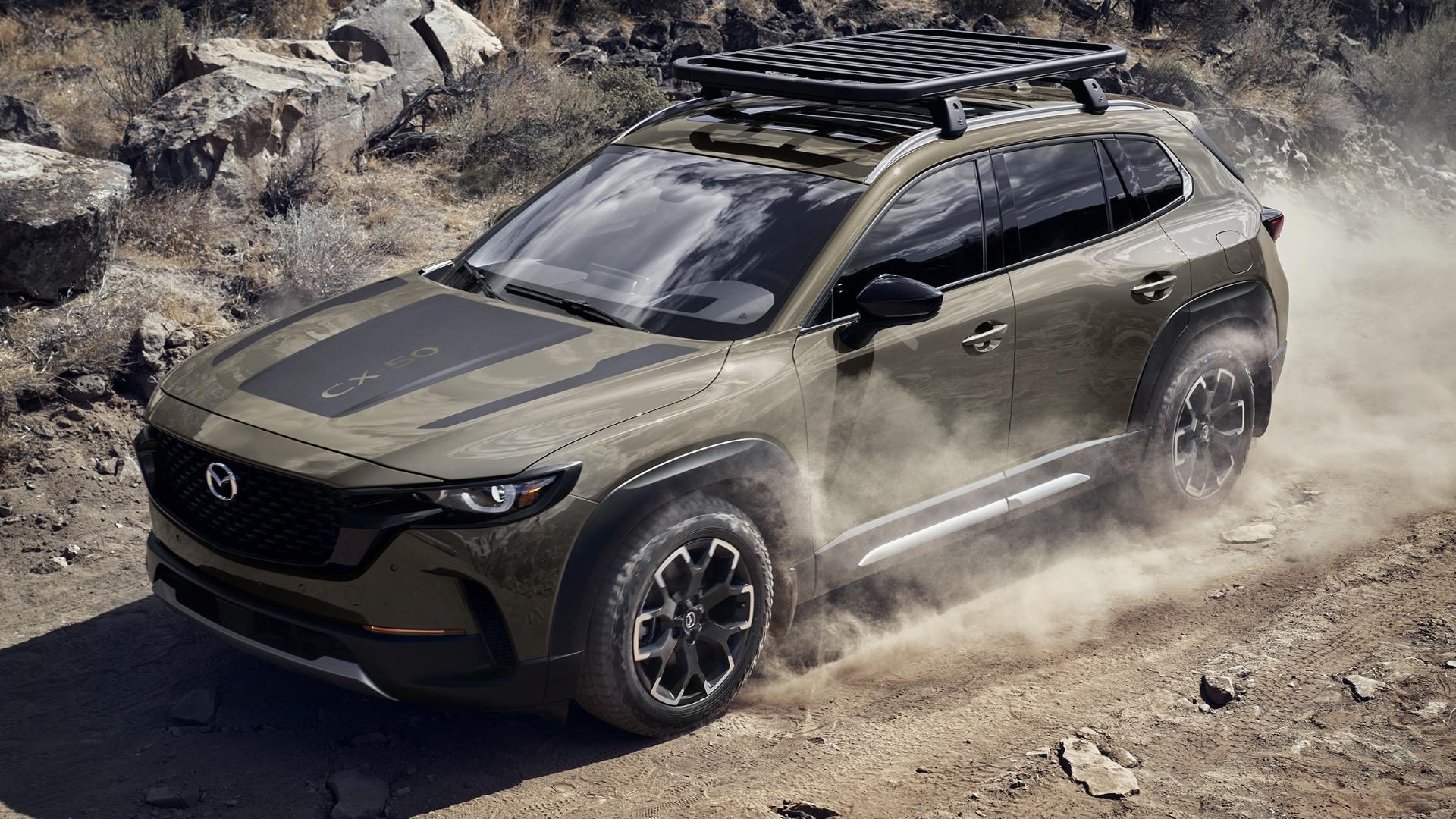
MAZDA CX-50 2023
For lovers of getaways (slightly) off the beaten path
Pros and cons
Pros
- Smooth and powerful turbo engine
- Exemplary steering
- Dynamic road comportment
- Quiet cabin
- Impeccable finish
- Long cargo floor
Cons
- Firm suspension
- Restricted visibility
- Unusual infotainment system
- Outdated transmission
- Improved but just adequate rear space
- High price
Overview
Mazda is adding another SUV to its lineup for model-year 2023. The new Mazda CX-50 slots slightly above the CX-5 in price, size, equipment, off-road capabilities and towing capacity. It shares its basic mechanical components, including the gasoline powertrains, with the CX-5, which is here to stay. But unlike the CX-5, the CX-50 targets avid fans of the outdoors and (mild) off-road adventures, like the Subaru Outback.
The Outback is an admitted and no doubt the chief rival of the CX-50, judging by the numerous similitudes between the two vehicles. The Mazda CX-50 also takes on larger compact SUVs of the likes of the Honda CR-V and Toyota RAV4. The automaker even compares it to luxury crossovers such as the Acura RDX and Lexus NX, which is not as outlandish as it may seem in light of the high-end image Mazda has been cultivating for several years now.
Price-wise, the Mazda CX-50 commands some $2,000 to $3,000 more than a similarly equipped CX-5. GS-L trim sells for $39,850, including destination charges, while a fully equipped GT Turbo tops out at $47,950. Later this year, an even more “rugged” Meridian Edition will join the lineup, distinguished by all-terrain tires mounted on 18-inch wheels and unique styling touches. A hybrid variant is also in the works, though Mazda did not want to say when it will go on sale.
Designed specifically for North America, the CX-50 is built in Alabama at a new Mazda/Toyota plant.
Verdict
Why choose a Mazda CX-50 rather than a Mazda CX-5? Mainly for its more practical cargo area and superior towing capacity, at least with the turbo engine. Also, the CX‑50’s driving position makes it more enjoyable than its smaller sibling on a day-to-day basis. Refined though the newcomer may be, price is something to think hard about when comparing it to the Subaru Outback or certain roomier and more powerful midsized SUVs.
Evaluation
Body and cabin
The Mazda CX-50 is 15 cm longer than the CX-5, placing it at the upper limit of the compact SUV segment. However, in width and wheelbase it compares to the midsized Ford Edge and Hyundai Santa Fe.Even so, the Mazda CX-50’s cabin is no roomier than that of shorter SUVs like the Honda CR-V and Toyota RAV4. True, the cabin feels more substantial than the CX‑5’s, and can accommodate four adults at a time, but the CX-5 holds the advantage in all other interior measurements except legroom.
It must be said that the CX-50 gives up 6 cm of height to its predecessor, mainly because of styling. It explains why its cargo volume barely exceeds that of the CX‑5, despite an extra 13 cm of floor length between the liftgate and the rear seatbacks. Still, if you rarely pile luggage right to the roof, you will probably find the CX-50’s longer cargo area more useful.
Unfortunately, it does not get the carpeted sides that prevent a lot of scratches in Mazda’s other SUVs. The automaker supposedly chose plastic to make the CX‑50 easier to clean, but we think it is more about cost saving. The same goes for the lack of a separate fold-down middle section on the rear seat as offered on the CX-5.
The CX-50 does rectify a major weakness of the CX-5: an uncomfortable driving position for tall individuals. The move to Mazda’s latest platform made it possible to advance the dead pedal, lengthen the centre armrest and provide more front knee room. The seats also are longer and wider than on the CX-5, making them more inviting without penalizing overall support. However, they display the same excessive firmness noted on several Mazdas over the years.
The dashboard also follows the automaker’s recent styling trends with its horizontal design and rich, elegant finish. The infotainment system still pairs a low-profile screen with a large control knob placed behind the shift lever and flanked by a few buttons to access the main functions. Though better organized than before, Mazda’s interface still has a steeper learning curve than several rival systems. For the first time, the screen is touch enabled when the vehicle is moving. However, it is situated too far from the driver for that to be really usable.
Wireless Android Auto/Apple CarPlay is another new feature for a Mazda, along with the standard panoramic opening sunroof. Dual-zone climate control, power liftgate, 10-way adjustable driver’s seat and push-button start are also standard, since the CX-50 comes in only two, relatively luxurious trims.
Safety
All CX-50s come with the usual driving assistance features like automatic emergency braking with pedestrian warning, lane departure warning, blind-spot monitoring and automatic high beams. GT trim adds others such as surround-view cameras, directional headlights, automatic emergency reverse braking and, new from Mazda, blind-spot collision avoidance assistance. As always, it must be remembered that none of these devices replace driver vigilance.
Crash test results
National Highway Traffic Safety Administration (NHTSA)
Overall score: 5 / 5
Frontal impact: 5 / 5
Side impact: 5 / 5
Rollover resistance: 4 / 5
Insurance Institute For Highway Safety (IIHS)
Moderate overlap frontal impact: 4 / 4
Small overlap frontal impact:
- driver side: 4 / 4
- passenger side: 4 / 4
Side impact: 4 / 4
Rear impact: 4 / 4
Roof strength: 4 / 4
IIHS Top Safety Pick
Mechanical overview
The Mazda CX-50 uses what Mazda calls its seventh-generation platform, which also underpins the CX-30, MX-30 and Mazda 3. Unlike the CX-5 and CX-9, the new model is equipped with a torsion beam rear suspension. The vast majority of CX-50 rivals use an independent suspension, more expensive to maintain that the torsion beam but also more sophisticated.The rest of the specifications closely resemble those of the Mazda CX-5, starting with the 2.5-litre four-cylinder engine. The base version still outputs 187 hp and 186 lb-ft of torque, which places the Mazda CX-50 in the range of a Hyundai Santa Fe or Subaru Outback.
With regular gasoline the turbocharged version develops 40 more horses and, more notably, 310 lb-ft of torque at 2,000 rpm. Using 93-octane gasoline boosts power to 256 hp and adds 10 lb-ft of torque.
Both engine variants are mated to a six-speed automatic transmission Mazda has been using for ten years. Consumers who were looking forward to the inline six and eight-speed transmission rumoured to be in the works will probably have to wait for arrival of the CX-70 and CX-90 in a few years’ time.
All CX-50s come with automatic all-wheel drive. As is customary, up to 50 percent of torque can be sent to the rear wheels depending on driving conditions. Mazda combines this AWD with its G-Vectoring Control Plus, which acts individually on the brakes at each wheel to sharpen response in all phases of a turn.
Both systems also contribute to the Off-Road and Sport driving modes offered by the CX-50. Off-Road mode reacts differently depending on incline and driving speed. Sport mode reduces the assistance and quickens the response of the steering, as well as holding shifts longer.
The GT Turbo version also includes a towing mode, as it is the only model to offer a 1,588 kg (3,500 lb) towing capacity, relatively rare for a compact SUV. This mode functions only when a factory wiring harness—available at dealerships—connects the trailer to the vehicle. The naturally aspirated engine versions can tow up to 907 kg (2,000 lb).
In terms of fuel economy, the Mazda CX-50 lists a combined city-highway rating of 8.9 L/100 km with the base engine and 9.4 L/100 km with the turbo. That is slightly more than the CX-5 and midway between an Outback and Santa Fe. Hopefully, the upcoming hybrid version will improve this aspect.
Driving impressions
If you have driven a recent Mazda SUV, you will feel at home at the wheel of the Mazda CX-50. First you’ll find the same precise and direct steering with just the right assist to connect the driver nicely to the road. The steering firms up a notch in Sport mode, but it already delivers excellent road feel in Normal.The CX-50 displays Mazda’s celebrated aplomb in turns, but the extra width relative to the CX-5 reduces agility somewhat. The suspension controls body lean well and ensures a stable ride on bumpy pavement. Few torsion-beam setups damper rear-wheel rebound with this efficiency.
However, the firmness of the springs might be off-putting for certain people. Describing the ride as stiff would be an exaggeration, but several competitors, starting with the Santa Fe and Outback, isolate the cabin better from pavement defects.
The test route organized in the Montérégie and Estrie regions included long sections of winding and muddy gravel roads that were badly battered by the winter. The CX-50 did a good job, though our tester’s big 20-inch winter tires made it very sensitive to road ruts. Off-road mode improved traction somewhat, but we noticed little difference from Normal mode. The 18-inch wheels of the upcoming Meridian Edition may be better adapted to off-road driving.
The turbo engine performs just as well on the CX-50 as it does on the other models of the Mazda lineup. Generous low-rev torque ensures energetic response without ever giving the impression that the engine is working hard. It doesn’t much matter if it loses steam at high rpm’s since it rarely hits that zone of the tachometer. It gets a bit loud in acceleration, but is always unfailingly smooth.
Mazda stoutly maintains that its six-speed transmission contributes to driving enjoyment. It is true that it exploits power very well by carefully avoiding jerking in conjunction with the hyper-linear throttle. Still, two or three extra gears could help reduce fuel consumption and make the vehicle more up to date. We’ll follow up when the new six-cylinder engine appears in the Mazda lineup.
Features and specs
Price range (including shipping and preparation) | ||
| Minimum price | $40,345 | |
|---|---|---|
| Maximum price | N/A | |
| Price as tested | N/A | |
| Trim levels | GS-L
GT
GT Turbo
Meridian Turbo | |
| Wheelbase | N/A | ||
|---|---|---|---|
| Length | N/A | ||
| Width | N/A | ||
| Height | N/A | ||
| Curb weight | N/A | ||
| Towing | Not recommended | ||