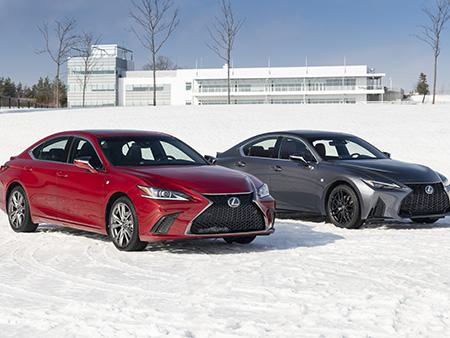
LEXUS Événement AWD 2021
A few driving lessons from closed-circuit winter testing
Pros and cons
Pros
- Not applicable
Cons
- Not applicable
Overview
All-wheel drive continues to widen its appeal in Canada, especially among buyers of luxury-brand vehicles. Lexus fans are a case in point, with 93 percent of them opting for an AWD model last year, compared to 77 percent in 2014. At the close of winter 2021, Lexus invited us to test and compare three types of all-wheel drive used on its best-selling products, including hybrids. We also took advantage of the closed-track sessions to brush up our driving skills.
The event demonstrated that not all all-wheel-drive systems are the same; CAA-Quebec’s experts explain why.
Verdict
A track test of an all-wheel drive reveals much about its capabilities in extreme conditions. In the case of Lexus, its traditional systems provide more precise control than the electric system of the hybrids, provided you use a bit of elbow grease. However, it should be remembered that in everyday life, the main drive wheels, front or rear, do most of the work. All-wheel drive, no matter which type, mostly helps accelerate away from a green light or get out of a snowbank… but it never lets you stop faster.
Evaluation
Body and cabin
Sedan, crossover or truck-based SUV: nearly every 2021 Lexus model offers standard or optional all-wheel drive. The only exceptions are the RC F sport coupe and the quasi-exotic LC, both rear-wheel drive.Toyota’s luxury division Lexus lined up six models for its all-wheel-drive test event: three SUVs, two sedans and a coupe.
The Lexus RX is the brand’s long-time best-selling model in North America. Sold since 1999, it was one of the first midsized crossovers based on a car platform—in this case, the Toyota Camry. Now in its fifth year, the fourth generation comes with standard all-wheel drive in Canada. It is offered as a gasoline or hybrid model, with a 3.5-litre V6 and five seats. A lengthened RX L model was introduced in 2018 to accommodate two more passengers.
Launched two years earlier, the Lexus NX series derives from the old Toyota RAV4. It, too, offers four-wheel drive to all its Canadian buyers and a choice of gas or non-plug-in hybrid engines. The NX 300 and base IS 300 sedan share the brand’s only turbo engine, a 2.0-litre four-cylinder outputting 235 horsepower. The hybrid powertrain is similar to that of the Toyota RAV4, Highlander and Sienna, with slightly less power.
The sub-compact Lexus UX SUV enters its third year on the market. It is less popular than its large siblings, perhaps due to a rather tight cabin for the category. The base model is front-wheel drive, but fully 99 percent of models sold in Canada pair a hybrid four-cylinder with all-wheel drive. Unlike the NX and RX, the UX uses the global platform underpinning, in various forms, nearly all recent transverse-engine Toyotas.
That is also the case of the Lexus ES, which has always been closely linked to the Camry. Originating with the Lexus brand thirty years ago, it offered AWD only last year. This system comes only with a 2.5-litre four-cylinder instead of the V6 or the hybrid engine offered for years now. As strange as it may seem, the 4WD ends up being the least expensive of the ES models.
Newly redesigned for 2021, the Lexus IS sedan is similar to earlier versions in terms of structure and mechanical layout. While a rear-wheel-drive base version is available, almost all IS models sold here have an AWD badge on the trunk lid and a 3.5-litre V6 under the hood.
The same powertrain is used for the Lexus RC series, which is more or less a two-door version of the IS. However, this model did not get the same refresh as the sedan this year. The sedan already is not noted for interior space; unsurprisingly, the rear seats on the RC are strictly symbolic.
At close to $70,000, the gasoline and hybrid RXs were the most expensive vehicles of the event. UX and ES models retail for around $50,000, with the others falling somewhere between the two extremes.
Safety
Toyota and its satellite brands were among the earliest to offer a full suite of driving assistance features on the near-totality of their lineups, starting in 2017. Lexus stands out in this respect from its German rivals, some of which barely offer automatic emergency braking as standard equipment. It is a clear advantage even though none of these systems are a substitute for driver vigilance.
The Insurance Institute for Highway Safety classes all the test-event models among the best in their respective categories in terms of crash protection. All are also equipped with LED headlights that were highly rated in IIHS tests.
Mechanical overview
The six models presented by Lexus at its AWD event demonstrate three distinct types of all-wheel drive.The Lexus NX 300, Lexus RX 350 and Lexus ES 250 are equipped with a part-time all-wheel drive system that sends all power to the front in normal driving. A driveshaft automatically channels up to 50 percent to the rear axle in case of front-wheel slippage, sporty driving or heavy acceleration. The two SUVs can also lock the torque split equally between the two axles up to 40 km/h. In theory, for example, that will allow you to get out of deep snow more easily.
With the Lexus UX 250h, Lexus NX 300h and Lexus RX 450h hybrid engines, there is no mechanical connection between the two axles. Instead, an electric motor mounted on the rear axle powers the wheels. As with the mechanical drive system, this occurs especially when the front wheels begin to slip. Up to 80 percent of the instant torque produced by the electric motor can be directed to the rear. Also, the brakes can reduce the speed of each rear wheel so that power goes to the one with the most traction.
The Lexus IS 350 and Lexus RC 350 differ from the preceding models because of their basic rear-wheel-drive/longitudinal-engine architecture. In normal driving, their full-time all-wheel drive permanently sends 70 percent of power to the rear and the rest to the front. This 70/30 split can vary up to 50/50 depending on road grip conditions.
All of the above vehicles offer Eco, Normal and Sport drive mode selection. These modify throttle, transmission and steering response enough to feel a clear difference in winter driving conditions.
Driving impressions
Lexus invited a group of journalists to the Canadian Tire Motorsport Park, 100 km north-east of Toronto, to compare the all-wheel drive systems described above. Luckily, the low temperatures of the previous day allowed us to finish the four planned sessions before a splendid March sun got the better of certain icy surfaces.The first workshop pitted a 2021 IS 350 against a trio of IS 300s of the first generation, circa 2001 to 2005. The latter are part of a fleet of vehicles used by an automotive journalist from Ontario for ice driving courses that are as formative as they are fun. The reason is, these indestructible, 20-year-old vehicles, some with over 400,000 km on the odometer, are simple rear-wheel drive vehicles deliberately deprived of stability and traction control and even anti-lock brakes. Some have studded tires, others do not. Chills, thrills and semi-controlled skids are guaranteed.
The current IS 350 made short work of the partially icy, partially snow-covered oval track. Even with stability control switched off, it took concentrated effort to slide the car sideways. The contrast with the old IS 300s was startling; despite the studded tires, it took constant play on the accelerator plus counter-steering to avoid a spin-out. It was even more delicate with the non-studded tires. In terms of safety, the modern IS 350 clearly held the advantage but for pure driving fun, the venerable IS 300s won the day.
The second exercise allowed the traditional AWD of the RX 350 to be directly compared to the electric control system of the RX 450h. The latter develops 13 horsepower more than its gasoline counterpart. Yet in full-on acceleration, the RX 350 systematically beat the hybrid to the finish line. Deactivating the stability control widened the gap whereas locking the centre differential degraded the RX 350’s performance slightly. Engaging the Eco mode tamed things to the point of cancelling nearly all risk of skidding, especially with the hybrid, which is already less playful in Normal mode. The takeaway is, driving enthusiasts will prefer the traditional all-wheel drive, but prudent drivers might like the hybrid’s electric system more, as well as the 26 percent reduction in fuel consumption.
The third scenario lined up two UX 250h’s, one with winter tires and the other with all-season. After a full-throttle start off the line, you had to apply the brakes as hard as possible at the end of a straight. Surprise: under acceleration, the tester with the four-season tires followed its rival relatively closely. Braking was an entirely different story: the winter-tire vehicle stopped several metres before the other. Just one more proof that all-wheel drive is not a substitute for prudent driving and keeping a proper distance from the preceding vehicle.
Our ultimate test of the day, a slalom, featured a pair of NX models, one hybrid and the other gasoline. Once again, the hybrid’s AWD system acted much more gradually than the traditional system on the NX 300. It is an advantage in everyday driving, but in an emergency there is almost no way you could pivot the rear end using the accelerator.
It is the exact opposite with the RC 350. Its rear end easily slid out on the same course, even with the stability control functioning. It was fun, but it could also catch an inattentive drive off-guard. All in all, the front-bias AWD of the ES 250 seemed to react more quickly than the full-time AWD of the RC 350. Although the ES is first and foremost a front-wheel drive, the rear end could be made to dance around quite gracefully.
One element that became manifest, independent of the type of all-wheel drive, was that the front end always wants to plough straight ahead when you take a slippery turn too quickly. Some models allow you to correct the situation with a press on the accelerator, others less so. But in all cases, you must avoid hitting the brakes or steering hard towards where you want to go. Instead, you must ease off the accelerator and steer slightly in the opposite direction, then quickly back in the desired direction, alternating between the two. That will allow the tires to find some grip rather than just slide sideways.
Features and specs
| Wheelbase | N/A | ||
|---|---|---|---|
| Length | N/A | ||
| Width | N/A | ||
| Height | N/A | ||
| Curb weight | N/A | ||
| Towing | Not recommended | ||