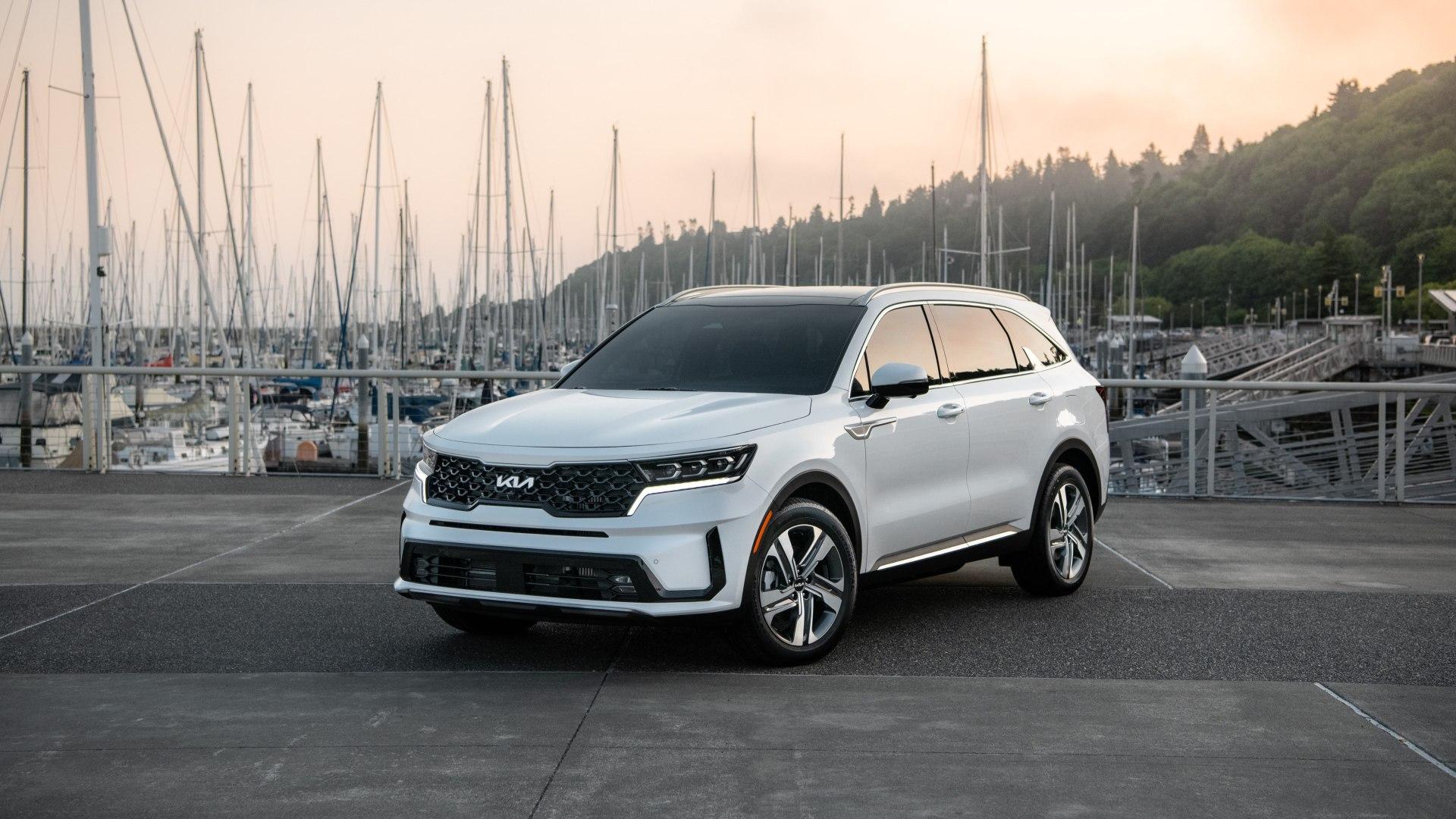
KIA Sorento PHEV 2023
As versatile as ever, especially the plug-in hybrid version
Pros and cons
Pros
- Quiet ride
- Comfortable suspension and seats
- Reasonable consumption for the size
- Spacious and practical cabin
- Generally logical controls
- Lower priced than a gasoline model
Cons
- Electric-gasoline transition sometimes slow
- 100‑percent electric mode practically inaccessible in winter
- Small gas tank
- Uninspiring handling
- Adaptive cruise control only (EX+ and SX)
Overview
Kia has been selling a plug-in hybrid version of the Sorento for about a year. In Canada, it is offered in three trim levels, and not limited to the most expensive model, as with certain competitors and Kia itself in the United States. All trims have an all-electric range of 51 km, with the battery reducing neither the number of rows (three) nor cargo space relative to the gas-only models. Thanks to government rebates, the Sorento PHEV costs less than an equivalent gasoline model.
The main rival of Kia’s plug-in SUV is its own close cousin, the Hyundai Santa Fe plug-in hybrid. However, the latter seats five only, in two rows of seats. The same goes for the Ford Escape plug-in hybrid and Toyota RAV4 Prime, both slightly less spacious than the Kia Sorento but comparable just the same. Only the newly redesigned Mitsubishi Outlander PHEV pairs a plug-in powertrain with seven-passenger seating, though again in a slightly smaller vehicle.
At around $50,000, the Kia Sorento PHEV EX prices at close to $3,000 more than a similar variant without the electric motor. That difference widens to $5,450 for an EX+ version and to more than $6,000 for an SX. However, the federal and provincial rebates reverse the situation, totalling $7,000 after calculating taxes.
Unlike the non-electrified Sorento, which Kia assembles in the United States, the PHEV is manufactured in South Korea.
Verdict
If you’re hoping for gasoline-free driving in cold weather, don’t buy the Kia Sorento PHEV: it succeeds no more often in this respect than any of the other plug-in hybrids we tested in similar conditions. But if you are turned on by a 20‑percent fuel economy relative to a gas-engine Sorento, not counting the many electric-only kilometres you’ll drive in good weather, by all means, order the plug-in variant. Its comfort, refinement and versatility will amply compensate for the long wait.
Evaluation
Body, cabin and cargo space
A badge on the liftgate, distinctive wheels, some metallicized trim bits and, of course, a charging port on the passenger side are all that distinguish a PHEV Sorento from a gas model, at least on the outside. Not forgetting paint colours, with slight differences between the two lineups. Two years on, the body styling is still as modern and attractive as ever.
The particulars of the plug-in’s cabin are equally discreet. Most noticeable is the rotary gear selector that Kia installs on all its electrified models. Note that if you turn it completely to the left to select Park, as usual with this type of selector, you will end up in reverse. It can be surprising, until you get used to pressing on the middle of the selector once the vehicle is parked.
Instead of a tachometer, the instrument cluster features a gauge indicating power demand or charging intensity, depending on the pressure on the accelerator and brake pedal. The SX also has its own colour combinations, including a nice off-white and navy.
The PHEV offers the same excellent finish and comfortable front seats as the other Sorento’s, as well as simple controls for the times, including a clear, well-organized centre infotainment screen. Some functions require too long a glance, but the Sorento still avoids the detestable row of virtual buttons found on the redesigned Sportage and the EV6.
The integration of a drive battery underneath the vehicle does not reduce interior volume in any way, relative to the gas models. Owners can therefore expect the same vast cargo space that has made the reputation of the Sorento, thanks to a size that is slightly larger than average in the compact crossover category.
However, for maximum advantage, they will have to lower the third-row bench, which in any case is only really useful for children. It should be noted that because of the second-row captain’s chairs, seating three in the back entails sacrificing part of the cargo space.
Safety features
Antilock brakes with electronic brake-force distribution and emergency brake assist
Stability and traction control
Hill start assist
Hill descent control
Front airbags
Driver knee airbags
Front and rear side airbags
Side curtain airbags
Six adjustable head restraints
Rear passenger alert and automatic rear door locking when a vehicle is alongside (standard, EX+ and SX; unavailable, EX)
Tire pressure monitoring
Reverse camera
Forward collision alert with automatic emergency braking and pedestrian detection
Lane departure warning with automatic corrective steering
Lane centering system
Automatic high beams
Rear parking sensors
Blind spot monitoring and rear cross traffic alert with automatic braking
Front parking sensors
Accident avoidance assistance at intersections and adaptive cruise control (standard, EX+ and SX; unavailable, EX)
Surround view monitoring, instrument cluster blind-spot display, and automatic reverse emergency braking (standard, SX; unavailable, other trims)
Crash test results
National Highway Traffic Safety Administration (NHTSA)
Overall score: 4 / 5
Frontal impact: 4 / 5
Side impact: 5 / 5
Rollover resistance: 4 / 5
Insurance Institute For Highway Safety (IIHS)
Moderate overlap frontal impact: 4 / 4
Small overlap frontal impact:
- driver side: 4 / 4
- passenger side: 4 / 4
Side impact: 4 / 4
Rear impact: 4 / 4
Roof strength: 4 / 4
IIHS Top Safety Pick
Visibility
For an SUV this size, the Sorento does very well in terms of visibility. The side, and the rear, windows continue relatively low, and the roof pillars are not too thick, with the exception of the last ones at the rear. Large, well-positioned outside mirrors help with lane changes.
Headlights: The Sorento PHEV’s LED projectors obtained the Insurance Institute for Highway Safety’s top score, meeting or surpassing all performance thresholds.
Mechanical overview
The Hyundai Motor Group did not have to look far to piece together the plug-in hybrid drivetrain of its compact (Hyundai Tucson and Kia Sportage) and midsize (Hyundai Santa Fe and Kia Sorento) crossovers. It simply paired its 1.6‑litre turbo four, used on several models since 2012, with an electric motor and a 14 kWh lithium-ion polymer battery.
The combination provides 261 horsepower and 258 pound-feet of torque, which slots it between the two available gasoline engines. There also is a non plug-in hybrid version that develops the same torque as the plug-in, but a maximum of 227 horsepower.
In both cases, a six-speed traditional automatic transmission—rather than an eight-speed as on the non-electrified Sorento—transmits torque to the four wheels. Unlike Mitsubishi and Toyota, which use a separate electric motor to power the rear wheels, Hyundai and Kia use a traditional all-wheel-drive system with a drive shaft. Up to half of torque is sent to the rear in case of loss of traction, in tight turns or in heavy acceleration. The vehicle operates in FWD in normal driving.
Natural Resources Canada (NRCan) estimates an electric range of 51 km, which places the Kia Sorento PHEV behind the Escape Plug-In Hybrid (60 km), Outlander PHEV (61 km) and RAV4 Prime (68 km). Oddly enough, the Santa Fe plug-in indicates 1 km less than its cousin, though it is mechanically identical. Charging time is an estimated 3 hours 25 minutes with a 240‑volt charger and 10 hours 35 minutes with a standard 120‑volt outlet. Expect longer real-life charging times, especially in winter, unless you are using a 40- or 48‑ampere household charger.
When the battery is not sufficiently charged, the vehicle functions like a traditional hybrid mainly using the gasoline engine. Even with a fully charged battery, the engine often keeps running at around 1200 rpm to help heat the cabin. Our winter test almost never allowed us to drive in 100‑percent electric mode. So keep in mind that it is mostly just in mild weather and summer that a plug-in hybrid is more economical.
As proof, our week-long test yielded a fuel consumption of 8.1 L/100 km. While that is 22 percent less than the 10.4 L/100 km registered with a 2.5‑litre turbo engine Sorento we tested during the winter of 2021, it largely surpasses NRCan’s estimated city-highway average of 6.9 L/100 km. Moreover, our Sorento PHEV required 1 L/100 km more than a Santa Fe plug-in we tested a week earlier, in very similar conditions.
There is nothing catastrophic about that consumption, but considering the fuel-tank capacity of just 47 litres, it means that fill-ups are relatively frequent in the cold-weather season.
Driving impressions
It is often said that electrified vehicles are more stable than the equivalent gasoline versions because their battery, often installed underneath the floor, reduces the centre of gravity. This is more or less true of the Kia Sorento PHEV because of the relatively small size of the battery.
We therefore did not observe any notable difference in handling between the gasoline and electric variants. The PHEV delivers adequate road holding and reassuring stability, though some corrective steering is necessary in sidewinds. The steering is relatively precise and provides decent road feel, thanks to its well-weighted assistance.
The softness of the suspension is, however, a hindrance in turns, because it allows too much body roll. Paired with undue rebounding on certain uneven surfaces, it makes the vehicle feel weighty and a bit unwieldly on secondary roads.
On the other hand, the ride is notable for a level of smoothness and quiet never before attained by the preceding generations of this crossover. The 19‑inch wheels on the plug-in models—rather than the 20‑inchers on the gas-engine versions—mask road imperfections even better. Here is where the driving enjoyment of this model is found, not in dynamic performance.
The plug-in hybrid powertrain contributes to the serene experience, not only thanks to its relative discretion but also to the smooth functioning of the automatic transmission. Power is adequate in all circumstances, and the electric motor eliminates the slight turbo delay displayed by the 1.6-litre four cylinder.
However, the automaker must quickly correct the sometimes nerve-wracking deadtime that occurs when you accelerate after a full stop after the gas engine temporarily turns off. We have often noted a good one-second delay, in all the recent Hyundai and Kia hybrids we have tested. It is not only irritating but could also prove dangerous, at a busy intersection, for example.
Other highlights
Braking: pedal is relatively natural and easy to modulate for an electrified vehicle. Smooth transition between regenerative and mechanical braking.
Driving assistance: adaptive cruise control is relatively well tuned. Unfortunately, the latest generation of Kias, including high-end versions of the redesigned Sorento, no longer allow it to be used as a classic cruise. In addition, the lane keeping system engages automatically with adaptive cruise. Though efficient, it therefore must be switched off every time the driver wishes to take full control.
Features and specs
Price range (including shipping and preparation) | ||
| Minimum price | $49,745 | |
|---|---|---|
| Maximum price | N/A | |
| Price as tested | N/A | |
| Trim levels | EX
EX+
SX | |
Chevrolet Blazer | ||
Ford Bronco | ||
Ford Edge | ||
Honda Passport | ||
Hyundai Santa Fe | ||
Jeep Grand Cherokee | ||
Jeep Wrangler | ||
Nissan Murano | ||
Subaru Outback | ||
Toyota 4Runner | ||
Toyota Venza | ||
Volkswagen Atlas Cross Sport |
| Wheelbase | N/A | ||
|---|---|---|---|
| Length | N/A | ||
| Width | N/A | ||
| Height | N/A | ||
| Curb weight | N/A | ||
| Towing | Not recommended | ||
| Main traction components | Key electric powertrain components |
|---|---|
| High-voltage battery | EV battery |
| Details on replacement battery | Details on replacement battery |
| Minimum end-of-warranty capacity | Minimal capacity at end of warranty |