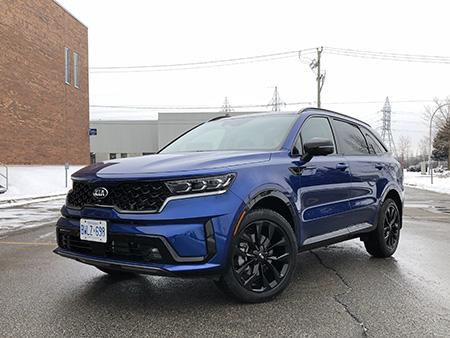
KIA Sorento 2021
The fourth-generation family SUV loses some ground
Pros and cons
Pros
- Comfortable suspension and seats
- Very quiet ride
- Flexible and energetic engine
- Commendable dual-clutch transmission
- Roomy and practical cabin
- Improvements in advanced safety
Cons
- Less towing capacity
- Sensitivity to side winds
- Body lean in turns
- Adaptive-only cruise control (EX+ and SX)
- No spare tire
Overview
The Kia Sorento enters its fourth generation in 2021. It still straddles the compact and traditional midsize SUV segments, but otherwise, it is all new. All models now have six or seven seats and a four-cylinder engine, turbocharged for the most part. Techno content is beefed up and driver assistance is refined. A conventional hybrid and a plug-in variant should follow by 2022, once they are compatible with all-wheel drive, which is standard in Canada.
The size of the Kia Sorento lines it up with five-seat midsize SUV’s like the Chevrolet Blazer, Ford Edge, Honda Passport and Hyundai Santa Fe. Meanwhile, its third row of seats lets it play on the same turf as big intermediates like the Ford Explorer, Mazda CX‑9, Subaru Ascent and Toyota Highlander. Of course, a $35,845 base-model Sorento won’t have the power, equipment or towing capacity of those vehicles, but it could pique the interest of the same potential buyers.
Kia still assembles the Sorento at West Point, Georgia.
Verdict
Despite its muscular persona, the 2021 Kia Sorento is not much more dynamic than its predecessor on the road. But safety, comfort and practicality are progressing, and isn’t that what counts in a family SUV? Regrettably, the turbo engine eliminates the advantage the former V6 offered in terms of towing capacity, without bringing any real benefit in terms of fuel economy. It is unfortunate, because it delivers the goods in all other respects.
Evaluation
Body, cabin and cargo space
At 480 cm the Kia Sorento slots about halfway between a compact and a midsize SUV. The length is the same as before, but the two rear rows afford better legroom in 2021, both on paper and in reality. Part of the secret resides in a gain of 3.5 cm in wheelbase linked to the use of an updated platform.Overall, the cabin provides a lot of room and comfort in the first two rows. The front seats lack side support in turns, but they are accommodating of most physiques and generally supportive on long trips. The new middle-row captain’s chairs are relatively flat, but the angle of recline is adjustable and they slide forward to provide more room in the third row. However, that space is still only suitable for small children, because the seat and the ceiling are much too low.
It is best to fold down the uncomfortable bench and take advantage of the vast cargo area behind the second row. The Sorento definitely stands out for versatility, superior to many compact SUV’s for a barely higher price. However, you have to be very careful to avoid scratching the bare plastic sides and the skimpy carpeting in the trunk.
It is a shame to note the absence of a spare tire when you lift the rear floor. It is replaced by a repair kit that complicates fixing a flat, often ending up with a tire that cannot be recuperated and a costly replacement. Carmakers often point to weight and fuel savings, but it is they who stand to gain the most in the long run, since the buyer won’t see the difference.
On a more positive note, Kia has succeeded in refreshing the dashboard without overly complicating it. The 10.25‑inch centre screen is not as straightforward as the interface on the outgoing model, but you get used to it fairly quickly. It is also notable for its sharpness, pleasing fonts and high degree of customization. The same applies to the all-digital gauge cluster on the SX. It comes with a head-up display that is highly practical but projects an image on the bottom of the windshield that is oddly cheap looking.
The heated seats and steering wheel, drive mode and climate control system all have their own controls separate from the screen—bravo. There is an abundance of storage and charge ports for all occupants. For all its functionality, the wide centre console reduces knee room. A number of rattles were noticeable on our test vehicle, and the memory system for the driving position was not working; hopefully, just early-model issues.
Safety features
- Antilock brakes with electronic brake force distribution and brake assist
- Stability and traction control
- Hill-start assist
- Hill-descent control
- Front airbags
- Driver knee airbags
- Front and rear side airbags
- Side curtain airbags
- Six or seven adjustable head restraints
- Passenger alert (rear bench) and automatic rear door locking in oncoming traffic (standard, EX+ and SX; unavailable, other models)
- Tire pressure monitor
- Rearview camera
- Forward collision warning with automatic emergency braking and pedestrian detection
- Lane departure alert with automatic steering assist
- Lane-keep assist
- Automatic high-beams
- Blind spot monitoring and rear cross traffic alert with automatic braking, rear parking sensors (standard, LX Premium, X‑Line, EX, EX+ and SX; unavailable, LX+)
- Front parking sensors, emergency intersection collision avoidance and adaptive cruise control (standard, EX+ and SX; unavailable, other models)
- Surround view monitor, blind spot display in instrument panel and automatic rear emergency braking (standard, SX; unavailable, other models)
Crash test results
National Highway Traffic Safety Administration (NHTSA)
Overall score: 4 / 5
Frontal impact: 4 / 5
Side impact: 5 / 5
Rollover resistance: 4 / 5
Insurance Institute For Highway Safety (IIHS)
Moderate overlap frontal impact: 4 / 4
Small overlap frontal impact:
- driver side: 4 / 4
- passenger side: 4 / 4
Side impact: 4 / 4
Rear impact: 4 / 4
Roof strength: 4 / 4
IIHS Top Safety Pick
Visibility
For an SUV this size, the Sorento does well in terms of visibility. The windows continue relatively low, on the sides as well as on the liftgate, and the roof pillars are not too wide, apart from the last rear. Large, well-positioned outside mirrors help when changing lanes. At this price, the base model should come standard with blind-spot monitoring.Lights: The redesigned Sorento has not been tested by the Insurance Institute for Highway Safety. We found that the LED projectors on EX trim and up deliver a wide, powerful beam in low-beam mode. Lighted distance lengthens suitably in high-beam mode. The automatic high beams sometimes do not deactivate immediately, which could dazzle other road users.
Mechanical overview
Kia calls on a heavily revised platform for the 2021 Kia Sorento, built with fewer, lighter and more solid components. The result is a 3% to 6% weight reduction, depending on the model.The main steering components as well as the all-wheel-drive system carry over with no major change. Like so many four-wheel-drive systems today, it mainly powers the front wheels in normal driving. It can direct up to half of the power to the rear, depending on surface conditions, the degree of acceleration and the selected driving mode.
The most significant changes are found under the hood. Following the trend, Kia has replaced the V6 of the mid- and high-end versions with a turbocharged four-cylinder. This 2.5‑litre engine will appear on several models manufactured by the Hyundai-Kia group this year, including the Santa Fe, a close cousin of the Sorento. It develops 281 horsepower, 9 less than the V6. On the other hand, it delivers 311 pound-feet maximum torque, more than the former six-cylinder and available at a much lower engine speed of 1,700 RPM.
New engine, new gearbox, this one an eight-speed wet-type dual-clutch automatic. According to the automaker, this innovative technique improves cooling and lubrication to better manage the high engine torque. The driver also can shift manually with the gearshift lever.
The normally aspirated 2.5‑litre engine on the LX+ and LX Premium is a slightly more powerful evolution of the former 2.4‑litre of the base Sorento’s. The conventional automatic transmission it pairs with also has eight speeds, two more than before.
It is important to note that towing capacity drops from 2,268 kg (5,000 lb) to 1,587 kg (3,500 lb) with the most powerful engine. Kia does not offer a technical explanation for the drop; the assumption is they hope to steer more potential buyers towards the Telluride, which of course costs much more than the Sorento.
Both powertrains promise better fuel economy than their 2020 equivalents. On paper, the turbo engine requires 10 percent less fuel than the old V6. Instead, our test conducted during the Christmas holiday period registered an increase of one-half litre per 100 km. It was mid-summer when we tested the Sorento V6, which of course gave it an edge, but we are still far off the mark.
We’ll have to see if the hybrid powertrain delivers the promised results. The official city/highway rating as evaluated by the U.S. Environmental Protection Agency is 6.3 L/100 km for a two-wheel-drive version. All-wheel drive, which will be standard in Canada, will likely increase this slightly. At 227 horsepower and 258 pound-feet of torque, the 1.6‑litre four-cylinder and electric motor combination will fill the power gap between the two gasoline engines.
Driving impressions
Does the 2021 Kia Sorento deliver the sporty drive its new, chiselled image suggests? Not quite. Make no mistake, it holds the road well, but there is too much body lean in turns to qualify the experience as dynamic.Bumpy roadways often set off small body movements. Also, side winds require frequent steering corrections at highway speed. It is unfortunate, because the steering provides more road feel and precision than the former model.
The redesigned Sorento is really more about smoothness. It is apparent in the ride, which adroitly masks road defects, and extends to the dual-clutch transmission, which shifts crisply while avoiding the slippage sometimes noticed with this type of gearbox.
This transmission is well matched to the wide power band of the engine, which displays a level of power and linearity unmatched by the outgoing Hyundai-Kia 2.0‑litre turbo four. Noisy acceleration is the only thing to stir up regret for the former Sorento V6—apart from the lost towing capacity, of course.
The refinement continues at stable speeds thanks to enhanced soundproofing, under the floor and around the engine compartment. In the absence of sustained winds, Kia’s best-selling SUV is still an excellent drive for long trips.
Other highlights
Braking: pedal has significantly more bite and progressiveness compared to the outgoing model. Power is amply sufficient in routine driving. Straight-line panic stops.
Driver assistance: adaptive cruise control is relatively well tuned. Unfortunately, on last-generation Kia’s with adaptive cruise—including high-end trims of the redesigned Sorento—it no longer can be used like a regular cruise control. Additionally, lane following engages automatically with the adaptive cruise. So despite its effectiveness, it always has to be deactivated when you want full control of the vehicle.
Features and specs
Price range (including shipping and preparation) | ||
| Minimum price | $35,845 | |
|---|---|---|
| Maximum price | N/A | |
| Price as tested | $49,595 | |
| Trim levels | LX+
LX Premium
X-Line
EX
EX+
SX | |
Buick Envision | ||
Chevrolet Blazer and Equinox | ||
Ford Edge and Escape | ||
GMC Acadia | ||
Honda CR-V and Passport | ||
Hyundai Santa Fe | ||
Jeep Cherokee and Grand Cherokee | ||
Mazda CX-5 and CX-9 | ||
Mitsubishi Outlander | ||
Nissan Murano and Rogue | ||
Subaru Ascent and Forester | ||
Toyota RAV4 and Venza | ||
Volkswagen Tiguan |
| Engine, horsepower and torque | 2.5L direct injection 4-cyl.; 191 hp at 6,100 rpm; 181 lb-ft at 4,000 rpm
2.5L turbo, direct injection 4-cyl.; 281 hp at 5,800 rpm; 311 lb-ft from 1,700 to 4,000 rpm |
|---|---|
| Transmission | 8-speed automatic with manual mode
8-speed dual-clutch automatic with manual mode |
| Front suspension | Independent with MacPherson struts |
| Rear suspension | Independent multilink |
| Front brakes | Ventilated disc |
| Rear brakes | Disc |
| Tires | 235/65R17
235/60R18
255/40R20 |
| Wheelbase | 281.5 cm | ||
|---|---|---|---|
| Length | 480 cm
481 cm (EX, EX+ and SX) | ||
| Width | 190 cm | ||
| Height | 169.5 cm (LX+ and LX Premium)
170 cm (EX, EX+ and SX)
178.5 cm (X-Line) | ||
| Curb weight | From 1,735 to 1,856 kg
1,856 kg | ||
| Towing capacity | Non turbo engine: 1,270 kg (2,800 lbs); turbo engine: 1,587 kg (3,500 lbs) | ||
According to Natural Resources Canada | ||
| City | 11.1 L/100 km (turbo engine) | |
|---|---|---|
| Highway | 8.4 L/100 km (turbo engine) | |
As measured by CAA-Québec | ||
| City | 10.5 L/100 km (turbo engine) | |
| Highway | N/A | |
| CO2 emissions | 4,660 kg/20,000 km (turbo engine) | |
| Fuel tank | 67 litres | |
| Recommended fuel | Regular-grade gasoline | |
| 0-100 km/h | 7.9 seconds |
|---|---|
| 60-100 km/h | 5.2 seconds |
| Entire vehicle | KIA SORENTO |
|---|---|
| Powertrain | Prix du modèle essayé (transport et préparation compris) |
| Hybrid or electric drive system components | Hybrid Drive components |
| Sound system, DVD player, navigation system | Sound System |
| Antipollution system | Essential |
| Corrosion | Corrosion |
| Seatbelts and airbags | Seatbelts and Airbags |
| Roadside assistance | Roadside Assistance |