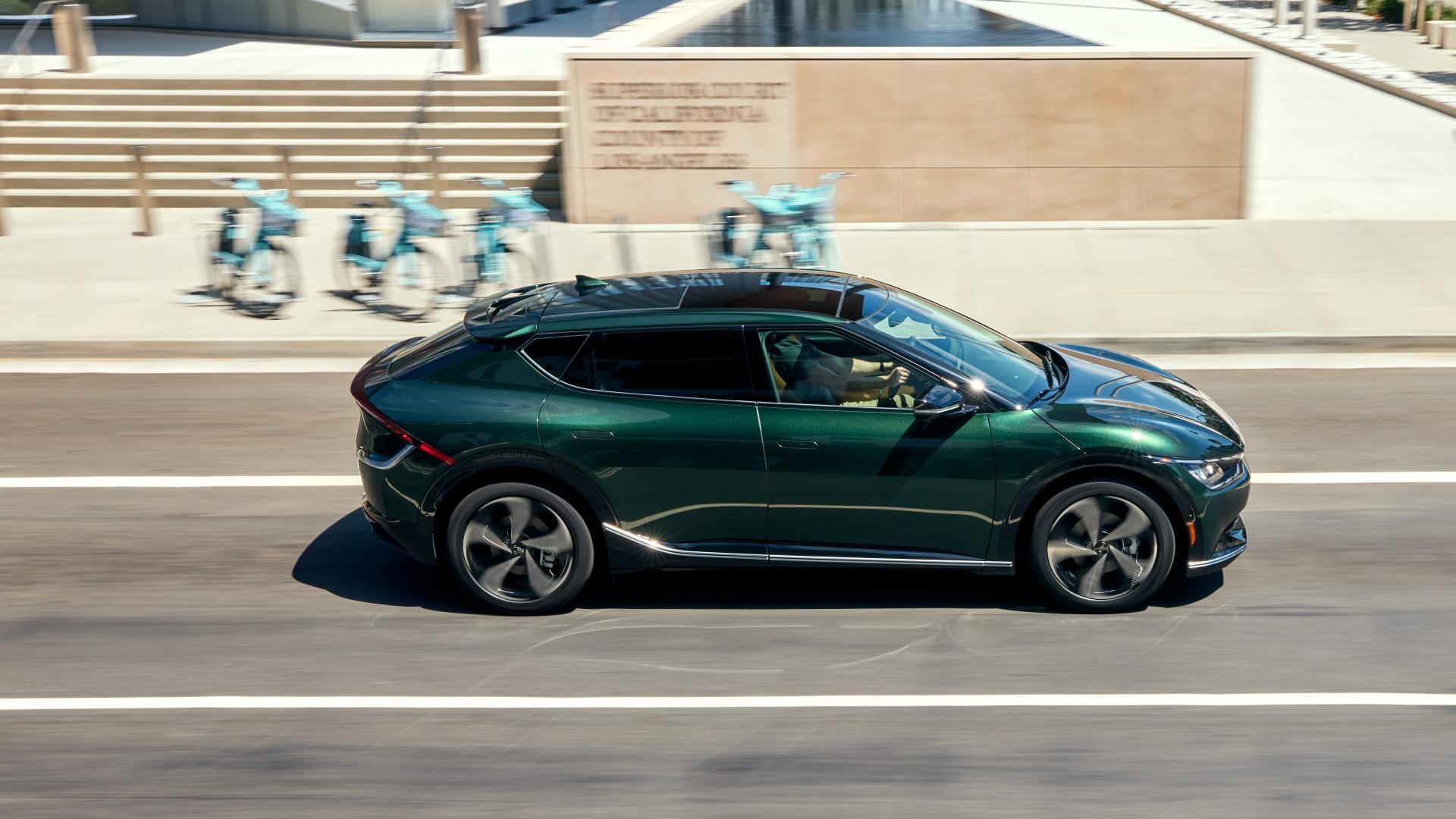
KIA EV6 2023
The 100% electric crossover offers a rare novelty: a GT performance version
Pros and cons
Pros
- Dynamic drive
- Wide choice of models
- Pleasant cockpit
- High residual value
- Realistic range in mild weather
- Quick GT model
Cons
- Confidential distribution
- Capricious ordering
- Mediocre visibility
- Firm ride
- Poor rear headroom
Overview
Although the Kia EV6 is officially celebrating its first birthday, we still see very few on the road—fewer even than the Hyundai IONIQ 5, which uses the same basic components. Be that as it may, the 2023 model of this 100-percent electric crossover is now officially on sale, the big news being the addition of a high-performing GT version. The five other variants offered in 2022 are still on the menu and still eligible for all government rebates despite price increases between $1,000 and $1,500.
Like Hyundai with the IONIQ 5, Kia offers the EV6 with rear-wheel or all-wheel drive. Two-wheel-drive models come with a choice of two battery sizes; AWD versions are equipped only with the larger of the two. Unlike Hyundai, Kia still sells a base model with no heat pump. It costs a few hundred dollars less than an IONIQ 5 Preferred, but we do not recommend it: the heat pump is worth its weight in gold, both to heat the interior more quickly and to obtain the longest possible range in winter.
For the rest of the Kia EV6 lineup, retail prices (including shipping and preparation but not dealer fees, which can vary) are $3,200 to $4,700 higher than for a corresponding IONIQ 5. On the other hand, the high residual value of the EV6 represents a savings of up to $200 per month over a four-year lease period, including fees and rebates. Obviously, conditions may change in the delay between the order and delivery; it illustrates the extent to which the retail and final purchase price can differ.
Kia assembles the EV6 in South Korea. If you are interested in this model, you might also like the Ford Mustang Mach-E, Nissan Ariya, Subaru Solterra, Tesla Model Y, Toyota bZ4X and Volkswagen ID.4, all part of the same segment.
Verdict
It is difficult to avoid comparing the Kia EV6 to its corporate cousin, the Hyundai IONIQ 5. What little the Kia yields to the Hyundai in terms of comfort and convenience, it makes up in driving dynamics and range. The powerful GT version also confers a measure of exclusivity that is relatively rare for the asking price. In the end, the decision likely will come down to style, purchase price and, frankly, which of the two makes can deliver first.
Evaluation
Body, cabin and cargo space
The Kia EV6 is a bit longer than the IONIQ 5 but it gives up 10 cm of wheelbase to its cousin, and nearly as much height. It explains why tall people seated in the back have to slouch a bit in the Kia. Additionally, front occupants do not get the same feeling of infinite space as in the IONIQ 5, because of the EV6’s sleeker lines and more restricted glass surface.
Still, the Kia provides very good leg room and knee room, front and back. Thanks to the dedicated EV platform, the completely flat floor provides room for large storage bins in the centre console.
The cargo area is appreciably long but loses height because of the sharply slanted liftgate. You have to lower the 60/40-split seatbacks to take full advantage of trunk volume, to the detriment of one or several passengers. This bench is very low, so as to create a level load surface when folded and to provide a maximum of headroom.
The front seats are much better shaped, but the cushions could be a bit longer. Several of our testers were annoyed that the back of their head constantly brushed against the head restraint.
Very contemporary and attentively, if not luxuriously finished, the impressive cockpit area features two 12.3-inch screens juxtaposed to appear as one. Clearly displayed and well-organized information and logical menus add to the enjoyment of the daily drive.
Kia provided a pair of rotary knobs and a row of control buttons below the centre screen to facilitate access to the main functions. However, it spoiled things by opting exclusively for touch-capacitive buttons that are almost impossible to use without taking one’s eyes off the road.
Worse still, the climate and infotainment systems use the same control buttons; you have to locate another small touch button to switch between the two. Complicating things further, the defrost and automatic climate controls display permanently beside the left rotary knob; if you touch them when trying to turn down the radio, you lower the cabin temperature instead. Good examples of bad ideas.
All EV6’s come well equipped, but you still need to plug in a cable to access Android Auto and Apple CarPlay. The base model makes some strange sacrifices to keep the sticker price as low as possible, giving up a humble low-wiper-fluid warning light, for example, in addition to the heat pump!
Like the IONIQ 5, the EV6 is deprived of a rear wiper. However, the result appears less dramatic than on the Hyundai: the Kia’s nearly horizontal rear window doesn’t seem to get splashed in the rain.
Safety features
Antilock brakes with electronic brake force distribution and brake assist
Stability and traction control
Hill-start assist
Front airbags
Driver knee airbag
Front side airbags
Side curtain airbags
Five adjustable head restraints
Rear passenger alert (with automatic rear-door locking if another vehicle approaches when the EV6 is parked)
Tire pressure monitor
Rearview camera
Forward collision warning
Automatic emergency braking with pedestrian detection
Automatic high-beams
Blind spot monitoring (with steering assist, GT-Line and GT)
Rear cross traffic alert (with automatic braking, GT-Line and GT)
Lane departure warning with steering assist
Lane-keeping assist
Adaptive cruise control
Emergency collision avoidance, surround-view monitor and instrument cluster blind spot display (standard, GT-Line and GT; unavailable, other versions)
Crash test results
National Highway Traffic Safety Administration (NHTSA)
Overall score: 5 / 5
Frontal impact: 5 / 5
Side impact: 5 / 5
Rollover resistance: 5 / 5
Insurance Institute For Highway Safety (IIHS)
Moderate overlap frontal impact: 4 / 4
Small overlap frontal impact:
- driver side: 4 / 4
- passenger side: 4 / 4
Side impact: 4 / 4
Rear impact: 4 / 4
Roof strength: 4 / 4
Top Safety Pick+
Visibility
Unlike the Hyundai IONIQ 5, which delivers an unrestricted view on all sides, the EV6 provides poor visibility on the sides and towards the rear. The fault lies with the narrow side windows and the skyward slant of the rear window. The sharply slanted windshield pillars and large side mirrors also block the view at intersections. Blind spot monitoring is not a luxury.
Headlights: Consumer Reports magazine gave the LED reflector low-beam headlights a good rating (3/5) even though the lighted distance was just adequate in a straight line. The high-beams were rated very good (4/5).
Mechanical overview
The Kia EV6 is one of three vehicles that currently use Hyundai-Kia’s E-GMP platform, the first designed specifically for all-electric models. The others are the IONIQ 5 and Genesis GV60, with more vehicles soon to follow.
The architecture is simple: a drive battery located under the cabin powers a rear electric motor in the two-wheel-drive versions. All-wheel drive adds a motor to power the front axle, without a transmission or driveshaft.
Key to the system is a lithium-ion polymer battery with a capacity of 58 kWh in the base EV6, which provides 373 km of range, according to Natural Resources Canada (NRCan). NRCan estimates a full charging time of 6 hours 20 minutes on a 240-volt connection; Kia indicates 5 hours 50 minutes with the same connection on a 48‑amp circuit. Also according to Kia, charging from 10 percent to 80 percent requires 1 hour 3 minutes at a 50 kWh fast-charging station.
This standard range EV6 is delivered with a single rear motor. Power output is 168 hp and 258 lb-ft of torque. Kia does not recommend towing with this configuration, whereas towing capacity is listed as 1,043 kg (2,300 lbs) with the 77.4 kWh battery.
That battery raises the power output of the rear-wheel-drive EV6 to 225 hp, whereas torque remains unchanged. Range jumps to 499 km, the longest of the lineup. The charging time is obviously longer as well: NRCan estimates it at 8 hours 40 minutes on a 240-volt connection, and Kia, 7 hours 10 minutes with the same voltage on a 48‑amp circuit. A fast-charge station achieves from 10 percent to 80 percent capacity in one hour 13 minutes, according to the manufacturer.
Ratings remain the same with all-wheel drive, with the exception of power, torque and range. The addition of a front motor boosts the first to 320 hp and the second to 446 lb-ft. On the other hand, NRCan indicates a drop in maximum range to 454 km with the 19-inch wheels, and to 406 km with the GT-Line Group 2’s 20-inch wheels.
The icing on the cake is the new GT variant. By installing larger electric motors, Kia wrings out no less than 576 hp and 546 lb-ft from the mechanicals. The manufacturer claims acceleration times under four seconds, which easily matches the performance of an exotic sports car—or a high-performance Tesla. Since battery capacity remains at 77.4 kWh, range drops to 332 km. It should be mentioned that energy consumption increases nearly 50 percent in the case of this ramped-up version, at least according to NRCan.
In this respect, our test drive of close to 1,600 km of an extended-range EV6 with all-wheel drive, conducted mainly on the highway at summer’s end, yielded a consumption of 17.5 kW-h/100 km, as calculated by the trip computer. A bit better than NRCan’s official rating, this result contrasts sharply with the 31 kW-h/100 km observed at the wheel of an IONIQ 5 last February.
As a rule, for trips of between 200 and 300 km, displayed range diminished 30 to 40 km more than the actual distance driven with the EV6.
Driving impressions
The EV6’s sleek lines immediately signal speed and emotion. Without classifying as a sport crossover, it definitely has a well-developed dynamic side.
The engine is the first agent: despite its 2,114 kg of weight, the EV6 accelerates with sustained vigour, as witnessed by a 5.6-second sprint from 0 to 100 km/h. Even more impressive, it took just 3.6 seconds to go from 60 to 100 km/h. All of that with exemplary linearity and in nearly total silence, typical of 100 percent electric models.
Once launched, the vehicle displays rock-solid straight-line stability. Swallowing up the kilometres between charging stations is child’s play, thanks to the excellent directional stability and well-controlled body movements. The only noise to filter into the cabin comes from the tires; without being annoying, it seemed more audible than in the IONIQ 5 we tested, with 20-inch winter tires that could have put it at a disadvantage.
The EV6 maintains this balance in turns, where the steering is pleasantly precise and well weighted. A bump in the middle of a curve can briefly upset the rear axle; several Hyundai-Kia products display this trait of character, with or without an independent suspension.
The EV6 suspension combines multilink arms with coil springs that we found to be a bit firmer than on the IONIQ 5. Without qualifying the ride as stiff, let’s just say that it doesn’t mask road imperfections as effectively as its corporate cousin, or a Volkswagen ID.4.
In short, the EV6 efficiently bridges the gap between the compliance of its German rival and the edginess of a Tesla Model Y, for example.
Other highlights
Braking: pedal is smooth and easy to modulate, for a system combining regenerative and regular mechanical brakes. Regenerative braking is efficient, and it is easy to adjust the level of intensity with the steering-wheel paddles. One-pedal driving is possible and relatively precise, but not as natural as with the Ford Mustang Mach‑E.
Driving assistance: adaptive cruise control is relatively progressive but slow to speed up after a preceding vehicle moves out of the lane. Kia no longer allows the adaptive cruise control system on its recent models to be used as a regular cruise. Lane keeping system is efficient.
Features and specs
Price range (including shipping and preparation) | ||
| Minimum price | $49,545 | |
|---|---|---|
| Maximum price | N/A | |
| Price as tested | N/A | |
| Trim levels | Standard Rage (RWD)
Long Range (RWD)
Long Range (AWD)
GT-Line I Long Range (AWD)
GT-Line 2 Long Range (AWD
GT (AWD) | |
Ford Mustang Mach-E | ||
Nissan Ariya | ||
Subaru Solterra | ||
Tesla Model Y | ||
Toyoba bZ4X | ||
Volkswagen ID.4 |
| Wheelbase | N/A | ||
|---|---|---|---|
| Length | N/A | ||
| Width | N/A | ||
| Height | N/A | ||
| Curb weight | N/A | ||
| Towing | Not recommended | ||
| Main traction components | Key electric powertrain components |
|---|---|
| High-voltage battery | EV battery |
| Details on replacement battery | Details on replacement battery |
| Minimum end-of-warranty capacity | Minimal capacity at end of warranty |