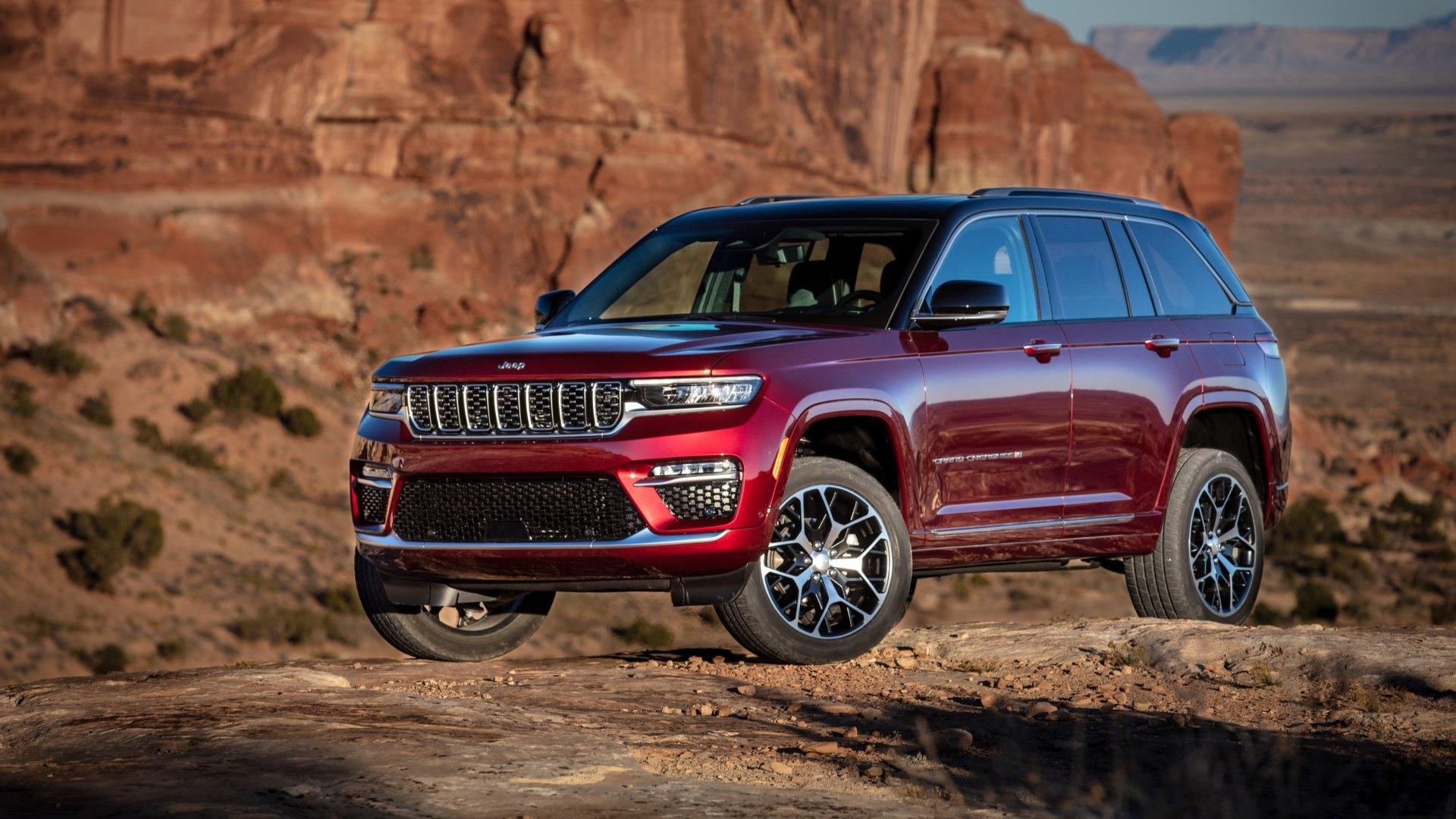
JEEP Grand Cherokee 2023
When Stellantis doesn't pull their punches
Pros and cons
Pros
- Well-matched engines
- Impeccable automatic transmission
- Excellent road comportment
- Inviting seats and driving position
- Roomy cabin (immense, L version)
- Rich materials
Cons
- High fuel consumption, city (V8)
- Inconsistent fit
- Fragile air suspension
- Questionable reliability
- Stiff price
Overview
The iconic Jeep Grand Cherokee just recently underwent its first major remake in 11 years. Jeep swapped the former Mercedes-Benz architecture for an Alfa Romeo platform (still unibody) that can accommodate the plug-in drivetrain already used on the Wrangler 4xe.
A new lengthened L version adds a third row of seats for the first time in this series, offered since 1992. Jeep is still producing the outgoing edition of the Jeep Grand Cherokee with fewer trim options, doubtless to retain buyers turned off by the prohibitive prices of the redesigned model.
And here, Jeep didn’t do things by halves. At $55,140 (including destination fees), a base Jeep Grand Cherokee Laredo is pricier than the high-end trims of several competitors. And that’s not counting the $2,000 for the six- or seven-seat L version, or the some $9,000 to $14,000 (!) for the plug-in hybrid drivetrain, exclusive to the short-wheelbase models. Result, the price band crosses the $100k psychological threshold for a fully equipped Summit Reserve 4xe.
Stellantis, the parent company of Jeep, is clearly and unapologetically courting the habitual clientele of European vehicles of the likes of BMW X5, Mercedes-Benz GLE, Land Rover Discovery and Range Rover Velar. A risky bet for a vehicle created and built in Detroit?
Verdict
The cabin is where the outgoing Jeep Grand Cherokee was especially showing its age. The redesigned model corrects this weakness with brio and further elevates the already convincing roadability of its predecessor. While a bit less agile, the new lengthened model compensates with a ton of extra interior space. However, the eternal question about Jeep reliability still prevails, no small thing considering the steep entry price.
Evaluation
Body, cabin and cargo space
With a 5‑cm longer wheelbase and 9 cm additional length, the 2023 Jeep Grand Cherokee now stands among the longest five-passenger utility vehicles on the market. The positive effect is clearly apparent, with rear seating and cargo space both considerably enhanced.The already roomy cabin becomes positively immense in the L version with its minivan-like dimensions. The interior volume of this lengthened model easily compares to that of the roomiest midsize SUVs, headed by Chevrolet Traverse, Ford Explorer and Hyundai Palisade/Kia Telluride.
As is customary with the Grand Cherokee, it is a big step up to the cabin. The culprit is the high ground clearance on which Jeep insists to uphold the Grand Cherokee’s celebrated off-road capability. Once inside, front-seat occupants should appreciate the well-shaped seats, designed to support people of all builds without being too firm. Everything is provided to obtain an excellent driving position, high without being high-perched.
This attention to ergonomics carries over to the dash, which features numerous buttons and well-sized knobs to access the main vehicle functions. No need to rummage through the touch screen to deactivate the lane departure alert, for example, change the direction of air flow or turn on the steering wheel heater.
This 10.1‑inch screen—8.4-inch on the entry-level models—is one of the simplest to use in the industry, even if the most recent version of Stellantis’ Uconnect system is a bit more complex. Wireless Android Auto and Apple CarPlay are standard, but believe it or not, you have to add an options package to obtain wireless device charging… even in a Summit model priced at over $80,000!
On the other hand, we can attest that the sound produced by the 19-speaker McIntosh audio system is outstanding. The attention to detail in Jeep’s new product is notably evident in the materials, as rich and elegant as those of certain prestige-badged competitors.
The ambiance is particularly luxurious in the Summit Reserve version with terracotta trim. However, the interior fit of our two test models displayed several easily visible flaws, something we also noted in a Grand Wagoneer tested briefly in the fall of 2021.
Other highlights
Instrumentation: 10.1‑inch fully digital screen is standard. There are several configurable displays, but they make the main dials too small in certain modes—notably, the trip computer’s. Head-up display is very clear, but available as an option only on Overland and Summit models.
Rear seats: second-row captain’s seats are standard on L version; a three-passenger bench is optional on the L model but standard on the short-wheelbase Grand Cherokee. This bench is low and rather firm. Seatbacks recline and on the L model, the seats slide to increase space in the third row. Typical of an SUV, this very low bench provides adequate headroom but zero thigh support. Flat floor with the seatbacks folded. Heated outboard seats on second row on Limited trim and up. Type A or C USB ports accessible in all rows.
Safety features
- Antilock brakes with electronic brake-force distribution and emergency brake assist
- Stability and traction control
- Hill start assist
- Hill descent control (standard, Trailhawk, Overland and Summit; unavailable, Laredo and Limited)
- Front airbags
- Driver knee airbags
- Front side airbags
- Side curtain airbags
- Five head restraints, adjustable on first two rows, folding on third
- Tire pressure monitor
- Reverse camera
- Forward collision warning
- Automatic emergency braking with pedestrian and cyclist detection
- Lane departure warning with automatic steering assist
- Lane-keeping assist
- Blind spot monitoring
- Read cross traffic alert
- Automatic high beams
- Adaptive cruise control
- Rear parking sensors with automatic braking
- Front parking sensors with automatic braking (standard, Overland and Summit; optional, Limited and Trailhawk; unavailable, Laredo)
- Surround view cameras and intersection assist (standard, Summit; optional, Limited, Trailhawk and Overland)
- Driver attention monitoring (standard, Summit; unavailable, other trims)
- Night vision assist (optional, Trailhawk, Overland and Summit)
Crash test results
National Highway Traffic Safety Administration (NHTSA)
Overall score: 5 / 5
Frontal impact: 4 / 5
Side impact: 5 / 5
Rollover resistance: 4 / 5
Insurance Institute For Highway Safety (IIHS)
Moderate overlap frontal impact: 4 / 4
Small overlap frontal impact:
- driver side: 4 / 4
- passenger side: 4 / 4
Side impact: 4 / 4
Rear impact: 4 / 4
Roof strength: 4 / 4
Visibility
Reasonable glass surface for an SUV, especially in the long version. The resulting visibility is adequate though hampered by thick windshield and roof pillars. Square shape helps to situate the vehicle in a parking lot, even in trims without surround view cameras.Headlights: yet to be evaluated by the Insurance Institute for Highway Safety, we found the standard LED headlights to be adequate in both low- and high-beam position.
Mechanical overview
Jeep is presenting the redesigned Grand Cherokee’s platform as all new, but in reality, it is a modified version of that used by the Alfa Romeo Giulia and Stelvio. As is customary, Jeep says it is more rigid and lighter than the structure it replaces. It also incorporates several components made of aluminum and magnesium to keep down the weight of the vehicle.Our two test vehicles were equipped with the air suspension that is standard on Trailhawk, Overland and Summit versions. Now equipped with adaptive shock absorbers, it also adjusts to five different heights. Buyers worried about the reliability of this system can turn to Laredo, Altitude or Limited models to get conventional multilink suspensions.
In terms of engines, Stellantis has already hinted that an inline turbo six-cylinder may soon be available for the Jeep Grand Cherokee and other models. But for now, the fifth generation proposes the same two gasoline engines as its predecessor. The first, a 293-horsepower, 3.6-litre V6, is standard on all Grand Cherokees, except the Trailhawk. Equipped with a very efficient and quiet automatic stop-start system, it is rated to tow up to 2,812 kg (6,200 lb).
The second is a 5.7-litre V8 that has powered a multitude of Chrysler, Dodge, RAM and Jeep products for close to 20 years. Optional on the Overland and Summit, here it produces 357 horses and considerably higher torque than the V6, which raises towing capacity to 3,265 kg (7,200 lb). Instead of automatic stop-start, the V8 includes a system that deactivates half of the cylinders at stable speed to improve fuel efficiency.
This system seemed to function well on the Grand Cherokee Summit we drove: it used 12.1 L/100 km on our test route, three-quarters on the highway, whereas Natural Resources Canada predicts a city-highway average of 14.1 L/100 km. Obviously, things worsen considerably in strictly urban driving.
We recorded almost similar fuel consumption with the lengthened V6 version, despite NRCan’s predicted average of 11.3 L/100 km. To be fair, the weather was much colder when we drove this V6 model than it was when we tested the V8.
That still represents a considerable thirst for fuel, especially with a pump price of close to $2 a litre. Jeep’s response is the 4xe, a plug-in hybrid version that mates a 2.0-litre turbo four-cylinder with an electric motor and 17.3 kWh lithium-ion battery. This is the only drivetrain offered on the Trailhawk version as of 2023 and is also available on Limited, Overland and Summit models. It is both the most powerful of the lineup (375 horses and 470 lb-ft of torque) and the most fuel efficient, at least on paper.
NRCan rates consumption at 36 kWh/100 km in electric mode, which is the equivalent of 4.2 L/100 km. Once the battery is depleted, the theoretical city-highway average is 10 L/100 km.
Claimed electric driving range is 42 km, with a 4-hour recharging time.
Are those realistic promises? We have our doubts, based on our winter test of the Jeep Wrangler 4xe. Equipped with the same drivetrain as the Grand Cherokee 4xe, it almost never drove in electric mode during our evaluation, in addition to displaying a gasoline consumption of 17 L/100 km… It remains to be seen in the case of the Grand Cherokee, especially if taking advantage of the 2,721 kg (6,000 lb) towing capacity.
Like the gasoline engines, the plug-in hybrid drivetrain is matched to an eight-speed automatic transmission with manual mode. It is delivered with a standard 4x4 system with automatic, 4Hi and 4Lo modes. The same system equips Overland and Summit models and is optional on the Limited. Limited and Laredo models come with a fully automatic part-time AWD system.
Driving impressions
The Jeep Grand Cherokee has long been the flagship of the Jeep range in terms of road behaviour. The new generation cements its reputation with panache.The engineers have ably merged this SUV’s strong North-American personality with its European roots—remember, its platform comes courtesy of Alfa Romeo. Though not as dynamic as a big-name German model, the Grand Cherokee inspires absolute confidence in all circumstances. Composed and insensitive to side winds, it tracks impeccably on the highway and brilliantly controls body movements, in corners as well as on bumpy pavement.
Part of the credit goes to the air suspension, which prevents potholes from jouncing the occupants without the feeling of floating. The steering is outstanding, precise and well-weighted in a category characterized more by excessive lightness.
Naturally, the L version is not quite as good at dissimulating its weight in a succession of turns, and its bulkiness makes itself felt in urban driving. The V6 engine has to work fairly hard, and the noise level can become a bit intrusive in acceleration. However, performance remains more than acceptable, thanks to the exemplary automatic transmission.
The V8 engine adds a remarkable level of flexibility and quiet to the short-body Grand Cherokee. However, it is hard to overlook its considerable environmental footprint, especially in urban or vigorous driving. And that’s not counting its $3,000 price tag and the additional registration fee.
How the plug-in hybrid engine performs in our driving conditions remains to be seen, but its sky-high price points to a long payback period. Until the new family of inline-six engines becomes available, the V6 still looks like the logical choice for this series.
Other highlights
Braking: powerful and straight stops; pedal is firm and may even be a bit hard for certain people but it ensures instant bite.
Driver assistance: lane departure alert is improved, more fluid than before. Lane-keeping system is adequate, generally avoids ping-pong effect between lane markings. Adaptive cruise control is well calibrated; it is still possible to revert to traditional cruise except with highway driving assist, standard on Summit models and optional on the Overland.
Features and specs
Price range (including shipping and preparation) | ||
| Minimum price | $57,140 | |
|---|---|---|
| Maximum price | N/A | |
| Price as tested | N/A | |
| Trim levels | Laredo (and L Laredo)
Altitude (and L Altitude)
Limited (and L Limited)
Overland (and L Overland)
L Overland V8
Summit (and L Summit)
Summit Reserve (and L Summit Reserve)
Trailhawk 4xe
Overland 4xe
Summit 4xe
Summit Reserve 4xe | |
| Wheelbase | N/A | ||
|---|---|---|---|
| Length | N/A | ||
| Width | N/A | ||
| Height | N/A | ||
| Curb weight | N/A | ||
| Towing | Not recommended | ||