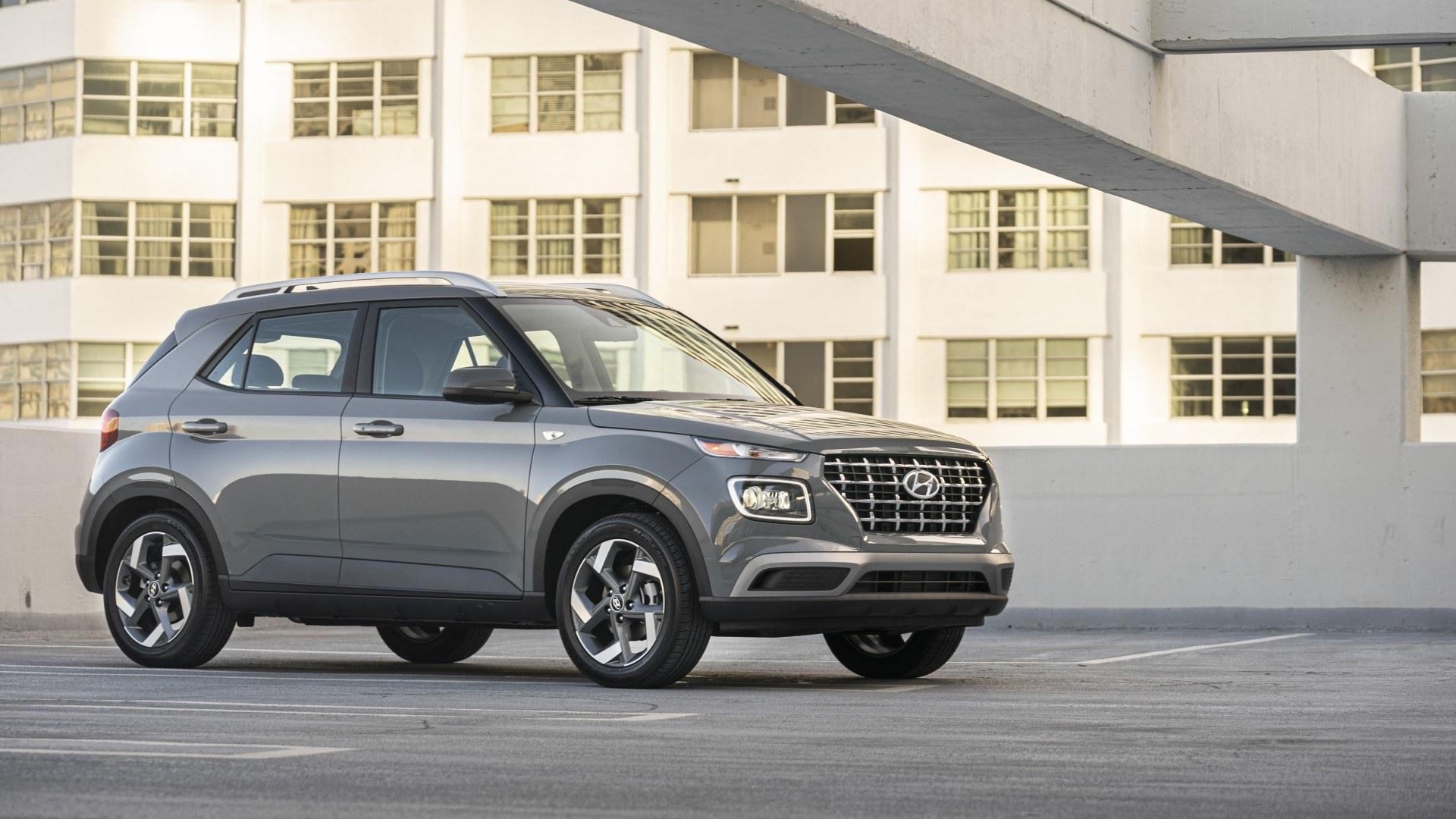
HYUNDAI Venue 2023
This front-wheel-drive micro SUV is essentially an Accent with attitude
Pros and cons
Pros
- Good visibility
- Relatively spacious interior
- Decent front seats
- Manoeuvrability in the city
- Smooth ride
- Simple controls
Cons
- High sensitivity to crosswinds
- Noisy ride
- Rear suspension sometimes bouncy
- Slow pickup for passing of merging
- Small trunk (rear backrests raised)
- High price for a subcompact in disguise
Overview
Pop quiz! How much would you have to pay to drive away in Hyundai’s cheapest hatchback? Around $16,000? Well, not exactly. That was five years ago, back in the days of the Accent L Manual without air conditioning. Nowadays, you’ll pay just over $23,000 for the Hyundai Venue Essential, a front-wheel-drive micro-SUV that, beneath its sharp lines, is really no different … than a better-equipped, high-riding Accent! Although the Venue hasn’t changed much since its introduction in 2020, its starting price has jumped by $4000. Therefore, we wanted to double-check its relevance in today’s market.
Of course, the Hyundai Venue is not the only one in its class. It competes against the Nissan Kicks, which inaugurated the small two-wheel-drive crossover category roughly one year before it. The Chevrolet Trax adds to the list for 2024, as its second generation no longer offers all-wheel drive. These three models compare well in terms of mechanics, equipment and target audience. The Venue is the smallest of the three, yet boasts more affordable pricing at all levels of the range.
The Venue and Trax are both built in South Korea, while the Kicks is made in Mexico.
Verdict
Don’t bother searching for the word highway or finding a picture of the hinterland on the Venue’s web page: Hyundai only showcases it in the “urban jungle.” At last, an honest marketing campaign! Agile, nimble and easy to drive from the suburbs to downtown, the Hyundai Venue becomes unstable, noisy and anemic as soon as it has to cope with wind, slopes or semi-trailers on the freeway. If you need to get out of town every so often, opt for a compact sedan to gain in confidence what you might be losing in versatility. Several carmakers, including Hyundai itself, still offer very capable models at prices on a par with the Venue.
Evaluation
Body, cabin and cargo space
The Hyundai Venue’s tall, squared-off frame doesn’t appeal to all, but it does allow easy access to the passenger compartment. It also contributes to the feeling of spaciousness in the cabin, especially considering the Venue’s very small size—barely 4m in length!
Four average-sized passengers can sit side by side without too much elbowing, and the two up front can enjoy surprisingly comfortable seats. These bucket seats don’t sag after an hour on the road, as is sometimes the case with entry-level vehicles. Testers of all sizes were able to find a suitable driving position, but the lack of a front middle armrest in the base model might bother some users.
However, fitting bulky child seats may prove a challenge, all the more so if the driver has to slide the seat back as far as possible. Furthermore, the trunk’s capacity is limited when the rear seatbacks are in place. The dual-level cargo floor slightly helps, but vacationers will be forced to choose between carrying passengers or baggage … that is, unless a roof box is installed, which could further exacerbate the Venue’s sensitivity to crosswinds.
Stretching 26cm longer than its Korean rival, the Nissan Kicks provides better cargo space. The even larger Trax may also prove a surprise in this regard, but we have yet to thoroughly assess it.
The interior is almost entirely lined in hard plastics, but they were well assembled in our test model. Some contrasting trim brightens up the ambience, especially in the Ultimate version. Each unit features the same 8" touchscreen, both logical and efficient. All the main functions can be accessed using knobs and physical buttons within arm’s reach. A classic gearshift and real handbrake round out this refreshingly user-friendly, albeit unspectacular, approach.
Other highlights
Convenience: air conditioning, power group, heated seats, cruise control, wireless Android Auto and Apple CarPlay as standard. Heated steering wheel, alloy rims and keyless starter included on Preferred version and above. Sunroof, 17-inch rims and automatic air conditioning exclusive to Ultimate. Customers crave gadgets, but these come at a price!
Safety features
Anti-lock brakes with electronic brake-force distribution and emergency brake assist
Stability and traction control
Hill-start assist
Front airbags
Front side airbags
Side curtain airbags
Front seat belts with pretensioners
Five head restraints (adjustable in the outboard seats, retractable in the centre seat)
Rear-seat bench reminder available
Backup camera
Tire pressure monitor
Forward collision warning system
Automatic front emergency braking with pedestrian detection
Lane departure alert with automatic steering assist
Auto high-beam headlights
Blind spot monitoring system and rear cross-traffic alert (standard on Preferred and Ultimate versions, not available on Essential)
Crash test results
National Highway Traffic Safety Administration (NHTSA)
Overall score: 4 / 5
Frontal impact: 4 / 5
Side impact: 5 / 5
Rollover resistance: 4 / 5
Insurance Institute For Highway Safety (IIHS)
Moderate overlap frontal impact: 4 / 4
Small overlap frontal impact:
- driver side: 4 / 4
- passenger side: 4 / 4
Side impact: 4 / 4
Rear impact: 4 / 4
Roof strength: 4 / 4
IIHS Top Safety Pick
Visibility
Square body lines, truncated rear end, wide windshield, rather horizontal window sill: all these attributes promote good visibility, making city driving all the easier. However, the wide C-pillars make it difficult to switch lanes, which is partly compensated for by electronic blind spot monitoring, except on the base version which lacks this feature.
Inspection
Overall good assembly quality, except for the filler pipe and fuel evaporation canister, which are poorly protected from road spray. The underbody lacks sufficient rustproofing, but some joints are properly sealed. Mechanical parking brake pivots prone to rust, but cheaper to repair than electric motors. Simple, low-cost suspension maintenance. Easy-to-access components for regular maintenance. Compact spare wheel as standard.
Mechanical overview
Mechanic-wise, it doesn’t really get any simpler than the Hyundai Venue, except perhaps for an electric vehicle. The only engine in the lineup is a 1.6-litre four-cylinder with multipoint fuel injection, but not direct injection as in most other modern powertrains. The 120 horsepower and 113 pound-feet of torque drive the front wheels exclusively through an continuously variable automatic transmission. The latter allows the selection of preprogramed gears with the lever, but the real manual gearbox of the Essential version has been discreetly withdrawn this year.
This sacrifice alone drove up the starting price by $1300 compared to a 2022 model. Hyundai piled on another $1050 increase without enriching the equipment.
As opposed to the Kia Soul, which is still available in a 100% electric version in Canada, or the Hyundai Elantra, offered with a hybrid powertrain, the Venue does not offer any sort of powertrain electrification. The vehicle’s economic purpose undoubtedly underpinned this strategy, the same one adopted by Nissan with its Kicks.
Nonetheless, an electrified variant would likely help reduce fuel consumption. The 7.9L/100km we achieved in the spring of 2023 is by no means a catastrophe, as it barely exceeds Natural Resources Canada’s combined city/highway rating. However, this is more than the result we achieved when driving a Hyundai Tucson Hybrid, a vehicle far more spacious, powerful and refined than the Venue.
Admittedly, the latter costs considerably less than its big brother, but one simply shouldn’t expect to experience the frugality of a true subcompact while driving it.
The torsion bar suspension and rear drum brakes are reminiscent of the Venue’s modest origins. However, these components boast the advantage of low maintenance costs. The Ultimate trim level is the only one with rear disc brakes.
Driving impressions
The island of Montréal was where we covered the first 50 kilometres or so of our test drive. This environment is perfectly suited to the Hyundai Venue, since its pocket size makes it easy both for navigating narrow streets and for parallel parking. The lightness of the steering, its sharp responsiveness and the short turning radius are significant strengths in city driving.
The soft suspension is yet another, as it copes well with potholes and other urban pavement defects. Meanwhile, Hyundai has clearly programmed the throttle and transmission to provide a crisp response when the light turns green. Combined with the Venue’s agility, this responsiveness makes the little vehicle quite enjoyable to drive at up to 80km/h.
However, another face revealed itself as we began our return to the Greater Québec area, with two passengers on board and a packed trunk. Whether you’re heading out onto a fast-moving highway or tackling a slope in the countryside, you’ll have to put up with the engine’s loud protests as it is running out of steam. This would be even more striking without the gears that the continuously variable transmission deftly simulates.
Once the cruise control is switched on, it’s the sound of rolling tires that takes over the cabin. The impressive audio system barely manages to bury it unless the volume is cranked up … in which case all hope of conversation is also buried. While the wind doesn’t whistle too much around the windshield pillars, strong gusts do considerably disrupt the driving experience. Frequent corrections are required, especially as the steering lacks firmness at cruising speed.
Furthermore, the body rolls noticeably when cornering, and the rear axle sometimes bounces to the point of slightly shifting over large undulations of road surface. While these behaviours don’t necessarily turn long journeys into a hazardous experience, they certainly don’t make for a very serene one.
Other highlights
Braking: a little too much bite at the top of pedal travel, then easy to modulate afterwards. Adequate strength of the rear disc system for a vehicle as light as the Venue; we didn’t rate the drum brakes of the most popular versions. Rather straight emergency stops, with no hasty anti-lock intervention.
Driver assistance: lane departure warning a little too sensitive when approaching markings between lanes, which can become irritating, especially in windy conditions. It takes several steps to deactivate it in the trip computer.
Features and specs
Price range (including shipping and preparation) | ||
| Minimum price | $23,173 | |
|---|---|---|
| Maximum price | N/A | |
| Price as tested | $27,723 | |
| Trim levels | Essential
Preferred
Ultimate | |
Chevrolet Trax | ||
Nissan Kicks |
| Engine, horsepower and torque | 4 cyl. de 1,6L; 121ch à 6300tr/min; 113lb-pi à 4500tr/min |
|---|---|
| Transmission | Automatique à variation continue, mode manuel |
| Front suspension | Indépendante, jambes de force |
| Rear suspension | Poutre de torsion |
| Front brakes | Disque ventilé |
| Rear brakes | Disque (Ultimate)
Tambour |
| Tires | 185/65R15
205/55R17 |
| Wheelbase | 252cm | ||
|---|---|---|---|
| Length | 404cm | ||
| Width | 177cm | ||
| Height | 156.5cm
159cm (with roof rails) | ||
| Curb weight | From 1201 to 1251kg | ||
| Towing | Not recommended | ||
According to Natural Resources Canada | ||
| City | 7.9L/100km | |
|---|---|---|
| Highway | 6.9L/100km | |
As measured by CAA-Québec | ||
| City | 7.9L/100km | |
| Highway | N/A | |
| CO2 emissions | 3540kg/20,000km | |
| Fuel tank | 45 liters | |
| Recommended fuel | Regular | |