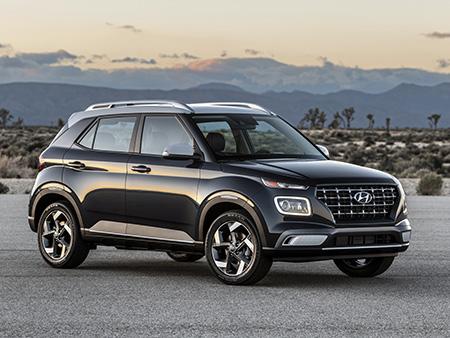
HYUNDAI Venue 2020
Hyundai's smallest SUV comes with up-to-date technology, a functional design, and a reasonable price tag
Pros and cons
Pros
- Roomy front seating
- Practical trunk
- Simple controls
- Generous equipment
- Agile in the city
Cons
- Limited passing power
- Poor soundproofing
- Body lean in turns
- Sensitivity to crosswinds
- Restrictive rear seating
Overview
So you want more SUV’s? Ask and you shall receive, is the reply from the automakers. That includes Hyundai, whose new Venue is its fifth crossover and small vehicle in Canada, shorter even than the subcompact Accent. Despite its toy-truck look, all-wheel drive is not available: power goes strictly to the front wheels, similar to the Nissan Kicks, the Venue’s main competitor.
Hyundai is clearly targeting young purchasers looking first and foremost for convenience, trendy gadgets and audacious styling. It comes at a price, of course: the South Korean-made Venue costs between $700 and $1,000 more than a similarly equipped Accent.
(Video in French only)
Verdict
Hyundai is a past master at calculating an equipment/cost ratio. The Hyundai Venue is a case in point, combining up-to-date technology, undeniable practicality, and reasonable price—at least for the base models. If you drive mostly in the city or suburbs, Hyundai’s newest offering could very well fit the bill. However, long highway trips, and frequent transportation of rear passengers, are not its strong suit.
Evaluation
Body, cabin and cargo space
The Hyundai Venue drew lots of attention during our week-long test. Its life-size Tonka shape and unique grille, combined with space-green accent paint, made our tester hard to miss.The styling proves very functional. A bit like the Kia Soul, the Venue’s high profile ensures excellent headroom. Front occupants of any size quickly feel at ease, thanks to the generous slide adjustment of the seats. The long scope of the telescoping steering wheel complements this feature and, unlike the Kona, the Venue offers a bit on padding on the armrests…
Speaking of padding, the front seats provide adequate comfort, for an entry-level vehicle. The cushions are rather short and flat, but without being overly hard. The same cannot be said of the rear bench, which is too firm, too low and too upright. Legroom quickly evaporates when the people in front take full advantage of the rearward seat adjustment. If you have a youngster seated behind you in a safety seat, you’ll definitely feel the push of little feet.
Hyundai clearly designed the Venue for two people and their belongings. Cargo space also benefits from the high body. It is especially true when the dual-level floor is completely lowered, contributing to the astonishing practicality of this small vehicle. In its upper position, the floor is almost level with the seats when they are folded.
The Venue also displays its practical side in everyday use. The 8-in. touch screen—a more-than-respectable size for the price—features the same logical interface as most other Hyundai’s. Android Auto and Apple CarPlay come standard, along with a pair of USB ports, air conditioning and ultra-rapid heated seats. The heating system is equally quick, and its manual controls are as simple as they are precise.
Our Trend model also included remote start and the heated steering wheel you won’t want to do without once you’ve tried it. However, if you want a sunroof, you have to forgo the two-tone paint.
Other highlights
Front access: slightly elevated sill and seat height facilitate access relative to a traditional subcompact. The rear doors do not open wide enough, making it difficult to install a child safety seat.
Instrumentation: impeccable analog gauges. Well-designed trip computer. Good quantity of customizable settings, for an entry-level vehicle.
Finish: precise fit. Lots of hard plastics, but comparable to other models of the segment. Original styling combines contrasting trims and colours echoing the body colours.
Safety features
- Antilock brakes with electronic brake force distribution and emergency brake assist
- Stability and traction control
- Hill start assist
- Front airbags
- Front side airbags
- Side curtain airbags
- Five adjustable head restraints
- Rearview camera
- Blind spot monitoring with rear cross traffic warning, forward collision warning with automatic emergency braking and pedestrian detection, lane departure warning and lane keeping assist (standard, Preferred, Trend and Ultimate; non available, Essential)
Crash test results
National Highway Traffic Safety Administration (NHTSA)
Overall score: 4 / 5
Frontal impact: 4 / 5
Side impact: 5 / 5
Rollover resistance: 4 / 5
Insurance Institute For Highway Safety (IIHS)
Moderate overlap frontal impact: 4 / 4
Small overlap frontal impact:
- driver side: 4 / 4
- passenger side: 4 / 4
Side impact: 4 / 4
Rear impact: 4 / 4
Roof strength: 4 / 4
Visibility
Excellent on all sides, thanks to large glass surfaces all around, elevated driving position and relatively square body. Blind spot monitoring is efficient, without the false warnings noted with other small Hyundai’s.Headlights: LED projectors on higher trims provide good lighting in low-beam position. Wide but rather short beam, extending noticeably in high-beam mode. Additional cornering lamps light automatically in the direction of the turn signal; we did not feel they were essential.
Mechanical overview
Hyundai did not have to look far for the underpinnings of its micro-SUV. It simply took the platform of the subcompact Accent, as it did a few years back to create the Kona, and shortened it to correspond to the vehicle’s more citified vocation. Electric-assist power steering in the steering column, torsion-beam rear suspension, rear drum brakes (except on Ultimate model): components that are not necessarily avant-garde but fully adequate on an entry-level vehicle. And, especially, easy and affordable to maintain.The same can be said of the powertrain, presented without turbo-charging, direct injection or other sometimes delicate systems. Instead, this reworked version of Hyundai’s 1.6-litre four-cylinder comprises a new type of variable valve timing designed mainly to promote fuel efficiency. Power is slightly lower relative to the former generation of the engine, whereas in the case of the Accent automatic, the combined consumption rating decreased by 8 percent, to 6.7 L/100 km.
Naturally, the Hyundai Venue’s less-aerodynamic body and higher weight result in higher consumption, averaging 7.5 L/100 km. The Nissan Kicks does slightly better, averaging 7.2 L/100 km, according to Natural Resources Canada.
One of Hyundai’s strategies to keep fuel consumption in check is the use of a continuously variable automatic transmission (CVT) in replacement of the conventional six-speed that paired with the former 1.6‑litre engine. It includes a manual mode that simulates eight speeds, to give the driver a bit more control. It generates gear shifts in heavy acceleration, including in automatic mode, to avoid running the engine at high rpm’s too long.
Power is transmitted exclusively to the front axle, to limit the additional costs associated with all-wheel drive. To compensate for the lack of AWD, Hyundai offers a snow mode feature that decreases the sensitivity of the accelerator and transmission in order to limit loss of traction on slippery pavement. Conversely, sport mode sharpens response, for a slightly more inspired drive.
Driving impressions
Unsurprisingly, the Hyundai Venue is at its best in town. Despite the modest engine power, acceleration proves amply sufficient to keep up with traffic. Moreover, engine noise is kept within reasonable limits at urban speeds.Much of the credit goes to the excellent continuously variable transmission, which responds faithfully to throttle inputs. You won’t encounter the elastic band effect often associated with CVT transmissions: hit the throttle and the vehicle takes off in a very linear manner; release the throttle and engine speed drops immediately. Everything functions smoothly. Hyundai has truly done its homework with its first CVT.
Things change considerably when you venture out on the open road. The engine displays its limits the minute you merge onto a highway or pass on a two-lane. You have to insist to obtain an acceptable result, with a notable increase in engine noise. Things tone down at highway speed, thanks once again to the well-tuned transmission.
Meanwhile, the cruise control cannot be counted on to keep things quiet. For some unexplained reason, it increases engine speed by at least 800 rpm, and sometimes more, to maintain the desired speed. You can get around this strange behaviour by manually selecting eighth “gear”, but then the transmission no longer automatically readjusts to maintain the set speed. It is the first time we have ever noted this reaction in a test vehicle.
It further underscores the mainly urban vocation of the Venue. The vehicle displays a high level of crosswind sensitivity requiring frequent steering corrections. It is a far cry from a touring car, especially on a windy winter day. The short wheelbase and high profile also make for a jittery ride, with constant small body movements at highway speeds.
All said, the Venue’s agile handling is best appreciated in the city, where its light, lively steering and small size also make parking a breeze.
Other highlights
Braking: good power and easily modulated pedal. No rear-end slippage was detected in heavy braking, despite the rear drum brakes.
Soundproofing: high wind and road noise at highway speed. Moderate engine noise at stable speed and in normal acceleration, loud during heavy acceleration.
Driving assistance: blind-spot monitoring is efficient, with none of the false alarms notably experienced with the Kona. Lane keep system is a bit insistent; it can be programmed as an alarm only, to avoid automatic steering corrections.
Features and specs
| Price range (including shipping and preparation) | ||
| Minimum price |
$18,909
| |
|---|---|---|
| Maximum price |
$26,709
| |
| Price as tested | $24,909 | |
| Trim levels | Essential Preferred Trend Ultimate | |
Nissan Kicks
| Wheelbase |
252 cm
| ||
|---|---|---|---|
| 404 cm |
404 cm
| ||
| Width |
177 cm
| ||
| Height |
156.5 cm
159 cm (with roof rack)
| ||
| Curb weight |
From 1,156 to 1,251 kg
1,251 kg
| ||
| Towing |
false
| ||
| According to Natural Resources Canada | ||
| City |
8.0L/100 km (automatic transmission)
| |
|---|---|---|
| Highway |
7.0 L/100 km (automatic transmission)
| |
| Result | ||
| Temperature |
3,560 kg/20,000 km
| |
| Temperature |
From -27°C to 0°C
| |
| CO2 emissions |
3,560 kg/20,000 km
| |
| Fuel tank |
45 litres
| |
| Recommended fuel |
Regular-grade gasoline
| |