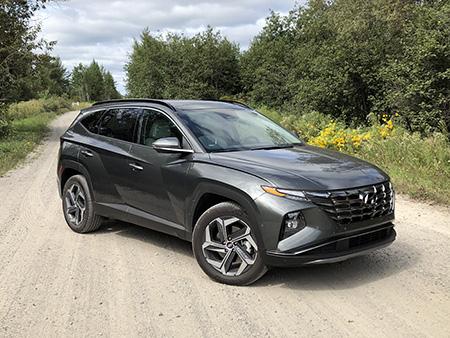
HYUNDAI Tucson 2022
An unconvincing hybrid powertrain
Pros and cons
Pros
- Competitive interior space
- Quiet cabin
- Comfortable ride
- Effective transmissions
- Smooth and flexible hybrid engine
- Good warranty
Cons
- Disappointing fuel economy (hybrid)
- Hesitations after a stop (hybrid)
- Frustrating touch controls
- Poor front-seat design
- Loose handling
Overview
After seven years with the same form, the Hyundai Tucson was showing its age compared with many recent compact SUVs. Apart from its badges, the fourth generation Hyundai is presenting for 2022 has little in common with its predecessor. Edgy styling, inside and out, dissimulates a new platform and reworked mechanicals—including a hybrid for the high-end trims. A plug-in version is also on the way for this new and considerably enlarged model.
Format and price now align the Hyundai Tucson with vehicles such as Ford Escape, Honda CR-V and Toyota RAV4. A Tucson under $30,000 is a thing of the past, unless you pass on all-wheel drive, and even then.
The lineup starts with the front-wheel-drive Essential, at $29,624, including destinations fees, and culminates with the Ultimate, at $43,524. Only that model and the Luxury, one step below, are equipped with the new hybrid powertrain. All other trims come with a four-cylinder gasoline engine that closely rivals that of segment leaders.
For the first time, Tucsons destined for the North-American market hail from Alabama, where Hyundai also assembles the Elantra, Sonata and Santa Fe.
Verdict
The Hyundai Tucson makes further strides in terms of space, quiet and ride comfort. Its technology is updated, though the user friendliness that normally characterises Hyundai dashboards is not always present. In addition, the hybrid powertrain does not exactly deliver on fuel economy, which is no better than for certain gasoline-only rivals. Let’s hope that the plug-in version can improve on that.
Evaluation
Body, cabin and cargo space
For the first time, Hyundai is offering the Tucson with two different wheelbases, depending on the market. Canada and the United States get the longer wheelbase that nearly matches that of the Santa Fe. It explains why the cabin is so much larger for 2022, rivalling roomier compact SUVs like the Honda CR-V.Four people now fit very comfortably in the Hyundai Tucson, or five on occasion. Cargo volume with the bench in place has increased 25 percent (20 percent with the seats folded). In both cases, according to Hyundai’s specifications, the Tucson edges out the Santa Fe, which is 15 cm longer!
It is easy to access the driver’s seat and to install a child safety seat. However, for most occupants the front seats are much too short for good thigh support. As these bucket seats are mounted high, the driving position is slightly perched even with the seat adjusted as low as possible. Occupants also have to deal with insufficient side support in corners and a decorative appliqué that interferes with their upper back.
In brief, be sure to test the comfort of these seats before signing on the dotted line. Also, take the time to try out the controls on the centre stack; most are touch operated on models with automatic climate control and on all trims with the 10.25‑inch touch screen. That means having to take one’s eyes off the road for every adjustment. The same applies when using the electronic gear selector on N‑Line, Luxury and Ultimate trims.
You soon begin wishing for physical buttons and knobs like Hyundai provided until just recently, for example on the Santa Fe and Palisade. The solution is to opt for an Essential or Preferred model, and adjust the climate control or raise the liftgate manually!
Other highlights
Convenience: adequate storage in quantity and volume, even though Hyundai stopped short of creating a shelf under the console on models with the push-button gear selector. Wireless charging, rear USB ports and panoramic sunroof standard starting with Preferred trim with Trend package. Power liftgate and auto-dimming rearview mirror restricted to Luxury and Ultimate.
Instruments: 10.25-inch digital display standard on N-Line trim and above; clear graphics, some customisation is possible. No head-up display available.
Safety features
- Antilock brakes with electronic brake force distribution and brake assist
- Stability and traction control
- Hill descent control (with AWD
- Front airbags
- Front side airbags
- Front centre airbag
- Side curtain airbags
- Front seatbelt pretensioners
- Five adjustable head restraints
- Rear passenger alert
- Tire pressure monitoring
- Rearview camera
- Forward collision warning
- Automatic forward emergency braking with pedestrian detection
- Lane departure warning with automatic lane keeping assist
- Automatic high-beams
- Driver fatigue detection
- Blind-spot monitoring with automatic steering assist, rear cross traffic alert with automatic braking, adaptive cruise control and automatic rear door locking when a vehicle pulls alongside (standard, Preferred, N‑Line, Luxury and Ultimate; unavailable, Essential)
- Rear parking sensors (standard, Luxury and Ultimate; unavailable, other models)
- Front parking sensors, rear automatic emergency braking and surround-view monitoring (standard, Ultimate; unavailable, other models)
Crash test results
National Highway Traffic Safety Administration (NHTSA)Overall score: 5 / 5
Frontal impact: 5 / 5
Side impact: 5 / 5
Rollover resistance: 4 / 5
Insurance Institute For Highway Safety (IIHS)
Moderate overlap frontal impact: 4 / 4
Small overlap frontal impact:
- driver side: 4 / 4
- passenger side: 4 / 4
Side impact: 4 / 4
Rear impact: 4 / 4
Roof strength: 4 / 4
IIHS Top Safety Pick+
Visibility
Forward visibility is adequate. Hampered on the sides and rearward because of thick roof pillars and high side windowsills. Essential trim has no blind-spot monitoring to facilitate lane changes but has the same large outside mirrors as the other trims.Headlights: The Insurance Institute for Highway Safety awarded its top score to the Ultimate version for its LED projectors, which excelled in nearly all tests. The LED reflectors on the other models obtained a 3 out of 4 rating because of their shorter lighted distance, especially in a left turn.
Mechanical overview
Traditionally based on the compact Elantra sedan, the Hyundai Tucson has moved onto the Hyundai-Kia group’s most recent midsize platform. It underpins notably the Hyundai Sonata, Kia Sorento and, stating this year, the Hyundai Santa Fe. As customary, this structure is claimed to be more solid than the version it replaces, with benefits expected in terms of safety, road behaviour and noise suppression.Hyundai reworked the Tucson’s suspension, steering and brakes to adapt them to the new architecture. The rack-and-pinion mounting points are closer to the centre of the wheels to improve steering agility. The centre of gravity has been lowered for similar reasons.
Two new powertrains are now listed. Essential, Preferred and N‑Line models get a 2.5‑litre four-cylinder good for 187 horsepower and 178 pound-feet of torque—respectively 6 and 3 more than the former 2.4‑litre. The adoption of dual injection (direct and cylinder head) and an eight-speed transmission achieves a 10‑percent reduction in fuel consumption, at least on paper.
The 9 L/100 km combined city/highway fuel rating is midrange for the segment, but no more. For a more fuel-efficient Tucson, Hyundai offers the option of a hybrid powertrain. It combines a 1.6‑litre turbo engine with an electric motor and 1.49‑kWh lithium-ion polymer battery. Total output is 227 horsepower and 258 pound-feet of torque starting at 1,500 rpm. Paired with a six-speed automatic transmission, this powertrain reduces average fuel consumption to 6.4 L/100 km, according to Natural Resources Canada.
Our observations qualify this somewhat: we measured 7.7 L/100 km during a test of more than 1,200 km, three-quarters on the highway. A RAV4 hybrid tested in the spring did 1 L/100 km better, whereas the gas-only Mazda CX5 turbo or Honda CR‑V deliver 8 L/100 km.
Hyundai Canada chose to restrict the hybrid motor to the two most expensive Tucsons, priced over $40,000. In the U.S., it is available as a stand-alone option across the lineup, a bit like Ford and Toyota on our side of the border.
Promised for later in the model-year, the plug-in version boosts power to 261 horsepower. Its 13.8‑kWh battery should allow 51 km of all-electric range and take around two hours to recharge at a 240-volt charging station. Gasoline consumption in hybrid mode is unknown at this time.
All hybrid Hyundai Tucsons come with all-wheel drive. Unlike Toyota, which powers the rear axle of its hybrids with a separate electric motor, Hyundai uses a traditional driveshaft system. The same system is used with the 2.5‑litre engine that is standard on the N‑Line and optional on the two other more affordable versions. True to trend, drivers have a selection of six drive modes that adjust steering, throttle, AWD, transmission and stability control.
All models can tow up to 907 kg/2,000 lb, 227 kg/500 lb more than the average SUV compact.
Driving impressions
Hyundai had already considerably softened the drive of the outgoing generation of the Tucson. The new one continues the trend: without erasing pavement defects, the suspension filters them before they reach the cabin. The vehicle is at ease on metropolitan Montreal’s patchwork of asphalt, concrete, cracks and bumps.The automaker could even have tautened the tunings a bit, to improve the handling of its SUV. While not affecting safety, pronounced body movements discourage pushing the Tucson in corners. Even on the highway, the vehicle sometimes weaves on ruts and long undulations.
Straight-line tracking at highway speed remains adequate thanks to the precise and well-weighted steering. Feedback is not much better than before, but the linearity of steering reaction is satisfactory for the category.
Linearity can also be invoked for the hybrid powertrain, which transfers imperceptibly from electric to gasoline mode. The instantaneous torque of the electric motor works with the turbo for excellent response at low and mid-range rpm’s where the engine spends most of its time. The result is notably quiet operation that is bolstered by effective wind and road noise soundproofing.
However, a noticeable hesitation is felt when reaccelerating after a brief stop, whether in dense traffic or at a stop sign. It’s as if the computer takes a half-second to decide what motor to start—electric or thermic. After a week at the wheel, we still hadn’t totally succeeded in getting around the problem.
Other highlights
Braking: pedal is easy to modulate and linear enough for a hybrid vehicle with regenerative braking. Straight and stable panic stops.
Driving assistance: adaptive cruise control is relatively well calibrated. Automatic speed control based on route and signage quickly becomes annoying, because it prevents following the natural flow of traffic. It can be switched off but no longer reverts to classic cruise control. Lane departure alert is too sensitive and steering corrections sometimes too abrupt. Lane keeping system is relatively linear.
Features and specs
Price range (including shipping and preparation) | ||
| Minimum price | $29,624 | |
|---|---|---|
| Maximum price | N/A | |
| Price as tested | $43,524 | |
| Trim levels | Essential
Preferred
N-Line
Luxury Hybrid
Ultimate Hybrid | |
Chevrolet Equinox | ||
Ford Escape | ||
GMC Terrain | ||
Honda CR-V | ||
Jeep Cherokee | ||
Kia Sportage | ||
Mazda CX-5 | ||
Mitsubishi Outlander | ||
Nissan Rogue | ||
Subaru Forester | ||
Toyota RAV4 | ||
Volkswagen Tiguan |
| Engine, horsepower and torque | 1.6L turbo, direct injection 4-cyl. with electric motor and 1.49 kWh lithium-ion-polymer battery; 227 hp at 5,500 rpm; 258 lb-ft from 1,500 to 4,500 rpm (regular hybrid)
1.6L turbo, direct injection 4-cyl. with electric motor and 13.8 kWh lithium-ion-polymer battery; 261 hp at 5,500 rpm; 258 lb-ft from 1,500 to 4,500 rpm (plug-in hybrid, on sale by 2022)
2.5L double injection (direct and multiport) 4-cyl.; 187 hp at 6,100 rpm; 178 lb-pi at 4,000 rpm |
|---|---|
| Transmission | 6-speed automatic with manual mode
8-speed automatic with manual mode |
| Front suspension | Independent with MacPherson struts |
| Rear suspension | Independent mutilink |
| Front brakes | Ventilated disc |
| Rear brakes | Disc |
| Tires | 235/65R17
235/55R19 |
| Wheelbase | 275.5 cm | ||
|---|---|---|---|
| Length | 463 cm | ||
| Width | 186.5 cm | ||
| Height | 166.5 cm (front-wheel drive)
168.5 cm (all-wheel drive) | ||
| Curb weight | From 1,515 to 1,925 kg
From 1,690 to 1,735 kg (regular hybrid) | ||
| Towing capacity | 907 kg (2,000 lbs) | ||
According to Natural Resources Canada | ||
| City | 6.3 L/100 km (regular hybrid engine) | |
|---|---|---|
| Highway | 6.6 L/100 km (regular hybride engine) | |
As measured by CAA-Québec | ||
| City | 7.7 L/100 km (regular hybride engine) | |
| Highway | N/A | |
| CO2 emissions | 3,040 kg/20,000 km | |
| Fuel tank | 42 litres (plug-in hybrid engine)
52 litres (regular hybrid engine)
54 litres (2.5L engine) | |
| Recommended fuel | Regular-grade gasoline | |
| 0-100 km/h | 8.4 seconds |
|---|---|
| 60-100 km/h | 5.7 seconds |