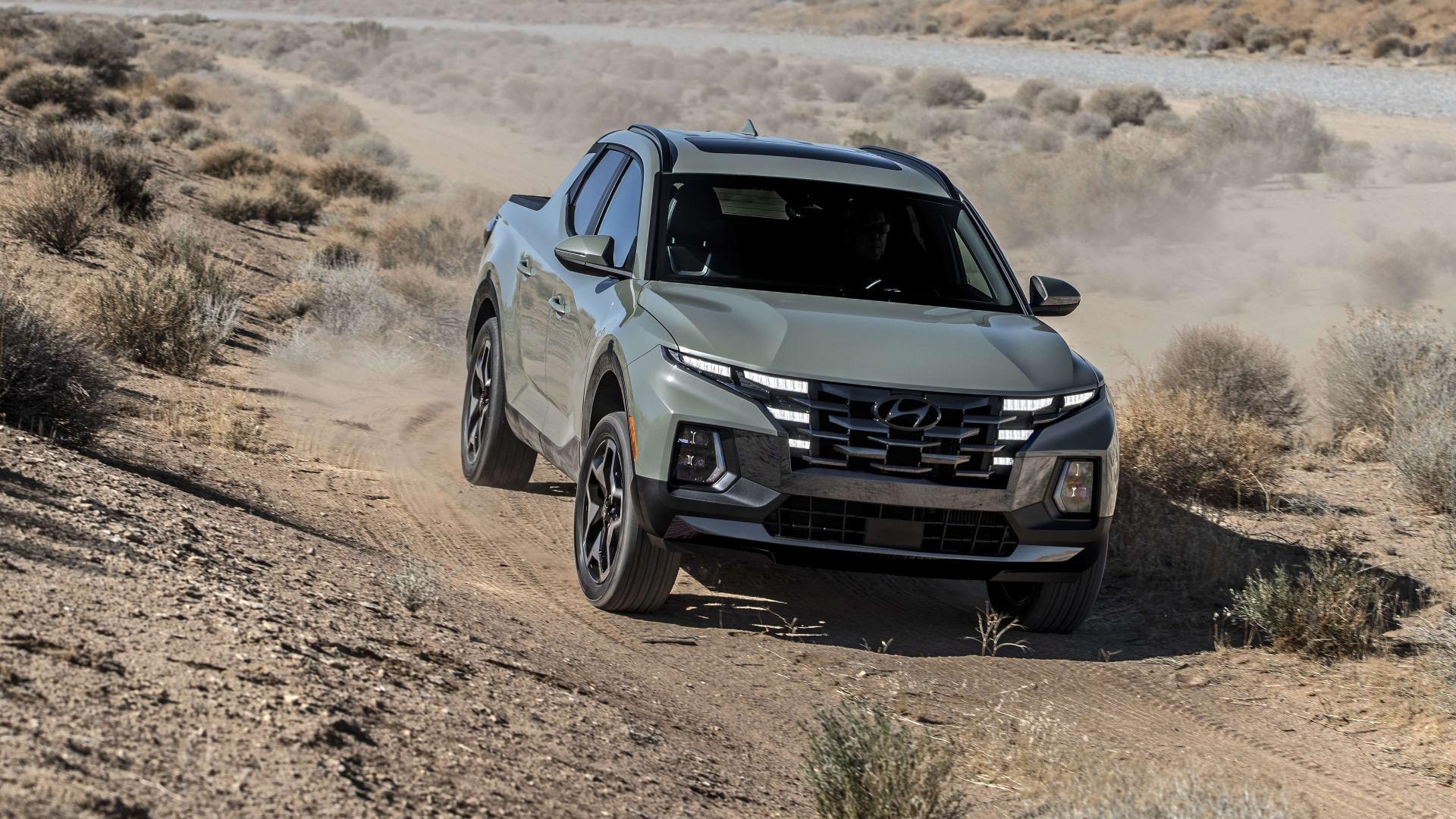
HYUNDAI Santa Cruz 2022
The compact pickup truck displays all the good manners of the SUV from which it derives
Pros and cons
Pros
- Smooth ride
- Stable road holding
- Well-weighted steering
- Smooth and lively engine
- Enjoyable driving position
- Good towing capacity
Cons
- Too-short bed
- Balky tonneau cover
- Restrictive rear seating
- Uncomfortable bench
- Poor rear visibility
Overview
Hyundai wants a share of the lucrative pickup truck market, and it is attacking with the Santa Cruz. This not your traditional, Ford F-150-type truck; rather, it is a derivative of the Hyundai Tucson unibody crossover compact. With its four-foot bed and four-cylinder turbocharged engine, the Hyundai Santa Cruz is a direct rival of the new Ford Maverick.But while the Maverick lineup includes pared-down versions priced under $30,000, Hyundai Canada is offering only well-equipped Santa Cruz’s selling between $40,000 and $47,000.
Why? Models distributed in Canada come only with all-wheel drive and a powerful turbocharged engine; two-wheel-drive and non-turbo engine versions are available in the United States. This high-end market orientation no doubt corresponds to the perceived wants of pickup buyers here, but it will be interesting to see how it stacks up against Ford’s more diversified approach.
Hyundai manufactures the Santa Cruz at the same factory as the Tucson, Santa Fe, Elantra and Sonata, in Alabama.
(Video in French only)
Verdict
Like the Honda Ridgeline from which it takes its cue, the Hyundai Santa Cruz stands out for its excellent road manners. No traditional pickup can match its comfort, agility or stability. However, tight rear seating and a very short bed restrict the versatility of Hyundai’s newcomer. A compact SUV like the Tucson is better suited to frequent transporting of passengers or long cargo items, but as an urban pickup truck, the Santa Cruz is an attractive choice.
Evaluation
Body, cabin and cargo space
The Hyundai Santa Cruz closely resembles the Tucson right back to the centre pillars at which point it adds an open pickup bed separate from the cabin. The absence of a body joint between the cabin and box emulates the Honda Ridgeline, which until the arrival of the Santa Cruz and Ford Maverick was the only unibody pickup on our market.Like its two direct rivals, the Hyundai is offered only in a four-door and short-bed configuration. The traditional competition composed notably of Ford Ranger, GMC Canyon, Nissan Frontier and Toyota Tacoma all propose a choice of cabin and bed lengths.
The Santa Cruz is 34 cm longer than the Tucson and along with the Ioniq 5 electric crossover it features the longest wheelbase of the Hyundai lineup. Though all these extra centimetres are devoted to the bed, it is still only 123 cm (4 ft.) in length at the top. Lowering the tailgate expands that to 190 cm (6 ft. 3 in.), but you’ll need a pivoting bed extender—Hyundai sells one as an accessory—to restrain cargo.
A standard retractable bed cover shields cargo from prying eyes and to a certain extent from the elements. Its frame reduces bed space, and on our tester the cover remained stuck in cold weather. Small items can be hidden away in a storage compartment under the bed floor.
Hyundai substantially shortened the rear seats of the Tucson when transforming it into a pickup. Adults risk feeling hemmed in and may gripe about the very upright seatback, much as in other, ordinary compact pickups. The seat bottoms flip up to make room for bulky items.
The front seats are much more inviting in terms of both space and comfort. Apart from bottom cushions that certain testers found too short, the seats combine good padding and support. The driving position is more like that of a raised car than the high perch of a truck. The only real weakness is a slight lack of space for one’s right foot when using the cruise control.
Lifted straight from the Tucson, the dash features a centre screen that is clear and logical, both the 20.3 cm (8 in.) on Preferred trims or the 26 cm (10.25 in.) version on the Ultimate model we tested. Several functions, including climate control, are accessed via separate capacitive touch buttons, practical but not as good as physical buttons that do not require taking your eyes off the road as often.
Happily, the seat and steering-wheel heaters work with real buttons, and the gear selector is a traditional lever, which is more intuitive to use than the Tucson’s push-button selector. All trims offer good storage, Android Auto/Apple CarPlay and front USB ports. However, the base model Preferred cannot get the automatic climate control, wireless charging pad, power driver’s seat or the excellent all-digital instrument cluster featured on the other versions.
Safety features
- Antilock brakes with electronic brake force distribution and brake assist
- Stability and traction control
- Front airbags
- Front side airbags
- Side curtain airbags
- Five head restraints, adjustable (side seats), folding (middle)
- Rear passenger alert
- Tire pressure monitoring
- Rearview camera
- Forward collision warning
- Automatic emergency braking with pedestrian and cyclist detection
- Lane departure warning with automatic lane centering assist
- Lane keeping system
- Automatic high beams
- Blind spot monitoring
- Rear cross traffic alert with automatic braking
- Adaptive cruise control and emergency collision avoidance assist (standard, Ultimate and Preferred with Trend package; unavailable, Preferred)
- Surround view monitoring system (standard, Ultimate; unavailable, other versions)
Crash test results
National Highway Traffic Safety Administration (NHTSA)Overall score: Not tested
Frontal impact: Not tested
Side impact: Not tested
Rollover resistance: Not tested
Insurance Institute For Highway Safety (IIHS)
Moderate overlap frontal impact: 4 / 4
Small overlap frontal impact:
- driver side: 4 / 4
- passenger side: 4 / 4
Side impact: 4 / 4
Rear impact: 4 / 4
Roof strength: 4 / 4
IIHS Top Safety Pick
Visibility
Forward visibility is adequate but restricted rearward by the narrow rear window and flaring rear sides. Thick rear pillars and small side windows make for hazardous lane changes. Cameras help when parking but soon become grimy in winter. Blind spot monitoring keeps trouble at bay.Headlights: The high-quality LED projectors on Ultimate models received top scores from the Insurance Institute for Highway Safety. They excelled in nearly all tests, unlike the lesser quality LED headlights on the two other trims, which received IIHS’s lowest rating.
Mechanical overview
The Hyundai Santa Cruz uses Hyundai’s most recent N3 platform that also underpins Tucson and Santa Fe SUVs and the Sonata sedan. This unibody structure features a four-wheel independent suspension, a setup that no conventional pickup of the segment offers.Despite the absence of heavy-duty rear leaf springs usual with pickups, Hyundai rates the towing capacity of the Santa Cruz at 2,268 kg (5,000 lb). That compares to the Ridgeline and most midsize SUVs and is 454 kg (1,000 lb) higher than the maximum towing allowance of the Maverick. In comparison, most traditional midsize pickups generally can tow at least 2,722 kg (6,000 lb).
Hyundai offers only one engine on Canadian Santa Cruz’s. It is the same turbocharged 2.5‑litre four‑cylinder that powers two versions of the Santa Fe and most Kia Sorento’s. Its 282 horsepower and 311 pound-feet of torque at 1,700 rpm exceed the ratings listed for the Maverick and Ridgeline.
The engine is mated to an eight-speed dual-clutch automatic transmission with full-time all-wheel drive. The front wheels do most of the work in normal driving; the rear wheels intervene in case of loss of traction, heavy acceleration or at speed in certain curves. A console-mounted selector offers a choice of three on-road and three all-terrain drive modes.
Despite its more-than-competitive power, the Santa Cruz we tested used less fuel than any other compact pickup we have tested to date. Our measured consumption of 10.4 L/100 km even bettered Natural Resources Canada’s combined city/highway rating of 10.6 L/100 km. The reasonable weight and aerodynamics obviously contribute to this result.
Driving impressions
Driving the Hyundai Santa Cruz highlights the main benefit of its unibody construction. Instead of the bouncy, slightly unsettled behaviour of traditional pickups, the Santa Cruz displays the good road manners of a compact crossover, like the one from which it derives.The Tucson’s comfortable ride is immediately apparent, with even better stability thanks to the lengthened wheelbase. The low interior noise level is also worthy of mention, compliments of a cabin that is separate from the cargo area.
Precise and well-weighted steering and low body lean ensure agile cornering. Dimensions similar to those of a midsize SUV make the Santa Cruz considerably easier to park and drive in the city than a traditional pickup.
Add the significant low- and mid-range torque of the turbo engine and you get an enjoyable and surprisingly dynamic drive for the category. A slight tendency for the rear end to lose traction on a slippery surface could surprise certain drivers, but the stability control intervenes quickly to prevent slides. All things considered, we prefer this hasty intervention of the all-wheel-drive system to clearly perceived front-wheel slippage followed by a sharp cut in power, as with other vehicles equipped with the same type of all-wheel drive.
Our main complaint concerns the dual-clutch transmission, still hesitant and jerky at low speed. It is definitely better than the automaker’s first such gearboxes, especially once the vehicle is underway. However, many regular automatics function more smoothly, including Hyundai’s.
Other highlights
Braking: pedal is progressive and easy to modulate. Adequate power. Antilock system intervenes frequently in winter driving, but not too intrusively.
Driving assistance: adaptive cruise control is quick to reduce speed behind a slower vehicle even at the shortest possible distance setting. It no longer can be switched to regular cruise control. Lane departure warning is very reactive to drifting within lane. Lane keeping system is relatively precise but has a tendency to let the vehicle travel too closely to a vehicle in an adjacent lane in a curve.
Features and specs
Price range (including shipping and preparation) | ||
| Minimum price | $40,524 | |
|---|---|---|
| Maximum price | N/A | |
| Price as tested | $47,024 | |
| Trim levels | Preferred
Ultimate | |
Ford Maverick | ||
Honda Ridgeline |
| Engine, horsepower and torque | 2.5L turbo 4-cyl. with direct and multiport injection; 281 hp at 5,800 rpm; 311 lb-ft from 1,700 to 4,000 rpm |
|---|---|
| Transmission | 8-speed dual-clutch automatic |
| Front suspension | Independent with MacPherson struts |
| Rear suspension | Independent multilink |
| Front brakes | Ventilated disc |
| Rear brakes | Disc |
| Tires | 245/60R18
245/50R20 |
| Wheelbase | 300.5 cm | ||
|---|---|---|---|
| Length | 497 cm | ||
| Width | 190.5 cm | ||
| Height | 169.5 cm | ||
| Curb weight | From 1,860 to 1,870 kg | ||
| Towing capacity | 2,268 kg (5,000 lbs) | ||
According to Natural Resources Canada | ||
| City | 12.1 L/100 km | |
|---|---|---|
| Highway | 8.6 L/100 km | |
As measured by CAA-Québec | ||
| City | 10.4 L/100 km | |
| Highway | N/A | |
| CO2 emissions | 5,000 kg/20,000 km | |
| Fuel tank | 67 litres | |
| Recommended fuel | Regular-grade gasoline | |
| 0-100 km/h | N/A |
|---|---|
| 60-100 km/h | 4.3 seconds |