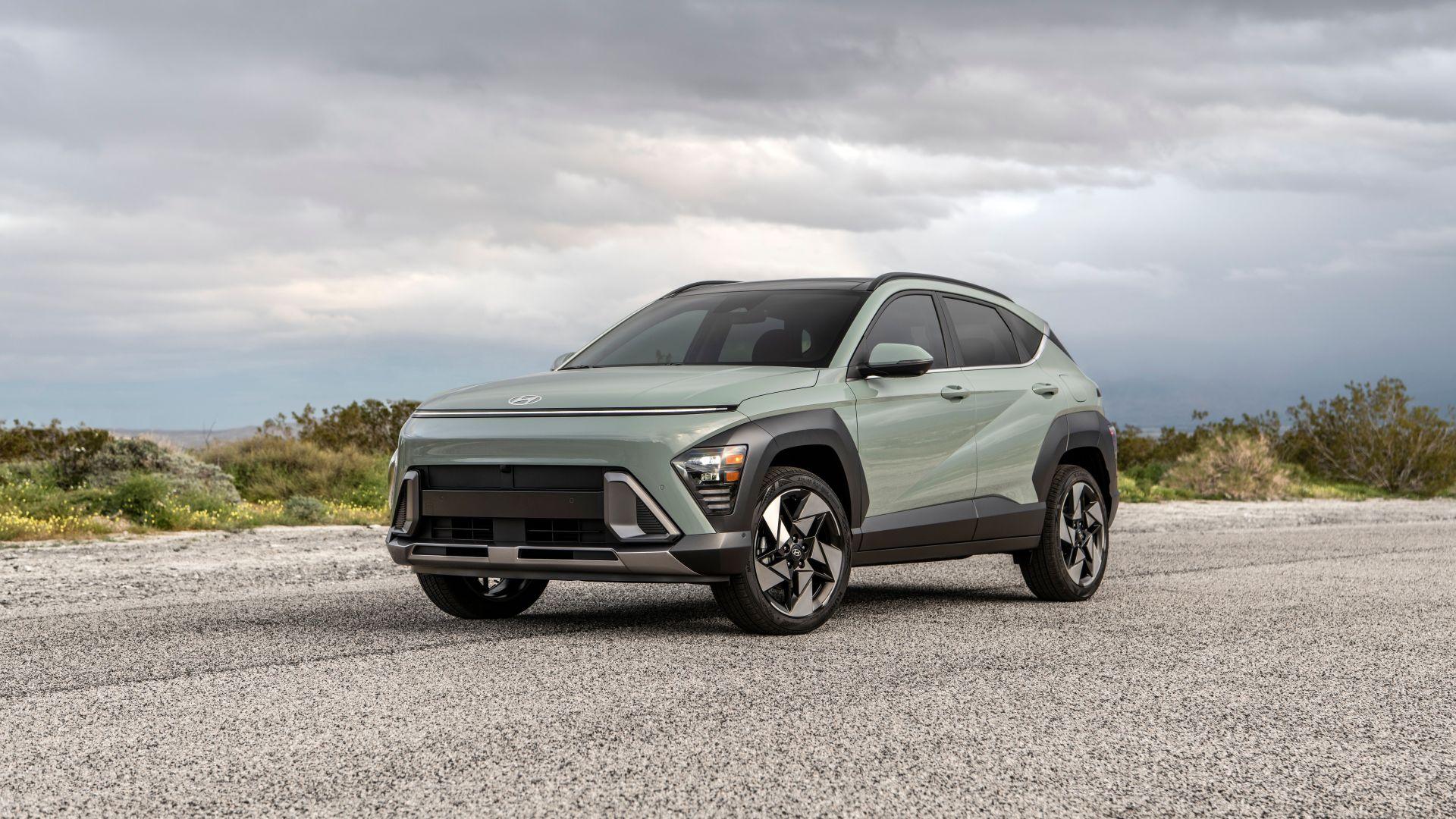
HYUNDAI Kona 2024
The second generation of the Hyundai Kona marks a significant step forward
Pros and cons
Pros
- Expanded trunk and rear seating areas
- Logical controls
- Improved soundproofing
- Solid road handling
- Plenty of storage space (N Line)
Blind-spot monitoring as standard
Cons
- Hesitant 8-speed transmission
- Turbo lag (N Line)
- Limited rearward visibility
- Steep price hike
- Increased consumption
Overview
Hyundai’s Kona accounts for more than a quarter of the automaker’s sales in Canada. As such, the manufacturer is counting heavily on the second-generation model to consolidate its momentum in the country. To this end, the main focus has been on aligning the Kona with other subcompact SUVs when it comes to size, safety and technology. The two already familiar gasoline engines are still on the program, as is the 100% electric variant expected in early 2024. To no one’s surprise, the price leaps considerably across the lineup.
As such, the base Hyundai Kona Essential version now retails for $28,523 (including freight, preparation and dealer fees), which is $3350 more than for a 2023 build. This variant and the next in rank, the Preferred, are still supplied with front-wheel drive, whereas some competitors have now abandoned this configuration. All-wheel drive costs $2000 on these models, but comes as standard on the N Line at $38,023. With the Ultimate package, premium paint and a black roof, the most expensive Kona now goes for $41,723. This brings it into line with rivals above the symbolic $40,000 milestone, as seen in the Mazda CX-30 GT Turbo and the Volkswagen Taos.
All this without even factoring in high financing costs, or the Hyundai Kona Electric, whose first-generation model was already well over that threshold. Hyundai has not yet revealed the price range of the renewed version, to be built in South Korea, much like the gasoline-powered models that are starting to reach dealerships.
Verdict
The Hyundai Kona 2024’s daring exterior may promise a revolution, but the new generation is actually more of a progression. Space, comfort, soundproofing, versatility: Hyundai has improved several aspects of its most popular model, but the underlying features haven’t changed much. In fact, Hyundai seems to have thrown in the towel on the fuel efficiency of its gasoline versions, which are now less efficient than their outgoing predecessors. Although the electric motor will undoubtedly save the day, it will also add to an already hefty bill.
Evaluation
Body and cabin
It is no coincidence that the revamped Hyundai Kona looks bigger than its predecessor: all dimensions have increased, especially length (+15cm) and wheelbase (+6cm). Excluding height, the vehicle exceeds the size of the first-generation Hyundai Tucson, which ran from 2005 to 2009.
First of all, this growth can be appreciated with the rear seats, which can now accommodate an average-sized person when the front bucket seats are adjusted for passengers up to 1.8m (5ft11in). Meanwhile, the trunk itself has also gained precious centimetres in length, enough for it to become one of the roomiest in its category, according to manufacturers’ data. The double-bottom design is still in place, which makes it possible to alternate between an increased loading height and a near-flat floor when the rear seats are lowered.
This enhanced practicality extends to the very front. The Hyundai Kona N Line features a steering column-mounted electronic gear selector, just like the IONIQ 5 and 6 models before it. While this may take some getting used to, the spacious storage compartments freed up in the centre console are quite welcome.
The horizontal dashboard layout is also inspired by the IONIQ series. Standard on all versions, the 12.3” touchscreen heralds a new generation of multimedia systems for Hyundai. Vertically arranged in columns, information is displayed clearly and without delay, while large virtual buttons are clearly indicated. N Line variants replace the standard instrumentation with another fully digital display similar in size to the central screen.
We salute the designers’ concern for ergonomics in the Kona, who kept physical buttons for ventilation, critical driving functions and the main entertainment applications. Simple controls that can be easily recognized by touch make for a much safer and smoother driving experience.
Android Auto and Apple CarPlay tend to achieve a similar effect, in part thanks to their intuitive voice recognition. Yet why on earth is it still necessary to plug in the device with a cable to be able to use them in the N Line Ultimate version, whereas the cheaper variants can activate it wirelessly?
Hyundai, Kia and Genesis are doing the same with most of their models, even as they introduce innovative technologies. This is the case with the digital key on the Kona N Line and Preferred models with Trend Package, a first for Hyundai that allows the vehicle to be unlocked and started using a phone. The new multimedia system can also be updated remotely.
All models are now equipped with four USB-C ports and a push-button keyless start/lock system.
Safety
Hyundai has greatly enhanced its driver assistance equipment for 2024. The Kona Essential version finally comes with blind-spot monitoring and cross-traffic alert, as well as detection of cyclists in front of the vehicle. In the Preferred and N Line versions, front automatic emergency braking can now activate when a vehicle is approaching from the opposite direction during a left-hand curve. The Ultimate package now includes a side blind spot display in the dashboard, surround-view cameras and rear automatic emergency braking. All models feature lane departure warning and automatic rear door locking when a vehicle drives by.
Crash test results
National Highway Traffic Safety Administration (NHTSA)
Overall score: 4 / 5
Frontal impact: 4 / 5
Side impact: 5 / 5
Rollover resistance: 4 / 5
Insurance Institute For Highway Safety (IIHS)
Moderate overlap frontal impact: 4 / 4
Small overlap frontal impact: 4 / 4
Side impact: 4 / 4
Rear impact: Not tested
Roof strength: Not tested
Mechanical overview
What has changed least in the Hyundai Kona is its mechanical design. The structure is a simple evolution of the former model, with a slightly modified suspension to accommodate the model’s increased size. In fact, the increased dimensions and additional equipment have raised the weight by 60 to 100kg, depending on version.
The steering remains unchanged, while the AWD models continue to be the only ones to boast independent rear suspension. The torsion bar on 2WD versions is not only simpler, but also cheaper to maintain over the long term.
Engine-wise, the Hyundai Kona Essential and Preferred both retain the previous model’s 2.0-litre four-cylinder layout, as well as the continuously variable automatic transmission that came with it since 2020. The 147 horsepower and 132 pound-feet of torque are about average, if nothing else, for an engine of this displacement.
In N Line versions, Hyundai continues to deploy the 1.6-litre turbocharged block it has been using for around ten years. Although output was reduced from 175 to 195 hp in 2020, it is now rated at 190 hp, while torque is still capped at 195 lb-ft between 1700 and 4500 RPM. A traditional eight-speed automatic transmission replaces the seven-speed dual-clutch gearbox of earlier generations, often criticized for its hesitating, jerky performance.
This represents the only mechanical innovation worthy of mention for the gasoline-powered Kona. We can also expect a near-status quo for the electric version, whose estimated range of 418km would barely exceed that achieved by the outgoing model. Furthermore, all-wheel drive is most likely to stick with gasoline-powered models. While Hyundai claims to have designed the revamped Kona primarily as an electric vehicle, upon closer inspection it becomes clear that the essential components have hardly changed at all.
Indeed, when it comes to fuel consumption, one could even speak of a regression. According to the manufacturer’s published ratings, the 2024 2.0-litre models equipped with AWD require 8.5L/100km in a city-highway combination, which is half a litre in increase from those before. The increase borders on 1L/100km in the case of the turbo engine, which is rated at 9.1L/100km. This is nearly as much as for a non-hybrid Tucson, a little less powerful than the Kona N Line, but considerably more roomy.
Driving impressions
We experienced the Hyundai Kona 2024 on a route which roughly linked Magog, the American border, and Lac-Brome in the Eastern Townships. With rolling hills, numerous bends, urban sections and highway stretches, complete with dilapidated pavement, the only thing missing was some snow to paint a perfect picture postcard of Quebec!
These very authentic conditions quickly highlighted the vehicle’s improvements in terms of refinement. The N Line version on test seemed to cope better with pavement imperfections than the previous Kona. As Hyundai hasn’t actually tweaked the suspension settings, the longer wheelbase could explain this increase in comfort and stability.
Meanwhile, road handling still embodies the dynamic character that sets the Kona apart from most rivals. The steering still lacks the communicative feel of a Mazda CX-30, but is much more direct and “spirited” than that of a Honda HR-V or Nissan Qashqai. The body stays almost level when cornering, which contributes to the sense of confidence behind the wheel.
It seems that the carmaker has paid special attention to the soundproofing of its little crossover, since tire noise is not as bothersome as it used to be. The powertrain is also quite discreet in regular driving conditions, at least with the turbo engine.
The latter enlivens the Kona with ease, even on slopes, and allows swift overtaking for a vehicle in this category. Its crisp acceleration contributes to the pleasure of driving on winding roads. However, to fully appreciate this, it is necessary to select the sport mode or play with the paddles behind the steering wheel. In normal mode, the transmission holds the engine outside its optimum power range, and the long turbo lag slows responsiveness.
In addition, this new gearbox adds another delay when prompted to downshift, resulting once again in some jerking when the whole engine suddenly wakes up. Even if city driving is less choppy than with the old dual-clutch transmission, it seems that the objective of smoothness has only been half-achieved.
We have yet to test drive the base-engine Kona and its electrified counterpart to fully paint the picture, but the glimpse we caught certainly points in the right direction.
Features and specs
Price range (including shipping and preparation) | ||
| Minimum price | $27,949 | |
|---|---|---|
| Maximum price | N/A | |
| Price as tested | N/A | |
| Trim levels | N/A | |
| Wheelbase | N/A | ||
|---|---|---|---|
| Length | N/A | ||
| Width | N/A | ||
| Height | N/A | ||
| Curb weight | N/A | ||
| Towing | Not recommended | ||