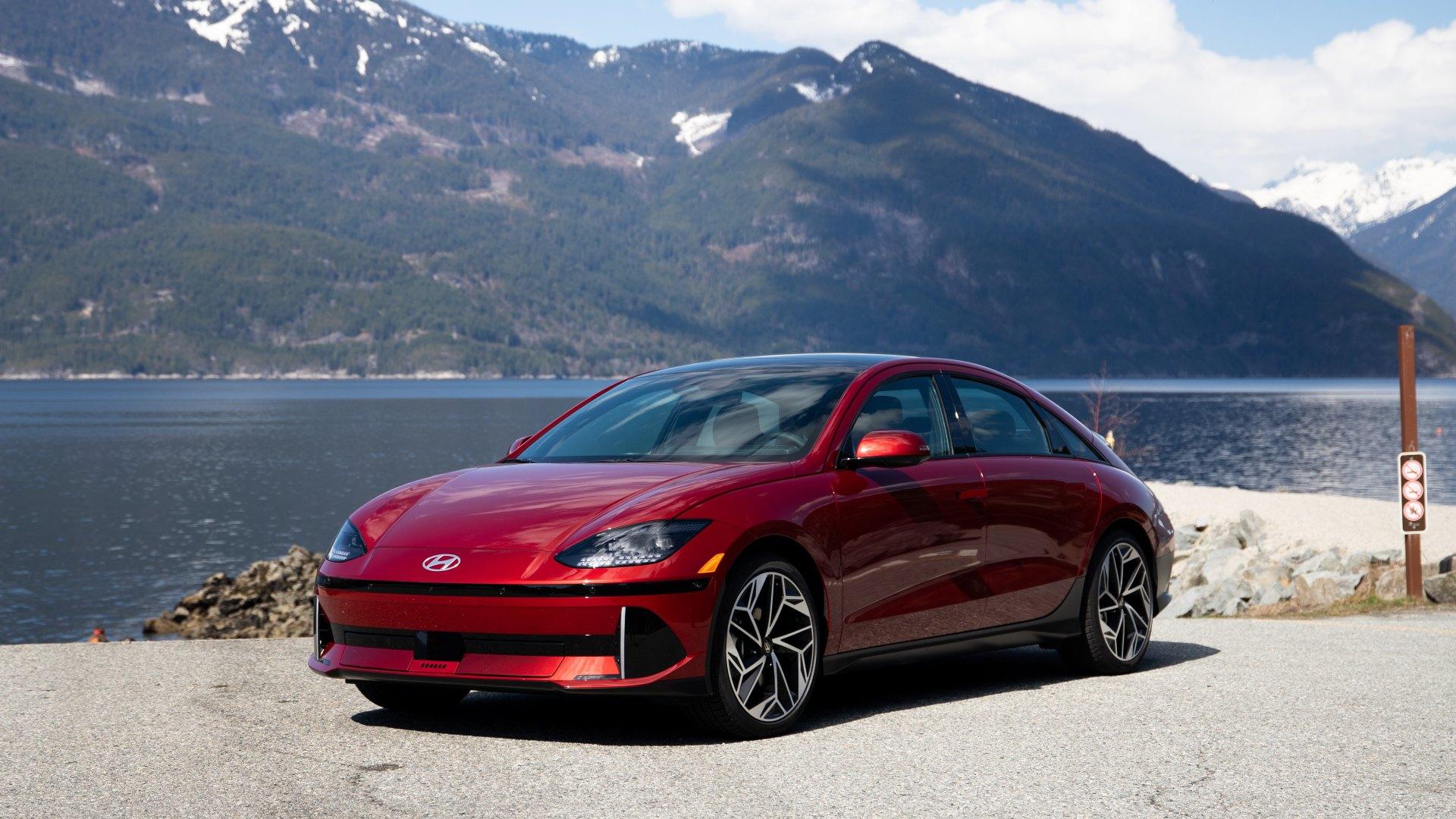
HYUNDAI IONIQ 6 2023
The sedan takes the essential virtues of the IONIQ 5 and pushes them a step further.
Pros and cons
Pros
- Excellent highway cruiser
- Quite ride
- Competitive and realistic range
- Inviting front seats
- Relatively simple controls
- Standard heat pump
Cons
- Uncomfortable rear seating
- Too-small trunk
- Significant drop in range with 20-inch wheels
- High driving positioning
- Restricted rear visibility
- Polarizing silhouette
Overview
Building on the success of its all-electric crossovers, Hyundai is now launching its first gasoline-free sedan. The IONIQ 6 keeps the platform, drivetrain and dashboard of the highly popular IONIQ 5 crossover and encloses them in a body designed to maximize the aerodynamics. The slippery styling helps boost the range of the rear-wheel-drive model to 581 km, which is impressive for a mass-market brand. For more power and performance, the catalogue also includes a dual-motor all-wheel-drive version.
Hyundai’s new sedan takes direct aim at the Tesla Model 3 and Polestar 2. It is evident in its $56,924 starting price (including shipping and preparation): $50 more than the Model 3, $674 more than the Polestar 2. With freight excluded, the IONIQ 6’s $54,999 price tag qualifies it for the $7,000 Quebec government rebate for all-electric vehicles. The federal government rebate of $5,000 brings the total discount to $12,000, applied as usual after taxes. Hyundai structured the lineup so that all versions of the IONIQ 6 are eligible for these financial incentives.
At the model launch we attended in Vancouver, Hyundai indicated it is allocating 2,000 to 3,000 units for Canada in 2023 (calendar year, not model-year). No pre-orders are accepted on the Hyundai Canada website, as each dealership is managing its own customer demand. Deliveries are expected to begin at the end of April.
The IONIQ 6 is built in South Korea, but the Hyundai-Kia group expects to produce 400,000 electric vehicles at its U.S. plant in Georgia starting in 2025.
Verdict
The IONIQ 6 takes the intrinsic virtues of the 5 and steps them up a notch. While the sedan cannot match its crossover sibling for versatility, it surpasses it in terms of stability, refinement and energy efficiency, in good part thanks to its polarizing silhouette. What it lacks in alertness compared to a Tesla Model 3, it makes up for in clearly superior smoothness, ease of use and dealer network.
Evaluation
Body and cabin
To say that Hyundai is not afraid to vary its stylistic approach to the IONIQ family is an understatement. The 6 sedan replaces the creased edges of the 5 crossover with curvy sides and dramatic arcs, elaborated for their aerodynamic value… to the benefit or detriment of esthetics, depending on your viewpoint. The 0.22 coefficient of drag is one of the lowest of the moment, notably thanks to the active air shutters in the front bumper and a plunging rear that brings to mind the Porsche Panamera… and the Infiniti J30 of the 90’s.
With that styling the IONIQ 6 doesn’t display the practicality of the IONIQ 5. It is evident it as soon as you open the trunk; its 376-litre capacity barely matches that of a compact sedan. Folding the rear seatbacks at least makes room for long, but not too high items, since the opening is small.
Thanks to a wheelbase almost as long as a minivan’s, the IONIQ 6 offers excellent legroom in the back; adults will feel much less hemmed-in than in a Model 3 or a Polestar 2. However, tight head and foot room restrict comfort, as does the very low bench seat.
It is probably why Hyundai is targeting couples rather than families with this car. The vast front passenger area offers accommodating seating for most physiques, though side support is a bit lacking in turns. The high driving position put us in mind of a Subaru Outback, even with the seat at its lowest setting; it contrasts with the car’s streamlined and dynamic silhouette.
The dashboard closely mirrors that of the IONIQ 5, except for the pair of ‘ears’ that protrude at either end. They serve to display the image relayed by a camera that replaces the outside mirrors… but not in North America, where the technology is not approved.
Two 12.3-inch screens dominate the dash, one facing the driver displaying driving information. We much prefer this layout to the single centre screen that Tesla insists on in the name of visual purity. The multimedia system displays a cascade of menus that can overwhelm at first, but an assortment of capacitive buttons, knobs and physical buttons facilitate access to the vital functions.
Android Auto and Apple CarPlay are standard, but only if you connect your mobile device with a cable. A majority of vehicles now allow wireless connection, including Hyundai’s equipped with an 8-inch screen; it’s high time the automaker extended this feature to all its models.
On the plus side, Hyundai has completely reworked its Bluelink application. It allows interaction with the vehicle via cellphone, notably to check the battery, begin charging, pre-condition the battery or pre-heat the cabin before departing. Included on most EV’s, such functions are part of the indisputable attractions of this type of vehicle.
Safety
All the usual driving assistance technologies are delivered standard, including blind-spot monitoring, lane keeping and adaptive cruise control. You have to order the Ultimate package to get surround-view cameras and several additional collision avoidance systems, including blind-spot, parking and intersection coverage. This package also includes highway lane change assist activated with the turn signal lever, detection of vehicles that cut in abruptly in dense traffic and automatic repositioning when a car gets too close in an adjacent lane.
Crash test results
National Highway Traffic Safety Administration (NHTSA)
Overall score: 5/ 5
Frontal impact: 4 / 5
Side impact: 5 / 5
Rollover resistance: 5 / 5
Insurance Institute For Highway Safety (IIHS)
Moderate overlap frontal impact: 4 / 4
Small overlap frontal impact:
- driver side: 4 / 4
- passenger side: 4 / 4
Side impact: 4 / 4
Rear impact: Not tested
Roof strength: Not tested
Mechanical overview
The Ioniq 6 is the fourth model designed on a Hyundai platform dedicated exclusively to 100-percent electric vehicles, after the IONIQ 5, Kia EV6 and Genesis GV60.
In Canada, the IONIQ 6 skips the standard-range battery that comes standard on the Ioniq 5 and EV6. It is delivered only with a 77.4kwh battery that can be charged from 10 to 80 percent capacity in 7 hours 30 minutes with a level 2 charger. Provided by the automaker, that figure seems more realistic than the 6 hours 43 minutes indicated for a full charge for the IONIQ 5. For the same gain in capacity, Hyundai indicates 1 hour 13 minutes on a 50kWh fast-charger, and as little as 18 minutes on a 350kWh charger.
Those charging times increase as temperatures drop, a phenomenon common to all electric vehicles. They also vary according to the number of amperes at which a level 2 charger operates.
Cold also influences range, of course, but the IONIQ 6 starts off with a hefty advantage. Hyundai indicates a target value of 581 km for the rear-wheel-drive version, 93 km more than for a RWD IONIQ 5. As the two vehicles are of similar weight, it is the IONIQ 6’s advanced aerodynamics that explain this significant improvement.
In comparison, a long-range Tesla Model 3 can deliver up to 576 km when its 75kWh battery is fully charged, all-wheel drive included. In the case of the IONIQ 6, AWD reduces range to 509 km; that’s the equivalent of the range of a Model 3 Performance, which is significantly more powerful than Hyundai’s sedan, but also much more expensive and ineligible for government EV rebates.
All the same, the IONIQ 6 AWD draws 320 horses and 446 pound-feet of torque from its dual motors, while the RWD model delivers 225 horses and 258 pound-feet.
Interestingly, the 20-inch wheels and wide tires that come with the Ultimate package on AWD versions reduce range by 74 km. The remaining 435 km figures well in the industry average, but it illustrates just how much wheel weight and the width of the contact surface of the tires increase the energy consumption of any vehicle, be it electric or gas-powered.
Driving impressions
Our first contact with an IONIQ 6 AWD with the Ultimate Package mostly took place on the expressways and main roads in the Vancouver area, on a splendid spring day.
Conditions were ideal to spotlight the energy efficiency of the new sedan. We ended our 208-km planned drive with a consumption of 17.4 kWh/100 km, which is much better than the 20.5 kWh/100 km combined city-highway rating. During that time, the range indicator went down 243 km. It seems like a lot, but prior to departure it displayed 462 km, or 27 km more than the claimed range for the car.
The many hilly descents that punctuated our route conserved the energy of the battery: we mostly drove with regenerative braking at level 3, the highest setting before one-pedal mode. The settings are controlled by the steering wheel paddles; level 3 provided engine braking appropriate for that type of terrain.
Like the cabin design, the mechanical relationship between the IONIQ 6 sedan and the crossover is evident. Instant and lively acceleration, quiet ride, comfortable suspensions: all ingredients already present on the IONIQ 5, but even more enhanced on the sedan.
With a lower centre of gravity than the SUV, combined with its exceptional aerodynamics, the Ioniq 6 proves extremely well planted on the road. It dissimulates its high weight well in corners, with less lean than the IONIQ 5 and more direct response to driver input.
Though they reduce range, the wide, 20-inch tires provide excellent grip and contribute to the quick steering reaction. However, the steering delivers less road feel than a Tesla or Polestar.
Hyundai’s big EV sedan is not as overtly dynamic as its two rivals, but it is more flexible and roomy, and considerably more affordable, similarly equipped. Which is why it deserves serious consideration, if you do not need the versatility of a hatchback.
Features and specs
Price range (including shipping and preparation) | ||
| Minimum price | $56,924 | |
|---|---|---|
| Maximum price | $65,924 | |
| Price as tested | N/A | |
| Trim levels | N/A | |
| Wheelbase | N/A | ||
|---|---|---|---|
| Length | N/A | ||
| Width | N/A | ||
| Height | N/A | ||
| Curb weight | N/A | ||
| Towing | Not recommended | ||