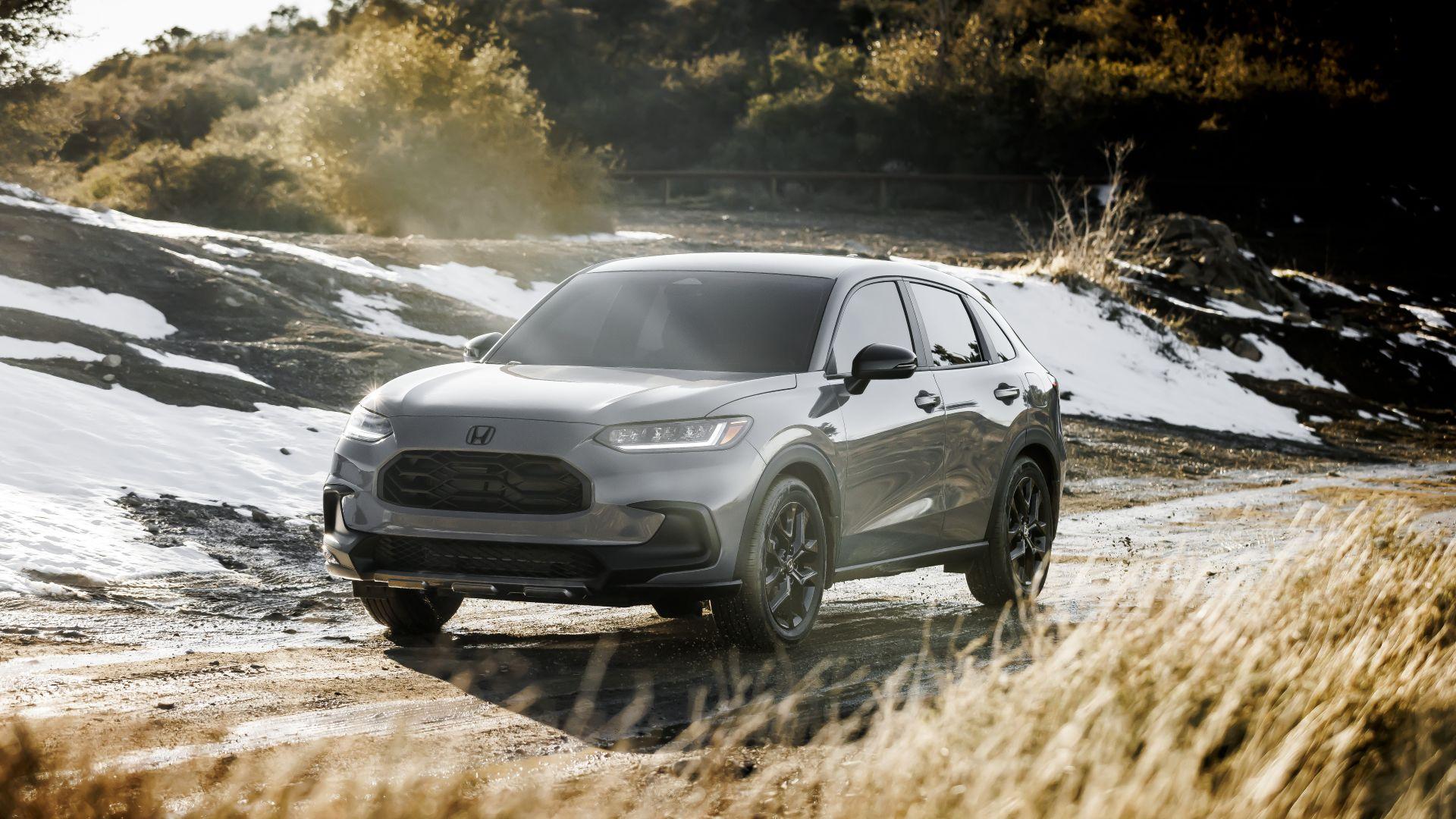
HONDA HR-V 2023
The new generation enters the big leagues
Pros and cons
Pros
- Simple controls
- Very good visibility
- Competitive space
- Easy-to-access cabin and trunk
- Improved ride comfort
Cons
- Noisy acceleration
- Ho-hum performance and drive
- Uninviting seats
- High price
- Build quality to be watched
Overview
Honda is renewing almost all its crossovers for 2023. Though still the smallest of the lineup, the Honda HR-V has grown in size after moving from the platform of the defunct Fit to that of the Civic. Accompanying the new dimensions, Honda now equips it with the same engine as its compact sedan and a similarly inspired cabin. The base model retains its front-drive configuration, though it can be ordered with the all-wheel drive delivered standard on Sport and EX-L Navi variants.
Like most Hondas, the HR-V has shot up in price. The base LX now costs $2,530 more, which raises the starting price to $30,680 (including destination fee). All-wheel drive adds $2,300, with the cost of financing among the highest of the category.
At this writing in March 2023, that translates to a monthly four-year lease payment of $592 (including taxes) for an all-wheel-drive HR-V LX. That’s much more than any other similarly equipped rival vehicle.
Even the Mazda CX-30 GT Turbo, which is much more powerful and luxurious than the base HR V, costs just $18 per month more, despite its $8,000 higher retail price.
Does the remake of this made-in-Mexico crossover justify its audacious price? Here’s what our experts have to say.
(Video in French only)
Verdict
The redesigned Honda HR-V is more agile, lively and advanced than its predecessor, but it loses some of the exceptional versatility than set it apart from the competition. It faces off against several very up-to-date models, sometimes more engaging, often as reliable, and still less expensive than the HR-V. If it has to be a Honda and AWD is not important, there’s the Civic hatchback, more spirited, more fuel efficient and just as roomy as its ‘lifted’ cousin… but not, unfortunately, less expensive.
Evaluation
Body, cabin and cargo space
While the outgoing HR-V was one of the smallest subcompact SUVs, the new edition takes a big step up. With a length of 456 cm, 22 cm more than before, the ‘small’ Honda now flirts with the compact crossover segment.
Despite this growth and a 4 cm gain in wheelbase, the cabin is not really roomier than before. Headroom is even reduced in some areas, and cargo volume loses up to 100 litres, depending on the model. Why? The new platform is not designed to accommodate the Magic Seat rear bench, found on the previous model, which could fold almost flat to the floor and had a bottom cushion that flipped up so as to carry a tall item.
Even without that trademark feature, the cabin is roomy enough for four average-size people, which is not the case for all its rivals. Interior volume of the HR-V is almost identical to that of the Civic hatchback, but because of its increased height, the crossover leads in terms of interior access. The doors, like the trunk, stand out for their large openings. The seatbacks fold to create a flat floor.
The redesigned dashboard also testifies to the HR-V’s close affiliation with the Civic, both in styling and functionality. Except for the lack of a tuning knob for the audio systems, the controls are a model of efficiency and simplicity, including the traditional gearshift lever. The touchscreen interface is hugely improved, in both logic and rapidity. However, be wary of the trip computer, which is fiddly to operate.
The HR-V displays some gaps in equipment. As an example, LX models do not have variable intermittent windshield wipers, an almost universal feature nowadays… except on base-model Hondas! The wireless versions of Android Auto and Apple CarPlay and phone charging are restricted to the costly EX-L Navi version. And despite its nearly $40,000 price tag, said version is not even entitled to a power hatch, let alone rear USB outlets or heated rear seats. Even a power driver’s seat and driver lumbar adjustment are missing, although they would have marginally improved the comfort of the seat, which is underpadded and too short.
As for an impression of luxury, the fit on our test model left much to be desired. One or two uneven body panel gaps is one thing, but a centre console and a dash top that move when pressed against is quite another, leading to questions about build quality.
Safety features
Antilock brakes with electronic brake force distribution and emergency brake assist
Stability and traction control
Hill start assist
Front airbags
Front side airbags
Side air curtains
Five adjustable head restraints
Rearview camera
Forward collision warning with automatic emergency braking
Lane departure warning
Lane keeping assist
Blind spot monitoring
Rear cross traffic alert
Automatic high beams
Front and rear parking sensors (standard, EX-L Navi; unavailable, other versions)
Adaptive cruise control
Crash test results
National Highway Traffic Safety Administration (NHTSA)Overall score: 5 / 5
Frontal impact: 5 / 5
Side impact: 5 / 5
Rollover resistance: 4 / 5
Insurance Institute For Highway Safety (IIHS)
Moderate overlap frontal impact: 4 / 4
Small overlap frontal impact:
- driver side: 4 / 4
- passenger side: 4 / 4
Side impact: 4 / 4
Rear impact: 4 / 4
Roof strength: 4 / 4
IIHS Top Safety Pick+
Visibility
Honda has taken great pains with visibility on its smallest crossover. The narrow roof pillars, wide windshield base and the free space between the outside mirrors and the edge of the doors facilitate the view at intersections. Blind-spot warning lamps on the outside mirrors finally now replace the LaneWatch system that only monitored the passenger side and obliged the driver to check the centre screen for a potential obstacle.
Headlights: the HR-V is one of the vary rare models whose headlights attain or surpass all optimal lighting thresholds established by the Insurance Institute for Highway Safety. However, it scored three on a scale of four because of the glare its LED reflector headlights create in low-beam mode.
Mechanical overview
The HR-V still uses the Fit platform everywhere except in North America, where the Fit was discontinued at the end of 2020. ‘Our’ model differs from the global version not only in size, but also because of its engine.
A direct carryover from the Civic, its 4-cylinder engine is 2.0L, rather than 1.5L as elsewhere in the world or 1.8L as on the previous North American model. Power is now 158 hp, 17 hp more than last year. Torque goes from 127 lb-ft to 138 lb‑ft, still attained over 4,000 rpm.
The North American variant does not have a hybrid option, unlike the HR-V of the other markets. A continuously variable transmission is the only one available, with no manual mode, but with simulated gear shifts in heavy acceleration.
All-wheel drive is optional on the base LX but standard on Sport and EX-L Navi models. An independent multilink rear suspension, similar to the Civic’s, replaces the torsion beam setup the former model inherited from the Fit.
More powerful than its predecessor but also around 100 kg heavier, the 2023 HR-V pays a slightly higher price at the pump. Natural Resources Canada indicates a combined city-highway rating of 8.7 L/100 km for an all-wheel-drive version, or 6 percent more than an equivalent 2022 model. We recorded 9.1 L/100 km in December 2022… the same result as for a CR-V, which is significantly quicker and roomier than its little brother!
However, there is another Honda you can drive that is just as roomy as the HR-V while saving between 1 and 1.5 L/100 km. The solution bears the Civic name and it offers as much interior space as the crossover, better performance and more dynamic handling, for about the same price. As a premium, its available manual transmission will delight the driving enthusiast. Have a look if you can make do without the HR-V’s (slightly) elevated driving position or its all-wheel drive.
Driving impressions
Noisy, and rather firm, the old HR-V lacked refinement and didn’t even offer the playfulness of the Fit from which it derived. The new version rectifies that situation, but only partially.
The new engine proves more discreet than the one it replaces, at least in urban driving. The increased low-speed torque lets you keep up with traffic with no problem and reduces the high revving that plagued the quietness of the preceding model. However, high revving still occurs in mountainous terrain or when merging onto the highway the least bit fast. Performance remains timid, since the additional power just offsets the redesigned model’s extra weight.
The transmission’s simulated speeds attenuate the noisy revving, but only in very heavy acceleration. The CVT transmission is generally efficient, but it still occasionally produces a slight elastic-band effect, where you feel a delay between right-foot input and the expected acceleration.
The HR-V is secure, composed and smoother than before on degraded pavement. However, it does not display the same balance as the Civic in turns, even though the two vehicles use the same independent rear suspension. The body leans and the steering, though precise, proves a bit too light to be really engaging. It is part of the price to pay to drive a crossover rather than a car.
One could reach the same conclusion after testing rival vehicles like the Nissan Qashqai and Toyota Corolla Cross. On the other hand, a stint at the wheel of a Mazda CX-30 or a Volkswagen Taos shows that you can drive a crossover and still have fun.
Other highlights
Braking: very good power. Pedal is appropriately firm and very easy to modulate. Antilock system is unobtrusive and efficient.
Driving assistance: adaptive cruise control is relatively quick but a bit abrupt when a vehicle suddenly appears in or disappears from the field of view. You can revert to regular cruise control by pressing a few seconds on the following distance button. Lane departure and lane keeping are somewhat hyperactive.
Features and specs
Price range (including shipping and preparation) | ||
| Minimum price | $30,730 | |
|---|---|---|
| Maximum price | N/A | |
| Price as tested | N/A | |
| Trim levels | LX (FWD)
LX (AWD)
Sport (AWD)
EX-L Navi (AWD) | |
Hyundai Kona | ||
Kia Niro | ||
Kia Seltos | ||
Mazda CX-30 | ||
Mitsubishi RVR | ||
Nissan Kicks | ||
Subaru Crosstrek | ||
Toyota Corolla Cross |
| Wheelbase | N/A | ||
|---|---|---|---|
| Length | N/A | ||
| Width | N/A | ||
| Height | N/A | ||
| Curb weight | N/A | ||
| Towing | Not recommended | ||