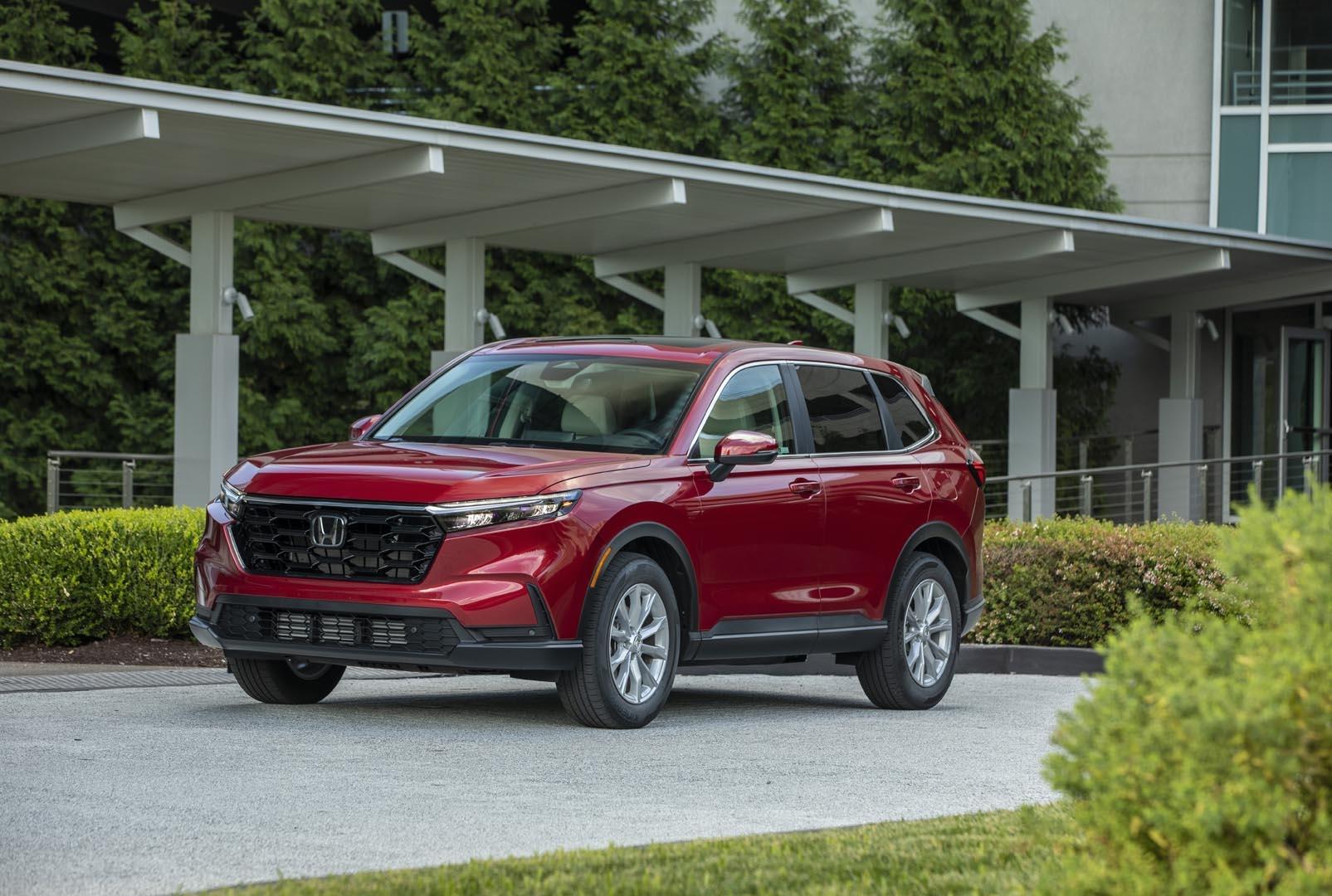
HONDA CR-V 2023
Canada's favorite Honda has been redesigned and is finally going hybrid.


Pros and cons
Pros
- Vast cabin
- Impressive cargo space
- Good balance of comfort and handling
- Logical controls and screens
- Reasonable fuel consumption (gasoline engine)
- Pleasant hybrid powertrain
Cons
- Exaggerated price
- Noisy turbo engine
- Hybrid engine is both rare and strangely thirsty
- Too-short front seats
- Incomplete equipment
- Highly prized by thieves
Overview
The 2023 model-year marks the arrival of the sixth generation of the Honda CR-V. Honda still bases its best-selling model on the Civic sedan, which received a new platform just over a year ago. A hybrid powertrain is finally available, but only on the most luxurious version. Unlike several rivals, Honda still offers a front-wheel drive version of its compact utility vehicle, which makes it slightly more accessible financially.
And every little bit helps, since the price of the Honda CR-V has risen between $3,370 and $5,370 this year. Of course, the hybrid powertrain accounts for about $2,000 of the sticker price of a CR-V Touring. However, it is still a significant increase, especially in a context of rising interest rates. For example, at the end of May 2023, the four-year lease rate for a CR-V LX with all-wheel drive was 7.59 percent. Total monthly payment after taxes: $722! Not so long ago, a better-equipped version went for less than $500 per month.
Honda builds the CR-V at two plants in the United States in addition to its Alliston, Ontario, facility, which is the global lead plant for this model.
Verdict
The redesigned Honda CR-V adds to the exceptional space and versatility that have characterized the series since its debut 26 years ago. With the reliability of the turbo engine apparently no longer an issue, we have no problem recommending this model, which is enjoyable on a daily basis, balanced on the road and relatively frugal at the pump. The stiff price, limited availability of the hybrid and the unfortunate popularity of the CR-V with thieves might lead you to look elsewhere, and there is no shortage of good choices.
Evaluation
Body, cabin and cargo space
Slightly longer and wider than the outgoing version, the redesigned Honda CR-V continues the tradition of space and versatility of this model. Few other compact SUVs can accommodate a family of four so easily—or five, thanks to the flat rear floor.
Though the front seats are still a bit short on thigh support for tall people, the majority of our testers found them satisfactory. They also appreciated the well-designed driving position. The rear doors open nearly 90 degrees, which makes it much easier to install a child safety seat.
Likewise, the cargo area is one of the most spacious of the segment, with a floor that is almost as low as a minivan’s. However, the rear seatbacks fold about 15 cm higher than the floor. The two-level floor no longer eliminates the difference in height, and the levers on either side of the trunk that used to fold the benches have disappeared. The sides of the cargo area still have a plastic finish that is very easy to scratch.
That’s the only notable fault in the finish of the cabin, which is trimmed in higher-quality materials than before. As it did for the bodywork, Honda has given the dash a sleeker design, similar to that of the new Civic in appearance and functionality.
All controls are logical and easy to access, including the dedicated knobs and buttons for climate control and the traditional gearshift lever. The touch screen is more responsive, the menus have been simplified and the buttons enlarged, but the seven-inch display on LX and Sport versions is too small, on a vehicle that has just been renewed. EX-L and Touring are the only models to get wireless Android Auto and Apple CarPlay and a wireless charging pad. However, as a phone can slide too easily on the pad, charging is constantly interrupted.
Other highlights
Windshield wipers: variable intermittent windshield wipers still unavailable on the LX, though the feature is almost universally available industry-wide. The wiper arms are partially hidden under the edge of the hood; wipers have to be in service mode in order to raise them to clear the windshield of snow. The washers take close to a second to respond, which is a real annoyance in the winter.
Convenience: only four speakers and alloy wheels discontinued on the LX, rear USB ports restricted to the Touring Hybrid, panoramic roof on the latter replaced by a standard sunroof, absence of ventilated seats and surround-view system: these few examples confirm that the competition often offers more equipment for less money than the CR-V.
Safety
- Antilock brakes with electronic brake force distribution and brake assist
- Stability and traction control
- Hill-start assist
- Hill-descent assist (standard, LX, LX-B, Sport, Sport-B and EX-L; unavailable, Touring Hybrid)
- Front airbags
- Driver and front passenger knee airbags
- Front and rear side airbags
- Side curtain airbags
- Front seatbelt pretensioners
- Five head restraints (adjustable on outboard seats, folding on middle seat)
- Rear occupant alert
- Rearview camera
- Tire pressure monitor
- Forward collision alert
- Forward automatic emergency braking
- Lane departure alert with steering assist
- Lane centering assist
- Blind-spot monitoring and rear cross-traffic alert (standard, LX, Sport, EX-L and Touring Hybrid; unavailable, LX-B and Sport-B)
- Automatic high beams
- Adaptive cruise control
- Front and rear parking sensors (standard, EX-L and Touring Hybrid; unavailable, LX, LX-B, Sport and Sport-B)
Crash test results
National Highway Traffic Safety Administration (NHTSA)
Overall score: 4 / 5
Frontal impact: 4 / 5
Side impact: 5 / 5
Rollover resistance: 4 / 5
Insurance Institute For Highway Safety (IIHS)
Moderate overlap frontal impact: 4 / 4
Small overlap frontal impact:
- driver side: 4 / 4
- passenger side: 4 / 4
Side impact: 4 / 4
Rear impact: 4 / 4
Roof strength: 4 / 4
IIHS Top Safety Pick+
Visibility
The traditional lines and large glass surface provide good overall visibility. However, the small outside mirrors bothered our test drivers; we recommend avoiding LX-B and Sport-B models, which are unavailable with blind-spot monitoring. The $550 saving and quicker delivery do not make up for the loss of this important security feature.
Mechanical overview
Apart from the rejuvenated platform and the arrival of the hybrid powertrain, the mechanical specifications of the 2023 Honda CR-V are very similar to those of its predecessor. A closer look reveals that Honda has tweaked the steering and suspensions, for a more inspiring drive. The engineers did not work in vain; see our driving impressions below.
The CR-V hybrid has been selling in the United States for three years and longer than that in other markets. It arrives in Canada in a revised version that still pairs a two-litre four-cylinder Atkinson cycle engine with two electric motors located in front. With 204 horsepower and 247 pound-feet of torque, it is the most powerful CR-V ever and, according to Natural Resources Canada, the most fuel efficient.
That is not what we experienced, since our test of a CR-V hybrid yielded a fuel consumption of 9.9 L/100 km. Admittedly, it was conducted during a cold spell in February, and more on the highway than in the city, where hybrids are sometimes more frugal. Still, that result is much higher than Natural Resources Canada’s combined rating and also surpasses the 9.1 L/100 km delivered by a gas-only model we tested during the same period.
Drivers here may have fewer regrets about Honda Canada’s decision to restrict the hybrid powertrain to the Touring. The automaker’s ‘eventual’ mission’ is to sell half of North-American CR-Vs with a hybrid system; clearly, the current structure of the line-up will not allow them to reach that objective.
That means that most CR-Vs will keep the 1.5-litre turbocharged four-cylinder launched in 2017. Thanks to some internal revisions, including a new turbocharger, maximum torque of 179 pound-feet now peaks at 1,700 rpm rather than 2,000 as before. However, the combined fuel economy Natural Resources Canada's rating increases from 8.1 to 8.4 L/100 km, probably because the weight has also risen slightly.
The two powertrains still call on a continuously variable transmission. Electronic on the hybrid, but traditional—belt and pullies—with the combustion engine, it now mimics gear changes at high rpms to reduce the noise level in heavy acceleration. It still does not offer a manual mode; the steering-wheel paddles on the hybrid version simply accentuate the level of regenerative braking.
Unlike the RAV4 hybrid, the dual-motor CR-V uses the same traditional all-wheel-drive system, equipped with a driveshaft, as the gasoline-only models. The system now can transfer up to half the torque to the rear wheels to improve traction on slippery surfaces or during acceleration. With or without AWD, the gasoline CR-V can still tow 680 kg (1,500 lb); towing is limited to 454 kg (1,000 kg) on the Touring Hybrid.
Driving impressions
Certain competitors are more dynamic than the CR-V, such as the Mazda CX-5, but they react a bit stiffly on degraded pavement. Others propose a more compliant ride, like the Nissan Rogue, but they do not control body movements as well.
Though the CR-V has tipped the scale one way or the other in the past, this year’s remake places it right in the middle. Stable on the highway and at ease in turns, Canada’s best-loved Honda isolates its occupants well from road imperfections. Honda has sharpened steering precision and response without sacrificing straight-line stability. Its filiation with the brilliantly revised 2022 Civic is more evident than with the HR-V, though it, too, is built on the compact sedan’s platform.
The turbo engine is equal to the task in most circumstances. Unlike other turbocharged engines, it stays energetic right to the upper reaches of the engine. That saves the day when passing or merging onto the highway, since a certain lack of low-end torque is felt despite the competitive specs on paper. A 1.5L displacement cannot work miracles.
The same applies to the noise level, which remains an annoyance in heavy acceleration despite the claims of the manufacturer. At least the soundproofing underneath the vehicle has been improved, though the Mazda CX-5 and CX-50 continue to do a better job of filtering road noise than the CR-V.
The hybrid powertrain largely corrects both those weaknesses thanks to the contribution of the electric motors. It would be the powertrain of choice if it were more economical at purchase and at the pump. We will have to test another CR-V Touring Hybrid in the summer to see if it delivers as promised in warmer temperatures better than in the middle of winter.
Other highlights
Braking: pedal is smooth and easy to modulate, even with the hybrid model’s regenerative braking. Antilock system is efficient and does not intervene unnecessarily on slippery roads.
Driving assistance: adaptive cruise control is relatively rapid, but a bit too abrupt when a vehicle appears or disappears suddenly from the field of view. You can switch to regular cruise by pressing the distance setting button for a few seconds. Lane departure alert and lane keeping are a bit hyperactive.
Features and specs
Price range (including shipping and preparation) | ||
| Minimum price | $36,240 | |
|---|---|---|
| Maximum price | $50,890 | |
| Price as tested | N/A | |
| Trim levels | LX-B
LX
Sport-B
Sport
EX-L
Touring Hybrid | |
Chevrolet Equinox | ||
Ford Escape | ||
GMC Terrain | ||
Hyundai Santa Fe | ||
Hyundai Tucson | ||
Jeep Cherokee | ||
Kia Sorento | ||
Kia Sportage | ||
Mazda CX-5 | ||
Mitsubishi Outlander | ||
Nissan Rogue | ||
Subaru Forester | ||
Toyota RAV4 | ||
Volkswagen Tiguan |
| Engine, horsepower and torque | 1.5L turbo 4-cyl.; 190 hp at 6,000 rpm; 179 lb-ft from 1,700 to 5,000 rpm
2.0L 4-cyl. with 2 electric motors; 204 hp; 247 lb-ft from 0 to 2,000 rpm (Touring Hybrid) |
|---|---|
| Transmission | Continuously variable automatic
Electronic continuously variable automatic (Touring Hybrid) |
| Front suspension | Independent with MacPherson struts |
| Rear suspension | Independent multilink |
| Front brakes | Ventilated disc |
| Rear brakes | Disc |
| Tires | 235/65R17 (LX)
235/60R18 (Sport and EX-L)
235/55R19 (Touring Hybrid) |
| Wheelbase | 270 cm | ||
|---|---|---|---|
| Length | 469.5 cm | ||
| Width | 194 cm (mirrors folded) | ||
| Height | 168 cm (LX front-wheel drive)
169 cm | ||
| Curb weight | From 1,583 to 1,785 kg
1,656 kg (EX-L)
1,785 kg (Touring Hybrid) | ||
| Towing capacity | 2.0L hybrid engine: 454 kg (1,000 lbs); 1.5L turbo engine: 680 kg (1,500 lbs) | ||
According to Natural Resources Canada | ||
| City | 6.0 L/100 km (2.0L hybrid engine) 9.1 L/100 km (1.5L turbo engine, all-wheel drive) | |
|---|---|---|
| Highway | 6.9 L/100 km (2.0L hybrid engine) 7.6 L/100 km (1.5L turbo engine, all-wheel drive) | |
As measured by CAA-Québec | ||
| City | 9.9 L/100 km (2.0L hybrid engine) | |
| Highway | 9.1 L/100 km (1.5L turbo engine, all-wheel drive) | |
| CO2 emissions | 3,020 kg/20,000 km (2.0L hybrid engine)
3,940 kg/20,000 km (1,5L turbo engine) | |
| Fuel tank | 53 litres | |
| Recommended fuel | Regular-grade gasoline | |