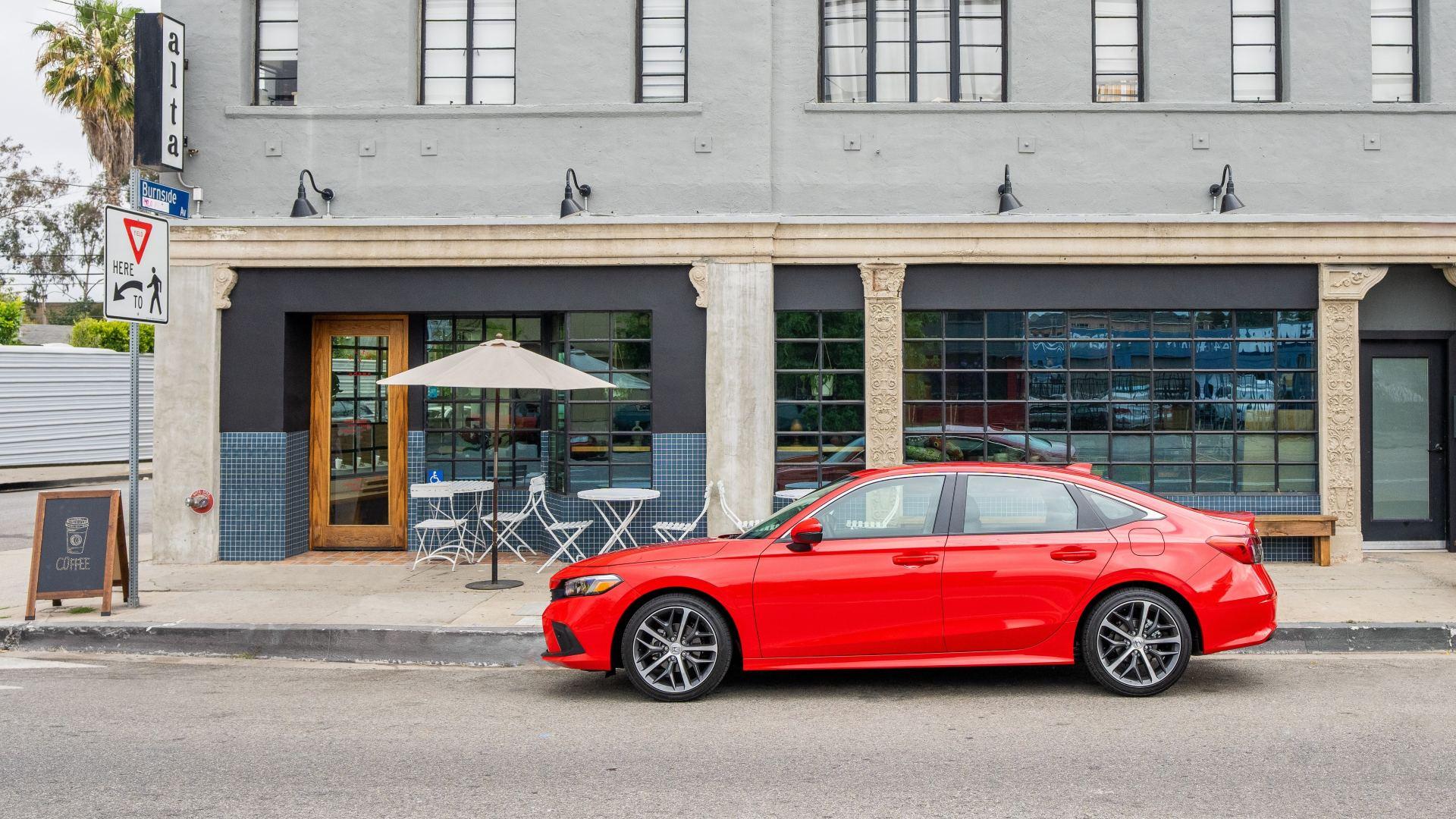
HONDA Civic 2022
The redesigned Civic has many qualities, but do they justify its high price tag?
Pros and cons
Pros
- Excellent visibility
- Roomy interior
- Simplified controls
- Exemplary handling
- Faultless automatic transmission
- Low fuel consumption
Cons
- Ride is still noisy
- Uncertain reliability (turbo engine)
- Low driving position
- Lack of seat support
- Trunk space (sedan)
Overview
The 2022 Honda Civic has been on the road since the beginning of summer 2021. Entirely redesigned inside and out, it displays numerous updates in terms of technology, safety and handling. Its gasoline powertrains are unchanged, whereas the platform and the rest of the mechanicals have undergone minor revisions. Will it be enough for the Civic to hold on to the title of best-selling car in the country, challenged for the first time in 23 years?
At the end of September 2021, it was overtaken by long-time rival Toyota Corolla in the sales race that excludes SUVs and pickups, much more popular now than cars. Toyota renewed its compact in 2020, while the preceding remake of the Civic dated back to 2016. The changes come just in time for the lineup, which traditionally includes a sedan and a hatchback but which lost its coupe at the end of 2020.
Interested parties, take note: while there are still a few $20,000 compact sedans out there, the Civic is not one of them. Taking into account the $1,065 price increase for the 2022 model-year, the least expensive Civic now sells for $26,165, including destination charges. Whether a cash purchase, financed or leased, the Civic is one of the most expensive cars of its segment.
The Civic sedan is still built in Ontario. The hatchback is assembled in Indiana following the closure of Honda’s U.K. plant in the summer of 2021.
(Video in French only)
Verdict
Interior space, finish, fuel efficiency, driving enjoyment… The redesigned Honda Civic is brimming with qualities that would amply justify another sales crown, especially if Honda has well and truly resolved the early problems of the turbo engine. But the competition is capable, attractive and often more affordable than the Civic, similarly equipped. What’s sure is drivers who still refuse to jump on the SUV or EV bandwagons have something to sink their teeth into.
Evaluation
Body, cabin and cargo space
The new Honda Civic’s clean, almost neoclassical lines sharply contrast with the fussy styling of the previous generation. The cabin is roomy enough for a family of four, whether the kids are full-grown or still using a child restraint. Honda fully merits its stellar reputation for maximizing interior space.Like its predecessor, the 2022 Civic has a very low driving position that may displease certain clienteles. You have to hoist yourself up to get out, a bit like exiting a sports coupe. The lack of lumbar support on the front seats could make a bad back worse. Even the luxurious Touring model does not offer lumbar adjustment.
That’s the extent of our complaints about the cabin, or almost. You won’t find a tuning knob with the Touring’s 9-inch touch screen. Happily, it has reappeared on the other versions, which have a 7-inch screen. All the other controls, without exception, stand out for their logical layout. Even the infotainment system interface has gained in simplicity and rapidity, though it is still slow to react at times.
The minimalist treatment of the cabin has done it a world of good, visually, functionally and in terms of finish. The quality of materials continues to progress. The honeycomb mesh strip that stretches across the dash is both chic and original.
Other highlights
Convenience: all Civics are well equipped, but Honda still deprives the base model of quasi-universal features such as variable intermittent windshield wipers. The base LX version has a single USB port whereas the other trims have three or four. Android Auto and Apple CarPlay are standard, but the wireless version is restricted to Touring models. The Touring is also the first in the history of the Civic to offer a brand-name audio system (Bose, as it happens); it sounds much better than the generic high-end systems of the past.
Trunk: trunk volume of the sedan has decreased by 9 litres (8 in the case of the Touring version, equipped with a subwoofer) even though the car is longer. Cargo space is acceptable, but several rival sedans offer more, starting with the Volkswagen Jetta. Opting for the Civic hatchback brilliantly remedies the situation, since it is one of the compact hatchbacks with the most cargo room.
Safety features
- Antilock brakes with electronic brake force distribution and brake assist
- Stability and traction control
- Hill start assist
- Front airbags
- Front knee airbags
- Front and rear side airbags
- Side curtain airbags
- Front seat belts with pretensioners
- Five adjustable head restraints
- Rearview camera
- Forward collision warning
- Forward automatic emergency braking
- Lane departure warning with automatic steering assist
- Lane keeping assist
- Automatic high-beams
- Blind-spot monitoring
- Rear cross traffic warning
- Adaptive cruise control (with traffic jam assist on models with automatic transmission)
- Front and rear parking sensors (standard, Touring sedan and Sport Touring hatchback; unavailable, other versions)
Crash test results
National Highway Traffic Safety Administration (NHTSA)Overall score: 5 / 5
Frontal impact: 4 / 5
Side impact: 5 / 5
Rollover resistance: 5 / 5
Insurance Institute For Highway Safety (IIHS)
Moderate overlap frontal impact: 4 / 4
Small overlap frontal impact:
- driver side: 4 / 4
- passenger side: 4 / 4
Side impact: 4 / 4
Rear impact: 4 / 4
Roof strength: 4 / 4
IIHS Top Safety Pick+
Visibility
The traditional lines of the new 2022 Honda Civic come with large side windows and thin roof pillars, particularly in front. The result is excellent visibility for a sedan. In other good news, Honda has finally replaced the passenger-side blind-spot camera with a normal monitoring system that covers both sides of the car. Better yet, it is standard on all trims.Headlights: The LED reflector headlights offered as standard equipment earned the Insurance Institute for Highway Safety’s top score. They are among the rare systems to meet or surpass nearly all IIHS evaluation thresholds.
Mechanical overview
The redesigned Honda Civic uses a more rigid yet barely heavier version of a platform launched by its predecessor in 2016. The main mechanical components also carry over, with minor revisions. That includes the fully independent suspension with a slightly thicker rear anti-sway bar.Honda applied the same philosophy to the powertrain. The 2.0-litre four-cylinder equipping the majority of the models has the same power (158 hp) and torque (138 lb-ft) ratings as in 2021. However, it is a bit more fuel efficient, on paper, thanks to a redesigned catalytic converter, the addition of automatic stop/start and an improved continuously variable automatic transmission (CVT).
All versions of the Civic now use the CVT, with only the hatchback eligible for a six-speed manual priced the same as the automatic. According to Natural Resources Canada, the three-pedal transmission comes with an 11‑percent penalty at the pump relative to the CVT with the 2.0‑litre engine, which is newly offered on the five-door LX.
The Touring sedan and Sport and Sport Touring hatchbacks still offer the direct-injected 1.5‑litre turbo engine also found under the hood of the Accord and CR‑V. Its 180 horsepower and 177 pound-feet of torque are identical to the ratings for the 2021 Sport and Sport Touring hatchback models; the 174 horsepower variant no longer exists.
This engine experienced its share of problems following its introduction six years ago. Deficient warm-up and, therefore, inadequate heating of the cabin, as well as fuel and oil mixing in the cylinders are the most common. Honda says the problems have been fixed, but only time will tell.
As evaluated by Natural Resources Canada, fuel consumption of the two available engines should attain an average of 6.9 L/100 km on the sedan. We measured 7 L/100 km in our test drive of close to 1,400 km conducted mostly on the highway, before cold weather set in.
Driving impressions
After several generic generations, the 2016 Honda Civic partially reinstated the agility that built the model’s reputation. The 2022 version marks a brilliant return to its roots.It takes just a few kilometres to appreciate the precision, rapidity and ideal weighting of the steering. Nimble in the city, incisive in corners and with good straight-line stability at highway speeds, the 2022 Civic displays a versatility formerly limited to larger and more costly cars.
The suspension is just firm enough to control body roll without punishing the occupants on degraded pavement. It seemed exempt of the clunks from the rear suspension that sometimes affected the former-generation Civic and certain Acura’s.
The turbo engine proves lively right across the rev range, whereas several equivalent engines peak as early as 4,000 rpm. Honda has successfully reduced the dull drone at low and mid-level rpm’s that was unworthy of a Honda-built engine. It becomes noisy in heavy acceleration only because the transmission holds it at the upper reaches of the tachometer. On the other hand, the rpm’s drop just as quickly when you release the throttle as they climb when you tramp the pedal—with no jerking or unpleasant rubber-band effect.
The exemplary behaviour reflects the attention to detail Honda has brought to the road dynamics of the Civic. Additional under-body sound insulation is still lacking for refinement to match the excellence of the drive—a little goes a long way.
Other highlights
Braking: pedal response is immediate and linear and power is well-adapted to the size of the car and its remarkable road capabilities.
Driver assistance: adaptive cruise control very quick to decelerate behind another vehicle, even at the shortest distance setting, and slow to reaccelerate after a lane change. It still can be used as a conventional cruise control if desired. Lane-departure warning is too sensitive, and steering corrections are sometimes abrupt. Lane-keep system is adequate, without too much ping-pong effect between the lane lines.
Features and specs
Price range (including shipping and preparation) | ||
| Minimum price | $26,165 | |
|---|---|---|
| Maximum price | N/A | |
| Price as tested | $32,265 | |
| Trim levels | Sedan
LX
EX
Sport
Touring
Si
Hatchback
LX
Sport
Sport Touring | |
Hyundai Elantra | ||
Kia Forte | ||
Mazda 3 | ||
Nissan Sentra | ||
Subaru Impreza | ||
Toyota Corolla | ||
Volkswagen Jetta |
| Engine, horsepower and torque | 1.5L turbo, direct injection 4-cyl.; 180 hp at 6,000 rpm; 177 lb-ft from 1,700 to 4,500 rpm
2.0L 4-cyl.; 158 hp at 6,500 rpm; 138 lb-ft at 4,200 rpm |
|---|---|
| Transmission | 6-speed manual
Continuously variable automatic
Continuously variable automatic with manual mode |
| Front suspension | Independent with MacPherson struts |
| Rear suspension | Independent multilink |
| Front brakes | Ventilated disc |
| Rear brakes | Disc |
| Tires | 215/55R16
235/40R18 |
| Wheelbase | 273.5 cm | ||
|---|---|---|---|
| Length | 452.9 cm (hatchback)
465.5 cm (sedan) | ||
| Width | 190 cm (mirrors folded) | ||
| Height | 141.5 cm | ||
| Curb weight | From 1,313 to 1,412 kg
1,371 kg | ||
| Towing | Not recommended | ||
According to Natural Resources Canada | ||
| City | 7.6 L/100 km (1.5L turbo engine, automatic transmission) | |
|---|---|---|
| Highway | 6.1 L/100 km (1.5L turbo engine, automatic transmission) | |
As measured by CAA-Québec | ||
| City | 7.0 L/100 km (1.5L turbo engine, automatic transmission) | |
| Highway | N/A | |
| CO2 emissions | 3,240 kg/20,000 km (2.0L engine, automatic transmission; manufacturer data) | |
| Fuel tank | 46 litres (hatchback)
46.9 litres (sedan) | |
| Recommended fuel | Regular-grade gasoline | |
| 0-100 km/h | N/A |
|---|---|
| 60-100 km/h | 4.9 seconds |