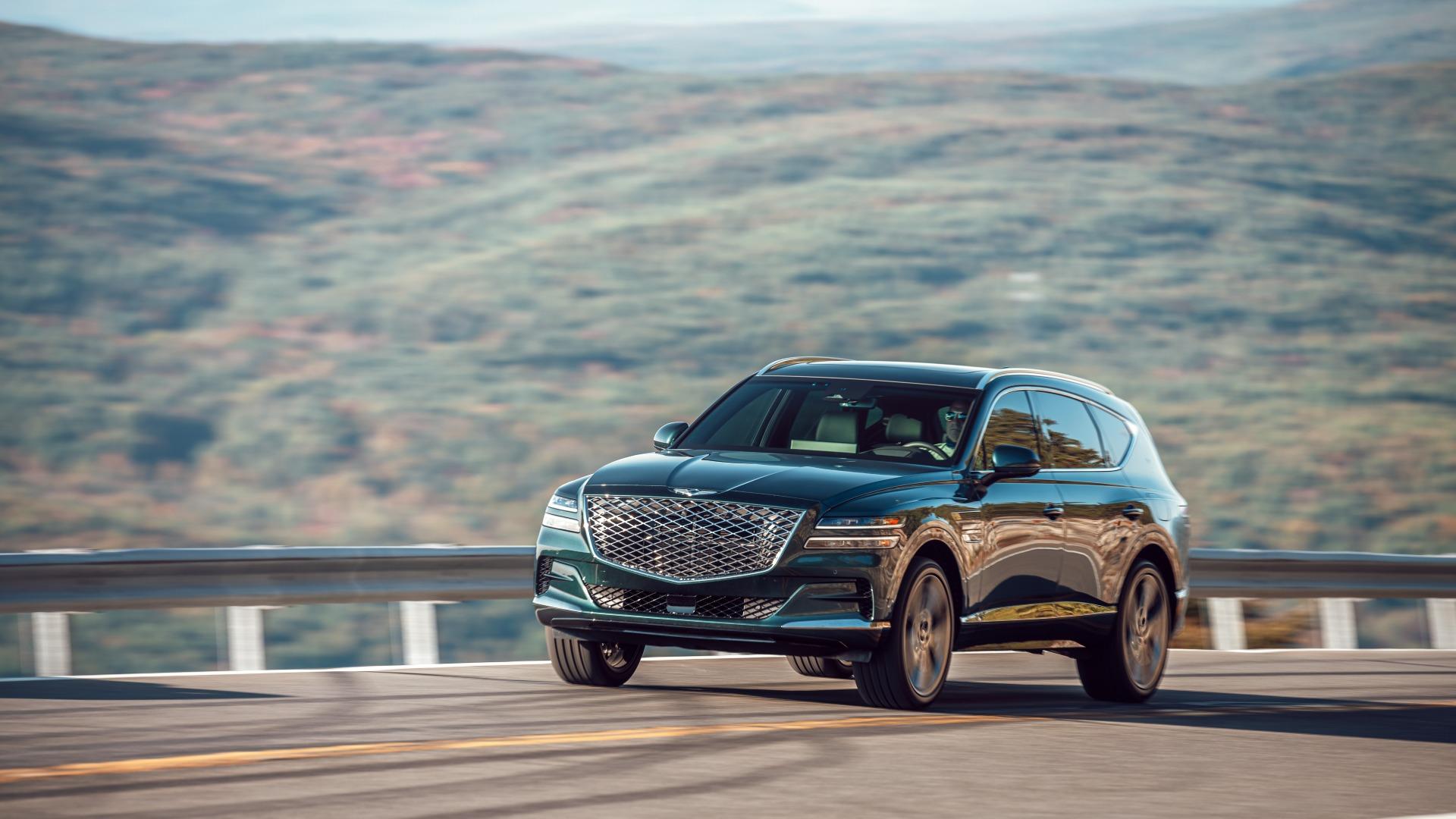
GENESIS GV80 2024
One of the most affordable models in its segment
Pros and cons
Pros
- Powerful V6 engine
- Very comfortable seats
- Luxurious finish
- Quiet running
- Excellent equipment/price ratio
- Customer-friendly after-sales service
Cons
- Sluggish transmission
- Poorly communicative steering
- Unpleasant steering wheel
- A few unusual controls
- Annoying ride over small bumps (22" tires)
- Not available in an electrified version
Overview
Three years on from the launch of the GV80, Genesis unveiled a slightly revamped version at the end of last September. The exterior and mechanical alterations are subtle, but the addition of a coupé body style to the catalogue will bring the offering on par with that of the competition, while an overhaul of the dashboard will improve user interaction with the vehicle. As we wait for the new design to arrive by the end of 2024, we set off to drive the current model for some 1200 km to assess its position in the market.
A glance at the Genesis GV80’s price range already places it among the most affordable models in its segment. Indeed, a bill of $76,000 for the 2.5T Advanced version is not exactly pocket change—in fact, it’s no less than $11,500 more than the price of the base model three years ago. Yet it’s still less than the price tag of several equivalent European rivals. However, the gap tends to widen further up the range, especially when it comes to monthly payments.
At the end of October 2023, the Genesis GV80 3.5T Prestige featured in our test drive was selling for $1590 per month, taxes included, on a 4-year lease with no down payment. This compares with a monthly payment of $1902 for a BMW X5 xDrive 40i and $2023 for a Mercedes-Benz GLE 450 4MATIC, with equipment similar to that of the Korean SUV. Models like the Acura MDX, Cadillac XT6, and Infiniti QX60 cost less than the GV80 3.5T, but don’t deliver as much power.
Built in South Korea, the GV80 still stands out from the competition thanks to Genesis’s comprehensive 5-year/100,000 km warranty, including maintenance and home service (within a 50 km radius of a dealership).
Verdict
People who spend close to $100,000 on a vehicle do so in part for the—often oversized—emblem that decorates the front grille. Even if the Genesis logo doesn’t (yet) arouse envy, the vehicles bearing its mark are clearly worth a detour. Lavishly equipped, carefully built and finely balanced, the Genenis GV80 could surprise many a conventional buyer of German products. While it lacks a little zip for drivers at heart, the comfort and peace of mind it promises are nonetheless highly appealing.
Evaluation
Body, cabin and cargo space
Genesis was clearly eyeing Germany when designing the GV80, as evidenced by its format, which is all but identical to that of the BMW X5 and Mercedes-Benz GLE. At nearly 5m in length, the South Korean model can easily accommodate four adults in the first two rows of seats, as well as a considerable amount of cargo behind them. Strictly available as a three-seat bench, the second row folds down electrically in the 3.5T Prestige version.
The latter is the only variant to offer an optional third row. Unless you frequently need to transport children, you’re better off without it, saving yourself $2000 and making the most of the very roomy storage compartment under the trunk floor.
While the bodywork already announces a certain lavishness, the interior is downright opulent. Genesis offers several colour combinations enhanced by authentic wood trim and metallic accents. All are offered at no extra charge, contrary to custom in this vehicle category.
Genuine leather seats come as standard on all GV80 models, rather than the faux leather found on many of the competition’s base versions. The quilted Nappa upholstery of the 3.5T Prestige variant is not only stylish: up front, it covers bucket seats which are both well padded and modelled to provide long-lasting support. For a change, rear occupants are not forgotten either, as they’re treated to a well-shaped, adjustable bench seat.
We found at least 16 settings on the driver’s side, including those for the side bolsters and thigh support. The massage function made some of our passengers jealous, as it’s only available to the driver. On the other hand, all side seats are heated and ventilated in the most expensive version.
In fact, the Genesis GV80 stands out from its European and American rivals for its lack of individual options. The generous equipment of the Advanced version—the only one available with the four-cylinder engine—should suit most people, while the Prestige version adds an exhaustive list of amenities and safety features for just $7500.
These include a 12.3” digital instrumentation whose three-dimensional function is more of a gimmick than anything else; it can be deactivated to ensure an extremely sharp image. All models feature an impeccable head-up display. The impressive resolution of the 14" central screen further contributes to the interior’s refined aesthetic, but it’s located a bit too far away for the touch-screen function to be of any real use. A large knob makes navigation easier than with the flat ring used in earlier years, but it blends too easily with that of the gear selector, and the complex menus require a good deal of adaptation.
The partial redesign of the 2025 model will replace this pair of screens with a single 27" display, and the small horizontal rotary volume and tuning switches with traditional knobs. The ventilation controls will retain their dedicated controls and screen, a commodity that has been dwindling all too quickly in recent years. Let’s hope that Android Auto and Apple CarPlay will now work wirelessly to remedy a strange omission, especially in the GV80’s price range.
Safety features
Antilock brakes with electronic brake-force distribution and brake assist
Stability and traction control
Hill-start assist
Hill descent control
Front airbags (including one airbag in the centre of the dashboard)
Driver knee airbag
Front and rear side airbags
Side curtain airbags
Seat belts with pretensioners
Five adjustable head restraints (seven with three rows of seats), front anti-whiplash
Rear-seat bench reminder available
Backup camera
Front and rear parking sensors
Tire pressure monitor
Forward collision warning
Front automatic emergency braking with detection of pedestrians, cyclists, and vehicles approaching from the opposite direction or on a transverse artery at an intersection
Lane departure alert with automatic steering assist
Lane-keeping assist
Automatic high beams
Adaptive cruise control
Blind-spot monitoring system with automatic steering assist
Rear cross-traffic alert with automatic braking
Emergency steering assist
Surround-view camera system
Rear automatic emergency braking and hypovigilance detection system (standard on 3.5T Prestige, unavailable on 2.5T Advanced and 3.5T Advanced)
Crash test results
National Highway Traffic Safety Administration (NHTSA)Overall score: 5 / 5
Frontal impact: 4 / 5
Side impact: 5 / 5
Rollover resistance: 4 / 5
Insurance Institute For Highway Safety (IIHS)
Moderate overlap frontal impact: 4 / 4
Small overlap frontal impact: 4 / 4
Side impact: 4 / 4
Rear impact: 4 / 4
Roof strength: 4 / 4
IIHS Top Safety Pick+
Visibility
The rather generous window area, the relatively horizontal sill of the side windows and the narrow A-pillars provide a good all-around view. The wide B-pillars make it difficult to see when changing lanes, but the electronic blind-spot monitoring system (with a display in the instrument panel in addition to indicators in the rearview mirrors) makes up for this more than adequately. The surround-view camera system is particularly helpful when parking this wide, curvy vehicle.
Mechanical overview
All gasoline-powered Genesis models feature the longitudinal engine platform typical of rear-wheel-drive vehicles. And, although the Canadian subsidiary only offers all-wheel drive models, power is primarily delivered to the rear wheels under normal driving conditions. This layout is in keeping with the European tradition of luxury vehicles, renowned for its beneficial effects on handling when cornering.
The rest of the components underneath the vehicle is in keeping with class standards, although Genesis has incorporated a few special features throughout the range. The self-locking rear differential is known to improve traction in bends and on slippery roads, while the adaptive damping system provides, in theory, a harmonious balance between comfort and roadholding.
Two turbocharged engines are available. One boasts four cylinders, and draws 300 hp and 311 lb-ft of torque from a 2.5-litre displacement. Power jumps to 375 hp and torque increases by 80 lb-ft in the case of the 3.5-litre V6, supercharged by one turbo per bank of cylinders. Both powertrains will gain slightly in power for the 2025 model year.
Each one is supported by an eight-speed automatic transmission designed by the Hyundai group (and not by an external supplier, as is the case with Audi, BMW or Infiniti, for example). A knob can be used to toggle between several driving modes for road and trail, although the GV80’s relatively low ground clearance limits its off-road performance. A hill descent control device even comes as standard for those looking to blow away the crowd on the way down from the ski lodge.
We have measured a consumption of 11.3L/100km while driving at least 80% of the time on the highway at the end of August 2023. Not a bad figure, considering that Natural Resources Canada’s official consumption rating is 10.4L/100km. A smaller, lighter Genesis GV70 fitted with the same V6 engine consumed 9.9L/100km in the previous week.
We can only look forward to the arrival of an electrified version of the GV80, akin to that of its “little brother,” to reduce the operating costs of this highly successful vehicle. If it does occur, let’s hope that Genesis limits the price premium to $6500 when compared with a high-end V6 version, as it does for the GV70, rather than charging $21,500 as is the case with the G80 sedan.
Driving impressions
Within the first few kilometres of driving the GV80, it’s clear that Genesis has thoroughly polished the driving experience of its largest SUV. Apart from a gearbox that’s sometimes rather reluctant to downshift, the harmony between the mechanical components turns out to be hard to disturb.
A stable, smooth ride that’s very quiet at cruising speed means that long journeys can be made with great peace of mind. The bountiful torque of the twin-turbocharged V6 makes acceleration and highway cruising effortless, although one shouldn’t expect the near-raging vigour of BMW’s inline 6-cylinder.
For those of you who just can’t get used to holding that thick single-spoke steering wheel, including yours truly, Genesis will be replacing it next year with a three-spoke wheel similar to that on the GV70 3.5T Sport. About time, too! In any case, the steering holds its course superbly and avoids the pitfall of being extremely light. Sensations, however, are less numerous or natural than in an X5 or Acura MDX Type S, just to name a few. Furthermore, these two rivals are more agile in the hinterland than the Genesis, whose weight takes its toll when cornering.
Nevertheless, the large 22" tires deliver a tenacious grip on asphalt. As usual with tires of this size, the very thin sides poorly filter out small bumps, potholes, cracks and other speed humps. Hardly dramatic, but not necessary either. The four-cylinder GV80 holds its own in normal driving as well, despite its smaller 20-inch wheels.
Other highlights
Braking: electric rather than hydraulic assistance, with no physical link to the pedal. Natural, progressive pedal feel. Short, linear emergency stops.
Driver assistance: progressive adaptive cruise control. However, its radar quickly gets dirty as soon as there’s a little de-icing salt on the road. Consequently, the system often switches off, even when road conditions allow it to be used in complete safety. It’s then impossible to shift to conventional cruise control. Further proof that autonomous driving in Quebec still has a long way to go. Lane-keeping assist significantly straighter than in the early years of the GV80.
Features and specs
Price range (including shipping and preparation) | ||
| Minimum price | $76,000 | |
|---|---|---|
| Maximum price | N/A | |
| Price as tested | $90,500 | |
| Trim levels | 2.5T Advanced
3.5T Advanced
3.5T Prestige | |
Acura MDX | ||
Audi Q7 | ||
BMW X5 | ||
Cadillac XT6 | ||
Infiniti QX60 | ||
Jaguar F-PACE | ||
Land Rover Discovery | ||
Lexus RX | ||
Lincoln Aviator | ||
Mercedes-Benz GLE | ||
Porsche Cayenne | ||
Volvo XC90 |
| Engine, horsepower and torque | 2.5L turbo 4-cyl.; 300hp at 5,800rpm; 311lb-ft from 1,650 to 4,000rpm
3.5L twin-turbo V6; 375hp at 5,800rpm; 391lb-ft from 1,300 to 4,500rpm |
|---|---|
| Transmission | 8-speed automatic with manual mode |
| Front suspension | Independent multilink |
| Rear suspension | Independent multilink |
| Front brakes | Ventilated disc |
| Rear brakes | Ventilated disc |
| Tires | 265/50R20
265/40R22 |
| Wheelbase | 295.5cm | ||
|---|---|---|---|
| Length | 494.5cm | ||
| Width | 197.5cm | ||
| Height | 171.5cm | ||
| Curb weight | From 2,150 to 2,308 kg
2,308kg | ||
| Towing capacity | 2,721kg (6,000lb) | ||
According to Natural Resources Canada | ||
| City | 12.9L/100km (3.5L engine) | |
|---|---|---|
| Highway | 10.4L/100km (3.5L engine) | |
As measured by CAA-Québec | ||
| City | 11.3L/100km (3.5L engine) | |
| Highway | N/A | |
| CO2 emissions | 5,580kg/20,000km | |
| Fuel tank | 80 litres | |
| Recommended fuel | Premium-grade gasoline | |
| 0-100 km/h | 8.2 seconds |
|---|---|
| 60-100 km/h | 5.5 seconds |