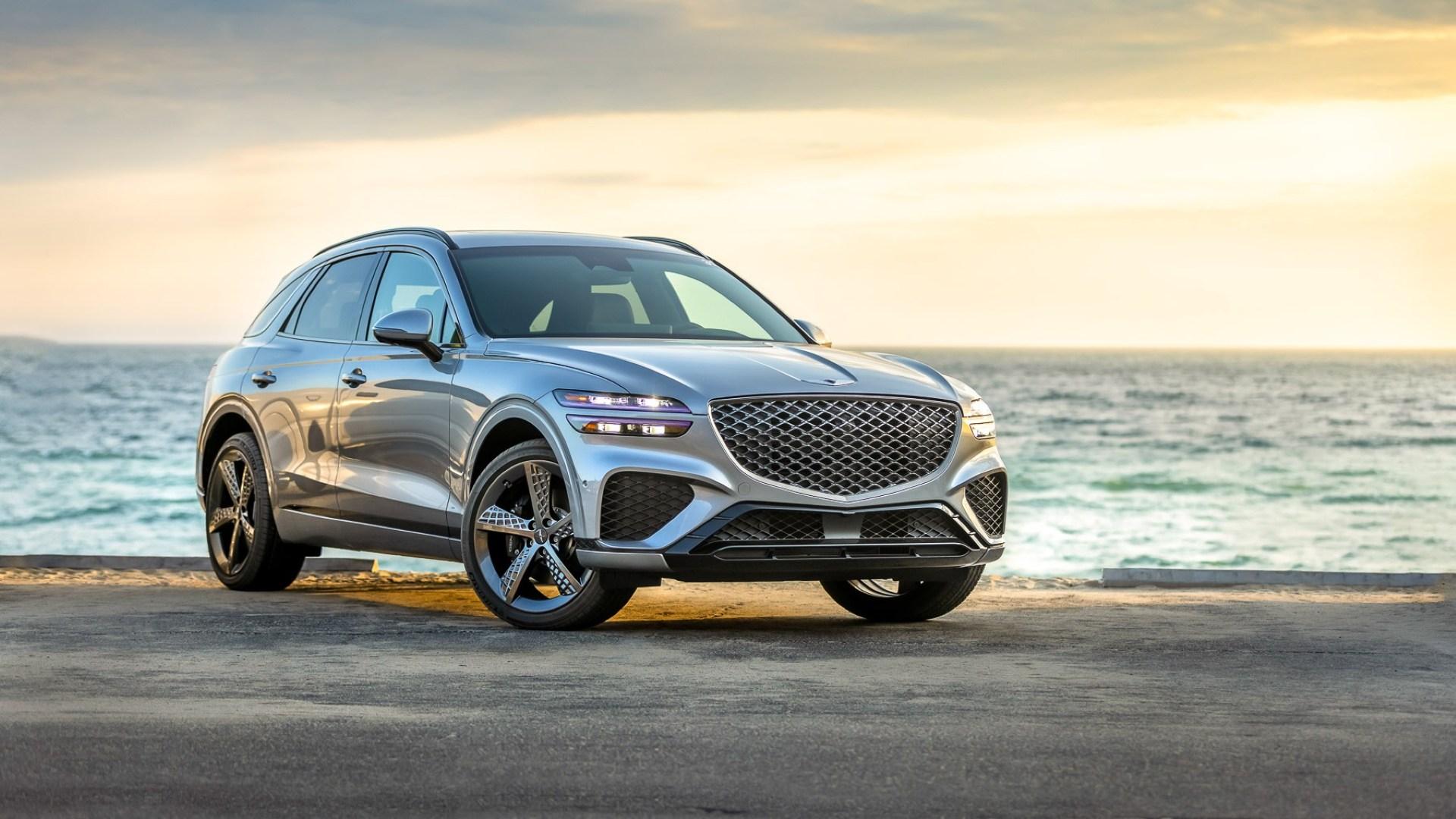
GENESIS GV70 2023
Is it deserving of all the praise it has received?
Pros and cons
Pros
- Responsive and well-adapted engines
- Smooth ride
- Impeccable finish
- Faultless soundproofing
- Excellent equipment-to-price ratioFree service and maintenance
Cons
- Transmission sometimes hesitates
- Uncommunicative steering
- Noticeable lean in turns
- Unpleasant steering wheel
- Some unusual controls
- Unproven reliability
Overview
The second crossover from Hyundai’s luxury Genesis brand, the Genesis GV70 launches into its second model-year with a soon-to-arrive, 100-percent electric variant. The aptly named Electrified model will use the same drivetrain as the excellent GV60 but otherwise will hew closely to its recent origins. While waiting for it to materialize, we tested a four-cylinder GV70 to see how it measures up to the accolades it has received.
Genesis builds its compact utility vehicle on a platform designed for a longitudinal engine and rear-wheel drive, though all units sold in Canada come with all-wheel drive. The GV70 thus uses the same architecture as the big names of its category, headed by BMW X3 and Mercedes-Benz GLC.
Its $57,500 starting price also echoes that of its main rivals, but in reality, it costs several thousand dollars less, similarly equipped. With a 39-month lease, a Genesis GV70 2.5T Advanced represents savings of over $200 per month (all taxes and fees included) relative to an equivalent X3 xDrive30i or GLC 300 4MATIC. And that’s not counting Genesis’ longer warranty and complimentary five-year maintenance program, including valet service and courtesy vehicle.
The gasoline-engine GV70’s are made in South Korea, whereas Genesis will be assembling the electric version in Alabama.
Verdict
The Genesis GV70 does not have the same reflexes as its German competition, nor their credentials—at least for now. However, that could change as target buyers discover the attention to detail that Genesis brings to its small SUV, both in the cabin and in the mechanical department. Comfortable, refined and amply powerful, the GV70 becomes even more appealing when price and the promise of outstanding after-sales service are factored in.
Evaluation
Body, cabin and cargo space
The GV70’s curvy styling is in sharp contrast to the more traditional lines of its rivals. For certain buyers, that is all the motivation they need o purchase one. At the same time, the coupe-like roofline reduces access to the rear seats, and the steeply slanted liftgate is a hindrance to loading bulky items.
The cargo area is slightly smaller than average, even though the rear bench seatbacks fold perfectly flat. The trunk’s carpeted sides help avoid scratching over time.
Another advantage, Genesis still provides a spare tire on all models. It is much more practical than a repair kit in the event of a flat and, potentially, much more economical than the run-flat tires of several competitors.
The cabin is roomy enough for four, but headroom is at a premium in the back, and a middle passenger has to put up with a high floor tunnel and firm and narrow cushions. The other rear passengers enjoy heated seats, reclining backrests, USB charging ports and separate climate controls.
Up front the seats prove to be quite comfortable but less supportive than they look. They are upholstered in good-quality leather, even on the least expensive versions, unlike the imitation leather often offered by the competition on lower trims. The GV70 is also distinctive for its luxurious finish and for the wide choice of colour combinations offered without the supplement charged by certain other automakers.
A 14.5-inch horizontal screen is centered and perched on top of the dash, as per current trends. It is impeccably clear but a bit too far from the driver to be truly useful as a touch screen. A controller knob is also provided on the console to navigate the system, but it can easily be mistaken for the gear selector knob just behind it. Some of the innumerable functions are buried deep in vertical menus that themselves require a certain period of adaptation. A judicious number of physical controls provide access to the main systems. The Lexicon audio system delivers vibrant sound; it is too bad that Android Auto or Apple CarPlay connection still requires a cable.
Another irritant is the steering wheel on the four-cylinder models; its single, very wide spoke makes it unpleasant to hold on long trips. The inverted tachometer (reading from right to left) is another quirky oddity.
Other highlights
Convenience: the lineup is composed of five variants with no optional equipment. All exterior colours are offered at no extra cost—a rarity for the category. Generous equipment starting with the base model 2.5T Advanced: standard panoramic sunroof, ventilated front seats, heated rear bench, onboard navigation and power adjusted steering column. Head-up display is standard on all but the 2.5T Advanced.
Safety features
Antilock brakes with electronic brake-force distribution and emergency brake assist
Stability and traction control
Hill start assist
Hill descent control
Front airbags
Driver knee airbags
Front side airbags
Side curtain airbags
Front center airbag between driver and front passenger seats
Five adjustable head restraints (front with whiplash mitigation)
Rear passenger alert
Tire pressure monitor
Reverse camera
Front and rear parking sensors
Forward collision alert
Forward automatic emergency braking
Automatic high beams
Blind spot monitoring with automatic corrective steering
Rear cross traffic alert with automatic braking
Lane departure alert with automatic corrective steering
Lane centering system
Adaptive cruise control
Surround view monitoring and rear automatic emergency braking (standard, 2.5T Advanced Plus, 2.5T Prestige and 3.5T Sport Plus; unavailable, 2.5T Advanced and 3.5T Sport)
Crash test results
National Highway Traffic Safety Administration (NHTSA)Overall score: 5 / 4
Frontal impact: 4 / 5
Side impact: 5 / 5
Rollover resistance: 4 / 5
Insurance Institute For Highway Safety (IIHS)
Moderate overlap frontal impact: 4 / 4
Small overlap frontal impact:
- driver side: 4 / 4
- passenger side: 4 / 4
Side impact: 4 / 4
Rear impact: 4 / 4
Roof strength: 4 / 4
IIHS Top Safety Pick+
Visibility
Adequate towards the front but impaired on the sides and to the rear by the limited glass surface and sloping rear. The small, teardrop-shaped outside mirrors are little help. The blind-spot monitoring and surround-view cameras are worth their weight in gold.
Headlights: the GV70’s LED projectors are top rated by the Insurance Institute for Highway Safety, for both the low- and high-beams.
Mechanical overview
The Genesis GV70 uses the same platform and gasoline engines as the G80 sedan and the GV80 midsized SUV. With 300 horsepower and 311 pound-feet of torque, the turbocharged 2.5-litre four-cylinder is one of the most powerful base engines of all compact luxury SUVs. And if that is not enough, the 3.5 twin-turbo V6 delivers 375 horses, barely less than the six-cylinder BMW X3 M40i BMW and Mercedes-AMG GLC 43 4MATIC, and its 391 pound-feet of torque is slightly higher than both.
Like the X3, the GV70 sends power to all four wheels via an eight-speed traditional automatic with paddle shifters. The rear-biased all-wheel drive system can send up to 100 percent of power to the rear in sporty driving. Conversely, half of torque can go to the front wheels when necessary. The 3.5T Sport Plus adds an electronically controlled rear differential with variable torque distribution between the two rear wheels.
Even if the GV70 is not really intended for off-roading, Genesis equipped it with mud and sand drive modes and hill-descent control. For on-road use, Snow, Eco, Comfort and Sport modes adjust throttle response, shift points, steering boost and engine sonority. There is also a Custom mode for drivers who want to personalize the settings, and a Sport+ setting for 3.5T models.
The latter also come with an adaptive suspension that scans the road ahead via a camera and constantly adjusts damping.
In terms of fuel economy, our four-cylinder GV70 tester averaged 8.7 L/100 km during our test of some 1,100 km, 80 percent on the highway in late summer 2022. This surprising result is almost the equivalent of Natural Resources Canada’s highway rating! According to NRCan, the V6 consumes around 2 L/100 km more. Genesis recommends premium gasoline for optimal performance, but both engines also run on regular.
Driving impressions
Even though its power rating defies all competition, the GV70’s 2.5‑litre engine does not really seem more vigorous than that of its German rivals. Still, it delivers solid performance enhanced by a new-found linearity for a Hyundai turbo four as well as noteworthy smoothness and quiet.
The equally smooth transmission usually keeps the engine at the right rpm level. It would be hard to fault if it were not that you sometimes have to insist for it to downshift promptly. Sport mode improves response, but it upshifts at too high an engine speed for daily driving, pushing up the noise level.
Overall, however, the occupants enjoy an exceptionally quiet ride that pairs with a suspension tuned more for comfort to create a very serene atmosphere in the GV70.
On the downside, drivers find themselves a bit too isolated from the roadway, especially since the steering masks the texture of the pavement. The GV70 negotiates twisty roads with easy competence but without the liveliness of the German competition, or even of an Acura RDX.
However, many people won’t mind sacrificing a bit of agility in exchange for a more compliant ride on our degraded roads.
Other highlights
V6 engine: briefly tested; makes the GV70 very rapid though not as explosive as the BMW X3 with the optional turbo six-cylinder. However, the convincing performance of the four-cylinder makes the V6 seem unnecessary, especially since it costs at least $9,000 more, consumes more gas and makes the front end weightier in turns.
Braking: well-balanced electric assist: pedal is progressive and firm enough for good initial bite. Power is adequate but not as forceful as the X3 with the Sport M package.
Driver assistance: adaptive cruise control is relatively progressive; cannot be used as a traditional system on recent models from the Hyundai group. Lane keeping system sometimes inconsistent. Lane departure warning is unobtrusive: it vibrates the steering wheel when markings are crossed.
Features and specs
Price range (including shipping and preparation) | ||
| Minimum price | $57,500 | |
|---|---|---|
| Maximum price | N/A | |
| Price as tested | $61,500 | |
| Trim levels | 2.5T Advanced
2.5T Advanced Plus
2.5T Prestige
3.5T Sport
3.5T Sport Plus | |
Acura RDX | ||
Alfa Romeo Stelvio | ||
Audi Q5 | ||
BMW X3 | ||
Cadillac XT5 | ||
Infiniti QX50 | ||
Jaguar F-Pace | ||
Land Rover Discovery Sport | ||
Land Rover Range Rover Evoque | ||
Lexus NX | ||
Lincoln Corsair | ||
Mercedes-Benz GLC | ||
Porsche Macan | ||
Volvo XC40 |
| Engine, horsepower and torque | 2.5L turbo 4-cyl.; 300hp at 5800rpm; 311lb-ft from 1650 to 4500rpm
3.5L twin-turbo V6; 375hp at 5800rpm; 391lb-ft from 1300 to 4500rpm |
|---|---|
| Transmission | 8-speed automatic with manual mode |
| Front suspension | Independent with MacPherson struts |
| Rear suspension | Independent multilink |
| Front brakes | Ventilated disc |
| Rear brakes | Ventilated disc |
| Tires | 235/55R19
255/40R21 |
| Wheelbase | 287.5cm | ||
|---|---|---|---|
| Length | 471.5cm | ||
| Width | 191cm | ||
| Height | 163cm | ||
| Curb weight | From 1890 to 2059kg
1964kg | ||
| Towing capacity | 1588kg (3500lb) | ||
According to Natural Resources Canada | ||
| City | 10.7L/100km (2.5L engine) | |
|---|---|---|
| Highway | 8.4L/100km (2.5L engine) | |
As measured by CAA-Québec | ||
| City | 8.7L/100km (2.5L engine) | |
| Highway | N/A | |
| CO2 emissions | 4580kg/20,000km | |
| Fuel tank | 66 litres | |
| Recommended fuel | Premium-grade gasoline | |