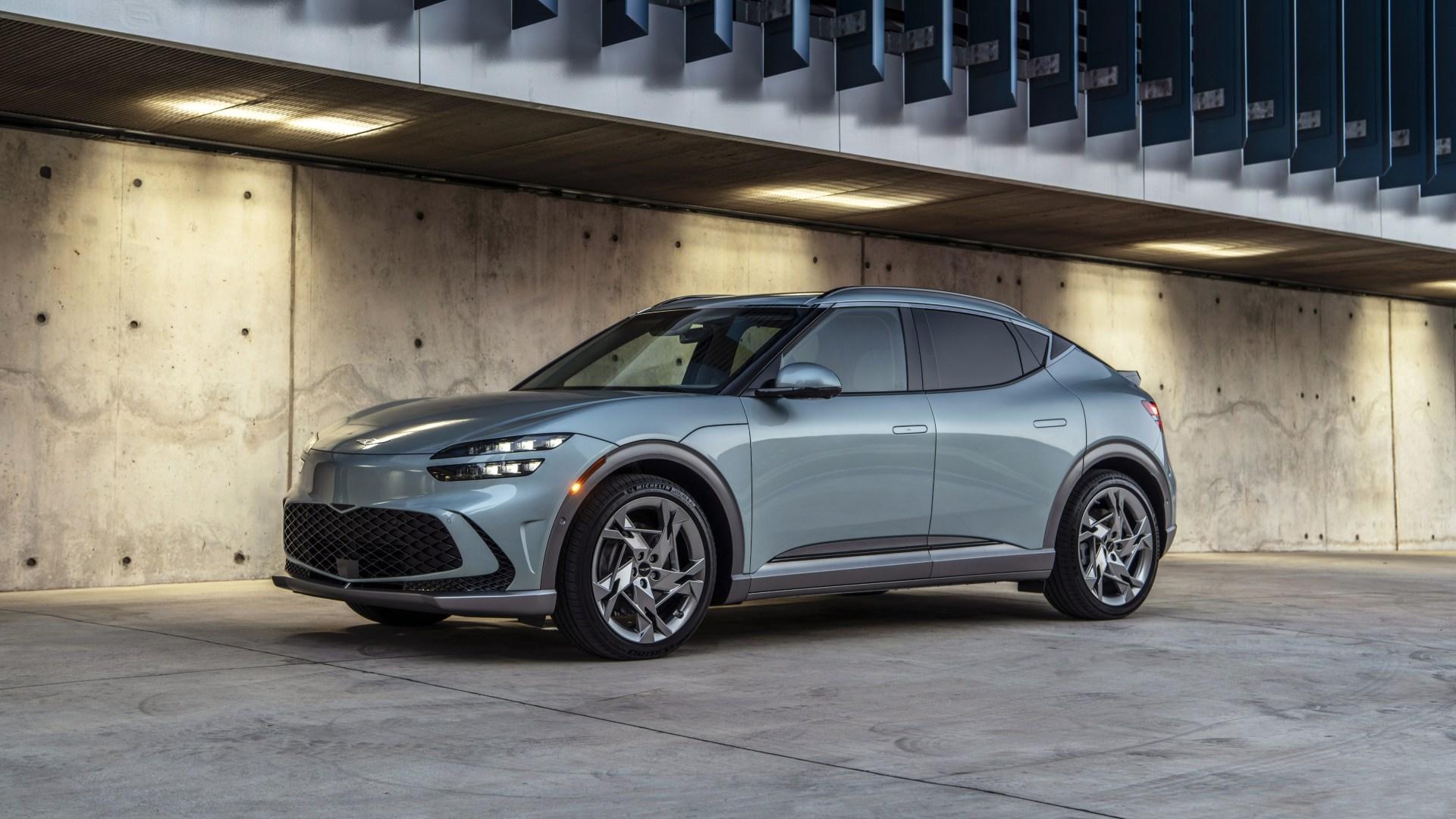
GENESIS GV60 2023
The fully electric, compact SUV lives up to Genesis's luxury label
Pros and cons
Pros
- Impressive power
- Engaging road manners
- Remarkably quiet ride
- Excellent price-to-equipment ratio
- Impeccable finish
- Relatively simple controls
Cons
- Poor range for the category
- Tight rear seating
- Wide turning circle
- Limited visibility (except forward)
- No rear wiper
- Ineligible for government rebates
Overview
Barely five years after it appeared on the scene, Genesis is launching its first 100 percent electric model in North America. The Genesis GV6 is built on the same platform as the popular Hyundai IONIQ 5, but it pushes the mechanicals, performance and technology to much higher levels. It also comes standard with all-wheel drive, so prized by luxury car buyers. The GV60 went on sale officially at the end of May with 1,500 already pre-ordered as the month began.
According to Genesis Canada executive vice-president Lawrence Hamilton, it could take up to a year to meet this initial demand. However, it remains to be seen if all those orders will hold when candidates learn that the GV60 is not eligible for government incentives for the purchase of electric vehicles (EV). The $71,000 starting price largely exceeds the $60,000 maximum fixed by Ottawa for sport-utility vehicles and the $65,000 threshold fixed by Quebec for all electric vehicles.
Other competitors of the Genesis GV60 find themselves in the same situation, including the BMW iX, Tesla Model Y and Volvo C40 Recharge. On the other hand, the Audi Q4 e-tron, Polestar 2 and Volvo XC40 Recharge all qualify for at least one of the two rebates.
Will that influence the choice of targeted buyers? Probably not, if they are looking at a high-end version of one or another of those models, none of which would have access to the rebates. From this viewpoint, the $79,000 the Genesis GV60 Performance commands seems more than reasonable, especially since it includes five-year maintenance, valet service and telematics connectivity.
The Genesis GV60 is assembled in South Korea, like the Hyundai IONIQ 5 and Kia EV6.
Verdict
The Genesis GV60 perhaps is not as practical as an Hyundai IONIQ 5, but it raises the level of refinement several notches higher than its mainstream-brand cousin. Attractive outside, welcoming inside, dynamic on the road and extremely quiet, the newcomer fully merits the Genesis luxury label. It remains to be seen how the public perceives its driving range, which is under the psychological bar of 400 km, and if the attractive price compensates for the lack of notoriety that still affects the brand.
Evaluation
Body and cabin
The sharp and pared down silhouette of the Genesis GV60 in no way reveals its family link to the Hyundai IONIQ 5. In fact, the GV60 is 13 cm shorter than its proletarian cousin, with a 10 cm shorter wheelbase. Genesis clearly is not targeting the same family clientele as Hyundai, since its new model is barely more spacious than certain subcompact SUVs.It quickly shows up in the back seats: the sloping roof limits headroom, adults cannot slip their feet under the front seats and the bench is too low for adequate thigh support. However, legroom is decent and convenience features include heated outboard seats, rear vents, USB ports and door sunshades.
The trunk floor, strangely enough, seemed lower than in the IONIQ 5, resulting in a surprising amount of cargo space for a vehicle no longer than a compact hatchback. The rear seatbacks fold nearly flat to this floor. Genesis opted to expose the wheel wells rather than dissimulate them behind linear side panels, which increases usable width.
The only visible misstep in terms of finish is the hard, easily scratched plastic used to line the sides of the trunk. Elsewhere in the cabin, Nappa leather and eco-friendly materials are as pleasing to the eye as to the touch. In addition to the classic dark grey and black combo, Genesis also proposes light tones and a navy-blue theme, according to the exterior paint.
The front seats do not just look good, they offer a multitude of adjustments. Performance trim adds power side bolsters on the driver’s seat, ensuring excellent support in turns, and a massaging function on both front seats. All GV60s come with a heated steering wheel, heated and ventilated front seats and heated outboard rear seats.
As with the IONIQ 5, instrumentation and driving information display on a clear and customizable 12.3‑inch screen. However, it is best to become familiar with the trip computer and steering-wheel-mounted controls before starting off, because they are not very intuitive.
The infotainment system uses a second similarly sized screen. It can be navigated with a controller on the console or by touch, though the right side is a relatively long reach for the driver. Graphics, response time and the organization of the information stand out in a segment where confusion too often reigns. A series of physical buttons makes it easy to transition from one main function to another. However, using Android Auto and Apple CarPlay requires a cable, whereas a good number of today’s vehicles offer a wireless connection.
On the other hand, the GV60 uses the market’s first system of facial recognition for door unlock. It took three tries for the computer to identify and register the face of yours truly, but everything worked without a hitch after that. Once inside, a fingerprint reader replaces the key. Genesis guarantees that the data is stored only in the vehicle and not on an outside server, but we have no way of verifying. We easily deleted the data at the end of our test.
The vehicle also is distinctive for its standard convenience features, including wireless charging for mobile devices, a fixed glass roof and the possibility to use the battery to power small appliances.
Safety
In keeping with its all-inclusive approach, Genesis equips all GV60s with the immense majority of driving assistance devices on the market. The only features restricted to the Performance version are the surround-view cameras, blind-spot display in the gauge cluster and reverse automatic emergency braking. Driver vigilance remains essential at all times despite all the technology.It is worthwhile noting that the Genesis GV60 is missing a rear wiper, like the Hyundai IONIQ 5 and the Kia EV6, which use the same platform. This omission proved disastrous on the IONIQ 5 in the winter, but the GV60’s good-sized rear spoiler and the more horizontal profile of the rear window may limit the consequences for the Genesis. Let’s hope so, because visibility to the rear and on the sides leaves much to be desired.
Crash test results
Insurance Institute For Highway Safety (IIHS)
Moderate overlap frontal impact: 4 / 4
Small overlap frontal impact:
- driver side: 4 / 4
- passenger side: 4 / 4
Side impact: 4 / 4
Rear impact: 4 / 4
Roof strength: 4 / 4
The 2023 Genesis GV60 has not yet been tested for crashworthiness by the National Highway Traffic Safety Administration (NHTSA).
Mechanical overview
Even though its wheelbase is 10 cm shorter than that of the Hyundai IONIQ 5, the Genesis GV60 houses under its floor the same 77.4 kWh lithium-ion-polymer battery as its cousin. It provides 399 km of driving range in the Advanced model, with more or less the same 314 hp and 446 lb‑feet of torque as the IONIQ 5 with all-wheel drive.The Performance variant lists the same torque as the Advanced, but with 429 hp of power. Why? The Performance uses a pair of identical 160 kW electric motors, one per axle, whereas the Advanced makes do with a 74 kW in front. The GV60 Performance also offers a Boost mode, which boosts power to 483 hp and torque to 516 lb‑ft.
The effect is startling, lasting 10 seconds with a touch of a button on the steering wheel. Genesis assures that the experience can be repeated with no limit apart from a more rapid decrease in range, already reduced to 378 km in the case of the Performance, which is heavier and more powerful than the Advanced.
In our opinion, the loss of 21 km is a small price to pay to benefit from the exclusive mechanical features of the high-end version. These include an electronic locking rear differential, adaptive suspension damping and larger, ventilated four-wheel brake rotors.
Natural Resources Canada (NRCan) has not yet published ratings for the GV60 but its estimated energy consumption and charging times are often higher than the manufacturers. For now, the automaker expects it will take 7 h 5 minutes to get from 10 percent to 100 percent capacity on a 240-volt 48‑amp charger. Hyundai indicates 6 h 43 min for the same battery on the IONIQ 5, whereas NRCan indicates 8 h 30 min.
According to Genesis and its parent company, their 77.4 kWh battery requires as little as 18 minutes to charge from 10 percent to 80 percent at one of the rare 350 kW public charging stations. The same exercise would take 1 h 13 min at a 50 kW station. We will verify these claims when we drive the GV60 here, especially in the winter when EV range usually drops by 30 to 50 percent and charging takes longer.
According to the trip computer, our test yielded a consumption of 21.8 kWh/100 km, or the equivalent of 2.5 L/100 km. That is about the equivalent of the combined city-highway rating announced by Genesis. We did not hesitate to exploit the generous resources of the motors, but on the other hand we always drove in maximum energy recuperation mode on releasing the throttle. The range indicator dropped by 239 km whereas we drove 202 km.
Driving impressions
Certain Genesis vehicles are sedate, like the G80 and GV80. However, the Genesis GV60 is cut from the same cloth as the G70 and GV70, which prioritize driving enjoyment.The driving dynamics of the GV60 quickly came to the fore on the winding and hilly roads of our test route in the Austin region of Texas. Totally unperturbed by a series of tight turns, the vehicle grips the road, with very little body lean. The combination of all-wheel drive and limited-slip differential guarantees faultless driveability while cancelling out any trace of understeer.
As with the majority of electric vehicles, the placement of the battery under the floor lowers the centre of gravity and contributes to the excellent stability. The precise steering transmits decent road feel thanks to well-weighted assistance. However, the turning circle is downright indecent for such a short vehicle; the Performance model’s enormous 21‑inch tires are no doubt partly to blame.
Specifically designed for the GV60, these same tires contribute to what is an exceptionally quiet ride, even for an electric vehicle. The only noise to trouble the tranquility of the cabin is a whisper of wind noise above the glass roof. Also notable is the comfort provided by the adaptive suspension, despite the aplomb it delivers in curves. The efficient regenerative braking lets you drive with nary a touch of the brake pedal, unless you are driving on the edge.
Best of all, the verve of the Performance version immediately puts a smile on your face. Acceleration is not only instantaneous, as with all EVs, but it literally sets you back in your seat. As for Boost mode, all we can say is don’t overdo it or you’ll risk upsetting the stomachs of unsuspecting passengers.
We can’t wait to put the GV60 through its paces on our roads and not forgetting cold weather, to confirm (or infirm) this first highly gratifying contact, low energy consumption included.
Features and specs
Price range (including shipping and preparation) | ||
| Minimum price | $71,000 | |
|---|---|---|
| Maximum price | N/A | |
| Price as tested | N/A | |
| Trim levels | N/A | |
| Wheelbase | N/A | ||
|---|---|---|---|
| Length | N/A | ||
| Width | N/A | ||
| Height | N/A | ||
| Curb weight | N/A | ||
| Towing | Not recommended | ||