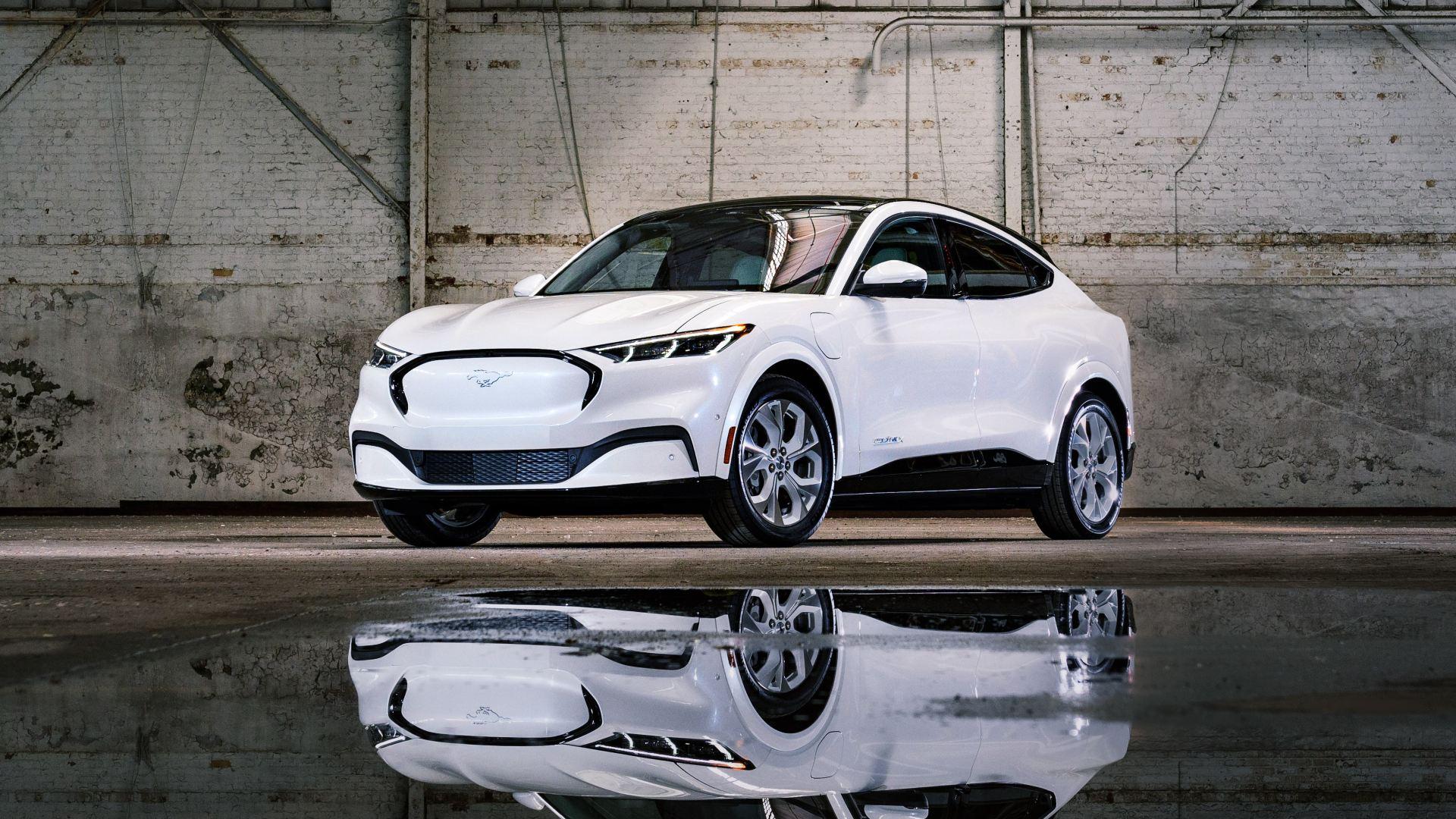
FORD Mustang Mach-E 2022
With all due respect to Mustang enthusiasts...
Pros and cons
Pros
- Very comfortable seats
- Generous cargo space
- Quiet ride
- Finely tuned suspension
- Easy and enjoyable to drive
- Successful one-pedal driving
Cons
- Difficult rear access
- Deficient visibility
- Confusing touch controls
- Imprecise range indicator
- Disappointing finish and quality
- High price
Overview
An all-electric crossover with four doors and all-wheel drive—called Mustang? It’s a chimera that became reality this year, devotees of the sporty Ford and its thunderous V8s notwithstanding. The first of a prospective series of electric vehicles (EVs) from the Blue Oval brand, the Ford Mustang Mach-E offers a driving range of 340 to 491 km. That’s less than its closest competitor, the Tesla Model Y; the Ford, however, qualifies for the $8,000 provincial rebate for electric vehicles—the two most affordable versions, at least.
The Mustang Mach-E is presented as a compact SUV, but with slightly lower height and ground clearance. The only way to get one for less than $60,000 is to choose a Select model or, at most, a rear-wheel-drive Premium. It also means accepting the regular 68 kWh battery. Opting for the extended-range battery (88 kWh) raises the retail price above that limit, which automatically blocks access to the Quebec rebate. In all cases, the price exceeds the ceiling fixed by Ottawa for its $5,000 EV rebate.
In real terms, it means that a four-wheel-drive extended-range Mach-E comes with a $72,000 price tag and a minimum monthly outlay of over $1,000, including taxes, for a four-year lease. In comparison, a Ford Escape SE plug-in hybrid costs about half that, purchased or leased. The $250 or so energy saving the Mustang allows yearly relative to the plug-in Escape, as calculated by Natural Resources Canada, will never completely erase the higher initial expense.
Ford builds the Mustang Mach-E in Mexico, at the facility that assembled the subcompact Fiesta until it was retired from the North-American market.
(Video in French only)
Verdict
The Ford Mustang Mach-E is a very attractive electric vehicle that is versatile, comfortable and brilliantly balanced. Here, enjoyment is found in the refined driving experience rather than the brute performance of a traditional Mustang. However, build quality is an issue, as for several other recent Fords, and the price is high for the size of the vehicle. In other words, the purchase of a Mach-E is a matter of conviction or pleasure, not price.
Evaluation
Body, cabin and cargo space
Apart from the iconic galloping horse badges and vertical tri-bar taillights, it is difficult to establish a visual link between the Mach-E and the traditional Mustang. Its shape is more audacious than that of a classic compact SUV, and it never fails to draw attention.It was not necessary to get up close to notice the poor build quality of our test vehicle. Poorly aligned body panels, scratched paint, loose trim: a newly launched Ford demonstrating shoddy assembly once again. The manufacturer has already initiated two recalls for the 2021 Ford Mustang Mach-E, including the risk the windshield and panoramic roof may detach from the vehicle!
Cabin fit was more attentive, but the finish was still a bit disappointing. An abundance of rather cheap black plastic lines the dash, console and doors; we expect more of a $70,000 vehicle.
On the other hand, the softly padded front seats provided excellent support and earned praise from all our testers. The rear bench prove less inviting, mostly because of the low cushion. However, this same positioning yields surprisingly good headroom in a vehicle with such a sloped roof.
The cabin easily accommodates four adults; the only challenge is accessing the rear seats without bumping your head on the way. You also have to accept not being able to see out because of the very narrow side windows.
Cargo space is among the roomiest of all the 100-percent electric vehicles. Folding the rear seatbacks creates a long and perfectly flat surface with nothing to envy many traditional compact SUVs. And that’s not forgetting the small vertical compartment under the hood, roomy enough for a carry-on bag.
However, the controls prove less practical than the trunk. A 15.5-inch touch screen is mounted vertically in the middle of the dash, like a giant hooked-on tablet. Clearly inspired by Tesla, it controls most vehicle parameters, including driver assistance, the trip computer and ventilation. The menus are relatively logical, but the sheer quantity of information frequently requires taking your eyes off the road.
Ford did, however, maintain a screen facing the driver that displays crucial information such as speed and range. Turn signals and wipers are still on stalks, and there is a rotary gear selector on the centre console. It is worth mentioning because Tesla is gradually eliminating these elements as it updates its lineup. Ford didn’t go quite that far, and so much the better.
Other highlights
Convenience: there are numerous open storage spaces but relatively few covered compartments. Navigation and unlocking/start via smart phone are standard. Heated seats and steering wheel are optional on Select model, which is rather hard to swallow for an electric vehicle that costs over $50,000.
Safety features
- Antilock brakes with electronic brake force distribution and brake assist
- Stability and traction control
- Hill start assist
- Front airbags
- Driver’s knee airbag
- Front and rear side airbags
- Side curtain airbags
- Front seatbelt pretensioners
- Five head restraints (adjustable, front and rear middle seats; fixed, rear outboard seats)
- Tire pressure monitoring
- Rearview camera
- Forward collision warning
- Automatic forward emergency braking with pedestrian detection
- Automatic reverse emergency braking
- Automatic post-collision braking
- Emergency avoidance assistance
- Lane departure warning with automatic steering assist
- Lane keeping assist
- Automatic high-beams
- Blind-spot monitoring
- Rear cross traffic warning
- Adaptive cruise control with traffic jam assist
- Front and rear parking sensors
- Surround-view camera system (standard, Premium and California Route 1; included in Comfort/Technology package—Select trim and Ford Co-Pilot360 Active 2 package—GT Performance Edition)
Crash test results
National Highway Traffic Safety Administration (NHTSA)Overall score: n/d
Frontal impact: Not tested
Side impact: 5 / 5
Rollover resistance: 4 / 5
Insurance Institute For Highway Safety (IIHS)
Moderate overlap frontal impact: 4 / 4
Small overlap frontal impact:
- driver side: 4 / 4
- passenger side: 4 / 4
Side impact: 4 / 4
Rear impact: 4 / 4
Roof strength: 4 / 4
IIHS Top Safety Pick
Visibility
This is a significant weakness of the Ford Mustang Mach-E. The tapered side windows, thick roof pillars and high rear window complicate parking and lane changes. The outside mirrors are too small and the rounded hood prevents situating the extremities of the vehicle. A panoply of electronic devices monitor the situation, but they quickly lose their usefulness when the cameras and sensors get dirty in winter.Headlights: The LED reflector headlights on Select and California Route 1 trims received a 2/4 rating from the Insurance Institute for Highway Safety, because the high beams do not light far enough ahead. IIHS awarded a top score for the LED projectors on Premium and GT Performance Edition trims, which deliver better lighting in all circumstances.
Mechanical overview
The Ford Mustang Mach-E inaugurates the first electric-vehicle platform designed by Ford. It is a widely reworked version of the fourth-generation Ford Escape architecture launched in 2020.The centerpiece of this platform—both literally and figuratively—is the vehicle’s drive battery. Placed under the floor, it solidifies the structure without intruding on cabin or trunk space.
Ford offers the lithium-ion battery with a capacity of 68 kWh or 88 kWh depending on the trim and options. On rear-wheel drive versions, this battery feeds a single motor mounted on the rear axle; all-wheel-drive models get a secondary motor on the front axle.
The range of the “small” battery is 370 km with two-wheel drive and 340 km with all-wheel drive. With the 88 kWh battery, range reaches 491 km with 2WD and 435 km with AWD.
The most recent GT Performance Edition model gives up 17 km of the latter value, claiming a power output of 480 hp and 206 lb-ft. That is 134 hp and 206 lb-ft more than an extended-range AWD Mach-E Premium!
Even the “slowest” version of the lineup, with the extended-range battery and rear-wheel drive, accelerates from 0 to 100 km/h in 6.2 seconds, according to the manufacturer. The GT Performance drops this to 3.7 seconds. It is exactly what Tesla claims for the Performance version of its Model Y, which holds a 70 km range advantage over the Mach-E, according to Natural Resources Canada.
NRC estimates a combined city/highway energy consumption of 20.7 kWh/100 km (the equivalent of 2.3 L/100 km) to 25.6 kWh/100 km (2.9 Le/100 km), depending on the model. Again, the Model Y fares better, with an average of 1.8 to 2.1 Le/100 km.
Like all EVs, the Mustang Mach-E recuperates deceleration energy to feed the battery. This regenerative braking system has a one-pedal driving mode that allows the mechanical brakes to be completely bypassed except in an emergency-braking situation.
This function is accessed via the centre screen, along with the Whisper (normal), Engage (sport) and Unbridled driving modes. The latter two modify both accelerator response and the synthetic engine sound from the speakers in a clearly perceptible manner.
In terms of charging times, it takes around 9 hours, with a 240-volt charger, to replenish the 68 kWh battery when depleted (which almost never happens). It takes 10 to 11-1/2 hours for the extended-range battery.
In our experience a 50‑kW fast charger recoups around 230 km of range per hour. Theoretically, the Mach-E can channel up to 150 kW of power, which obviously speeds things up. As an example, we recuperated 113 km in just 15 minutes using a 100-kW charger at an Electric Circuit location.
Driving impressions
By calling its first all-electric crossover a Mustang, Ford raised high expectations in terms of performance and driving enjoyment. Our test of a Mach-E First Edition—the equivalent of an extended-range AWD Premium—showed that the automaker achieved its goals.First off, let’s address the elephant in the room: the synthetic sound of the Mach-E is nothing like the throaty rumble of a traditional Mustang GT V8. The absence of a gas engine and gearbox also dampens the mechanical drive sensation of a sports car.
Just the same, the all-electric Mustang delivers a high level of driving pleasure. The battery drivetrain is impressive for its smooth operation and its linear throttle response in Whisper (normal) mode. Adding to this refinement, acceleration is instantaneous, though not as uninhibited as with a gas-engine Mustang GT or certain Tesla models.
The one-pedal driving mode has been particularly well tuned. It only takes a few kilometres in the city to be able to dose the deceleration as naturally as you would by pressing on the brake pedal.
As with several blue-oval products, the Ford Mustang Mach-E gets precise and well-weighted steering that delivers a nice level of road feel. Straight-line steering is good at highway speed, and corner entry is incisive and enjoyable.
The finely tuned suspension ably masks the vehicle’s high weight and limits body lean in turns. The cabin is well isolated from impacts on degraded roads, despite the 20‑inch tires. The balance between comfort and handling is commendable, as is the suppression of wind and road noise.
The result is a pleasant and serene ride, the only caveat being the imprecision of the range indicator. The indicated maximum distance dropped more quickly than the kilometres travelled on each of our trips, both in the city and on the highway, with the discrepancy reaching 50 percent certain cases. It should be kept in mind when planning stops at a quick charger on long trips.
Other highlights
Driver assistance: adaptive cruise control is well programmed, reaccelerating promptly when changing lanes to pass a slower vehicle. Ford allows it to be used like a regular cruise control, if desired, or an “intelligent” cruise that adjusts the speed to posted limits. Lane-departure warning is too sensitive, with sometimes overly brusque steering corrections. Lane keeping system is adequate, with little “ping-pong” effect between the lanes.
Features and specs
Price range (including shipping and preparation) | ||
| Minimum price | $52,490 | |
|---|---|---|
| Maximum price | N/A | |
| Price as tested | $73,495 | |
| Trim levels | Select
Premium
California Route 1
GT Performance Edition
First Edition (available at model launch only) | |
Polestar 2 | ||
Tesla Model Y | ||
Volvo XC40 Recharge |
| Engine, horsepower and torque | Rear electric permanent magnet motor with 68 kWh lithium-ion battery; 266 hp; 317 lb-ftRange: 370 km
Level 2 complete charge (240 V): 8 hrs 30 min
Front and rear electric permanent magnet motors with 68 kWh lithium-ion battery; 266 hp; 428 lb-ftRange: 340 km
Level 2 complete charge (240 V): 8 hrs 30 min
Rear electric permanent magnet motor with 88 kWh lithium-ion battery; 290 hp; 317 lb-ftRange: 483 or 491 km depending on trim level
Level 2 complete charge (240 V): 10 hrs 55 min or 11 hrs 25 min depending on trim level
Front and rear electric permanent magnet motors with 88 kWh lithium-ion battery; 346 hp; 428 lb-ftRange: 435 km
Level 2 complete charge (240 V): 10 hrs 40 min
Front and rear electric permanent magnet motors with 88 kWh lithium-ion battery; 480 hp; 634 lb-ftRange: 417 km
Level 2 complete charge (240 V): 10 hrs |
|---|---|
| Transmission | 1-speed direct drive automatic |
| Front suspension | Independent with MacPherson struts |
| Rear suspension | Independent multilink |
| Front brakes | Ventilated disc
Regenerative braking system |
| Rear brakes | Disc
Regenerative braking system |
| Tires | 225/60R18
225/55R19
245/45R20 |
| Wheelbase | 298.4 cm | ||
|---|---|---|---|
| Length | 471.3 cm | ||
| Width | 188.1 cm | ||
| Height | 161.3 cm
162.4 cm
162.5 cm | ||
| Curb weight | From 1,993 to 2,232 kg
2,232 kg | ||
| Towing | Not recommended | ||
According to Natural Resources Canada | ||
| City | 21.8 kWh/100 km (equivalent to 2.4 L/100 km) | |
|---|---|---|
| Highway | 25 kWh/100 km (equivalent to 2.8 L/100 km) | |
As measured by CAA-Québec | ||
| City | Not observed | |
| Highway | N/A | |
| CO2 emissions | 0 g/20,000 km | |
| Fuel tank | Not applicable | |
| Recommended fuel | 100% electric vehicle | |
| 0-100 km/h | 5.3 seconds |
|---|---|
| 60-100 km/h | 3.7 seconds |