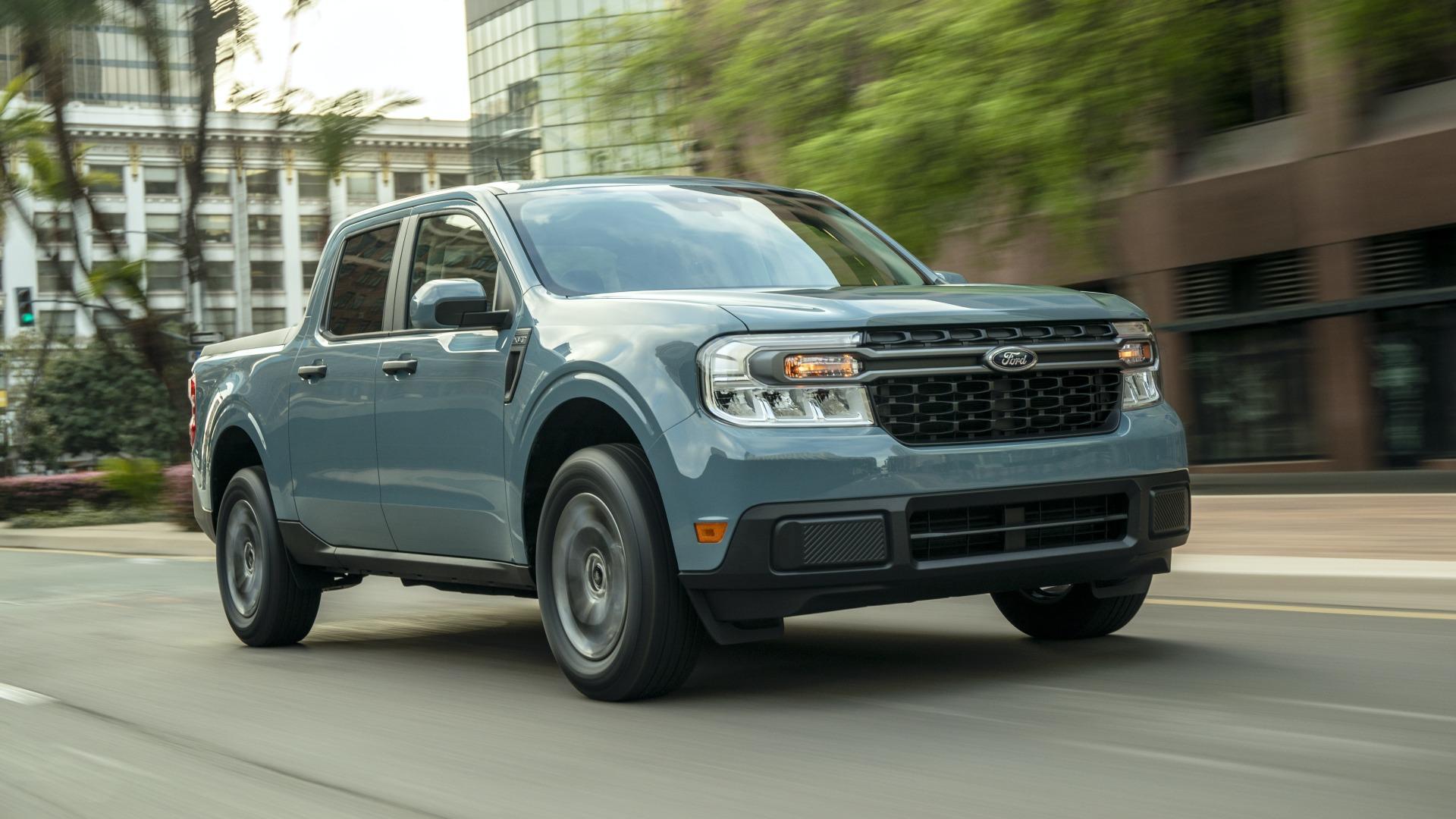
FORD Maverick 2022
Beneath its simple exterior, this compact pickup truck boasts some surprising features
Pros and cons
Pros
- Very fuel efficient (hybrid)
- Stable road comportment
- Excellent visibility
- Wide choice of models
- Interesting price
- Short but well-designed bed
Cons
- No all-wheel drive with the hybrid engine
- Firm suspension
- Limited standard equipment
- Expensive high-end versions
- Cheap finish
Overview
The most affordable Ford vehicle sold in Canada
Ford has expanded its line of pickups downwards with the launch of the Ford Maverick. This new model uses a small SUV unibody platform, like the Honda Ridgeline and Hyundai Santa Cruz. However, it distinguishes itself from its rivals with its offer of a hybrid powertrain with two-wheel drive, for under $30,000. Of course, the catalogue also lists four-wheel-drive versions, powered by a turbocharged gasoline engine.
Now the most affordable Ford vehicle sold in Canada, the Ford Maverick comes in three trims with a variety of packages and standalone options. Unique to the category, this strategy makes it possible to order a more personalized unit than the competition at a generally lower price. For example, the best-equipped Maverick rings in at $47,545 (including destination fees), which is less than a base Ridgeline.
But that’s if you can get hold of the model you want. Dealer inventories are very tight and the rare models in stock are almost always equipped with the optional gas engine and four-wheel drive. To obtain a model under $35,000, especially with the hybrid drivetrain, you’ll have to put in an order and be prepared to wait.
The Ford Maverick is assembled in Mexico at the same plant as the Ford Escape, with which it shares several of its mechanical components.
(Video in French only)
Verdict
More civilized to drive than a traditional pickup
The Ford Maverick holds some surprising trump cards under its unassuming demeanor. Its fuel-sipping hybrid engine makes it by far the most energy-efficient pickup on the market. Good roadability is also part and parcel, and versatility, too, despite the short bed. You have to pass on a bit of luxury, but pickup fans who do not need a high payload capacity will find it is more civilized to drive than a traditional pickup.
Evaluation
Body, cabin and cargo space
The Ford Maverick looks small parked next to a Ford F‑150 or even a Ranger, but with a length of 507 cm, it is longer than most midsized SUVs. It also is longer than its main rival, the Santa Cruz, which gives it a slight load advantage with the tailgate closed.
At 138 cm (54 in., or 4.5 ft.), the bed is shorter than that of a midsized or full-size model. The tailgate therefore has to be lowered to transport long items. Fortunately, Ford provides six tie-downs to anchor goods in place. The tailgate also can be positioned at an angle level with the top of the wheel wells, allowing a four-by-eight sheet of plywood to be carried flat. The bed contains a 12‑volt outlet (or a 110‑volt domestic outlet with the XLT Luxury and Lariat Luxury packages). The usual bed tonneau covers and linings are available at dealerships.
Ford is offering its small pickup with a four-door crew cab and one bed length only. There is ample space for four people, though things get tight in back when the front bucket seats are pushed far back. The front seats have a short, flat and firm bottom cushion that hampers comfort. The rear bench is not much better shaped, but at least the seatback angle is less upright than on the Santa Cruz. The bottom cushion flips up in one piece to reveal two fairly roomy bins for storing booster cables or a backpack, for example.
The interior design echoes the square body shape: everything is rectangular, horizontal and flat. Exposed bolts, open storage spaces and hard plastic trim create an industrial ambiance, at least in the XL model we tested. While this design forgoes any semblance of luxury, it proves perfectly functional, with a wealth of interior storage spaces, simple controls and a well-designed touch screen.
The expected convenience essentials are present and accounted for, including Android Auto, Apple CarPlay, USB ports, automatic climate control and ordinary power features. However, it is unfortunate that Ford charges a supplement for such routine features as cruise control and heated seats. Worse still, several driving assistance features are optional on all trims. That notably includes blind-spot monitoring and lane departure warning, which are standard on a host of less expensive vehicles.
Safety features
Antilock brakes with brake force distribution and emergency brake assist
Stability and traction control
Hill start assist
Hill descent control (with FX4 Package, XLT and Lariat; unavailable, XL)
Front airbags
Driver knee airbag
Front side airbags
Side curtain airbags
Five head restraints (adjustable in front and on rear middle seat, folding on rear outboard seats)
Rear passenger alert
Tire pressure monitoring
Backup camera
Forward collision warning
Automatic emergency braking with pedestrian alert
Automatic high-beams
Blind-spot monitoring, rear cross traffic alert, land departure alert with automatic steering assist and lane keeping assist (with optional Ford Co-Pilot 360)
Rear parking sensors, adaptive cruise control and evasive steering assist (with Lariat Luxury Package)
Crash test results
National Highway Traffic Safety Administration (NHTSA)
Overall score: 4 / 5
Frontal impact: 5 / 5
Side impact: 5 / 5
Rollover resistance: 4 / 5
Insurance Institute For Highway Safety (IIHS)
Moderate overlap frontal impact: Not tested
Small overlap frontal impact: Not tested
Side impact: 4 / 4
Rear impact: Not tested
Roof strength: Not tested
Visibility
One of the Ford Maverick’s strong points, thanks to large windows with horizontal sills, and well-sized mirrors. The flat sides and square body shape help to situate the extremities.
Mechanical overview
The Ford Maverick is based on a lengthened version of the Escape compact crossover platform and shares most of its mechanical components. It thus is 49 cm longer than its donor vehicle, with a 36.6 cm longer wheelbase.
Ford also decided to install the Escape’s hybrid drivetrain as standard equipment on the XL and XLT. It combines a 2.5‑litre four‑cylinder with an electric motor and a small 1.1 kWh battery. Total output is 191 hp, or 10 more than the Escape hybrid.
The higher output is due to a redesigned and more efficient electric motor for the Maverick. Similar to Toyota’s hybrids, it is integrated into the electronic continuously variable transmission that controls the system. The hybrid drivetrain is offered with four-wheel drive on the Escape, but not on the Maverick for the time being. Torque goes entirely to the front wheels, which makes the Maverick the only FWD pickup sold in Canada.
Four-wheel-drive is automatically paired with the 2.0‑litre turbo engine. The latter standard on the Lariat and offered on XL and XLT models for a very reasonable supplement of $1,600. It develops 250 horses with a robust 277 lb‑ft of torque at 3,000 rpm via an eight-speed automatic transmission. Premium gasoline is required for maximum performance; Ford does not indicate the power loss with regular gas.
Unsurprisingly, the Maverick hybrid has the best fuel-efficiency rating of the lineup: Natural Resources Canada indicates a combined city/highway average of 6.3 L/100 km, compared to 9.6 L/100 km for the turbo engine. Our test result of 6.5 L/100 km confirms the hybrid’s low thirst, especially as we mostly drove on the highway; in comparison, the official highway rating is 7.1 L/100 km.
Also differentiating the drivetrains, towing capacity goes from 907 kg (2,000 kg) for a hybrid to 1,814 kg (4,000 lb) for a turbocharged Maverick equipped with the 4K towing package. There’s also a different rear suspension: independent multilink with the four-wheel drive vs torsion beam with the two-wheel drive.
Driving impressions
If you have previously driven a Ford Ranger or one of its rivals, you likely have noticed that they handle like small trucks: the rear axle bounces and the cab often wobbles on its frame. Nothing of that with the Maverick, which delivers the stability and cohesion of a slightly raised car. In fact, it displays several characteristics of the Ford Escape, which is a compliment considering its good road manners.
The well-weighted steering tracks well on the highway and guides the Maverick accurately in turns. The body leans if hustled through turns, but body movements are generally well controlled. The rear end does not tend to swerve, despite the torsion-beam setup on FWD versions.
Still, the suspensions deliver a firm ride that becomes almost harsh on degraded pavement. That is a characteristic inherited from the Escape that the lengthened wheelbase of the Maverick does not succeed in erasing.
The low interior noise level partially restores the equation in terms of refinement, along with the smooth functioning of the hybrid drivetrain. The excellent continuously variable transmission reacts faithfully to the slightest modulation of the accelerator, with no rubber-band effect and without holding the engine at high rpms unnecessarily. The gas and electric motors transition smoothly, supplying ample power for passing or merging onto a busy highway.
The turbo engine has a higher tow capacity than the hybrid, but it does not increase the payload, rated 680 kg (1,500 lb). Unless all-wheel drive is an absolute must, you might like to consider the significant fuel savings and long range—we drove up to 718 km on a single tank—the hybrid drivetrain provides.
Other highlights
Braking: hard-to-modulate pedal, initially spongy in regenerative braking, then too much bite when the mechanical brakes take over. System provides good power; antilock brakes intervene rarely and discreetly. Service recommendations include cleaning the brakes annually to preserve the components, which are seldom solicited in normal driving.
Driving assistance: functions are easily personalized via the touch screen. Lane keeping is sometimes abrupt; a button on the end of the turn signal lets you deactivate it if desired.
Features and specs
Price range (including shipping and preparation) | ||
| Minimum price | $29,845 | |
|---|---|---|
| Maximum price | N/A | |
| Price as tested | N/A | |
| Trim levels | XL Hybrid (FWD)
XL EcoBoost (AWD)
XLT Hybride (FWD) | |
Hyundai Santa Cruz |
| Wheelbase | N/A | ||
|---|---|---|---|
| Length | N/A | ||
| Width | N/A | ||
| Height | N/A | ||
| Curb weight | N/A | ||
| Towing | Not recommended | ||