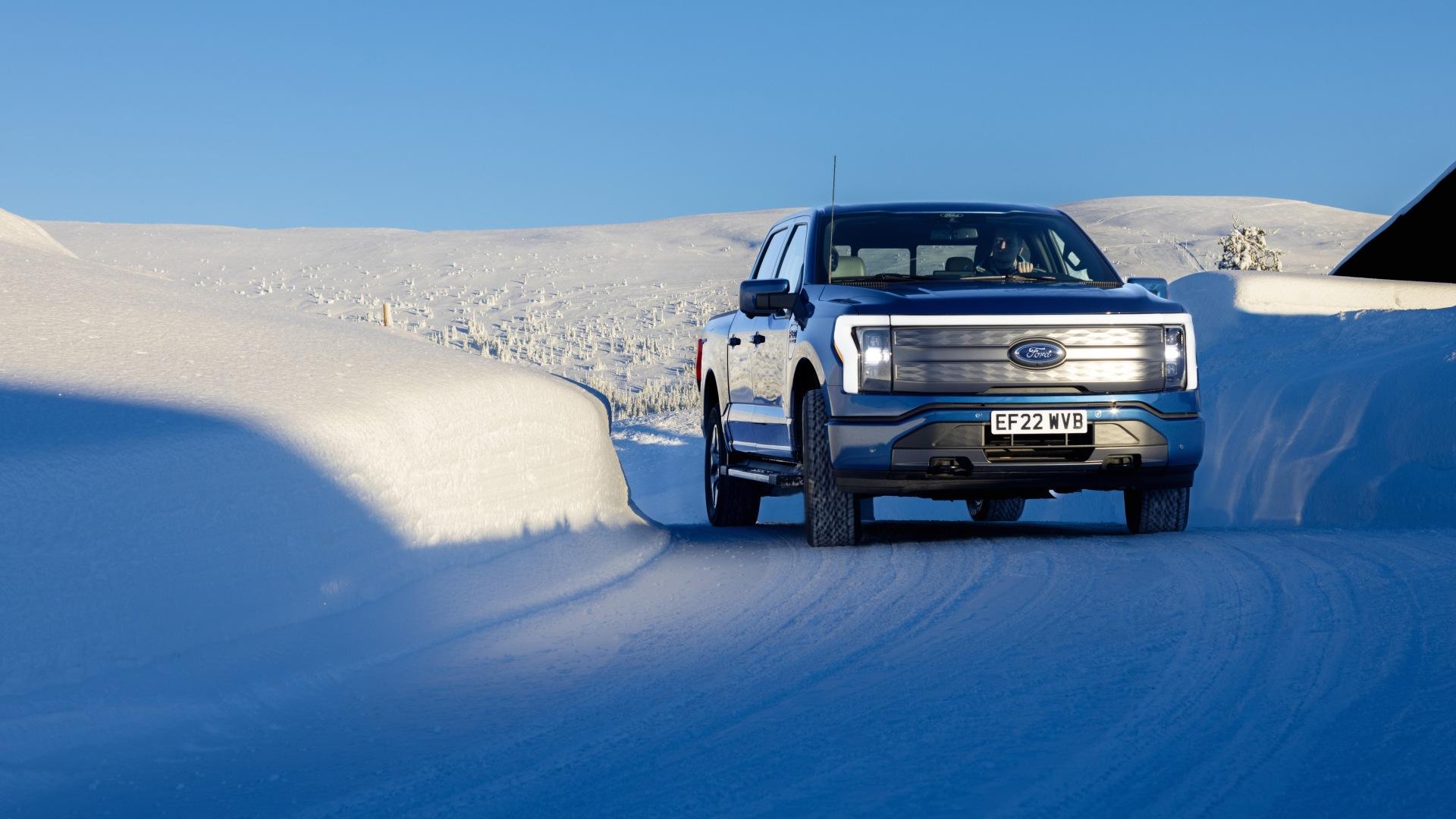
FORD Lightning 2023
The 100% electric Ford paves the way for gas-free pickups
Pros and cons
Pros
- Impressive power
- High payload and towing capacities
- Excellent balance of comfort and handling
- Impressively quiet ride
- Very practical cab and cargo box
- Realistic range indicator
Cons
- Reduced range under load or towing
- Slow level 2 charging
- Disappointing finish
- Very high price
- Long delivery delay
Overview
Ford is the first major manufacturer to offer a 100% electric pickup, the Ford F-150 Lightning. It beats out General Motors and RAM, which will be joining in model-year 2024. Ford’s offering debuts as a crew cab with a 5.5 ft. cargo box, the configuration most popular with pickup fans. The catalogue lists two battery capacities, the largest of which (131 kWh) delivers a maximum range of 515 km. That is the battery that equipped our Lariat test model, which sells for close to $112,000.
Needless to say, at this price the vehicle we tested largely exceeds the eligibility thresholds for government rebates. At around $81,000, even the least expensive Lightning does not qualify. Buyers must therefore count on savings in energy and maintenance to recuperate the extra cost relative to an equivalent gas-engine F-150. In the case of our test model, the difference was about $27,000, before taxes.
Based on an annual driving distance of 20,000 km, we calculate it would take nearly nine years to recoup the extra cost of the electric variant. And that is for home charging only; public charging is much more expensive, especially at a fast charge facility. Our estimate also excludes regular use of the Lightning’s extensive hauling and towing capacities. None of which is an obstacle as Ford paves the way for gas-free pickups.
The F-150 Lightning is built at an all-new plant in Dearborn, Michigan, home of Ford’s world headquarters.
(Video in French only)
Verdict
Never has an Ford F-150 been as comfortable, quiet, balanced and pleasant to drive as this 100-percent electric variant. Ford also deserves a tip of the hat for maintaining its payload and towing capabilities, despite the addition of a very heavy battery under the floor. However, taking advantage of all that capacity requires a good measure of planning, especially on long trips. And if the choice of the Lightning is based on savings, it will take precise calculations and disciplined use to succeed.
Evaluation
Body, cabin and cargo space
Though it looks a lot like a conventional Ford F-150, the Lightning is distinguished by a unique grille, crossed by an LED light bar, rear taillight treatment and specific 20-inch wheels.
Up front, another surprise: a waterproof front trunk, or frunk. Replacing the engine compartment, it prevents users from having to sacrifice the rear seats to shelter their gear from inclement weather—which a tonneau cover over the bed can’t always achieve well. Ford outfits it with four 120-volt outlets, powered by a 9600-watt generator that also provides the juice for two other standard outlets in the cab, plus four in the cargo box, where there is also a 240-volt, 30-amp outlet!
The frunk proved useful for transporting our luggage and gifts during the Christmas holidays, but like the cargo box, it is not heated. In addition, since the hood is power opened, ice or snow should not be allowed to accumulate.
The cab reprises all the practical attributes of the other F-150’s, from the easily accessed storage compartments under the rear bench to the famous multifunction console with its folding shift lever and pop-out workstation. The wide front seats comfortably accommodate all builds, though side support is a bit weak in turns.
Unfortunately, the Lightning is afflicted by some of the same finish issues as several other Ford models in the past several years. Our tester displayed uneven gaps and poorly fitted trim in the cabin. That is no more appropriate in a $100,000-plus vehicle than is the cheap plastic that covers much of the dashboard.
On the upside, the fully digital instrument cluster provides an abundance of useful driving and towing information. However, it displays the percentage of battery charge only in semi-autonomous Blue Cruise driving mode.
To access charge data and the majority of vehicle settings, you have to use the enormous infotainment touch screen. This portrait-style display features well-designed, but very numerous menus. Ford has provided shortcuts and allows the display to be personalized for easier use. It is relatively manageable as long as you don’t try fine-tuning the advanced functions while driving, which Ford did not bother to block.
Funnily enough, during one trip the F-150 Lightning icon in the top left corner of the screen morphed into an image of the Mustang Mach‑E. It’s easy to see where Ford’s electric pickup got its screen!
Safety features
Antilock brakes with electronic brake force distribution and emergency brake assist
Stability and traction control
Hill start assist
Hill descent control
Front airbags
Front side airbags
Side curtain airbags
Five adjustable head restraints
Rear passenger alert
Tire pressure monitor
Reverse camera
Forward collision warning with automatic emergency braking and pedestrian detection
Lane departure warning with automatic corrective steering
Lane keeping assist
Blind spot monitoring
Rear cross traffic alert
Automatic high beams
Parking sensors
Collision avoidance assist at intersections
Adaptive cruise control
Surround view monitoring
Crash test results
National Highway Traffic Safety Administration (NHTSA)Overall score: 5 / 5
Frontal impact: 4 / 5
Side impact: 5 / 5
Rollover resistance: 4 / 4
Insurance Institute For Highway Safety (IIHS)
Moderate overlap frontal impact: Not tested
Small overlap frontal impact: Not tested
Side impact: Not tested
Rear impact: Not tested
Roof strength: Not tested
Visibility
The expansive glass surface provides good front and side visibility. The problem with a pickup is always the height of the driver relative to the road, and the length of the box; the large outside mirrors, reverse camera and blind-spot monitoring (with trailer coverage) partially compensate. The surround-view system facilitates parking manoeuvres.
Headlights: all F-150 Lightning models come with directional LED projector headlights similar to those of the high-end gas versions, which obtained top ratings from the Insurance Institute for Highway Safety.
Mechanical overview
Evidently, it is not the particularities of its body and cab that differentiate the Lightning most from the other Ford F-150’s, but its innards.
It starts with a pair of electric motors good for 452 horsepower with the standard-range battery, and 580 hp with the extended-range battery. Apart from the F-150 Raptor’s optional supercharged V8, no other engine in the rest of the lineup is as powerful. The 775 pound-feet of torque easily surpasses the ratings of the other engines of the series.
One electric motor per axle automatically creates all-wheel drive with no driveshaft. Torque mainly transits via the rear wheels in normal use, then to the front in heavy acceleration or loss of rear traction, for instance.
The electric Ford F-150 does not have a 4 Lo function for off-road use, but the driver still has access to a variety of driving modes, which notably vary power distribution, throttle response and power steering assist.
The Lightning is exclusively equipped with an independent rear suspension with semi trailing arms and coil-over shocks rather than the leaf spring/solid axle suspension of the rest of the lineup. Its 20‑inch wheels are mounted with low rolling resistance tires, replaced by Michelin winter tires on our test vehicle.
The imposing body stretches a total of 591 cm and surmounts a high-voltage battery of 98 kWh on the XLT and Lariat. The range rating for this battery is 386 km, with a full charging time of 12 hours on a 240-volt charger, according to Natural Resources Canada (NRCan).
The second battery listed in the catalogue has a capacity of 131 kWh, one of the highest on the market. It boosts the range to 483 km on the Platinum, and 515 km on the two other slightly lighter versions. NRCan estimates that a full charge will take 10 hours on a 240‑volt unit.
Those are the official estimates. Our winter experience behind the wheel of a long-range Lariat revealed another reality. During our two-week test over the holiday season, maximum range with a fully charged battery never exceeded 335 km. That represents a 35‑percent decrease in range at minus 5°C, and dropped more with the temperature.
This can, of course, be mitigated by keeping the Lightning plugged in at home until it’s time to drive off. Using the preconditioning function to warm the cab while plugged in also reduces the demand on the battery.
At the end of our 1,400‑km test, conducted mostly on the highway, the trip computer indicated a consumption of 40 kWh/100 km. NRCan’s official rating for highway use is 33.3 kWh/100 km.
It should be noted that our test unit transported nothing more than a family and some light luggage. In their test, our colleagues from Car Guide saw their energy consumption nearly double when towing a 3,000‑lb. trailer, despite the 10,000‑lb tow capacity. That would indicate a range of around 250 km in the summer, and barely 150 km in the winter. It is something to think about, both for contractors who count on using the full payload capacity and for retiree camping fans.
We mostly charged our pickup at Electric Circuit 240‑volt 30‑amp public charging stations. Charging from 25 to 100 percent capacity systematically took 15 or 16 hours. That again reveals the optimism of the official ratings, at least for winter use. A more powerful home station—several mass-produced models now function at 48 amperes—would obviously reduce this time.
There were two consolations: first, we added 140 of range in 40 minutes on a 100‑kWh fast charger, then 40 km in a brief stop of 15 minutes. Temperature and battery charge influence the rate of charge, but the latter peaked at over 75 Kw each time, which seems very reasonable.
Second, our test vehicle was quite good at calculating vehicle range, which stabilized rapidly once the vehicle was moving (and the battery warmed up). For example, a 200‑km drive usually decreased the displayed range by around 210 km. On some trips we even saw the indicator drop less quickly than the distance travelled.
Driving impressions
Ford took great care in fine-tuning the Lightning driving experience. If it were not for its considerable size, its road behaviour could almost be mistaken for that of a luxury sedan.
The firm ride attributed to several recent Ford vehicles and the jittery rear end common to pickups are conspicuously absent in the Lightning. Its smooth ride is explained to a large extent by the robust independent rear suspension made of aluminum.
Generous soundproofing also contributes by masking almost all noise from under the vehicle. All that is heard is a bit of wind noise, which highlights the inherent quietness of the electric powertrain.
Combined with the heavy battery under the floor, the finely tuned suspension also provides a stability and balance unheard of until now in a full-sized pickup. Imperturbable on the highway, the electric F-150 winds through corners with ease. Obviously, the laws of physics must be obeyed: this high, weighty (nearly 3,000 kg) vehicle will never be sporty, but its precise steering guides it effortlessly nonetheless, in all circumstances.
The electric powertrain eliminates the jerkiness of the 10-speed transmission used on the gas versions. Power delivery is not only perfectly linear but also provides impressive performance for a vehicle of this size. We did not do any towing, but with 775 lb-ft. of torque on tap, this pickup should have no difficulty whatsoever.
If future GM and RAM models drive as well as the Lightning, the only thing pickup fans may miss is the sound of a V8 engine. Oh nostalgia…!
Other highlights
Braking: very efficient and natural one-pedal driving; you soon learn how to modulate the throttle to slow smoothly to a full stop, without ever touching the brakes. Powerful mechanical braking, but with sharp initial bite. Antilock brakes are efficient and unobtrusive on slippery surfaces.
Driving assistance: the optional Blue Cruise function combines adaptive cruise control and lane keeping to allow hands-free highway driving. A camera monitors driver attentiveness, which must be optimal for the system to engage. Certain curves require driver intervention, otherwise the function deactivates. Overall, the system works well, but GM’s Super Cruise system allows longer hands-free driving because it also manages lane changing. It is still possible to opt for traditional cruise control use, if desired.
Features and specs
Price range (including shipping and preparation) | ||
| Minimum price | $71,295 | |
|---|---|---|
| Maximum price | N/A | |
| Price as tested | N/A | |
| Trim levels | N/A | |
| Wheelbase | N/A | ||
|---|---|---|---|
| Length | N/A | ||
| Width | N/A | ||
| Height | N/A | ||
| Curb weight | N/A | ||
| Towing | Not recommended | ||